A book lies open on the table.
A notebook waits beside it.
There is something we genuinely want to read, understand or create.
Yet our attention moves elsewhere.
We remember an unfinished task.
Think about a conversation.
Notice another activity that suddenly seems more urgent.
And before long, the original intention has been replaced by several competing thoughts.
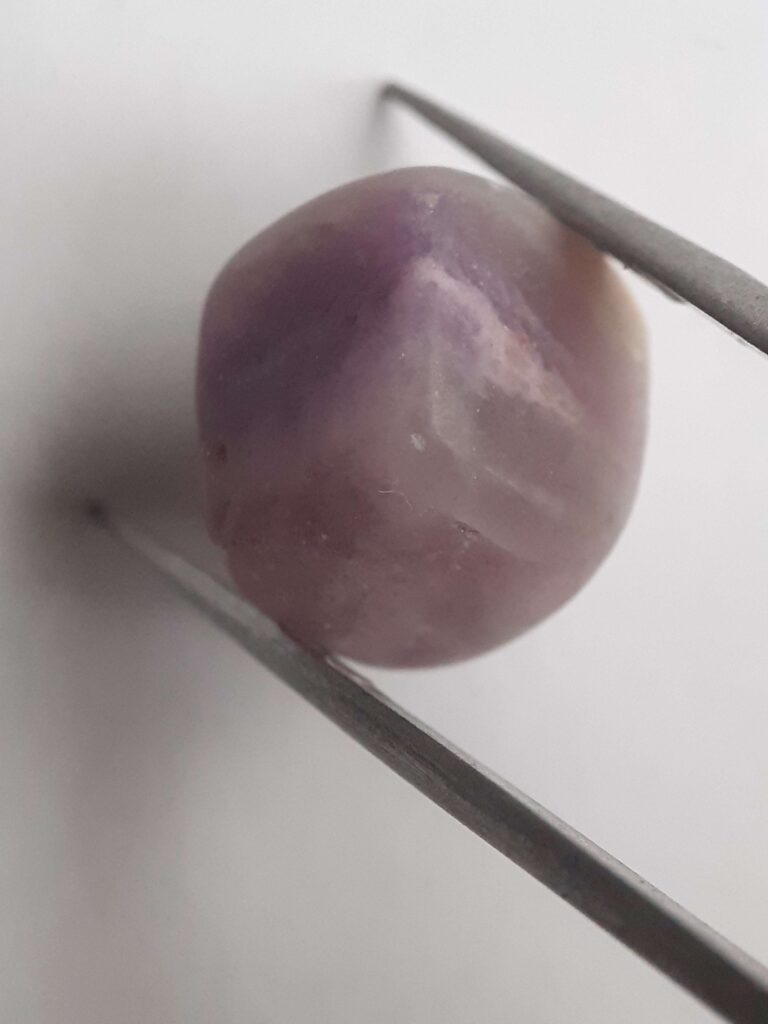
Within contemporary crystal spirituality, Fluorite is frequently associated with mental clarity, concentration, organised thinking and the ability to focus.
Some practitioners believe that Fluorite clears energetic confusion, supports intellectual activity or encourages harmony between thought and intention.
Others place it on a desk, hold it before studying or incorporate it into meditation arrangements.
These interpretations belong to modern spiritual belief systems.
There is no reliable scientific evidence that Fluorite improves cognitive performance, enhances memory, balances mental energy or influences concentration through supernatural mechanisms.
Nevertheless, a gemstone can serve as a meaningful personal symbol.
Its presence may represent an intention.
Its placement may mark the beginning of an activity.
And its use within a deliberate routine may provide a familiar reminder of what someone has chosen to do.
This article introduces an original contemporary practice:
This article introduces a practice known as the fluorite mindful focus ritual:
The Fluorite One-Task Threshold Ritual.
Rather than attempting to increase concentration through gemstone energy, the exercise uses one Fluorite stone to represent a simple commitment to the fluorite mindful focus ritual:
For a limited period, one activity deserves our attention.
The ritual does not promise perfect focus.
It does not require the mind to become completely silent.
And it does not treat distraction as a personal failure.
Its central principle is straightforward:
Attention does not have to be perfect to be deliberate.
Table of Contents
Fluorite in Contemporary Crystal Spirituality
Fluorite occupies a familiar place in modern crystal traditions concerned with concentration and mental clarity.
Practitioners sometimes describe it as a stone of order.
Others associate it with discernment, learning, structured thinking or the ability to separate important concerns from unnecessary distractions.
Different colours of Fluorite may also receive different symbolic interpretations.
Purple Fluorite is sometimes associated with intuition.
Green Fluorite may be connected with renewal or emotional harmony.
Multicoloured Fluorite is occasionally interpreted as representing balance between different aspects of personal experience.
These associations vary between practitioners.
They are not scientifically established effects.
Nor should contemporary Fluorite meanings automatically be presented as ancient, universally shared teachings.
The One-Task Threshold Ritual does not depend on a particular colour.
It uses Fluorite as a symbolic marker of attention.
The gemstone represents the intention to concentrate.
The actual activity remains the responsibility of the participant.
Why Attention Has Spiritual Significance
Attention is not merely a question of productivity.
Within many contemplative traditions, deliberate attention forms part of religious, philosophical or meditative practice.
A person may direct attention toward a prayer.
A repeated phrase.
A visual object.
The sensations of breathing.
Or the experience of the present moment.
The meaning of these activities depends on their cultural and religious context.
They should not be reduced to interchangeable concentration techniques.
In contemporary crystal spirituality, some practitioners similarly use gemstones as focal objects.
A stone may represent a chosen intention or provide a visual centre for reflection.
The One-Task Threshold takes a practical approach to this symbolism.
It does not claim to reproduce an ancient religious ceremony.
Instead, it explores how an ordinary object can represent the decision to give one activity deliberate attention.
The objective is not to become more productive at every moment.
It is to practise choosing where attention goes.

The Difference Between Concentration and Mindfulness
Concentration and mindfulness are related, but they are not identical.
Concentration generally involves directing attention toward a particular object or activity.
Mindfulness is commonly described as awareness of present-moment experience without automatically judging that experience.
A person concentrating on a book may attempt to follow the meaning of the text.
A person practising mindfulness may also notice when attention wanders, without treating that wandering as failure.
The US National Center for Complementary and Integrative Health explains that meditation encompasses different practices, including techniques involving focused attention.
Some use breathing.
Others involve sounds, visual images or repeated phrases.
The One-Task Threshold is not equivalent to a formal meditation programme.
It borrows the ordinary principle of deliberately returning attention to a chosen activity.
The Fluorite stone remains a symbolic object rather than a scientifically demonstrated concentration aid.
Why Switching Between Tasks Can Be Difficult
Modern daily life often involves several competing activities.
Someone may be reading while remembering an unanswered message.
Preparing a document while thinking about another project.
Or attempting to complete a creative activity while considering household responsibilities.
Switching between tasks is sometimes necessary.
However, cognitive psychology has demonstrated that changing between demanding tasks can involve measurable performance costs.
The American Psychological Association has published educational guidance on task-switching research.
It explains that switching between complex tasks can require adjustments in cognitive control.
Experiments have found that people may respond more slowly when changing tasks than when repeating the same task.
These effects vary according to task complexity, familiarity and other circumstances.
This does not mean that every interruption is harmful.
Nor does it mean that multitasking is always impossible.
But it helps explain why repeatedly changing activities may require additional effort.
The One-Task Threshold uses this research as educational context.
It does not suggest that Fluorite removes task-switching costs.
The Problem of Attention Residue
A particularly interesting concept in cognitive psychology is attention residue.
Researcher Sophie Leroy investigated this phenomenon in a 2009 paper published in Organizational Behavior and Human Decision Processes.
Her research examined what happens when people switch from one task to another.
The findings suggested that thoughts associated with a previous activity may remain active after a person has moved to a different task.
This lingering attention can interfere with subsequent performance.
The experiments also showed that disengaging from a previous task is more complicated than simply declaring it finished.
The results concern particular experimental conditions.
They should not be interpreted as proof that everyone must complete every task before beginning another.
Nevertheless, the research illustrates an important distinction.
Physically changing activities does not necessarily mean that attention has fully changed with them.
The Fluorite ritual addresses this distinction symbolically.
It marks a conscious transition into one chosen activity.
The Psychology of Personal Rituals
Rituals appear in religious traditions, family customs, public ceremonies and everyday personal routines.
Their meanings vary considerably.
A ritual may express belonging.
Mark a transition.
Represent a commitment.
Or establish a familiar sequence of actions.
A 2018 review published in Personality and Social Psychology Review examined psychological research into rituals.
The authors proposed a framework involving emotional regulation, performance-related goals and social connection.
They also explored how structured actions and symbolic meaning may contribute to the experience of ritual.
This research does not establish that every ritual is beneficial.
Nor does it prove that a gemstone produces psychological effects.
The Fluorite One-Task Threshold has not been clinically or experimentally evaluated.
Its significance lies in the personal meaning assigned to the sequence.
The gemstone marks a beginning.
The activity provides the substance.
And the closing gesture marks the end.
Introducing the Fluorite One-Task Threshold Ritual
This is an original contemporary symbolic practice.
It is not an ancient Fluorite ceremony.
It is not a clinically validated attention-training method.
And it does not require belief in supernatural gemstone energy.
The exercise can be used before reading, studying, drawing, writing or another manageable activity.
Choose something that can reasonably receive uninterrupted attention for approximately ten to twenty minutes.
You will need one Fluorite palm stone, tumbled stone or smooth natural specimen.
A small tray or stable surface is useful.
You may also use a notebook and pen if the chosen activity requires them.
No additional gemstones are necessary.
No crystal grid is required.
The stone does not need to be exposed to moonlight, placed in water or energetically activated.
Its purpose is to represent a chosen period of attention.
Stage One – Choosing One Activity
Begin by identifying a single activity.
It might be reading several pages of a book.
Writing a short passage.
Sketching an object.
Reviewing a document.
Or learning something that interests you.
Choose an activity that is appropriate to your circumstances.
Avoid selecting something that requires constant monitoring of several unrelated responsibilities.
The purpose is not to eliminate necessary interruptions.
It is to create a manageable opportunity for deliberate attention.
Consider the following question:
What deserves my attention for the next few minutes?
There is no need to choose the most important task of the entire day.
One modest activity is sufficient.
Stage Two – Preparing the Space
Place the Fluorite on a small tray beside your working area.
Keep the surface comfortable and practical.
An open book, notebook or drawing sheet may occupy the centre.
The gemstone should remain outside the immediate working space.
It must not interfere with tools, equipment or movement.
Remove unnecessary objects if doing so makes the activity easier.
However, the ritual does not require a perfectly organised environment.
Some people work comfortably in visually busy surroundings.
Others prefer simplicity.
The arrangement should support the participant rather than impose an aesthetic standard.
Stage Three – Crossing the Threshold
Before beginning the activity, place the Fluorite on the left side of the tray.
Pause briefly.
Consider a simple intention:
For this period, I choose to attend to one thing.
The statement is not a magical affirmation.
It does not activate the gemstone.
It simply identifies the activity that will receive attention.
You may touch the stone briefly or leave it where it rests.
Then begin.
There is no need for chanting, elaborate breathing or ceremonial gestures.
The symbolic threshold has been crossed.
Stage Four – Working With Attention
Continue the chosen activity at a comfortable pace.
If reading, follow the text.
If drawing, observe the subject.
If writing, concentrate on the passage you are developing.
There is no requirement to achieve an exceptional result.
The objective is to remain engaged with the chosen activity when reasonably possible.
Attention may wander.
That is not evidence that the ritual has failed.
When you notice a distraction, simply consider whether you wish to return to the activity.
The Fluorite does not pull attention back through supernatural energy.
The decision to return is a human action.
Stage Five – The Interruption Note
Sometimes a genuinely important thought arises during focused activity.
You may remember an appointment.
A practical obligation.
Or something that should be addressed later.
Trying to suppress every such thought may be unnecessary.
Instead, keep a small piece of paper nearby.
If appropriate, record the concern in a few words.
Then return to the original activity.
This optional step is called the Interruption Note.
It is a practical organisational technique incorporated into the original ritual.
It has not been independently validated as part of a Fluorite intervention.
The objective is simply to distinguish an activity that requires immediate attention from one that can wait.
If something genuinely urgent occurs, attend to it.
The ritual should never override safety or necessary responsibilities.
Stage Six – Completing the Chosen Period
When the agreed period has ended, stop the activity at a natural point if possible.
You may finish a paragraph.
Complete a drawing line.
Or note where to continue later.
There is no requirement to finish the entire project.
A period of attention can be complete even when the larger activity remains unfinished.
This is important.
The ritual should not create pressure to work beyond reasonable limits.
The chosen period represents an opportunity for attention, not a demand for achievement.
Stage Seven – Moving the Fluorite
At the end of the session, move the Fluorite from the left side of the tray to the right.
This is the closing gesture.
The movement represents the end of the chosen period.
It does not release stored energy.
It does not seal a supernatural intention.
And it does not determine the quality of the work completed.
The gesture simply marks a transition.
You have finished the period of deliberate attention.
The stone remains an ordinary physical object with personally assigned meaning.
Why the Ritual Uses Only One Stone
Contemporary crystal arrangements sometimes combine several gemstones.
Practitioners may believe that different stones contribute complementary energetic qualities.
Some arrangements place a central stone within a geometric grid intended to amplify a particular intention.
These beliefs have not been scientifically demonstrated.
The One-Task Threshold deliberately uses one Fluorite.
Its symbolic role is unambiguous.
It marks one activity.
One period of attention.
And one closing transition.
Additional gemstones are unnecessary.
A larger or more expensive specimen does not establish stronger concentration energy.
The practice depends on the participant’s actions rather than the number of stones.
Fluorite and the Third Eye Chakra
Within contemporary seven-chakra spirituality, Fluorite is sometimes associated with the third eye chakra.
Modern practitioners commonly connect this chakra with insight, intuition, awareness and mental clarity.
Some also associate particular Fluorite colours with the heart or crown chakras.
These correspondences vary between spiritual systems.
They should not automatically be described as ancient or universal.
Historical South Asian chakra traditions developed within diverse religious and philosophical contexts.
Their symbolic structures are not identical to modern gemstone correspondence charts.
There is no reliable biomedical evidence that Fluorite balances an anatomical third-eye energy centre or improves cognition through chakra energy.
For the One-Task Threshold, chakra symbolism is optional.
Readers who appreciate it may interpret the gemstone as representing awareness.
Others may simply use it as a personal reminder to concentrate.
The exercise does not require belief in chakras.
Fluorite as a Pocket Stone for Everyday Attention
A small Fluorite pocket stone may serve as a discreet symbolic reminder.
For example, someone may carry it before attending a lecture.
Beginning a reading session.
Or preparing for a creative activity.
The stone need not be displayed.
It may remain in a pocket or pouch.
Before beginning, the person can briefly consider:
What am I here to pay attention to?
This is a question of intention.
The gemstone does not improve hearing, comprehension or memory through supernatural energy.
Nor does carrying it guarantee that distractions will disappear.
Its significance is personal.
A Fluorite Palm Stone for Quiet Observation
The One-Task Threshold can also be adapted for a short, non-productive activity.
Instead of studying or working, choose an object to observe.
It might be a leaf.
A ceramic cup.
A drawing.
Or the Fluorite itself.
Spend a few minutes noticing its visible appearance.
There is no need to analyse the object.
Nor must the experience lead to a particular conclusion.
The purpose is simply to practise deliberate observation.
This differs from attempting to use the gemstone to increase productivity.
It treats attention as an experience worth exploring in its own right.
The exercise is not a substitute for formal meditation instruction or healthcare.
Mindful Attention Without Perfect Stillness
Some people imagine meditation as complete mental silence.
They may believe that thoughts must disappear before the practice can be considered successful.
However, contemporary mindfulness education often emphasises noticing when attention wanders and returning without harsh judgement.
The Greater Good Science Center at the University of California, Berkeley, provides an educational practice called Mindful Breathing.
It describes focusing attention on breathing and returning when distractions arise.
The Fluorite ritual is not the same exercise.
It does not require breath-focused meditation.
Nevertheless, both involve the ordinary act of noticing where attention has gone.
A wandering mind does not automatically mean failure.
The opportunity to return is part of the experience.
When Single-Tasking Is Not Appropriate
Some situations require divided attention.
A caregiver may need to remain responsive to another person’s needs.
A professional may have responsibilities that involve monitoring several systems.
A parent may need to interrupt an activity.
And emergencies always take priority.
The One-Task Threshold should never be used to justify ignoring necessary responsibilities.
Nor should it be practised while driving, operating machinery or performing other safety-critical activities that require full situational awareness.
The ritual is intended for suitable, low-risk activities.
Its duration and structure should remain flexible.
The Difference Between Attention and Productivity
An important feature of the ritual is that it does not require an impressive outcome.
A person might read only a few pages.
Write a paragraph.
Or spend fifteen minutes considering a drawing.
The activity may still be meaningful.
Modern productivity culture sometimes treats every moment as an opportunity to achieve more.
But deliberate attention can also support activities undertaken for enjoyment.
Reading poetry.
Observing a painting.
Listening carefully to a musical performance.
Or learning without a deadline.
The Fluorite ritual does not measure personal worth through output.
Its symbolic purpose is to make attention intentional.
Can Fluorite Improve Studying?
Contemporary crystal practitioners sometimes recommend Fluorite for studying, examination preparation or intellectual work.
They may believe it improves memory, understanding or concentration.
These claims are not supported by reliable scientific evidence.
There is no established basis for concluding that Fluorite improves examination performance through supernatural energy.
Effective learning depends on many factors, including appropriate study methods, practice, understanding and individual circumstances.
The One-Task Threshold may provide a personally meaningful structure for beginning a study session.
However, the complete ritual has not been tested for educational effectiveness.
Its symbolic component should not be confused with a proven learning intervention.
Fluorite and Creative Work
Creative activities can involve a different relationship with attention.
A painter may alternate between close observation and broader consideration.
A writer may pause to reconsider an idea.
A designer may compare several possibilities.
These changes are not necessarily distractions.
They may form part of the creative process.
The One-Task Threshold should therefore be adapted rather than applied rigidly.
A creative session might involve one general activity while allowing several related processes.
The goal is not to restrict imagination.
It is to distinguish meaningful exploration from unwanted interruptions.
The gemstone remains a symbol of the chosen activity, not a controller of thought.
A Fluorite Centre Stone for a Reading Space
Readers who enjoy symbolic arrangements may create a small Fluorite reading space.
Place one Fluorite palm stone on a dry wooden tray beside a favourite book.
Add a comfortable reading lamp.
A notebook may be included if desired.
The arrangement should remain simple and practical.
Some contemporary practitioners may interpret the Fluorite as a centre stone representing mental clarity.
Others may appreciate it purely as a visual reminder.
There is no reliable evidence that arranging Fluorite in a particular direction produces a measurable concentration-energy field.
The arrangement’s meaning comes from personal interpretation.
Why Colour Does Not Determine Concentration
Modern crystal spirituality sometimes assigns different energetic qualities to different Fluorite colours.
Purple may be associated with intuition.
Green with harmony.
Blue with communication.
Multicoloured specimens may be linked with integration or balance.
These are contemporary symbolic interpretations.
There is no reliable evidence that one Fluorite colour improves concentration more effectively than another through gemstone energy.
For the One-Task Threshold, colour is a matter of personal preference.
A person may choose a stone whose appearance they appreciate.
The symbolic function remains the same.
The Importance of a Closing Gesture
Many everyday activities have recognisable beginnings but less clearly defined endings.
A person may stop reading because another task appears.
Leave a document unfinished.
Or move from one activity to another without consciously acknowledging the transition.
The closing gesture in the Fluorite ritual provides a symbolic boundary.
Moving the stone marks the end of the chosen period.
It does not guarantee mental disengagement.
Research into attention residue indicates that transitions between tasks can remain cognitively complicated.
Nevertheless, the gesture may serve as a personally meaningful way to acknowledge that an activity has ended for now.
It should not become compulsory.
If the gesture feels unnecessary, the practice can be simplified.
A Five-Minute Version of the Ritual
Not everyone wishes to dedicate twenty minutes to a structured exercise.
A shorter version is possible.
Choose one manageable activity.
Place the Fluorite beside it.
Identify your intention.
Spend approximately five minutes attending to the activity.
When finished, move the stone to the other side of the tray.
That is sufficient.
The exercise does not become more spiritually powerful through longer repetition.
Nor is a longer session necessarily better for every person.
The duration should suit the circumstances.
A Weekly Fluorite Attention Practice
Readers who enjoy recurring symbolic routines may experiment with a weekly variation.
On the first day, choose a short reading session.
On another day, try a creative activity.
Later, use the ritual before a practical task.
At the end of the week, consider whether the structure was personally useful.
Did it help clarify what you intended to do?
Did the closing gesture feel meaningful?
Was the practice comfortable?
Or did it add unnecessary complexity?
There is no correct answer.
The ritual should remain optional.
If it becomes burdensome, discontinue it.
Its purpose is not to create another obligation.
When Ritual Becomes Too Rigid
Structured actions can sometimes become excessively demanding.
Someone may begin to believe that an activity cannot succeed unless every ritual step is completed perfectly.
This is not the intended use of the One-Task Threshold.
The Fluorite does not need to occupy an exact position.
There is no required number of touches.
No mandatory sequence of affirmations.
And no consequence if the stone is forgotten.
The practice should never encourage fear that something bad will happen if it is performed incorrectly.
People experiencing distressing compulsive behaviours or significant anxiety should seek appropriate professional support rather than relying on crystal rituals.
Flexibility is essential.
What Scientific Research Does and Does Not Establish
Research into task switching, attention and mindfulness provides useful educational context.
Psychologists have documented costs associated with switching between demanding tasks.
Studies have investigated the difficulty of disengaging from unfinished activities.
And researchers have explored how structured rituals may relate to emotional, social and goal-directed processes.
However, these findings do not establish that Fluorite possesses concentration-enhancing energy.
They do not demonstrate that placing a gemstone on a desk improves memory.
Nor do they validate the One-Task Threshold as a clinical or educational intervention.
The exercise is an original symbolic practice.
Its possible personal meaning should not be presented as proof of therapeutic effectiveness.
Attention as a Form of Choice
Perhaps the most interesting aspect of the One-Task Threshold is its simplicity.
It does not ask someone to become exceptionally productive.
It does not promise perfect concentration.
And it does not suggest that every distraction can be eliminated.
Instead, it invites one modest decision.
Choose an activity.
Give it attention for a manageable period.
Notice when that attention changes.
And decide whether to return.
The Fluorite remains a symbol.
The choice remains human.
Final Reflection: One Thing at a Time
Fluorite cannot clear mental confusion through scientifically demonstrated crystal energy.
It cannot guarantee better memory.
It cannot balance cognitive functions through chakra mechanisms.
And it cannot eliminate the ordinary limitations of human attention.
Yet within contemporary crystal spirituality, its association with clarity and concentration provides a meaningful symbolic starting point.
The One-Task Threshold transforms that symbolism into a simple practice.
One stone.
One chosen activity.
One deliberate beginning.
And one recognisable ending.
The ritual does not require perfection.
Attention may wander.
An interruption may occur.
The activity may remain unfinished.
None of these outcomes makes the practice a failure.
Its value, if the participant finds it meaningful, lies in the opportunity to choose deliberately.
Fluorite does not create concentration through supernatural energy.
It can become a personal symbol of the intention to give one moment, one activity and one experience our attention.
Sometimes, that intention is enough to begin.
References & Further Reading
The following sources provide scientific and educational context for attention, task switching, mindfulness and the psychology of rituals.
They are drawn exclusively from professional psychological organisations, universities, peer-reviewed research and a government health-research institution.
None establishes supernatural concentration-enhancing, healing or chakra-balancing properties of Fluorite.
1. American Psychological Association – Multitasking: Switching Costs
Institution: American Psychological Association
Published: 20 March 2006
Type: Professional psychological research education
This resource examines experimental research into task switching and the cognitive costs associated with changing between demanding activities.
It explains how switching tasks can require adjustments in mental control and how task complexity influences performance.
The research provides context for the article’s discussion of deliberate attention.
It does not investigate gemstones.
Direct source:
https://www.apa.org/topics/research/multitasking
2. Leroy – Why Is It So Hard to Do My Work? The Challenge of Attention Residue When Switching Between Work Tasks
Author: Sophie Leroy
Publication: Organizational Behavior and Human Decision Processes
Volume: 109, Issue 2
Pages: 168–181
Published: 2009
DOI: 10.1016/j.obhdp.2009.04.002
Type: Peer-reviewed experimental research
This paper investigates attention residue when individuals switch between work-related tasks.
The research suggests that thoughts associated with a previous task can interfere with performance on a subsequent activity.
The findings help explain why transitions between tasks may require cognitive effort.
They do not establish any additional benefit from Fluorite.
Direct research record:
https://doi.org/10.1016/j.obhdp.2009.04.002
Accessible academic abstract:
https://ideas.repec.org/a/eee/jobhdp/v109y2009i2p168-181.html
3. University of California, Berkeley – Mindful Breathing
Institution: Greater Good Science Center, University of California, Berkeley
Programme: Greater Good in Action
Type: University-based, research-informed contemplative practice
This educational resource explains a focused-attention exercise involving awareness of breathing.
It describes the process of noticing distraction and returning attention to a chosen focus.
The practice provides a useful comparison with the deliberate-attention principle used in the Fluorite ritual.
The two exercises are not identical.
Direct source:
https://ggia.berkeley.edu/practice/mindful_breathing
4. Hobson et al. – The Psychology of Rituals: An Integrative Review and Process-Based Framework
Authors: Nicholas M. Hobson, Juliana Schroeder, Jane L. Risen, Dimitris Xygalatas and Michael Inzlicht
Publication: Personality and Social Psychology Review
Volume: 22, Issue 3
Pages: 260–284
Published online: 2017; journal issue 2018
DOI: 10.1177/1088868317734944
Type: Peer-reviewed psychological review
This review examines psychological research into rituals and proposes a framework involving emotional regulation, goal-related behaviour and social connection.
It considers how structured actions and symbolic meaning may influence the experience of ritual.
The paper provides theoretical context for the One-Task Threshold.
It does not evaluate Fluorite or supernatural gemstone effects.
Direct source:
https://doi.org/10.1177/1088868317734944
5. National Center for Complementary and Integrative Health – Meditation and Mindfulness: Effectiveness and Safety
Institution: US National Institutes of Health
Last updated: June 2022
Type: Government evidence-based health education
This resource reviews meditation and mindfulness research, including focused-attention practices.
It discusses possible benefits, methodological limitations and potential adverse experiences.
It also cautions against replacing conventional healthcare with complementary practices.
The resource provides scientific context for the article’s distinction between symbolic reflection and established treatment.
Direct source:
https://www.nccih.nih.gov/health/meditation-and-mindfulness-effectiveness-and-safety
6. University of California, Berkeley – Just One Thing: Pay Attention!
Institution: Greater Good Science Center, University of California, Berkeley
Author: Rick Hanson
Type: Educational article on attention and contemplative practice
This resource discusses practical ways to approach deliberate attention.
It considers intention, interest and maintaining focus during ordinary activities.
It provides additional educational context for the One-Task Threshold’s emphasis on choosing an activity and returning attention when it wanders.
The article does not investigate gemstone effects.
Direct source:
https://greatergood.berkeley.edu/article/item/just_one_thing_pay_attention
Educational and Scientific Clarification
Fluorite’s associations with mental clarity, concentration, learning, organised thinking, intuition and chakra practices belong to contemporary crystal spirituality.
These interpretations are not scientifically established therapeutic or supernatural properties.
There is no reliable evidence that Fluorite improves memory, enhances cognitive performance, treats attention disorders, balances anatomical energy centres or influences mental activity through gemstone energy.
The Fluorite One-Task Threshold Ritual described in this article is an original contemporary symbolic exercise.
It is not an ancient religious ceremony.
It is not a clinically validated attention-training intervention.
And it is not a substitute for professional medical, psychological or educational support.
Scientific research into task switching, mindfulness and ritual psychology does not establish additional benefits from Fluorite.
Participation should remain voluntary, flexible and appropriate to the individual’s circumstances.
The practice should never interfere with necessary responsibilities, safety-critical activities or professional healthcare.
Gemstones and spiritual practices should never replace appropriate medical treatment or evidence-based psychological care.