Table of Contents
A Treasure More Precious Than Gold?
In 1525, members of Francisco Pizarro’s expedition encountered an Indigenous trading vessel off the coast of what is now Ecuador and northern Peru.
The significance of the Spondylus Shell in Ancient Andean Spirituality is a profound reflection of cultural beliefs and practices.
Its cargo contained remarkable valuables.
Gold and silver ornaments, finely woven textiles and other luxury goods formed part of an established network of exchange.
This highlights the value of the Spondylus Shell in Ancient Andean Spirituality, a cultural treasure that transcends simple material worth.
Yet one of the most surprising commodities was neither gold nor a conventional gemstone.
This emphasizes the role of the Spondylus Shell in Ancient Andean Spirituality, showcasing its importance beyond mere aesthetics.
It was a brightly coloured marine shell.
The material belonged to the genus Spondylus, commonly called the thorny oyster or spiny oyster.
Its naturally orange, red and purple shell had been valued by Andean societies for many centuries.
For certain communities, it possessed significance far beyond personal decoration.
The reverence for the Spondylus Shell in Ancient Andean Spirituality illustrates its role as a sacred object in rituals and offerings.
The enduring legacy of the Spondylus Shell in Ancient Andean Spirituality continues to captivate researchers and enthusiasts alike.
It was associated with water, agricultural abundance, ceremonial offerings and relationships with sacred beings.
The Spanish chronicler Pedro Sarmiento de Gamboa later recorded the exceptional esteem in which these shells were held.
Modern archaeological research confirms that Spondylus was incorporated into prestigious jewellery, ceremonial objects and offerings deposited in sacred landscapes.
The history of Spondylus demonstrates how a natural material from the sea became a powerful expression of religious belief, political authority and humanity’s dependence upon water.
Its importance offers an unusually well-documented example of the relationship between natural materials and ancient spirituality.
What Is Spondylus?
Spondylus is a genus of marine bivalve molluscs.
Despite the common name thorny oyster, these animals are not identical to the familiar edible oysters.
They produce distinctive shells that may display prominent spines and irregular external surfaces.
Their colours can range from pale cream to orange, red and purple, depending on the species and individual specimen.
The shell is a biological structure produced by a living organism.
Like many molluscan shells, it consists predominantly of calcium carbonate combined with an organic matrix.
It is therefore an organic ornamental material rather than a crystalline gemstone such as sapphire, quartz or garnet.
This distinction matters in gemmology.
A mineral has a defined crystalline structure and chemical composition.
A biological shell is a composite structure formed through the activity of an organism.
Nevertheless, shells have been used as precious ornamental materials across many cultures.
Spondylus provides one of the most remarkable examples.
The Natural Beauty of the Thorny Oyster
The visual appearance of Spondylus is extraordinary.
Its outer shell can possess an irregular, almost sculptural structure.
Some species develop long spines.
Others display shorter projections and pronounced ridges.
The natural coloration is particularly striking.
Rich orange and reddish tones can appear alongside pale areas and darker purple patches.
When the shell is cut and polished, these colours can become the central feature of jewellery and decorative objects.
Ancient artisans exploited the material’s appearance with considerable sophistication.
They produced beads, pendants, plaques and small figurines.
The shell could also be incorporated into elaborate ceremonial ornaments.
Its value was therefore partly connected with its physical beauty.
But appearance alone does not explain its exceptional status.
Why Was Spondylus So Valuable in the Andes?
The geography of western South America provides an important explanation.
Much of the Peruvian coast is influenced by the cold Humboldt Current.
Spondylus species prized by ancient Andean societies were more readily available in warmer tropical waters farther north, particularly around the coast of present-day Ecuador.
This created a geographical separation between major sources of the material and many communities that desired it.
Obtaining complete, attractive shells could also be difficult.
The Metropolitan Museum of Art explains that some of the finest specimens were collected from underwater beds approximately five to twenty metres deep.
Harvesting such material required specialised knowledge and considerable effort.
Transporting it southward involved networks of exchange.
By the time the shell reached inland settlements or distant ceremonial centres, it represented much more than a common coastal resource.
Its rarity, acquisition and circulation all contributed to its prestige.
Before the Inca: A Long History of Sacred Shells
Spondylus symbolism did not originate with the Inca Empire.
The Metropolitan Museum documents its importance in ancient Andean societies from at least the first millennium BCE.
Whole shells appeared in offerings and funerary contexts.
Worked shell was incorporated into ornaments.
Images of Spondylus also appeared in ceramics and metalwork.
Different societies developed their own uses and interpretations.
Among the important cultural traditions were those of the Wari, Lambayeque or Sicán, and Chimú.
These societies occupied different regions and historical periods.
They should not be treated as interchangeable.
Their surviving objects demonstrate both continuity in the value of Spondylus and variation in the ways it was represented.
The Wari and the Sacred Image of the Shell
The Wari civilisation flourished in parts of the central Andes centuries before the rise of the Inca Empire.
A remarkable Wari ceramic vessel preserved by the Metropolitan Museum dates to approximately 800–900 CE.
It depicts a figure seated on a stepped platform holding a Spondylus shell.
The shell is not simply an incidental decorative detail.
Its prominent position suggests that the material carried recognisable significance within the visual language of the period.
The exact interpretation of the figure remains a matter of archaeological study.
Nevertheless, the object demonstrates that the shell was important enough to become the subject of carefully constructed ceremonial imagery.
The material was not valued only when physically present.
Its image could also communicate meaning.
The Lambayeque: A Shell Held by a Powerful Figure
A gold beaker from the Lambayeque, or Sicán, tradition provides another example.
The object dates to approximately 900–1100 CE.
It is preserved by the Metropolitan Museum of Art.
The vessel depicts a figure holding what is most likely a Spondylus shell.
The combination is striking.
Gold, a highly prestigious material, was used to represent a person presenting another precious substance.
The shell occupies a central position within the imagery.
This suggests that its symbolic value was recognisable independently of its material price.
However, the precise identity of the depicted figure and the intended meaning of the scene should not be asserted without further evidence.
The object establishes the prominence of Spondylus in Lambayeque artistic and ceremonial expression.
The Chimú and the Luxury of Spondylus Jewellery
The Chimú civilisation developed a powerful state along the northern coast of Peru.
Its capital was Chan Chan, near modern Trujillo.
Chimú artisans produced sophisticated works in metal, textiles and shell.
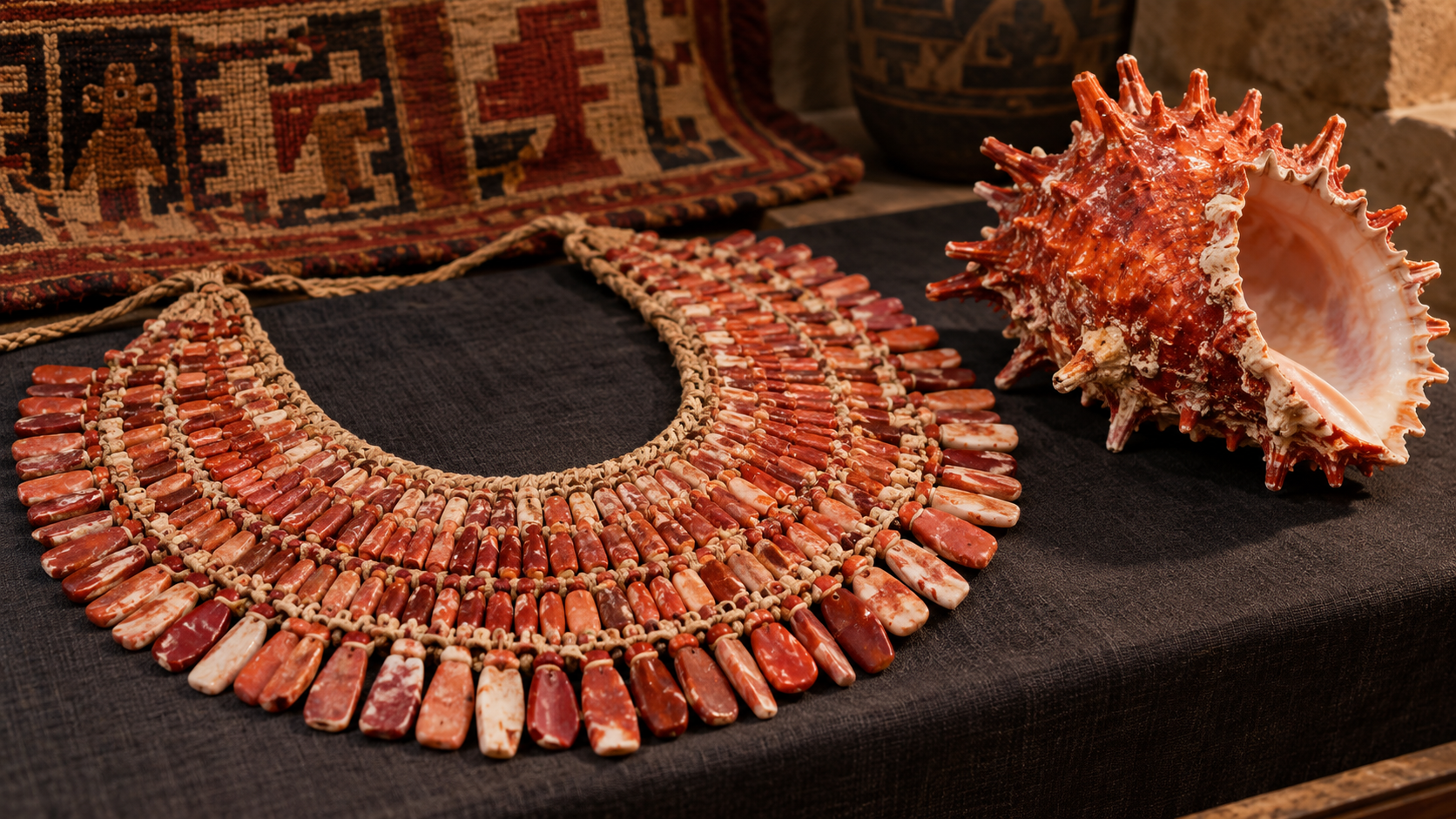
One of the most remarkable surviving objects is a large Spondylus collar in the Metropolitan Museum of Art.
Dating to approximately 1000–1470 CE, the collar consists of thousands of small reddish-orange shell beads arranged on a cotton backing.
Its broad form would have covered much of the wearer’s upper chest.
The design combines brilliant shell colour with carefully organised beadwork.
The result is both visually impressive and technically demanding.
Such an object demonstrates the prestige associated with Spondylus.
It also reveals the enormous labour required to transform raw shell into finished ceremonial or elite adornment.
Jewellery as an Expression of Authority
The Chimú collar illustrates an important feature of ancient precious materials.
Their significance was not necessarily limited to private decoration.
Large, elaborate ornaments could communicate social position.
They could also associate their wearers with religious or political authority.
The Metropolitan Museum interprets Spondylus regalia within a wider Andean relationship between supernatural power, abundance and rulership.
The shell’s sacred associations could therefore contribute to the public presentation of elite status.
However, a prestigious ornament should not automatically be described as a ritual instrument.
Its precise use depends on archaeological context and surviving documentation.
The distinction between elite jewellery and ceremonial equipment is not always clear.
Both could express relationships between power, belief and natural materials.
Spondylus and the Sacred Importance of Water
One of the most significant associations of Spondylus concerns water.
Water was essential to agricultural life in the Andes.
Many regions experienced marked seasonal variation.
Communities also faced the dangers of drought and destructive flooding.
The relationship between water and agricultural abundance therefore had practical, economic and religious importance.
Early colonial accounts describe Spondylus as closely connected with water and fertility.
The shell was understood as a precious material originating from the sea.
Within particular Andean religious frameworks, it could participate in offerings intended to secure rain, irrigation or productive harvests.
This symbolism was not simply a modern interpretation based on the shell’s colour.
It is supported by historical accounts and archaeological evidence of ceremonial deposition.
The Daughters of the Sea
The Metropolitan Museum discusses an Andean description of Spondylus as the daughters of the sea, associated with the source of waters.
The expression communicates an important religious relationship.
The shell came from the ocean.
Yet it could be offered far inland, including in agricultural and freshwater settings.
The connection between marine origin and terrestrial fertility was central to its symbolism.
In this worldview, the material could help express a relationship between different parts of the natural environment.
The ocean, rain, springs and cultivated land were connected through religious interpretation.
This was not a scientific theory of the water cycle.
It was a culturally meaningful way of understanding and responding to environmental dependence.
Offerings in Springs and Agricultural Fields
Historical accounts describe the deposition of Spondylus shells in springs, wells and cultivated areas.
Such offerings were associated with hopes for continued water availability and productive agriculture.
The intended effects belonged to religious belief.
The archaeological and historical record can establish that offerings were made and that certain meanings were attributed to them.
It cannot establish that the shells physically caused rainfall or increased agricultural yields through supernatural mechanisms.
This distinction is essential.
A ritual may be historically documented even when its proposed supernatural effect is not scientifically demonstrable.
The cultural importance of the practice does not depend upon proving that the shell controlled the weather.
Spondylus as Food for Sacred Beings
The spiritual importance of Spondylus also appears in Andean narrative traditions.
The Huarochirí Manuscript, recorded in the early colonial period, preserves religious accounts from the central Andean region.
One passage describes a supernatural being requesting Spondylus rather than ordinary offerings.
The account has been interpreted as evidence of the shell’s exceptional religious status.
It presents the material as something appropriate for a divine recipient.
However, the manuscript must be understood within its historical context.
It was recorded during the period of Spanish colonial rule.
Its contents reflect Indigenous religious knowledge transmitted through a complex process of documentation and translation.
It should not be treated as a universal statement of every Andean society’s beliefs.
Why the Shell’s Natural Form May Have Mattered
Spondylus possesses an unusual appearance.
Its spines distinguish it from many smoother shells.
Its colour can be exceptionally vivid.
Living Spondylus also possesses light-sensitive structures along its mantle.
The Metropolitan Museum suggests that such characteristics may have contributed to its associations with divine perception or oracular power.
This is an interpretive possibility rather than an established universal belief.
Nevertheless, it illustrates how natural characteristics can influence religious symbolism.
The shell’s biology supplied distinctive visual features.
Human communities interpreted those features within their own cultural systems.
The resulting meanings were not properties measurable through mineralogical analysis.
The Inca Empire and the Value of Mullu
The Inca Empire expanded across much of the Andes during the fifteenth and early sixteenth centuries.
Its rulers incorporated territories with diverse cultural histories.
Spondylus remained an important precious material during this period.
In Quechua contexts, the term mullu is associated with Spondylus and related valued shell materials.
The Inca used shell in ornaments and ceremonial offerings.
Its movement across the empire depended upon specialised production and transport networks.
The acquisition of such material could also demonstrate imperial access to distant resources.
Spondylus therefore participated in relationships between religion, economic organisation and political authority.
The Spondylus Workshop at Cabeza de Vaca
Archaeological research provides important evidence of how the Inca obtained and processed Spondylus.
Excavations at Cabeza de Vaca, in the Tumbes region of northwestern Peru, revealed a specialised shell-working workshop.
Research published by Peru’s Ministry of Culture documents the site’s importance during the Inca period.
The workshop formed part of a larger administrative and ceremonial centre.
Its principal activity involved producing objects from Spondylus.
Other shell species were worked in smaller quantities.
This discovery demonstrates that the material’s significance was supported by organised production.
Spondylus was not merely collected and casually exchanged.
It could be processed within a substantial economic and political system.
From Tropical Coast to Sacred Highland Landscape
The journey of Spondylus from the Pacific coast to the Andean highlands was remarkable.
The shell originated in a marine environment.
It could then travel hundreds of kilometres through established networks of exchange and imperial redistribution.
Eventually, it might be transformed into jewellery or deposited as an offering.
This movement changed its social context.
A natural shell became a worked luxury material.
A worked object could become part of a ceremonial assemblage.
And a ceremonial assemblage could be placed within a sacred landscape.
Each stage added meaning through human action.
The shell’s biological composition remained fundamentally the same.
Its cultural significance developed through its relationships with people and places.
Lake Titicaca: A Sacred Landscape
Lake Titicaca lies high in the Andes between present-day Peru and Bolivia.
It occupies an important place in the histories and religious traditions of several Andean societies.
The region was significant long before Inca expansion.
During the Inca period, the lake became associated with important origin traditions and pilgrimage activities.
The Island of the Sun was especially significant within Inca religious geography.
Archaeological research has revealed ceremonial installations and underwater offerings in the lake.
These discoveries demonstrate that sacred activity was not restricted to temples or mountain summits.
Water itself could become the setting for ritual deposition.
An Extraordinary Discovery Beneath the Lake
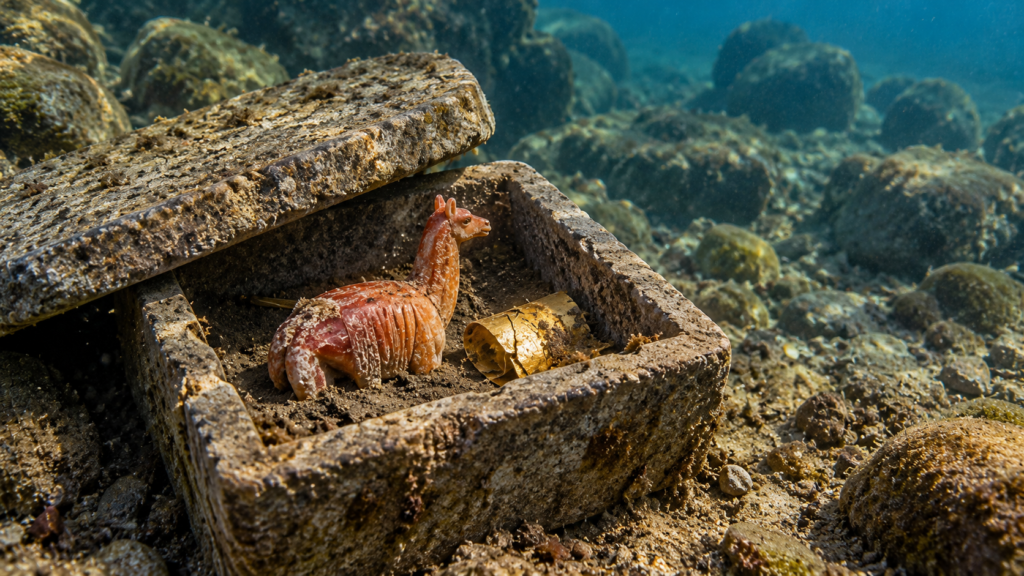
In 2020, archaeologists Christophe Delaere and José M. Capriles published research describing an intact Inca offering discovered underwater at Lake Titicaca.
The find came from the K’akaya reef area.
Divers recovered a carved stone box.
Inside were two remarkable objects.
One was a small camelid figurine carved from Spondylus shell.
The other was a rolled object made from thin gold sheet.
The discovery provided direct archaeological evidence of a carefully prepared offering.
It was particularly important because the objects remained together inside their original container.
Their association could therefore be studied with greater confidence than objects recovered from disturbed contexts.
Why a Spondylus Llama?
Camelids were essential to life in the Andes.
Llamas and alpacas supplied materials and played important economic and social roles.
Camelid representations also appeared in ceremonial contexts.
The miniature Spondylus figure from Lake Titicaca combined two meaningful elements.
Its form represented an Andean camelid.
Its material originated from the sea.
The combination may have expressed relationships between different environments, resources and sacred powers.
However, the precise intention of the offering cannot be reconstructed with certainty.
The archaeologists identified its ritual context and examined possible interpretations.
They did not establish one definitive supernatural meaning.
This uncertainty is part of responsible archaeological interpretation.
Gold and Shell in the Same Offering
The association between Spondylus and gold is particularly revealing.
Gold was an important material in Inca ceremonial and elite contexts.
Yet the shell was not simply a cheap substitute.
It possessed a different origin and set of cultural associations.
The stone box brought the two materials together.
One originated from a marine organism.
The other was a precious metal obtained through geological processes.
Both had been shaped through human craftsmanship.
Both were placed in the lake as part of an offering.
Their combination demonstrates how different materials could participate in a single ceremonial act.
It also challenges modern assumptions that the monetary value of gold necessarily determined the relative sacred importance of every material.
Why the Location of the Discovery Matters
Earlier underwater investigations had identified ceremonial offerings around the Khoa reef near the Island of the Sun.
The discovery at K’akaya expanded the geographical evidence.
It demonstrated that comparable ritual deposits were not confined to one previously known location.
The researchers suggested that the wider lake played an important role in Inca ceremonial life.
The findings also contribute to understanding how the expanding Inca state engaged with communities already living around Lake Titicaca.
Sacred landscapes could possess political as well as religious importance.
The offering therefore provides evidence concerning more than personal spirituality.
It belongs to the history of imperial expansion, ceremonial geography and relationships with local populations.
Sacred Offerings and the Ethics of Interpretation
Inca ceremonial deposits sometimes contained miniature figures made from gold, silver or shell.
Certain offering traditions were associated with capacocha, a state-sponsored ritual system that could involve human sacrifice.
However, not every deposit containing Spondylus should automatically be identified with that practice.
The Lake Titicaca stone box contained a shell camelid and gold sheet.
It did not contain human remains.
Archaeological interpretation must respect these differences.
The material evidence should determine what can be stated confidently.
It is equally important to recognise that many archaeological locations remain culturally significant to Indigenous communities today.
Their heritage should not be reduced to exotic stories about ancient rituals.
Is Spondylus a Gemstone?
Spondylus is best described as an organic ornamental material.
It belongs to a different category from crystalline mineral gemstones.
Its shell consists primarily of biogenic calcium carbonate and an organic component.
The structure develops through biological processes.
Its colour and texture vary naturally.
When worked into beads or decorative objects, it may function as a gem material in the broad ornamental sense.
However, it should not be identified as coral, carnelian or red jasper simply because it possesses similar colours.
Those materials have different origins and compositions.
Correct identification is essential for both gemmology and historical scholarship.
Why Spondylus Is Not Coral
Spondylus and precious coral are both marine-derived ornamental materials.
But they are produced by different organisms.
Spondylus shells are created by bivalve molluscs.
Precious coral is formed by colonial marine animals belonging to the cnidarians.
Their biological structures and growth processes differ.
Their physical appearances also differ.
A polished reddish Spondylus bead may superficially resemble coral.
However, similarity of colour does not establish material identity.
Ancient jewellery must therefore be examined carefully before its composition is described.
The Science Behind Its Colour
The red, orange and purple colours of Spondylus belong to its biological shell formation.
They are associated with pigments and structural characteristics developed during shell growth.
The exact appearance varies between species and individuals.
These colours are not produced by a supernatural energy field.
They are natural properties of a biological material.
The shell’s cultural significance, however, may have been influenced by its vivid appearance.
This illustrates an important relationship.
Natural characteristics can contribute to symbolism without the symbolism becoming a measurable physical property.
Did Spondylus Really Influence Rainfall?
There is no scientific evidence that placing Spondylus shells in a field or spring causes rainfall or increases crop production through supernatural mechanisms.
Rainfall is governed by atmospheric and environmental processes.
Agricultural productivity depends upon factors including water availability, soil conditions, climate and cultivation practices.
Ancient Andean communities nevertheless developed religious practices intended to establish favourable relationships with sacred powers.
Spondylus offerings belonged to some of these traditions.
The offerings are historically documented.
Their supernatural efficacy is not scientifically established.
Recognising this distinction does not diminish their historical importance.
Fertility in Ancient Andean Belief
The word fertility requires careful interpretation.
In the context of Spondylus, it often concerns agricultural productivity and the abundance of natural resources.
It should not automatically be interpreted as a claim about human reproductive health.
The shell’s relationship with water was particularly significant.
Water allowed crops to grow.
It sustained animals and human communities.
Its availability could determine the success of an agricultural season.
Religious offerings expressed hopes concerning these essential conditions.
The symbolism therefore emerged within a specific environmental and cultural setting.
Spondylus and Modern Crystal Spirituality
Modern crystal-healing literature sometimes attributes emotional or energetic properties to shells.
These may include harmony, protection, emotional healing or connection with the sea.
Such interpretations can be meaningful within contemporary personal practices.
However, they should not automatically be presented as ancient Inca beliefs.
The historical evidence concerning Spondylus focuses on ceremonial offerings, water, abundance, elite display and relationships with sacred beings.
Modern claims about chakras, vibrational healing or emotional energy belong to different interpretive frameworks.
There is no established scientific evidence that wearing Spondylus produces supernatural healing effects.
Its historical significance does not depend upon such claims.
Why Cultural Context Matters More Than a List of Powers
A modern description might reduce Spondylus to a few supposed spiritual properties.
Yet its ancient history is far richer.
The material connects tropical marine ecosystems with highland societies.
It reveals long-distance trade networks.
It demonstrates extraordinary craftsmanship.
It appears in prestigious ornaments and religious imagery.
It was deposited in springs, agricultural settings and sacred waters.
It participated in political and ceremonial relationships.
These meanings cannot be adequately represented by a generic statement that the shell attracts abundance.
Its significance developed through specific societies and historical circumstances.
What Can We Establish with Confidence?
The archaeological, historical and biological evidence supports several important conclusions.
Spondylus is a genus of marine bivalve molluscs.
Its shell is a biologically produced calcium-carbonate material rather than a crystalline mineral gemstone.
Its vivid colours and distinctive shape contributed to its desirability.
Ancient Andean societies valued Spondylus long before the rise of the Inca Empire.
Wari, Lambayeque and Chimú objects demonstrate its importance in art and prestigious material culture.
Early colonial accounts associate Spondylus with water, fertility and ceremonial offerings.
Chimú artisans produced elaborate ornaments containing thousands of shell beads.
The Inca maintained specialised shell-working activities, including at Cabeza de Vaca in the Tumbes region.
Inca ritual deposits included miniature figures carved from Spondylus.
A 2020 archaeological publication documented an intact underwater offering at Lake Titicaca containing a Spondylus camelid figurine and rolled gold sheet.
The exact religious meaning of individual archaeological deposits cannot always be reconstructed.
There is no established scientific evidence that Spondylus controls rainfall, produces supernatural protection or independently treats medical conditions.
A Different Understanding of Precious Materials
Spondylus challenges the modern assumption that the most valuable natural materials must be rare crystalline gemstones or precious metals.
For certain ancient Andean communities, a marine shell could possess exceptional importance.
Its value depended on several factors.
Its natural appearance.
Its difficult acquisition.
Its long-distance movement.
Its craftsmanship.
Its role in ceremonial practice.
And its relationship with water and sacred geography.
These factors produced a form of value that cannot be understood through modern gemstone pricing alone.
Conclusion: When the Sea Became Part of Sacred Life
The history of Spondylus is one of the most compelling examples of natural materials acquiring profound spiritual and cultural significance.
The shell originated in the warm waters of the eastern Pacific.
Its extraordinary colours and distinctive form made it desirable.
Its acquisition required specialised knowledge.
Its movement across the Andes depended upon extensive networks of exchange.
Ancient artisans transformed it into beads, collars and figurines.
Religious traditions associated it with water, agricultural abundance and sacred beings.
Its importance continued through several major Andean societies and into the Inca period.
The remarkable discovery of a shell camelid inside an underwater offering box at Lake Titicaca demonstrates that these traditions were expressed through actual ceremonial practices.
Yet the evidence must be interpreted carefully.
Archaeology can document the objects.
Historical texts can preserve aspects of religious belief.
Biology can explain the shell’s origin and physical composition.
Science does not establish that the material possessed supernatural powers over rainfall or fertility.
Spondylus became sacred not because its biological structure contained scientifically measurable spiritual energy, but because ancient Andean communities incorporated it into meaningful relationships between the ocean, water, agriculture, political authority and the sacred world.
For Natural Gems Belgium, its history illustrates an essential principle.
The value of a natural material cannot always be understood through hardness, rarity or commercial price.
Its cultural history may be equally important.
Spondylus is not a conventional crystalline gemstone.
Yet its story reveals something fundamental about humanity’s relationship with precious natural materials.
Sometimes the most extraordinary significance belongs not to a diamond or sapphire, but to a shell carried from the sea into the mountains and offered to a sacred lake.
References & Further Reading
1. The Metropolitan Museum of Art – Thorny Oysters: The Daughters of the Sea
https://www.metmuseum.org/perspectives/design-for-eternity-thorny-oysters
Source description: Scholarly article by curator Joanne Pillsbury, published in 2016. Examines the religious importance of Spondylus in ancient Andean societies, including its associations with water, agricultural abundance, sacred beings and long-distance trade. Discusses archaeological objects and early colonial accounts.
2. The Metropolitan Museum of Art – Chimú Spondylus Collar
https://www.metmuseum.org/art/collection/search/319053
Source description: Detailed museum catalogue for an elaborate Chimú collar made from thousands of Spondylus beads. Explores the material’s trade, symbolism, royal associations and historical importance along the northern coast of Peru.
3. The Metropolitan Museum of Art – Lambayeque Beaker with Figure and Spondylus Shell
https://www.metmuseum.org/art/collection/search/309414
Source description: Official collection record for a gold vessel dating to approximately 900–1100 CE. Documents a figure holding a shell identified as probably Spondylus, illustrating its importance in prestigious artistic and ceremonial imagery.
4. Cambridge University Press, Antiquity – The Context and Meaning of an Intact Inca Underwater Offering from Lake Titicaca
https://doi.org/10.15184/aqy.2020.121
Source description: Peer-reviewed archaeological study by Christophe Delaere and José M. Capriles, published in 2020. Documents the discovery of an intact stone offering box containing a Spondylus camelid figurine and rolled gold sheet at Lake Titicaca. Examines the religious and political significance of underwater offerings.
5. Pennsylvania State University – The Context and Meaning of an Intact Inca Underwater Offering from Lake Titicaca
Source description: University research record for the 2020 archaeological publication, providing the authors, publication details, abstract and direct access to the scholarly DOI.
6. Peru Ministry of Culture – El taller de Spondylus de Cabeza de Vaca, Tumbes
https://revistas.cultura.gob.pe/index.php/cuadernosqn/article/view/459
Source description: Archaeological research by Carolina Vílchez Carrasco, published in 2013. Documents excavations at the Inca shell-working workshop of Cabeza de Vaca in the Tumbes region and explains its role in Spondylus production and distribution. Original research published in Spanish.
7. The Metropolitan Museum of Art – Inca Miniature Camelid Effigy
https://www.metmuseum.org/art/collection/search/309960
Source description: Detailed museum research on Inca camelid figurines and their ceremonial contexts. Includes discussion of comparable figures made from Spondylus shell and the ethical considerations surrounding sacred archaeological deposits.
8. The Metropolitan Museum of Art – Inca Miniature Female Effigy
https://www.metmuseum.org/art/collection/search/309944
Source description: Scholarly collection record discussing miniature Inca figures, their construction, associated shell objects and ritual deposition. Provides important contextual evidence for the use of Spondylus in ceremonial assemblages.
9. British Museum – Nasca Spondylus Shell Ornament
https://www.britishmuseum.org/collection/object/E_Am1913-1020-1
Source description: Official museum catalogue for an ornament from the Nasca cultural tradition incorporating Spondylus shell, malachite and resin. Demonstrates the wider use of shell materials in ancient Peruvian decorative and funerary contexts.
10. Museo de Arte de Lima, via Google Arts & Culture – Paccha Decorated with Spondylus Shell Representations
Source description: Museum object record for an Inca-period ceremonial vessel decorated with Spondylus imagery. Explains the relationship between shell symbolism, water and agricultural fertility within Andean religious traditions.
Historical, Cultural and Scientific Distinctions
Scientifically established: Spondylus is a genus of marine bivalve molluscs.
Scientifically established: Its shell is a biological calcium-carbonate material rather than a crystalline mineral gemstone.
Scientifically established: Spondylus species possess distinctive shell structures and naturally variable coloration.
Archaeologically documented: Ancient Andean societies used Spondylus in jewellery, ceremonial objects and offerings.
Historically documented: Spondylus circulated through extensive trade networks connecting tropical coastal regions with the central Andes.
Historically documented: Chimú artisans produced elaborate shell-bead ornaments.
Historically documented: The Inca operated specialised shell-working facilities, including at Cabeza de Vaca.
Religious tradition: Certain Andean societies associated Spondylus with water, agricultural abundance and sacred beings.
Archaeologically documented: An intact Inca offering containing a Spondylus camelid figurine and rolled gold sheet was recovered from Lake Titicaca.
Historical limitation: The precise intended meaning of every individual offering cannot be reconstructed with certainty.
Modern metaphysical belief: Contemporary spiritual practices may associate shells with emotional harmony, protection or connection with water.
Scientific limitation: There is no established scientific evidence that Spondylus causes rainfall, enhances fertility through supernatural means, balances chakras or independently produces medical healing.
The history of Spondylus demonstrates that natural materials can acquire profound spiritual significance through cultural traditions and historical relationships.
Its biological origin is scientifically established.
Its ceremonial use is archaeologically documented.
Its symbolism is supported by historical sources.
Its supernatural efficacy remains a matter of belief rather than scientific demonstration.