Some conversations never happen.
Words remain unspoken.
An apology never arrives.
A disagreement ends without resolution.
Or a relationship changes before everything that needed to be said has been expressed.
These experiences can leave us with complicated feelings.
Disappointment may coexist with affection.
Anger may accompany sadness.
We may understand another person’s circumstances without accepting their behaviour.
And sometimes, we may wish to find a more peaceful relationship with our memories without wanting to restore the relationship itself.
Within contemporary crystal spirituality, Rhodonite is frequently associated with compassion, forgiveness, emotional balance and the healing of interpersonal difficulties.
Some practitioners believe that Rhodonite helps release resentment, supports reconciliation or restores harmony within the heart.
These are spiritual interpretations rather than scientifically established gemstone properties.
There is no reliable evidence that Rhodonite transmits healing energy, removes emotional trauma or changes human relationships through supernatural mechanisms.
Nevertheless, a gemstone can become a meaningful personal symbol.
Its appearance may remind someone of an intention.
Its presence may mark a deliberate moment of reflection.
And its association with compassion can provide a starting point for considering how we respond to difficult interpersonal experiences.
For this article, we explore an important distinction:
Compassion does not require reconciliation.
And forgiveness, when freely chosen, does not mean that harmful behaviour must be accepted.
Drawing on contemporary spiritual symbolism and psychological research into forgiveness, self-compassion and expressive writing, we introduce an original reflective practice:
The Rhodonite Unsent Letter Ritual.
Its purpose is not to force forgiveness.
It does not promise emotional healing.
Instead, it offers a structured opportunity to acknowledge feelings, express thoughts privately and consider the boundaries that may be necessary for personal wellbeing.
Table of Contents
Why Rhodonite?
Rhodonite occupies a distinctive place within contemporary crystal spirituality.
It is commonly associated with compassion, forgiveness, emotional recovery and interpersonal understanding.
Some modern practitioners describe it as a gemstone for difficult relationships.
Others believe it helps balance emotional reactions or encourages reconciliation after conflict.
These interpretations are not scientifically established.
They should also not automatically be described as ancient or universally recognised spiritual traditions.
For the present exercise, Rhodonite serves a symbolic purpose.
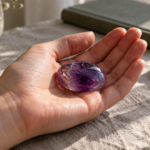
Its characteristic pink-to-rose appearance, often interrupted by darker markings, provides an interesting visual metaphor.
The pink areas may be interpreted as representing warmth, care and compassion.
The darker markings may symbolise difficult experiences, personal limits or unresolved emotions.
This comparison is an original symbolic interpretation.
It is not a scientific explanation of the gemstone.
Nor does it imply that its appearance contains information about human emotions.
Instead, the contrast becomes a reminder that compassion and difficulty can coexist.
A person may care about someone while recognising that a relationship is unhealthy.
They may understand another person’s behaviour without excusing it.
And they may choose kindness without abandoning necessary boundaries.
The Spiritual Meaning of Forgiveness
Forgiveness has been discussed within many religious, philosophical and ethical traditions.
However, these traditions do not all define forgiveness in the same way.
Some understand it through moral responsibility.
Others emphasise compassion, reconciliation, repentance or the release of resentment.
The meaning of forgiveness also varies according to the circumstances.
Forgiving a minor misunderstanding is not equivalent to responding to serious betrayal, exploitation or abuse.
Contemporary crystal spirituality often presents forgiveness as a process of releasing emotional burdens.
Rhodonite may be described as helping practitioners let go of anger or restore emotional harmony.
Such statements express spiritual beliefs.
They do not demonstrate that a gemstone can influence psychological processes through invisible energy.
Nevertheless, forgiveness is also a legitimate subject of psychological research.
Understanding that research helps distinguish meaningful personal reflection from unsupported healing claims.
What Does Psychology Mean by Forgiveness?
The American Psychological Association describes forgiveness as a voluntary process involving changes in feelings and attitudes toward someone who has caused harm.
Importantly, forgiveness is not equivalent to excusing the behaviour.
It does not require forgetting what happened.
And it is not the same as reconciliation.
These distinctions are essential.
A person may eventually experience less resentment toward someone while continuing to recognise that the person’s behaviour was unacceptable.
They may forgive without restoring contact.
They may also pursue accountability or justice.
Forgiveness does not erase responsibility.
The APA’s explanation also recognises that forgiveness is a voluntary process.
It should not be imposed as a moral obligation.
For the Rhodonite ritual, this principle is fundamental.
The participant is never required to forgive.
The exercise can remain meaningful even when forgiveness is neither possible nor desired.
Forgiveness and Reconciliation Are Different
Reconciliation concerns the restoration of a relationship.
It generally requires some form of renewed interaction, cooperation or trust.
Forgiveness concerns a person’s response to an experienced wrong.
The two processes may occur together.
But they do not have to.
Harvard University’s Human Flourishing Program has examined forgiveness from psychological, philosophical and public-health perspectives.
Its educational discussion emphasises that forgiveness differs from excusing wrongdoing, abandoning justice or restoring a relationship.
This distinction becomes particularly important when someone has experienced repeated harmful behaviour.
Reconciliation may be inappropriate or unsafe.
Even when forgiveness is personally meaningful, the individual may reasonably choose to maintain distance.
The Rhodonite Unsent Letter Ritual therefore avoids presenting restored relationships as the desired outcome.
Its purpose is reflection.
Not reunion.
Compassion Does Not Mean Accepting Harm
Compassion is often associated with kindness, understanding and concern for suffering.
But compassion does not require unlimited availability.
Nor does it mean tolerating disrespect.
A person may recognise that someone else is experiencing difficulties while still refusing unacceptable treatment.
For example, understanding that a colleague is under pressure does not require accepting repeated verbal aggression.
Recognising that a family member has personal problems does not mean abandoning every personal boundary.
And caring about someone does not necessarily make continued contact appropriate.
The Greater Good Science Center at the University of California, Berkeley, discusses these distinctions in its educational work on forgiveness.
Its research-based resources emphasise that forgiveness should not be confused with condoning wrongdoing or surrendering personal protection.
This is particularly relevant to contemporary crystal spirituality.
A gemstone should never be presented as a reason to remain in an unsafe relationship.
Nor should a spiritual practice pressure someone to reconcile before they are ready.
Rhodonite and the Heart Chakra
Within contemporary seven-chakra spirituality, Rhodonite is frequently associated with the heart chakra.
This chakra is commonly linked with compassion, affection, emotional openness and interpersonal relationships.
The modern system draws inspiration from broader South Asian religious and philosophical traditions.
However, historical chakra systems are diverse.
Their number, location, symbolism and interpretation have varied across texts and traditions.
Specific correspondences between modern commercial gemstone names and individual chakras should not automatically be presented as ancient teachings.
The association between Rhodonite and the heart chakra is best understood as part of contemporary crystal spirituality.
Some practitioners believe that Rhodonite balances the heart chakra or helps restore emotional harmony.
These claims have not been scientifically established.
Modern biomedical research has not demonstrated chakras as anatomical energy centres capable of being adjusted by gemstones.
For the present ritual, the heart chakra association remains optional symbolism.
The exercise does not require belief in chakras.

Why Write a Letter That Will Never Be Sent?
An unsent letter offers a particular kind of privacy.
It allows a person to organise thoughts without immediately involving someone else.
The writer does not need to anticipate a response.
Defend every statement.
Or decide whether the other person will agree.
The letter can remain entirely personal.
This makes the exercise different from preparing a message intended for delivery.
Its purpose is not persuasion.
Nor is it necessarily reconciliation.
Instead, the writer can explore what they wish to express.
A letter may contain disappointment.
Confusion.
Unanswered questions.
Or recognition of a personal boundary.
However, writing about difficult experiences is not automatically beneficial for everyone.
Psychological research into expressive writing has produced mixed results.
Some studies have identified small improvements in selected psychological outcomes.
Others have found little or no reliable benefit.
The Rhodonite ritual should therefore be understood as an optional reflective exercise rather than an established therapeutic intervention.
What Research Says About Expressive Writing
Expressive writing became an important research subject through the work of psychologist James W. Pennebaker and subsequent investigators.
Researchers have examined whether writing about personal experiences influences psychological or physical wellbeing.
The findings are complex.
A meta-analysis published in the British Journal of Clinical Psychology in 2023 examined 31 experimental studies involving 4,012 participants.
The researchers reported a small overall reduction in symptoms of depression, anxiety and stress in the populations studied.
However, the effect was modest.
Other systematic reviews have reached less favourable conclusions.
A 2009 meta-analysis of randomised controlled trials found no significant overall effects on psychological or physical health outcomes.
These findings should not be treated as contradictory proof that writing either always works or never works.
They demonstrate that outcomes depend on study populations, methods, interventions and the measures being investigated.
The Rhodonite Unsent Letter Ritual has not itself been scientifically tested.
No evidence establishes that adding Rhodonite improves the effects of expressive writing.
The Rhodonite Unsent Letter Ritual
The following exercise is an original contemporary reflective practice.
It combines Rhodonite’s modern spiritual symbolism with private writing and consideration of personal boundaries.
It is not a traditional religious ceremony.
It is not a clinical forgiveness intervention.
And it is not intended to process severe trauma without professional support.
For this exercise, choose a relatively manageable interpersonal experience.
A minor disagreement.
An unresolved misunderstanding.
Or a situation in which you wish you had expressed yourself more clearly.
Avoid beginning with an experience that feels overwhelming.
You will need:
- One Rhodonite palm stone, tumbled stone or cabochon.
- Two sheets of writing paper.
- A pen.
- One plain envelope.
- A quiet, comfortable place where your writing can remain private.
Approximately fifteen to twenty minutes may be convenient.
There is no scientifically established ideal duration for this particular ritual.
You may stop whenever you wish.
Stage One — Choosing the Experience
Begin by placing the Rhodonite on the table.
Sit comfortably.
Take a moment to observe the stone.
Notice its colour.
Its irregular darker markings.
And the contrast between the different areas.
Within the ritual, this contrast represents the coexistence of compassion and difficult emotions.
The symbolism is personal.
The stone is not absorbing resentment or removing negative energy.
Now consider a manageable interpersonal experience.
Choose something you can reflect upon without becoming overwhelmed.
Perhaps someone misunderstood your intentions.
A conversation ended abruptly.
Or you felt unable to express an important concern.
You do not need to reconstruct every detail.
Simply identify the situation.
If the experience involves serious abuse, violence or traumatic memories, this self-guided exercise may be unsuitable. Professional support and personal safety should take priority.
Stage Two — Writing What Was Never Said
Place the first sheet of paper in front of you.
The Rhodonite remains beside it.
Begin writing a private letter.
You may address it to the person involved.
But remember:
The letter is not intended to be sent.
Its purpose is to express your perspective.
You may begin with a simple statement:
There is something I never had the opportunity to explain.
Continue in your own words.
Describe what happened from your perspective.
What did you find difficult?
What would you have wanted the other person to understand?
What remains unresolved?
There is no requirement to use positive language.
You do not need to excuse the other person’s behaviour.
You also do not need to make accusations beyond what you can reasonably describe.
The exercise is intended to help organise your thoughts.
It is not a formal record of events.
Nor should it replace documentation that may be necessary for legal, professional or safeguarding purposes.
The Difference Between Expression and Rumination
Writing about an experience can sometimes help clarify thoughts.
But repeatedly revisiting the same distressing material may also become unhelpful.
Psychologists distinguish between constructive reflection and rumination.
Rumination involves repetitive thinking that may continue without producing new understanding or useful action.
An unsent letter should not become an obligation to relive every painful detail.
If writing begins to intensify distress, stop.
You may choose a different subject.
Take a break.
Or discontinue the exercise entirely.
There is no spiritual consequence for leaving the letter unfinished.
The Rhodonite does not require completion.
Stage Three — The Compassionate Perspective
When you have finished the first letter, place it to one side.
Move the Rhodonite beside the second sheet of paper.
This stage changes the focus.
The first letter concerned what you wished to express to someone else.
The second concerns how you speak to yourself.
Imagine that a trusted friend had experienced a similar situation.
What might you say to them?
Would you insist that they should have handled everything perfectly?
Would you tell them that their feelings were unimportant?
Or would you acknowledge that difficult interpersonal situations can be complicated?
Write a short paragraph addressed to yourself.
You might begin:
It is understandable that this situation has been difficult.
Then consider what would be reasonable, compassionate and truthful.
Compassion does not require pretending that every decision was correct.
You may recognise mistakes.
Acknowledge responsibility.
And still avoid unnecessary self-condemnation.
The goal is not self-excuse.
It is a more balanced perspective.
The Psychology of Self-Compassion
Psychologist Kristin Neff has contributed substantially to contemporary research into self-compassion.
Her framework identifies three central components.
Self-kindness.
Common humanity.
And mindfulness.
Self-kindness involves responding to personal difficulties with understanding rather than excessive self-criticism.
Common humanity recognises that imperfection and difficulty are part of human experience.
Mindfulness involves acknowledging thoughts and feelings without becoming entirely absorbed by them.
The Greater Good in Action programme at the University of California, Berkeley, includes a self-compassionate letter exercise informed by this research.
Participants are encouraged to write to themselves with understanding and kindness.
The Rhodonite ritual uses a related idea but remains a separate, original symbolic practice.
The research concerns human psychological processes.
It does not establish therapeutic effects from Rhodonite.
Compassion Is Not the Same as Self-Excuse
An important distinction deserves attention.
Being compassionate toward yourself does not mean denying responsibility.
If you have behaved unfairly, acknowledging that behaviour may be necessary.
An apology may be appropriate.
A practical correction may be possible.
Or a change in future behaviour may be required.
Self-compassion does not remove these responsibilities.
Instead, it offers an alternative to responding through relentless self-criticism.
A person can recognise an error without defining their entire identity by it.
They can accept accountability without concluding that improvement is impossible.
Within the ritual, Rhodonite represents this balance.
Compassion alongside responsibility.
Not compassion instead of responsibility.
Stage Four — Identifying a Healthy Boundary
Now consider whether the experience has revealed a personal boundary.
A boundary concerns what you are willing to accept, share, discuss or participate in.
It may involve time.
Privacy.
Communication.
Physical space.
Or expectations within a relationship.
On the second sheet, beneath your compassionate reflection, write one boundary that may be relevant.
For example:
I can listen to disagreement without accepting insults.
Or:
I am allowed to take time before responding to a difficult message.
Another possibility might be:
I can care about someone without agreeing to every request.
These are examples rather than universal rules.
A boundary should be appropriate to the situation.
It should also recognise the rights and autonomy of other people.
A personal boundary is not a guarantee that someone else will change.
It describes what you may choose to do when particular circumstances arise.
Boundaries Are Not Punishments
Healthy boundaries are sometimes misunderstood as attempts to control other people.
But a boundary is different from a demand that someone else behave exactly as we wish.
For example, telling another person that they must never disagree with us is not the same as deciding that we will leave a conversation if it becomes abusive.
The first attempts to control another person’s opinions.
The second describes a response to unacceptable behaviour.
Clear boundaries can support respectful communication.
They can also help individuals recognise when a relationship requires additional distance.
However, boundaries are not always easy to establish.
Power differences, financial dependence, family circumstances and safety concerns can complicate the situation.
The Rhodonite ritual should not imply that every problem can be solved by writing one sentence.
Some circumstances require practical assistance, professional advice or external protection.
Stage Five — The Unsent Letter
Return to the first sheet of paper.
Read it only if doing so feels comfortable.
You may notice that some statements still feel important.
Others may no longer express exactly what you wish to say.
There is no need to edit the letter.
You may fold it.
Place it inside the plain envelope.
And close the envelope without addressing it.
This action marks the end of the writing exercise.
It does not symbolically erase the experience.
It does not guarantee emotional relief.
And it does not transfer negative energy into the envelope.
The action simply creates a distinction between private reflection and communication intended for another person.
The letter remains yours.
You can store it securely.
Destroy it later if appropriate.
Or decide not to keep it.
There is no requirement to send it.
In fact, the exercise is designed specifically around the freedom not to send it.
Why the Letter Should Remain Unsent
A private letter may contain thoughts that are useful to explore but inappropriate to communicate immediately.
It may reflect a temporary emotional state.
It may include assumptions that require reconsideration.
Or it may contain information that should remain confidential.
Sending such a letter could create consequences that the writer did not intend.
The ritual therefore separates expression from action.
If a real conversation is necessary, it should be considered independently.
You may wish to prepare a different message.
Seek advice.
Or choose a suitable time and setting.
The unsent letter is not a substitute for constructive communication.
It is a private reflective document.
Stage Six — Closing the Ritual
Place the sealed envelope on one side of the table.
Leave the second sheet visible.
Position the Rhodonite beside the boundary statement.
Take a moment to consider the difference between the two pieces of writing.
The first expresses what remained unsaid.
The second concerns how you wish to respond to yourself and what boundaries may be necessary.
Neither requires forgiveness.
Neither demands reconciliation.
The Rhodonite represents compassion without surrendering personal responsibility or protection.
You may conclude with a simple reflection:
I can acknowledge difficult feelings while choosing how I respond.
There is no requirement to repeat this statement.
No special breathing pattern is necessary.
And the gemstone does not need to be activated or energetically cleansed.
Return the Rhodonite to its usual place.
The ritual is complete.
What If You Do Not Feel Forgiving?
Nothing in the exercise requires forgiveness.
This point is particularly important.
Contemporary spiritual discussions sometimes present forgiveness as an obligation.
A person may be told that anger must be released before emotional progress becomes possible.
Or that maintaining resentment attracts negative energy.
These claims are not scientifically established.
They may also create unnecessary pressure.
Forgiveness researchers and mental health professionals recognise that the process is complex and personal.
Harvard University’s educational discussions have highlighted the risk of pressuring people to forgive, particularly following abuse or serious harm.
Someone may choose not to forgive.
They may require more time.
Or they may prefer to focus on safety, practical recovery and personal boundaries.
These choices do not indicate spiritual failure.
Rhodonite cannot determine whether forgiveness is necessary or appropriate.
Can Anger Have a Legitimate Purpose?
Anger is often portrayed negatively in crystal-healing language.
Some practitioners describe it as an undesirable vibration or energy that must be removed.
Such explanations are not scientifically established.
Anger is a normal human emotion.
It can arise when someone perceives unfairness, danger or a violation of personal expectations.
Its presence does not automatically indicate a psychological problem.
Nor does anger always lead to harmful behaviour.
A person can feel angry while choosing a measured response.
The important distinction concerns how the emotion is understood and expressed.
Persistent anger may sometimes become distressing or interfere with daily life.
But suppressing every feeling of anger is not necessarily a constructive alternative.
The Rhodonite ritual allows anger to be acknowledged without requiring retaliation or forced positivity.
The Difference Between Emotional Healing and Medical Treatment
Within contemporary gemstone spirituality, Rhodonite is sometimes described as a stone for emotional healing.
This phrase requires careful interpretation.
In spiritual language, healing may refer to a personal sense of meaning, acceptance or emotional change.
However, the same word is also used in medical and psychological contexts.
These meanings should not be confused.
There is no reliable evidence that Rhodonite treats depression, anxiety disorders, trauma-related conditions or other mental health difficulties.
A gemstone should not be presented as a substitute for psychotherapy, medication or professional assessment.
The Unsent Letter Ritual is an optional reflective activity.
It has not been clinically validated.
Its possible personal significance does not establish therapeutic effectiveness.
Rhodonite as a Pocket Reminder
The full ritual may not be appropriate for everyday use.
A small Rhodonite pocket stone can nevertheless serve as a symbolic reminder.
For example, someone preparing for a difficult but ordinary conversation may associate the stone with respectful communication.
Another person may use it to remember a personal boundary.
A third may simply appreciate its association with compassion.
The stone does not need to remain in contact with the body.
It does not influence another person’s behaviour.
And it cannot guarantee that a conversation will proceed peacefully.
Its role is symbolic.
If carrying it becomes inconvenient, the reminder can be replaced by a written note or another personal object.
The intention does not depend on possessing a gemstone.
A Rhodonite Palm Stone Reflection
Some readers may prefer a shorter practice.
Choose one Rhodonite palm stone.
Sit comfortably.
Hold the stone naturally.
Consider one question:
What would compassion look like in this situation without abandoning my boundaries?
There is no requirement to answer immediately.
You may reflect on the question briefly.
Or write down a thought.
Perhaps compassion means listening more carefully.
Perhaps it means recognising your own limitations.
Or perhaps it means choosing not to continue a harmful interaction.
The answer depends on the circumstances.
The gemstone does not provide supernatural guidance.
It simply represents the question.
An Indoor Rhodonite Compassion Arrangement
Contemporary crystal spirituality frequently uses gemstone arrangements to represent intentions.
Some practitioners create crystal grids using geometric patterns.
Others select a central stone associated with a particular spiritual theme.
For a compassion-oriented arrangement, Rhodonite may be chosen as the symbolic centre stone.
A simple composition is sufficient.
Place one Rhodonite on a clean surface.
Beside it, position a small card containing a personal reflection.
The card might refer to patience, responsibility or respectful communication.
There is no need to add other gemstones.
No sacred geometry is required.
And there is no evidence that a particular arrangement generates healing energy.
The composition functions as a visual reminder.
Its significance comes from the meaning assigned by the individual.
Why a Single Centre Stone May Be Enough
Crystal grids can become elaborate.
Multiple gemstones.
Complex patterns.
Specific orientations.
And detailed activation rituals.
These arrangements may have personal or spiritual meaning for practitioners.
However, there is no reliable scientific evidence that increasing the number of gemstones strengthens an energetic effect.
For the Rhodonite exercise, one stone is sufficient.
Its purpose is symbolic rather than mechanical.
The arrangement does not need to be expensive.
A small tumbled stone can serve the same reflective function as a large polished specimen.
The size, rarity or price of the gemstone does not determine the quality of someone’s compassion.
Forgiveness Without Reconciliation
A particularly important application of the ritual concerns situations in which renewed contact is not appropriate.
A person may wish to understand their feelings about a past relationship.
They may eventually experience less resentment.
Yet they may also recognise that restoring contact would be harmful.
These positions are not necessarily contradictory.
The American Psychological Association explicitly distinguishes forgiveness from reconciliation.
Harvard University’s Human Flourishing Program makes a similar distinction.
Forgiveness does not automatically restore trust.
Trust generally depends on behaviour, reliability and circumstances.
The Rhodonite ritual should never be used to persuade someone to return to an unsafe relationship.
Its purpose is personal reflection.
Not the restoration of contact at any cost.
The Importance of Accountability
Compassion is sometimes misunderstood as the absence of consequences.
But a person may respond compassionately while still expecting accountability.
For example, an apology may be meaningful.
Yet it does not automatically repair every consequence of harmful behaviour.
A relationship may require changed conduct.
Restitution.
Or a gradual rebuilding of trust.
Some situations may involve formal procedures or legal responsibilities.
A private spiritual exercise cannot replace these processes.
Nor should it be used to avoid difficult practical decisions.
The Rhodonite ritual encourages the participant to distinguish between emotional reflection and external action.
Both may matter.
But they serve different purposes.
When You Are the Person Who Caused Harm
Not every difficult interpersonal experience involves being wronged by someone else.
Sometimes we recognise that our own behaviour caused distress.
In such circumstances, the ritual can be adapted.
The first letter may describe what you wish you had handled differently.
The second may explore how to accept responsibility without excessive self-condemnation.
A practical boundary might concern your own future behaviour.
For example:
I will not continue a conversation when I am too angry to communicate respectfully.
Or:
I will acknowledge mistakes rather than immediately becoming defensive.
However, an unsent letter does not replace an apology when one is appropriate and safe.
Nor does it repair harm automatically.
The exercise may support private reflection.
Actual accountability requires appropriate behaviour.
Why Self-Compassion Matters
People sometimes respond to interpersonal mistakes with harsh self-criticism.
They may repeatedly revisit what happened.
Imagine alternative outcomes.
Or conclude that one mistake defines their character.
Self-compassion offers a different approach.
It does not require denying the mistake.
Instead, it involves responding with honesty and understanding.
The Greater Good in Action self-compassionate letter exercise encourages participants to consider how they would address a friend experiencing similar difficulties.
This can provide a useful perspective.
However, the Rhodonite ritual is not identical to that researched exercise.
Its gemstone symbolism and specific sequence have not been tested.
Any psychological benefit should therefore not be assumed.
What Does It Mean to Let Go?
The expression letting go appears frequently in spiritual writing.
But it can mean different things.
For one person, it may involve deciding not to pursue an argument.
For another, it may mean accepting that an apology will never arrive.
Someone else may understand it as reducing the amount of time spent revisiting an experience.
These interpretations are not equivalent.
Letting go should not be presented as forgetting.
Nor should it mean abandoning justified concerns.
The Rhodonite ritual does not require the participant to release anything.
The envelope is simply a container for a private letter.
Its closure marks the end of the exercise.
It does not prove that an emotional process has been completed.
When the Ritual May Be Inappropriate
A private writing exercise is not suitable for every situation.
Some people may find that writing about painful experiences increases distress.
Others may experience intrusive memories or become overwhelmed.
The ritual should not be used as a self-guided method for processing severe trauma.
It should also not replace support when someone is experiencing ongoing abuse, coercion or threats.
In such circumstances, safety planning and appropriate professional assistance are more important than symbolic reflection.
If the exercise causes significant distress, discontinue it.
There is no spiritual penalty.
The gemstone does not require the participant to continue.
The Cultural and Spiritual Limits of the Practice
The Rhodonite Unsent Letter Ritual is a contemporary creation.
It is not presented as an ancient ceremony.
Nor does it claim to reproduce a specific religious tradition.
Its components have different origins.
Rhodonite’s associations with compassion and forgiveness belong to contemporary crystal spirituality.
Self-compassion and expressive writing are subjects of modern psychological research.
Forgiveness has a much broader history across religious, ethical and philosophical traditions.
These subjects can be discussed together.
But their differences should remain clear.
Scientific research into writing does not prove gemstone healing.
Spiritual symbolism does not establish clinical effectiveness.
And historical religious teachings should not be attributed to Rhodonite without appropriate evidence.
A Different Understanding of Compassion
Compassion is sometimes portrayed as an unlimited willingness to give.
But a more balanced understanding recognises that care and personal limits can coexist.
A person may wish another individual well without maintaining contact.
They may acknowledge suffering without accepting harmful behaviour.
They may offer understanding while still requiring accountability.
Within the Rhodonite ritual, this balance becomes the central symbolic theme.
The pink areas of the gemstone represent compassion.
The darker markings represent boundaries and difficult experiences.
Neither cancels the other.
This is a metaphor.
Not an energetic property.
Its value lies in the reflection it encourages.
The Letter That Remains Private
There is something distinctive about writing words that are not intended for another person’s eyes.
The writer does not need to persuade.
There is no audience to impress.
No immediate argument to win.
And no obligation to produce a perfect conclusion.
The letter can remain unfinished.
It can contain uncertainty.
Or it can simply acknowledge that something mattered.
The Rhodonite sits beside the paper.
Not as a supernatural healer.
But as a symbol of the intention to approach the experience thoughtfully.
The most important action belongs to the person writing.
Compassion With Boundaries
A meaningful spiritual practice does not need to promise that every relationship can be repaired.
Some relationships change.
Some disagreements remain unresolved.
And some boundaries must remain in place.
The Rhodonite Unsent Letter Ritual offers a way to reflect on these realities without demanding a particular emotional outcome.
It does not require forgiveness.
It does not insist on reconciliation.
And it does not claim that a gemstone can remove psychological suffering.
Instead, it invites a more careful question.
How can I respond with compassion while remaining honest about what happened and what I need?
For some people, the answer may involve an apology.
For others, a conversation.
A boundary.
A period of distance.
Or the decision to seek support.
The gemstone does not determine the answer.
It simply represents the possibility of considering it.
The Meaning of Rhodonite in This Ritual
Rhodonite’s contemporary spiritual associations with compassion and forgiveness provide a symbolic foundation.
Its contrasting appearance offers a visual metaphor for the complexity of human relationships.
But the practice’s deeper meaning lies elsewhere.
In acknowledging difficult feelings.
In distinguishing responsibility from self-condemnation.
In recognising that forgiveness is voluntary.
And in understanding that compassion does not require surrendering personal boundaries.
The unsent letter creates a private space for expression.
The second sheet encourages a more compassionate perspective.
The boundary statement connects reflection with practical responsibility.
Together, these actions form a contemporary ritual of personal meaning.
They do not constitute medical treatment.
Nor do they establish supernatural gemstone effects.
Final Reflection: Kindness Without Losing Yourself
Not every disagreement ends with an apology.
Not every relationship can be restored.
And not every difficult experience needs to be transformed into a lesson about forgiveness.
Sometimes, the most meaningful response is simply to acknowledge what happened.
To recognise what remains unresolved.
And to consider how we wish to behave moving forward.
Rhodonite may symbolise compassion within contemporary crystal spirituality.
But compassion is not something a gemstone can guarantee.
It is expressed through human attitudes, choices and actions.
The Unsent Letter Ritual does not promise to change the past.
It cannot determine another person’s behaviour.
And it does not require the writer to feel differently when the exercise ends.
Instead, it offers a moment of reflection.
A private letter.
A compassionate perspective.
And a boundary that may deserve attention.
We can acknowledge pain without allowing it to define every future decision.
We can recognise another person’s humanity without excusing harmful behaviour.
And we can practise compassion without abandoning ourselves.
Perhaps that is the most meaningful interpretation of Rhodonite’s contemporary spiritual symbolism.
Not the supernatural removal of difficult emotions.
But the reminder that kindness and personal boundaries can exist together.
References & Further Reading
1. American Psychological Association – Forgiveness
Institution: American Psychological Association
Resource: Forgiveness
Type: Professional psychological reference and educational resource
The American Psychological Association provides an authoritative explanation of forgiveness as a voluntary psychological process.
The resource distinguishes forgiveness from reconciliation, excusing wrongdoing and simply accepting harmful behaviour.
It also introduces educational material from researchers investigating forgiveness and interpersonal relationships.
This source provides the principal psychological foundation for the article’s distinction between compassion, forgiveness and reconciliation.
American Psychological Association — Forgiveness
2. Harvard University – Forgiveness Is Good for Us. Why Is It So Difficult?
Institution: Harvard University
Publication: Harvard Gazette
Published: April 2024
Type: University research communication and interdisciplinary discussion
An educational discussion involving researchers and scholars examining forgiveness from psychological, philosophical, religious and public-health perspectives.
The resource addresses the difference between forgiveness and reconciliation.
It also considers the potential harm of pressuring individuals to forgive, particularly following abuse or serious interpersonal harm.
This provides important context for the article’s emphasis on voluntary forgiveness and personal boundaries.
Harvard Gazette — Forgiveness Is Good for Us. Why Is It So Difficult?
3. Harvard Human Flourishing Program – The Power of Forgiveness
Institution: Harvard University
Programme: Human Flourishing Program
Published: 2023
Type: Academic educational discussion
An examination of forgiveness, its psychological significance and its relationship with accountability and justice.
The article explains why forgiveness should not be confused with excusing harmful conduct or restoring a relationship.
It also discusses research into structured forgiveness interventions.
The resource supports the article’s distinction between private emotional processes and external responsibilities.
Harvard University — The Power of Forgiveness
4. Greater Good Science Center – Forgiveness Defined
Institution: University of California, Berkeley
Resource: Forgiveness Defined
Type: University-based psychological education
An accessible introduction to the psychological understanding of forgiveness.
The resource explains that forgiveness does not require forgetting, condoning wrongdoing or reconciling with someone who has caused harm.
It also discusses research into forgiveness and wellbeing.
This source supports the article’s discussion of compassionate responses that do not require renewed contact.
Greater Good Science Center — Forgiveness Defined
5. Greater Good in Action – Self-Compassionate Letter
Institution: University of California, Berkeley
Programme: Greater Good in Action
Type: Research-informed wellbeing exercise
An educational practice based on psychological research into self-compassion.
The exercise encourages participants to write to themselves with understanding and kindness.
It draws on concepts associated with psychologist Kristin Neff, including self-kindness, common humanity and mindfulness.
This resource provides background for the compassionate-writing component of the Rhodonite ritual.
The gemstone ritual itself has not been scientifically evaluated.
Greater Good in Action — Self-Compassionate Letter
6. Guo (2023) – The Delayed, Durable Effect of Expressive Writing on Depression, Anxiety and Stress
Author: Lin Guo
Publication: British Journal of Clinical Psychology
Volume: 62, Issue 1
Pages: 272–297
Published: 2023
Type: Peer-reviewed meta-analysis
DOI: 10.1111/bjc.12408
A meta-analysis examining 31 experimental studies involving 4,012 participants.
The research identified a small overall effect of expressive writing on symptoms of depression, anxiety and stress in the populations studied.
The findings provide context for the potential psychological significance of writing about personal experiences.
They do not establish that every writing exercise is beneficial or that gemstones produce additional effects.
PubMed — Expressive Writing Meta-Analysis
7. Health Effects of Expressive Writing on Stressful or Traumatic Experiences – A Meta-Analysis
Publication: Psychosocial Medicine
Published: 2009
Type: Peer-reviewed meta-analysis
A review of randomised controlled trials investigating expressive writing and psychological or physical health outcomes.
The analysis did not identify significant overall effects on the main health outcomes examined.
This source provides an important counterbalance to more positive findings.
It demonstrates why expressive writing should not be presented as a universally effective therapeutic intervention.
PubMed Central — Health Effects of Expressive Writing
8. Greater Good Science Center – How to Overcome Barriers to Forgiveness
Institution: University of California, Berkeley
Type: University-based psychological education
An educational discussion of difficulties that may arise when considering forgiveness.
The resource addresses personal protection, harmful behaviour, reconciliation and the importance of respecting boundaries.
It provides further context for distinguishing compassion from the obligation to restore a relationship.
Greater Good Science Center — Barriers to Forgiveness
Educational and Scientific Clarification
Rhodonite’s associations with compassion, forgiveness, emotional balance and the heart chakra belong to contemporary crystal spirituality.
These interpretations are not scientifically established energetic or therapeutic properties.
The Rhodonite Unsent Letter Ritual described in this article is an original contemporary reflective exercise.
It combines personal symbolism with ideas informed by psychological research into forgiveness, self-compassion and expressive writing.
It is not a historically documented religious ceremony or a clinically validated treatment.
Scientific studies investigating forgiveness or expressive writing do not establish that Rhodonite produces additional psychological, physiological or supernatural effects.
The exercise should not be used as treatment for depression, anxiety disorders, trauma-related conditions or other medical or psychological difficulties.
Forgiveness is voluntary.
Reconciliation is not required.
Personal safety, accountability and appropriate boundaries remain important.
Gemstones and spiritual practices should never replace professional healthcare, psychological support, legal assistance or evidence-based treatment.
The exercise should be discontinued if it causes distress or becomes emotionally overwhelming.