There are moments in life when we no longer belong entirely to the past, yet cannot clearly imagine the future.
A familiar situation has changed.
A relationship has ended.
A professional role has disappeared.
A long-established routine no longer fits.
Or an important personal transition has begun without revealing where it will eventually lead.
These experiences can be difficult to describe.
We may not feel ready to move forward.
But returning to what existed before may no longer be possible.
Anthropologists have studied comparable transitional states through the concept of liminality.
The term describes an intermediate condition associated with passages between established social positions, identities or stages of life.
Within contemporary crystal spirituality, Labradorite is frequently associated with transformation, intuition, personal development and navigating change.
Some practitioners believe that Labradorite provides energetic protection during transitions or helps individuals recognise new possibilities.
These interpretations belong to modern spiritual belief systems.
They are not scientifically established gemstone properties.
There is no reliable evidence that Labradorite emits a transformative energy, predicts future events or alters psychological states through supernatural mechanisms.
Nevertheless, a gemstone can become a meaningful symbol.
It may represent a personal experience.
Mark a moment of reflection.
Or serve as a tangible reminder that uncertainty is sometimes part of change.
This article brings together two subjects that should be understood independently.
The anthropological study of transitional rituals.
And the contemporary symbolic use of Labradorite.
From these foundations, we introduce a practical exercise:
The Labradorite Threshold Ritual.
This article will also cover the Labradorite transition ritual, which can aid in navigating these transformative experiences.
Its purpose is not to force a new beginning.
Instead, it offers an opportunity to acknowledge the uncertain space between what has changed and what has not yet become clear.
Table of Contents
Why Labradorite?
Labradorite occupies an interesting position within contemporary gemstone spirituality.
It is often associated with transformation, intuition, self-discovery and personal development.
Some practitioners describe it as a stone of change.
Others believe it provides spiritual protection during unfamiliar circumstances.
Within modern metaphysical interpretations, Labradorite is sometimes connected with the third-eye chakra and the idea of inner awareness.
These associations are not scientifically verified.
They should not automatically be described as ancient or universally recognised spiritual traditions.
For the ritual explored here, Labradorite serves a symbolic purpose.
Its changing visual appearance, particularly the shifting flashes of colour that may become visible when the stone is moved, offers a metaphor for changing perspectives.
An object may appear different depending on how it is observed.
Likewise, a personal situation may be understood differently as circumstances develop.
This comparison is metaphorical.
It does not imply that the gemstone reveals hidden truths or possesses supernatural insight.
The stone simply becomes a reminder that our understanding of a situation may change over time.
What Is Liminality?
The word liminality comes from the Latin limen, meaning threshold.
In anthropology, it is closely associated with the work of Arnold van Gennep.
Van Gennep’s influential study Les Rites de Passage, published in 1909, examined rituals associated with transitions between social positions and stages of life.
He identified a recurring three-part structure.
Separation.
Transition.
Incorporation.
The first stage involves leaving a previous condition or social position.
The second is an intermediate phase in which the individual has not yet fully entered the new position.
The third involves incorporation into a new recognised status.
This framework became highly influential in the anthropology of religion and ritual.
It is important, however, to understand its original context.
Van Gennep was studying culturally organised rites of passage.
He was not proposing a gemstone meditation system.
Nor was he claiming that all personal uncertainty possesses supernatural significance.
The Labradorite ritual presented in this article uses his framework as intellectual inspiration.
It is a contemporary personal adaptation, not a historically documented rite of passage.
The Three Stages of a Rite of Passage
Separation: Leaving a Previous Condition
The first stage involves separation from an established position.
In traditional rites of passage, this might involve symbolic or physical actions marking a departure from an earlier social identity.
The details vary considerably between cultures.
In everyday contemporary life, a transition may begin when a familiar role or circumstance changes.
Someone finishes a period of education.
A person leaves a workplace.
A household changes.
Or a long-standing responsibility comes to an end.
These experiences are not automatically equivalent to traditional rites of passage.
Nevertheless, the idea of separation offers a useful framework for reflection.
Something has changed.
An earlier arrangement may no longer describe the present.
Recognising that fact can be an important part of understanding the situation.
Liminality: The Space Between
The second stage is the liminal phase.
It is the intermediate condition between established positions.
The individual has left one status but has not yet been incorporated into another.
Anthropologist Victor Turner developed this concept further.
His work explored the social, symbolic and experiential dimensions of liminality.
The Hartford Institute for Religion Research explains that Turner was particularly interested in the transitional condition in which established social distinctions may temporarily become less clearly defined.
Turner also developed the concept of communitas, referring to forms of social connection that can emerge among people sharing particular transitional experiences.
Liminality is therefore not simply another word for personal confusion.
It belongs to a substantial body of anthropological scholarship.
However, the concept has also become influential in contemporary discussions of identity, uncertainty and personal change.
For our ritual, it provides a metaphor for a period in which the next stage remains unclear.
Incorporation: Entering a New Condition
The third stage involves incorporation or reintegration.
In traditional rites of passage, the individual enters a newly recognised social position.
The transition is acknowledged through culturally meaningful actions.
In contemporary personal reflection, incorporation may be understood more modestly.
A new routine becomes familiar.
A changed responsibility becomes manageable.
Or someone begins to understand their circumstances differently.
Not every transition produces a dramatic transformation.
Sometimes the new condition develops gradually.
And sometimes the future remains uncertain for longer than expected.
The Labradorite ritual does not attempt to accelerate this process.
Its purpose is to recognise that different stages of change may require different responses.
Why Humans Create Rituals Around Change
Rituals appear in many societies and religious traditions.
They can mark births, marriages, deaths, initiations, seasonal events and changes in social responsibility.
Their meanings vary according to cultural context.
They may express religious beliefs.
Reinforce community relationships.
Establish social recognition.
Or provide symbolic structure around important experiences.
Modern psychology has also investigated why ritualised behaviour can be meaningful.
A major review published in Personality and Social Psychology Review examined psychological research concerning rituals.
The authors, Nicholas Hobson and colleagues, proposed a framework involving three broad functions.
Emotion regulation.
Performance-related goals.
And social connection.
The review also considered how structured actions and symbolic meanings may influence people’s experiences.
This does not mean that every ritual is beneficial.
Nor does it establish that spiritual objects possess supernatural powers.
Instead, the research suggests that ritualised actions can have psychological significance under certain conditions.
Rituals, Uncertainty and the Sense of Control
Uncertainty can be uncomfortable.
When important circumstances change, individuals may experience a reduced sense of control.
Some aspects of the situation remain within their influence.
Others do not.
Psychological research has investigated whether symbolic rituals can affect how people respond to difficult experiences.
Michael Norton and Francesca Gino conducted experiments examining rituals following different forms of loss.
Their research, published in the Journal of Experimental Psychology: General in 2014, found that ritual activities were associated with reduced reported grief in the experimental conditions studied.
An increased sense of control helped explain the observed relationship.
The research is interesting because the rituals did not necessarily depend on established religious beliefs.
However, the findings require careful interpretation.
The experiments do not demonstrate that every ritual reduces distress.
They do not establish that symbolic actions can resolve the underlying causes of grief.
And they provide no evidence that Labradorite itself produces psychological benefits.
The study concerns human responses to ritualised behaviour.
Our Labradorite exercise is a separate, untested contemporary practice.
The Spiritual Symbolism of the Threshold
A threshold is a physical boundary between spaces.
A doorway.
An entrance.
A passage from one environment into another.
Across different cultural and religious contexts, thresholds have acquired symbolic importance.
They can represent arrival, departure, transition or the crossing of a boundary.
These meanings are not identical across cultures.
For the Labradorite Threshold Ritual, the threshold represents a period of uncertainty.
The person is not necessarily ready to enter a new chapter.
But they may recognise that something has changed.
The symbolic purpose is to acknowledge this intermediate condition.
Not to force a conclusion.
Not to predict the future.
And not to claim that a gemstone can determine the correct direction.
The Labradorite Threshold Ritual
The following exercise is an original contemporary practice.
It is inspired by the three-stage framework of rites of passage but does not reproduce a traditional cultural or religious ceremony.
It combines symbolic reflection with a simple physical arrangement.
Only one Labradorite stone is required.
A polished palm stone is particularly suitable.
A cabochon or small natural specimen can also be used.
Choose a stone that is comfortable and safe to handle.
You will also need three small pieces of paper.
A pen.
And a stable table.
The ritual can be completed in approximately ten to fifteen minutes.
There is no scientifically established ideal duration.
The exercise should remain comfortable and voluntary.

Preparing the Three Positions
Place the three pieces of paper horizontally across the table.
Leave a small space between them.
The left position represents the past.
The centre represents the present transitional condition.
The right position represents the future.
You may write a short heading on each paper.
What Has Changed
What Is Uncertain
What I Can Explore
These headings are deliberately different from a traditional rite-of-passage ceremony.
They provide a modern reflective structure.
The papers do not possess spiritual power.
Their purpose is to organise the exercise.
Place the Labradorite beside the first paper.
Take a moment to observe the arrangement.
Stage One — Acknowledging What Has Changed
Begin with the left-hand paper.
Consider a situation that has recently changed.
Choose something appropriate for quiet personal reflection.
It does not need to be a major life event.
Perhaps a familiar routine has ended.
A project has been completed.
Your responsibilities have changed.
Or you have recognised that an earlier expectation is no longer realistic.
Write one or two sentences describing the change.
Avoid judging whether the experience should have happened differently.
Simply identify what has changed.
Now place the Labradorite on the left-hand paper.
Within the ritual, the stone represents acknowledgment.
It does not remove memories.
It does not erase emotional attachments.
And it does not release invisible negative energy.
Its role is symbolic.
You may silently reflect:
Something has changed, and I can acknowledge that change without needing to understand everything immediately.
There is no requirement to feel relieved.
The purpose is recognition.
Stage Two — Remaining in the In-Between
Move the Labradorite to the centre paper.
This is the central stage of the exercise.
Consider what remains uncertain.
Perhaps you do not yet know what you want.
Perhaps an important decision depends on information that is unavailable.
Or perhaps you are adjusting to circumstances that still feel unfamiliar.
Write down one uncertainty.
Keep the statement specific.
For example:
I do not yet know which direction I want to take.
Or:
I am still learning what this change means for my daily life.
Now consider an important distinction.
Uncertainty is not necessarily a problem that can be solved immediately.
Some situations require information.
Others require time.
Still others involve decisions or events beyond our control.
The purpose of this stage is not to celebrate uncertainty or pretend that it feels pleasant.
It is to recognise the difference between what is known and what remains unresolved.
The Labradorite represents the transitional condition.
Its symbolic association with transformation may be meaningful to someone who follows contemporary crystal spirituality.
But the stone does not reveal what will happen next.
A Moment of Observation
While the Labradorite rests in the centre position, observe it briefly.
If the stone displays changing colours when moved, gently adjust its angle.
Notice how its appearance changes with the viewing position.
This provides a visual metaphor.
A situation may look different when approached from another perspective.
However, not every perspective is equally accurate.
New information may clarify a problem.
Other interpretations may turn out to be mistaken.
The exercise is not intended to suggest that every possible interpretation is true.
Instead, it encourages intellectual flexibility.
You may ask:
What do I know?
What am I assuming?
What information is still missing?
These questions can be more useful than attempting to force a feeling of certainty.
Stage Three — Identifying a Possible Direction
Move the Labradorite to the right-hand paper.
This position represents exploration.
Not a guaranteed outcome.
Not a predetermined destiny.
And not a supernatural prediction.
Consider one constructive possibility.
It might involve gathering information.
Speaking with someone knowledgeable.
Exploring a new routine.
Or allowing yourself additional time before making a decision.
Write down one reasonable next step.
The action does not need to resolve the entire situation.
For example:
I will investigate two possible options before deciding.
Or:
I will speak with someone whose experience may help me understand the situation.
The purpose is to identify an action that respects the uncertainty rather than denying it.
The Labradorite represents the possibility of movement.
The individual remains responsible for choosing an appropriate course.
Completing the Ritual
Leave the Labradorite on the third paper for a moment.
Look at the three positions.
The past.
The uncertain present.
The possible future.
Consider how they relate to one another.
The exercise does not require a dramatic emotional conclusion.
You may feel clearer.
You may still feel uncertain.
Or you may discover that the situation requires more time.
All are acceptable outcomes.
When you are ready, collect the papers.
Keep them if they are useful.
Or store them privately.
Return the Labradorite to its usual place.
The ritual is complete.
No energetic cleansing is required.
No special activation is necessary.
The symbolic meaning comes from the reflection you have undertaken.
Why the Middle Stage Matters
Many personal development discussions emphasise moving forward.
Making decisions.
Taking action.
Achieving transformation.
But not every transitional period is ready for immediate resolution.
The middle stage of the ritual deliberately avoids demanding a new beginning.
It creates space for recognising uncertainty.
This is an important distinction from practices focused primarily on motivation or goal achievement.
Sometimes the most responsible decision is to wait for additional information.
Sometimes circumstances require patience.
And sometimes a person needs practical assistance before taking the next step.
The Labradorite does not make these decisions.
It simply represents the possibility of remaining attentive while the situation develops.
Liminality Is Not a Medical Diagnosis
The concept of liminality comes from anthropology.
It is not a psychiatric diagnosis.
Feeling uncertain during a transition does not automatically indicate a mental health condition.
However, significant life changes can sometimes coincide with emotional distress.
The Labradorite Threshold Ritual should not be used to diagnose, explain or treat psychological difficulties.
It is not a substitute for professional support.
If a transition involves severe distress, persistent impairment or concerns about personal safety, appropriate healthcare or professional assistance may be necessary.
A symbolic exercise cannot resolve every difficulty.
Its limitations should remain clear.
Labradorite and Contemporary Transformation Beliefs
Within modern crystal spirituality, Labradorite is sometimes described as a gemstone of transformation.
Practitioners may believe it encourages personal growth.
Strengthens intuition.
Or provides protection during periods of change.
These claims have not been scientifically established.
There is no reliable evidence that Labradorite changes human consciousness through an invisible energetic field.
Nor has it been shown to influence future events.
For this article, transformation is understood through ordinary human experience.
Circumstances change.
People learn.
Responsibilities develop.
Relationships evolve.
And personal understanding may shift.
The gemstone represents these possibilities symbolically.
Its role is not to cause them.
The Third-Eye Chakra Association
Some contemporary crystal practitioners associate Labradorite with the third-eye chakra.
In modern seven-chakra systems, this chakra is commonly connected with intuition, perception and inner awareness.
These interpretations draw on broader spiritual ideas associated with South Asian chakra traditions.
However, historical chakra systems are diverse.
They should not be reduced to one universal modern arrangement.
Specific gemstone-chakra correspondences are often contemporary developments.
It would therefore be misleading to claim that Labradorite was universally associated with the third-eye chakra in ancient religious traditions.
Modern biomedical science has not established chakras as anatomical energy centres.
The Labradorite ritual does not require chakra beliefs.
A practitioner may appreciate the spiritual symbolism.
Another reader may understand the stone simply as a meaningful object used during reflection.
The Difference Between Intuition and Evidence
Labradorite is frequently associated with intuition in contemporary spiritual descriptions.
Intuition can refer to impressions or judgments that arise without a fully conscious reasoning process.
Such experiences are part of ordinary human cognition.
But intuition is not automatically reliable.
An impression may reflect useful experience.
It may also be influenced by expectations, emotional reactions or incomplete information.
The Labradorite ritual should not encourage individuals to treat every intuitive feeling as an unquestionable truth.
Instead, it can provide an opportunity to distinguish between impressions and evidence.
What feels important?
What can be verified?
What remains uncertain?
And what would help clarify the situation?
These questions preserve the reflective value of the ritual without attributing supernatural knowledge to the gemstone.
A Labradorite Pocket Stone for Transitional Days
The complete three-stage exercise may be unnecessary during ordinary daily activities.
A small Labradorite can also serve as a pocket reminder.
For example, someone adjusting to a new environment may carry the stone as a symbol of patience.
A person navigating changing responsibilities may associate it with adaptability.
Another individual may use it to remember that uncertainty does not always require an immediate response.
The stone does not need to remain in contact with the body.
Nor must it be carried continuously.
Its role is personal and symbolic.
If the stone is forgotten, the underlying intention remains possible.
The individual does not become less capable of adapting because a gemstone is absent.
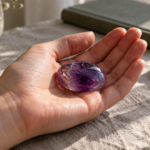
A Quiet Labradorite Palm Stone Reflection
Some readers may prefer a shorter exercise.
Choose one polished Labradorite palm stone.
Sit comfortably.
Rest the stone in your hand.
Observe its appearance for a few moments.
Then consider one question:
What part of my current situation remains uncertain?
There is no need to answer immediately.
You may simply acknowledge the question.
If a useful thought arises, consider writing it down.
If nothing becomes clearer, the exercise can end without a conclusion.
The purpose is reflection rather than revelation.
There is no requirement to experience unusual sensations.
And there is no evidence that the stone transmits information through supernatural energy.
When a Transition Involves Loss
Some changes are welcome.
Others are painful.
A transition may involve the loss of a relationship, a familiar environment or an important role.
In such circumstances, a ritual may carry personal meaning.
Research by Norton and Gino suggests that certain ritual activities can influence people’s reported experiences of grief and control under experimental conditions.
However, grief is complex.
There is no universal sequence that every individual must follow.
And no gemstone ritual can guarantee emotional recovery.
The Labradorite Threshold Ritual should not pressure someone to move on before they are ready.
Its middle stage may be particularly relevant as a symbolic acknowledgment that a person does not yet know what comes next.
But participation should remain voluntary.
For significant grief or distress, compassionate social support and appropriate professional care may be more important than any personal ritual.
The Importance of Cultural Respect
Van Gennep’s theory of rites of passage emerged from the comparative study of cultural and religious practices.
Turner’s later work examined ritual symbolism, social relationships and transitional conditions.
These scholars were not describing a universal gemstone ceremony.
Nor should the practices of particular communities be reduced to generic personal development techniques.
Traditional rites of passage can involve collective obligations, religious authority, social recognition and culturally specific meanings.
A private Labradorite exercise does not reproduce those functions.
It is therefore more accurate to describe the present ritual as inspired by an anthropological framework.
This distinction allows readers to appreciate the scholarship without claiming cultural authenticity that the practice does not possess.
Why Rituals Can Feel Meaningful
The psychological significance of ritual may involve several processes.
A structured sequence can organise attention.
Symbolic actions can represent values or experiences.
And a meaningful practice may create a sense of continuity.
The review by Hobson and colleagues discusses how rituals may operate through both physical actions and the meanings people attribute to them.
This helps explain why a simple action can feel significant.
Placing a gemstone on a piece of paper does not physically alter the future.
But the action may represent a personal acknowledgment.
Moving the stone from one position to another can make an abstract transition visible.
The meaning belongs to the individual.
It is not evidence of an invisible energetic mechanism.
When Ritual Becomes Unhelpful
A ritual should remain a voluntary activity.
It should not become something a person feels compelled to perform repeatedly to prevent imagined harm.
Nor should it replace practical decisions.
If someone begins to believe that forgetting the Labradorite will cause a negative event, the ritual has moved away from its intended symbolic purpose.
The stone does not control external circumstances.
It cannot guarantee protection.
And it cannot prevent unwanted events.
The exercise should support reflection, not dependence.
If the ritual becomes distressing or compulsive, discontinue it.
Professional advice may be appropriate when repetitive behaviours interfere with daily life.
A Ritual Without Forced Positivity
Contemporary spiritual discussions sometimes suggest that every transition should be welcomed as an opportunity for growth.
But this interpretation can overlook genuine difficulties.
Not every change is desirable.
Some transitions involve disappointment.
Others create practical hardship.
A person may experience uncertainty without finding it exciting or spiritually meaningful.
The Labradorite Threshold Ritual does not require positive thinking.
It does not ask participants to reinterpret every loss as a hidden blessing.
Instead, it encourages an accurate acknowledgment of circumstances.
Something has changed.
The present may remain uncertain.
And future possibilities may require time, information or assistance.
This is a more balanced approach than insisting that transformation must always feel uplifting.
The Value of Not Knowing Yet
Modern life often rewards certainty.
Clear decisions.
Definite plans.
Immediate explanations.
Yet some situations cannot be resolved on demand.
A person may need to gather information.
Observe how circumstances develop.
Or recognise that several possibilities remain open.
The concept of liminality offers a way to think about this intermediate condition.
It does not eliminate uncertainty.
But it provides language for describing it.
The Labradorite becomes a personal symbol of this experience.
Its changing visual appearance offers a reminder that perception can shift.
The ritual encourages reflection without pretending that every question has an immediate answer.
A Different Way to Understand Transformation
Transformation is frequently portrayed as a dramatic event.
A sudden realisation.
A complete change of identity.
Or the discovery of a new direction.
But many changes are gradual.
Someone may slowly adjust to a new responsibility.
A person may develop a different understanding of an earlier experience.
Or an unfamiliar situation may become more manageable through repeated ordinary actions.
The Labradorite ritual does not promise instant transformation.
It acknowledges that change can involve periods of ambiguity.
Its symbolism is therefore deliberately restrained.
The gemstone does not create a new identity.
It represents the possibility that understanding may continue to develop.
The Three Papers as a Personal Reflection Tool
The three-stage arrangement can also be used without gemstones.
This is worth emphasising.
The practical value of identifying change, uncertainty and possible next steps does not depend on Labradorite.
The stone adds personal symbolism.
It may make the exercise aesthetically appealing or emotionally meaningful.
But it is not necessary for the reflective process.
A notebook can serve the same organisational purpose.
The ritual should not encourage unnecessary purchases.
Nor should it imply that a larger or more expensive Labradorite provides stronger psychological effects.
The symbolic meaning is not determined by monetary value.
Revisiting the Ritual
A person may choose to repeat the exercise after circumstances change.
Perhaps new information becomes available.
An earlier concern becomes less important.
Or a previously unclear decision becomes easier to evaluate.
The three papers can be completed again.
This does not mean that the original ritual failed.
It simply reflects the fact that personal circumstances evolve.
There is no prescribed frequency.
The practice should not become a rigid obligation.
It may be useful once.
Occasionally.
Or not at all.
Its purpose is to provide a framework for reflection when that framework feels relevant.
The Science and the Spiritual Interpretation
The Labradorite Threshold Ritual brings together several distinct subjects.
Anthropology provides a framework for understanding culturally organised transitions.
Psychology investigates how ritualised actions can influence attention, emotion and the sense of control.
Contemporary crystal spirituality associates Labradorite with transformation and intuition.
These subjects should not be treated as interchangeable forms of evidence.
Anthropological research does not demonstrate gemstone healing.
Psychological experiments involving rituals do not establish supernatural energy.
And personal spiritual experiences do not, by themselves, prove a physical mechanism.
The scientific position remains clear.
There is no reliable evidence that Labradorite possesses therapeutic or transformative energetic powers.
At the same time, people may assign meaningful symbolism to objects.
A personal ritual can be appreciated as a reflective practice without making unsupported medical or supernatural claims.
The Deeper Meaning of the Threshold
A threshold separates two spaces.
But it also connects them.
It marks the place where one environment ends and another begins.
The Labradorite Threshold Ritual uses this image to explore a familiar human experience.
The past may no longer describe our circumstances.
The future may remain uncertain.
And the present may require patience.
The three-stage arrangement does not resolve these difficulties.
Instead, it makes them visible.
The first position acknowledges what has changed.
The second recognises what remains unknown.
The third considers what may reasonably be explored.
The Labradorite moves between these positions.
Its movement represents reflection.
Not supernatural transformation.
Learning to Remain in the In-Between
Not every meaningful spiritual practice needs to promise an extraordinary experience.
Sometimes its value lies in asking a better question.
What has changed?
What remains uncertain?
What can I realistically influence?
And what deserves more time?
These questions do not require belief in gemstone energy.
They can be approached through personal reflection.
For those who appreciate contemporary crystal spirituality, Labradorite may add a symbolic dimension.
Its association with transformation can represent the experience of moving between familiar and unfamiliar circumstances.
But the gemstone does not determine the outcome.
The individual remains responsible for evaluating information, seeking support and making decisions.
The most meaningful part of the ritual may therefore be its refusal to demand immediate certainty.
It allows the present to remain unfinished.
When the Next Chapter Has Not Yet Begun
There is a particular kind of uncertainty that appears when an earlier chapter has ended but a new one has not yet taken shape.
We may wish to move forward.
Yet the direction remains unclear.
We may want answers.
Yet the information is incomplete.
We may feel pressure to make a decision.
Yet waiting could be the more responsible choice.
The concept of liminality gives this experience a name.
The Labradorite Threshold Ritual offers a contemporary symbolic way to reflect upon it.
The stone does not open a supernatural doorway.
It does not reveal a hidden destiny.
And it does not promise protection from change.
Instead, it represents a simple possibility.
That we can acknowledge what has happened without pretending to know everything that follows.
The past can be recognised.
The present can remain uncertain.
And the future can be approached without demanding that it reveal itself immediately.
Perhaps this is the most meaningful interpretation of Labradorite as a contemporary symbol of transformation.
Not that it gives us the power to control change.
But that it can remind us to remain thoughtful while change unfolds.
The threshold is not necessarily a place where we are lost.
Sometimes, it is simply the place where we have not yet arrived.
References & Further Reading
1. Hartford Institute for Religion Research – Rites of Passage
Author: Stephen D. Glazier
Institution: Hartford Institute for Religion Research
Resource: Encyclopedia of Religion and Society
Type: Academic religious-studies reference
An authoritative introduction to the anthropological concept of rites of passage.
The resource explains Arnold van Gennep’s three-stage framework of separation, liminality and reintegration.
It also discusses the contributions of Victor Turner and Mary Douglas to the study of transitional rituals.
This is the principal historical and anthropological foundation for the article.
2. Tzanelli, R. – Rite of Passage
Author: Rodanthi Tzanelli
Publication: The Blackwell Encyclopedia of Sociology
Publisher: Wiley
Published: 2007
Type: Scholarly encyclopedia reference
A concise academic discussion of rites of passage and their interpretation within sociology and anthropology.
The publication examines van Gennep’s three-stage model and the social significance of transitional rituals.
It also provides references to foundational scholarship by van Gennep, Turner and other researchers.
https://doi.org/10.1002/9781405165518.wbeosr070
3. Hobson et al. – The Psychology of Rituals: An Integrative Review and Process-Based Framework
Authors: Nicholas M. Hobson, Juliana Schroeder, Jane L. Risen, Dimitris Xygalatas and Michael Inzlicht
Publication: Personality and Social Psychology Review
Volume: 22, Issue 3
Published online: November 13, 2017
Journal issue: 2018
Type: Peer-reviewed scientific review
A substantial review examining the psychological functions of ritualised behaviour.
The authors discuss emotion regulation, performance-related goals and social connection.
The publication also considers how structured physical actions and symbolic meanings may contribute to people’s experiences of rituals.
This research provides a scientific framework for understanding ritual without attributing supernatural properties to gemstones.
https://doi.org/10.1177/1088868317734944
4. Norton & Gino – Rituals Alleviate Grieving for Loved Ones, Lovers, and Lotteries
Authors: Michael I. Norton and Francesca Gino
Publication: Journal of Experimental Psychology: General
Published: February 2014
Volume: 143, Issue 1
Pages: 266–272
Type: Peer-reviewed experimental psychological research
A series of experiments investigating how ritualised actions influence reported grief following different forms of loss.
The researchers found that increased feelings of control helped explain some of the observed effects.
The findings concern human responses to rituals and do not establish therapeutic effects from gemstones.
https://pubmed.ncbi.nlm.nih.gov/23398180
5. Harvard Business School – The Power of Rituals in Life, Death, and Business
Author: Carmen Nobel
Institution: Harvard Business School
Published: June 3, 2013
Type: University research communication
An accessible explanation of research conducted by Michael Norton, Francesca Gino and colleagues.
The article explores the relationship between rituals, loss, personal meaning and perceived control.
It provides useful background for readers interested in the psychological significance of symbolic actions.
https://www.library.hbs.edu/working-knowledge/the-power-of-rituals-in-life-death-and-business
6. Brooks et al. – Don’t Stop Believing: Rituals Improve Performance by Decreasing Anxiety
Authors: Alison Wood Brooks, Juliana Schroeder, Jane L. Risen, Francesca Gino, Adam D. Galinsky, Michael I. Norton and Maurice E. Schweitzer
Publication: Organizational Behavior and Human Decision Processes
Published: 2016
Volume: 137
Pages: 71–85
Type: Peer-reviewed experimental psychological research
A scientific investigation into the relationship between ritualised actions, performance anxiety and task performance.
The researchers found that certain ritual activities reduced anxiety and improved performance under the experimental conditions studied.
The study also examined the importance of interpreting actions as meaningful rituals.
It does not investigate Labradorite or crystal-healing practices.
https://doi.org/10.1016/j.obhdp.2016.07.004
7. National Center for Complementary and Integrative Health – 8 Things to Know About Meditation and Mindfulness
Institution: US National Institutes of Health
Type: Evidence-based medical and wellness education
An authoritative overview of research into meditation and mindfulness.
The resource explains potential benefits, scientific limitations and possible negative experiences associated with contemplative practices.
It provides important context for distinguishing optional reflective exercises from clinically established treatment.
https://www.nccih.nih.gov/health/tips/8-things-to-know-about-meditation-and-mindfulness
Educational and Scientific Clarification
The associations between Labradorite, transformation, intuition, spiritual protection and the third-eye chakra are contemporary spiritual interpretations. They are not scientifically established energetic or therapeutic properties.
The Labradorite Threshold Ritual described in this article is an original contemporary reflective exercise.
It is inspired by the anthropological framework of rites of passage but is not a reconstruction of any historically documented cultural or religious ceremony.
There is no evidence that Arnold van Gennep’s or Victor Turner’s anthropological theories involved Labradorite or gemstone meditation.
Research concerning rituals, grief, uncertainty and psychological wellbeing does not demonstrate that Labradorite produces additional psychological, physiological or supernatural effects.
The ritual should not be presented as a treatment for anxiety, depression, trauma, grief or other medical or psychological conditions.
Gemstones and spiritual practices should not replace professional healthcare, psychological support, practical assistance or evidence-based decision-making.
Participation should remain voluntary, and the exercise should be discontinued if it causes distress or becomes compulsive.