Table of Contents
Introduction: Why Cabochon Quality Requires a Different Approach
A beautifully polished gemstone cabochon can appear deceptively simple.
Unlike a faceted gemstone, it may have no complex arrangement of facets, no carefully calculated pavilion angles and no conventional brilliant-cut geometry.
Instead, its appearance is dominated by a smooth, curved surface.
Yet producing an excellent cabochon requires considerable skill.
The cutter must understand the gemstone’s internal structure, colour distribution, physical properties and optical behaviour.
The final shape must be appropriate for the material.
The surface should be polished correctly.
The proportions should support the intended appearance.
And when the gemstone displays an optical phenomenon, the cutting orientation may determine whether that phenomenon becomes spectacular or almost invisible.
Consider three gemstones.
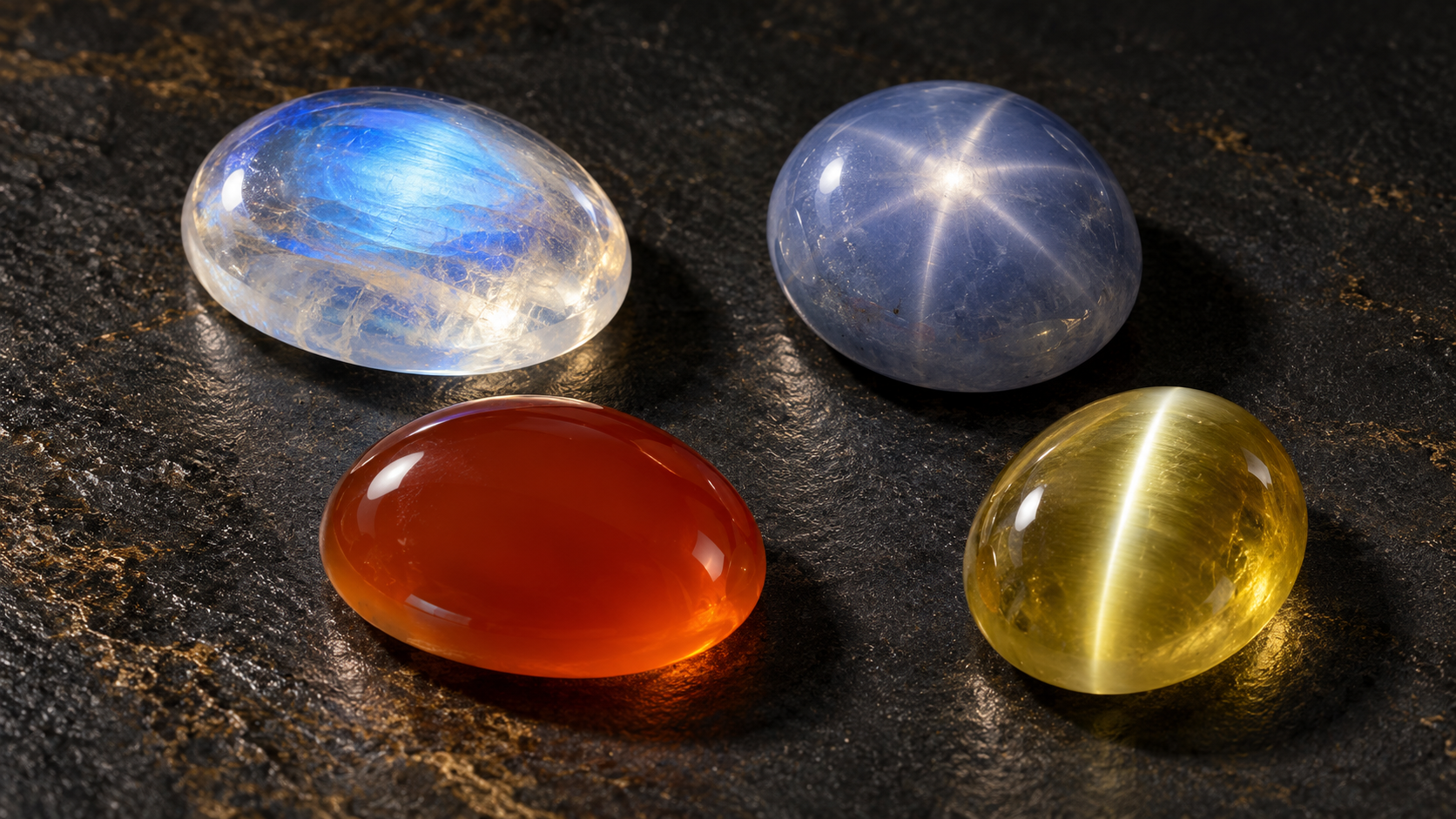
The first is a natural moonstone displaying a beautiful floating blue sheen.
The second is a star sapphire with a sharply defined six-rayed star.
The third is a polished carnelian cabochon with rich orange-red colour and a smooth, symmetrical dome.
All three are cabochons.
However, their quality cannot be evaluated using exactly the same criteria.
The moonstone must be examined for the strength and orientation of its adularescence.
The star sapphire must be assessed for the definition, centring and movement of its star.
The carnelian requires particular attention to colour, proportions, symmetry and surface finish.
These examples illustrate an essential principle of gemstone evaluation:
The quality of a cabochon depends on how successfully its cutting and polishing reveal the desirable characteristics of the individual gemstone.
This guide explains how to make that assessment systematically.
1. What Is a Gemstone Cabochon?
A cabochon is a gemstone that has been shaped and polished rather than cut with the multiple flat facets associated with conventional faceted gemstones.
The most familiar cabochon has a smooth, convex upper surface and a relatively flat base.
However, cabochons can take several forms.
Some have shallow domes.
Others have high, rounded domes.
Certain gemstones are fashioned as double cabochons, with curved surfaces on both sides.
Specialised cutting styles include sugarloaf cabochons, which have a more elevated, angular profile.
The outline may be oval, round, pear-shaped, rectangular, freeform or another shape.
The word cabochon originates from the French word caboche, referring to a head.
In gemmology, the term describes a cutting style rather than a mineral species.
Consequently, a cabochon can be fashioned from many different gemstone materials.
Examples include:
- Moonstone
- Sapphire
- Ruby
- Chrysoberyl
- Opal
- Carnelian
- Agate
- Chalcedony
- Labradorite
- Turquoise
- Jade
- Quartz
- Garnet
The choice of cabochon cutting is often influenced by the gemstone’s transparency, inclusions, colour distribution and optical characteristics.
2. Why Are Some Gemstones Cut as Cabochons?
Faceting and cabochon cutting serve different optical objectives.
A conventional faceted gemstone uses carefully positioned flat surfaces to control the paths of light entering and leaving the stone.
The cutting design can produce brilliance, contrast, dispersion and other optical effects.
Cabochon cutting generally places greater emphasis on the gemstone’s bodycolour, surface appearance and internal optical phenomena.
This makes it particularly suitable for opaque and translucent materials.
For example, an opaque turquoise specimen does not benefit from conventional pavilion-based brilliance in the same way as a transparent sapphire.
A polished cabochon can instead emphasise its colour, texture and natural matrix.
Other gemstones are cut as cabochons because they contain internal structures that produce unusual optical effects.
Examples include the floating sheen of moonstone, the narrow luminous line of cat’s-eye chrysoberyl and the star displayed by certain sapphires.
These effects are often best revealed through a correctly oriented curved surface.
GIA’s educational research explains that cabochon cutting is especially important for gemstones displaying chatoyancy and asterism.
The curved surface allows the internal structures responsible for these phenomena to produce a visible optical effect.
However, not every gemstone with an attractive optical phenomenon must be cut as a cabochon.
The choice depends on the material, the desired appearance and the cutter’s objectives.
3. The Five Principal Areas of Cabochon Evaluation
A systematic cabochon assessment should consider five broad areas.
Shape and proportions
Does the cabochon have an appropriate outline and dome profile?
Symmetry and cutting execution
Is the gemstone shaped consistently and intentionally?
Polish and surface condition
Is the surface properly finished, or are polishing defects visible?
Colour and internal characteristics
Does the cutting style present the gemstone’s colour and natural features attractively?
Optical performance
If the gemstone displays an optical phenomenon, how effectively does the cut reveal it?
These areas are closely related.
A cabochon may have excellent polish but poor proportions.
Another may have a slightly irregular outline yet display an exceptional optical phenomenon.
A third may be technically symmetrical but show unattractive colour distribution.
Therefore, cabochon quality should not be reduced to one characteristic.
The correct assessment considers the relationship between all relevant features.
4. Evaluating the Outline Shape
The first practical step is to examine the gemstone from directly above.
This is often called the face-up position.
The outline should be assessed before examining the dome.
For a conventional oval cabochon, the outline should generally appear balanced.
The two ends should have a harmonious relationship.
The sides should follow smooth curves.
The outline should not appear unintentionally distorted.
For a round cabochon, the shape should appear circular rather than noticeably elliptical.
For a pear-shaped cabochon, the shoulders should be balanced and the point should align appropriately with the main axis.
However, these principles do not mean that every cabochon must possess perfect geometric symmetry.
Freeform cabochons are often intentionally asymmetrical.
Opal cutters, for example, may preserve an unusual outline to retain valuable play-of-colour.
Similarly, a cabochon cut from a limited section of rare material may be shaped to preserve an exceptional natural feature.
The important distinction is between intentional design and poor cutting execution.
An irregular outline can be attractive when it serves a clear purpose.
An unintentionally distorted outline generally indicates weaker cutting quality.
5. Understanding Cabochon Dome Proportions
The dome is one of the most important structural elements of a cabochon.
It influences the gemstone’s appearance from different viewing directions.
It also affects how light interacts with the polished surface.
Cabochons may have low, medium or high domes.
There is no universally correct dome height for every gemstone material.
A low dome may be appropriate for a decorative agate or certain opals.
A higher dome may be desirable for a moonstone displaying adularescence.
The correct profile depends on the optical characteristics and intended use of the gemstone.
Low-dome cabochons
A low-dome cabochon has a relatively shallow upper surface.
This profile may be suitable when the gemstone’s principal appeal is its colour, pattern or surface appearance.
However, an excessively flat dome can reduce the visibility of certain optical phenomena.
GIA specifically notes that very flat moonstone cabochons may fail to display their characteristic sheen effectively.
Medium-dome cabochons
A medium dome often provides a balanced appearance.
It can offer a harmonious relationship between height, outline and visible surface area.
For many ordinary cabochons, this profile is aesthetically versatile.
However, its suitability still depends on the material.
High-dome cabochons
A high dome creates a more pronounced curved profile.
This can be beneficial for certain optical effects.
However, excessive height is not automatically a sign of superior cutting.
An overly tall cabochon may appear disproportionate.
It may also be less suitable for certain jewellery settings.
The correct objective is not to maximise height.
It is to select the dome profile that best supports the gemstone’s appearance.
6. How to Examine Dome Symmetry
After examining the outline, observe the cabochon from the side.
Then rotate it slowly.
For a conventional symmetrical cabochon, the dome should rise smoothly toward its highest point.
The apex should be positioned appropriately relative to the outline.
A well-executed oval cabochon generally has a balanced profile along its principal axes.
Potential cutting problems include:
- An unintentionally displaced apex
- One side rising more steeply than the other
- Uneven curvature
- Localised flat areas
- Abrupt changes in the dome profile
- Asymmetrical shoulders
These characteristics may become easier to observe when the gemstone is rotated under reflected light.
A smooth highlight should travel across the dome without unexpected interruptions caused by polishing or shaping irregularities.
However, the examination must account for the intended cutting style.
A sugarloaf cabochon has a different geometry from a conventional oval dome.
A freeform opal may intentionally preserve an irregular profile.
The correct question is therefore:
Does the dome demonstrate controlled cutting appropriate to the gemstone and its intended design?
7. The Relationship Between the Dome and the Base
The base of a cabochon is sometimes overlooked during evaluation.
However, it can provide important information about cutting quality.
Many conventional cabochons have a relatively flat base.
Others may have a slightly curved base or a deliberately different construction.
The relationship between the base and dome influences the gemstone’s overall proportions.
For ordinary cabochons, an excessively thick base may add unnecessary weight without improving face-up appearance.
A very thin base may be unsuitable for certain materials or settings.
Some gemstones retain natural matrix on the reverse.
This can be an intentional part of the finished specimen.
Boulder opal provides an important example.
Its natural ironstone matrix may remain attached to the opal layer.
This is not automatically a cutting defect.
The cutter may preserve the matrix because it supports the material or contributes to the gemstone’s appearance.
A careful evaluation therefore distinguishes between natural matrix, intentional backing and assembled gemstone construction.
These are different characteristics and should be described accurately.
8. Evaluating Cabochon Polish Quality
Polish is one of the most important indicators of lapidary workmanship.
A well-polished cabochon should have a surface finish appropriate to its mineral composition and structure.
Under reflected light, the surface should appear smooth.
The reflection of a light source should generally move across the dome without interruptions caused by scratches or polishing defects.
Potential surface problems include polishing lines, scratches, pits, flat spots and uneven lustre.
However, these features should not automatically be interpreted in the same way.
A polishing scratch is a workmanship characteristic.
A natural surface-reaching inclusion may be related to the gemstone’s internal structure.
A small cavity in a porous material may be an inherent material characteristic rather than evidence of careless polishing.
The distinction requires careful observation.
Practical polish examination
Begin by viewing the gemstone under diffuse illumination.
Then introduce a small reflected light source.
Rotate the cabochon slowly.
Observe how the reflection moves across the polished surface.
A continuous, smooth reflection generally supports good surface finishing.
Irregular reflections may reveal surface defects.
Magnification can help identify their nature.
A 10× loupe is often sufficient for preliminary examination.
However, not every natural gemstone material can achieve the same type of surface finish.
A polished jade cabochon may exhibit a different lustre from a polished quartz cabochon.
Therefore, polish should be judged in relation to the gemstone’s material properties.
9. Distinguishing Polish Defects from Natural Characteristics
This distinction is particularly important when evaluating natural gemstones.
A gemstone may contain fractures, inclusions, colour zones or structural irregularities.
Some of these characteristics can intersect the polished surface.
For example, a natural fracture may reach the dome.
This does not necessarily mean that the cutter created the fracture.
However, the feature may still affect durability or appearance.
Similarly, a cabochon fashioned from an aggregate material may contain natural boundaries between mineral components.
These boundaries can produce variations in surface texture.
A gemmological description should distinguish between:
Natural characteristics: Features associated with the gemstone’s formation or subsequent geological history.
Cutting characteristics: Features resulting from shaping, orientation and proportions.
Polishing characteristics: Features associated with the finishing process.
Condition characteristics: Damage or wear that may have occurred after cutting.
This distinction allows a more precise assessment than simply describing every visible imperfection as a clarity defect.
10. Colour Evaluation in Cabochons
Colour remains an important quality factor for many cabochons.
However, its assessment differs according to the material.
For a uniformly coloured carnelian cabochon, the evaluator may consider hue, tone, saturation and distribution.
For an agate cabochon, attractive banding may be more important than uniform colour.
For a multicoloured jasper, the natural pattern may be central to the gemstone’s appeal.
For an opal, the relationship between bodycolour and play-of-colour becomes particularly important.
Therefore, colour uniformity is not a universal requirement.
Some cabochons are valued because they display distinctive natural patterns.
Others are preferred when the colour is relatively consistent.
The cutting orientation can influence the final appearance.
A cutter may position the most attractive colour region toward the upper surface.
Alternatively, the cutter may preserve a distinctive natural pattern even when this requires an unusual shape.
The correct evaluation should consider whether the cutting style presents the material’s desirable characteristics effectively.
11. Optical Phenomena: Why Cabochon Orientation Matters
Some gemstones display special optical effects caused by interactions between light and internal structures.
These are often described as phenomenal gemstones.
Important examples include:
- Adularescence
- Chatoyancy
- Asterism
- Labradorescence
- Play-of-colour
- Aventurescence
These phenomena have different physical causes.
Some involve light reflecting from aligned inclusions.
Others result from interactions with microscopic layers or highly ordered internal structures.
A major scientific review published in Gems & Gemology in 2025 examines these effects and their underlying microstructures.
The study emphasises that different phenomena must be interpreted according to their specific physical mechanisms.
For cabochon evaluation, this has an important practical consequence.
A gemstone may contain the internal structures necessary to produce an optical phenomenon.
However, if the cutter chooses an unsuitable orientation, the effect may be weak, displaced or difficult to observe.
Cutting orientation is therefore sometimes as important as polishing quality.
12. Moonstone: Evaluating Adularescence
Moonstone is one of the best-known phenomenal gemstones.
Its characteristic optical effect is called adularescence.
This appears as a soft, floating sheen that moves across the gemstone as the viewing direction changes.
The effect is associated with the internal structure of feldspar.
Microscopic intergrowths and variations in refractive index influence how light interacts with the material.
The resulting sheen may appear white, silvery or blue.
What should be evaluated?
Strength of the sheen
The adularescence should be clearly visible under appropriate illumination.
A strong effect is generally more desirable than a very weak one.
Position of the sheen
The sheen should be well positioned relative to the dome.
GIA identifies a centred sheen as an important quality characteristic.
Movement
When the gemstone is tilted, the sheen should move attractively across the surface.
Viewing range
A phenomenon visible from several useful viewing directions is generally preferable to one that appears only at a very restricted angle.
Dome proportions
An excessively flat cabochon may fail to reveal the effect effectively.
Bodycolour and transparency
The background appearance should be evaluated separately from the sheen.
A gemstone may have attractive bodycolour but weak adularescence.
Another may display excellent adularescence but contain distracting inclusions.
The final assessment should consider the relationship between these characteristics.
13. Star Sapphire: Evaluating Asterism
Asterism is an optical phenomenon in which intersecting bands of light produce a star-shaped appearance.
In star sapphire, the effect is commonly associated with oriented microscopic inclusions.
The most familiar star sapphires display six rays.
Other configurations are possible.
GIA explains that the quality of a star depends on several characteristics.
These include its definition, position, contrast and movement.
Star definition
A high-quality star should have clearly visible rays.
The rays should not appear excessively blurred or broken.
Centring
The rays should ideally intersect near the centre of the dome.
An off-centre star may indicate a less effective cutting orientation.
However, unusual internal structures can sometimes complicate the relationship between the star and the dome.
Ray consistency
The rays should be reasonably balanced in brightness and appearance.
A star with one strong ray and several weak rays may appear less harmonious.
Contrast
The star should stand out clearly against the gemstone’s bodycolour.
Movement
When the gemstone is moved under a suitable light source, the star should appear to move across the surface.
This movement is an important characteristic of genuine asterism.
Transparency
A star sapphire does not necessarily need high transparency.
The inclusions responsible for the star can also reduce transparency.
The best balance depends on the relationship between star visibility, colour and the gemstone’s overall appearance.
A very sharp star is not automatically sufficient to establish that a sapphire is natural.
Synthetic and treated materials can also display asterism.
14. Cat’s-Eye Gemstones: Evaluating Chatoyancy
Chatoyancy produces a narrow band of reflected light resembling the slit-shaped pupil of a cat.
The effect is commonly associated with aligned needle-like inclusions, fibres or hollow tubes.
When these structures are oriented appropriately relative to the cabochon, reflected light forms a luminous band.
Chrysoberyl is one of the most important gemstones displaying this phenomenon.
Other materials, including quartz, tourmaline and certain additional gemstones, may also exhibit chatoyancy.
What makes a good cat’s-eye?
A well-developed cat’s-eye should have a clear, relatively narrow luminous band.
The band should be positioned attractively across the dome.
It should move smoothly when the gemstone is rotated.
The contrast between the eye and the bodycolour is also important.
In some chrysoberyl specimens, the eye separates two regions with different apparent brightness.
This is traditionally described as the milk-and-honey effect.
The appearance can be especially attractive when the contrast is strong.
However, a cat’s-eye effect should not be evaluated solely by the brightness of its central line.
The gemstone’s bodycolour, transparency, proportions and overall appearance remain important.
GIA research has also documented unusual cat’s-eye gemstones in which the inclusions responsible for chatoyancy are concentrated within a narrow internal layer.
These examples demonstrate why careful cutting orientation can be essential.
15. Labradorite: Evaluating Labradorescence
Labradorite can display striking flashes of colour.
This phenomenon is called labradorescence.
It is associated with fine-scale structures within the feldspar.
Light interacting with these structures produces the characteristic coloured reflections.
The effect may appear blue, green, yellow, orange or in combinations of colours.
When evaluating a labradorite cabochon, the observer should consider the brightness and coverage of the colour flashes.
The orientation of the polished surface is particularly important.
A gemstone may show a strong flash from one direction and appear relatively dark from another.
This behaviour is not necessarily a cutting defect.
However, a well-oriented cabochon should present the desired effect attractively under practical viewing conditions.
The evaluator should examine the gemstone while rotating it slowly.
The amount of visible colour, its intensity and its distribution across the dome are relevant.
A broad, vivid flash may be more attractive than a small isolated reflection.
Nevertheless, the final judgement depends on the individual gemstone and the intended design.
16. Opal: Evaluating Play-of-Colour and Cutting Quality
Precious opal displays a phenomenon known as play-of-colour.
This differs fundamentally from the optical effects observed in moonstone or star sapphire.
Play-of-colour results from interactions between light and ordered microscopic structures within the opal.
The phenomenon can produce changing spectral colours as the viewing angle changes.
GIA identifies play-of-colour as one of the most important factors in opal evaluation.
However, cutting quality remains significant.
Colour brightness
The intensity of the play-of-colour should be assessed.
Bright, clearly visible colours are generally desirable.
Colour coverage
The evaluator should consider how much of the gemstone displays play-of-colour.
Large inactive areas may affect visual appeal.
Pattern
The arrangement of colour patches or flashes can be an important characteristic.
Viewing angles
The gemstone should be rotated to determine how the colours change.
Surface condition
Crazing, cracks, pits and other condition characteristics require careful examination.
Cut and proportions
Symmetry, thickness, polish and overall design should be assessed.
However, a freeform opal may be deliberately cut to preserve an exceptional colour pattern.
GIA specifically includes symmetry, thickness, polish and sizing among the factors relevant to opal cutting quality.
This illustrates why cabochon assessment must combine optical appearance with technical workmanship.
17. Natural Matrix, Backing and Assembled Cabochons
Not every cabochon consists of one continuous piece of gemstone material.
Some gemstones naturally occur in association with host rock.
Others may be assembled from multiple components.
These situations must be distinguished.
Natural matrix
A gemstone may retain part of its natural host material.
Boulder opal is a familiar example.
The retained matrix may be an intentional and legitimate part of the gemstone.
Doublets
A doublet consists of two joined components.
In opal jewellery, a thin opal layer may be attached to a supporting backing.
Triplets
A triplet generally contains three layers.
An opal layer may be positioned between a backing and a transparent protective dome.
These constructions can produce attractive jewellery.
However, they should be described accurately.
An assembled gemstone is not equivalent to a solid, single-piece gemstone.
GIA’s educational guidance explains the distinction between solid gemstones and assembled materials.
For buyers, accurate disclosure is essential.
A visually attractive cabochon should not be assumed to be a solid natural gemstone solely because its upper surface appears convincing.
18. Treatments and Surface Enhancements
Cabochons can be subjected to treatments intended to modify colour, clarity, durability or appearance.
Examples may include dyeing, impregnation, stabilisation or other material-specific processes.
The relevance of each treatment depends on the gemstone.
Certain porous materials are particularly susceptible to impregnation or dyeing.
Opal may also be subjected to treatments that modify its appearance or stability.
However, visual examination alone may not reliably identify every treatment.
A uniformly coloured cabochon is not necessarily dyed.
A polished gemstone with a strong optical effect is not necessarily untreated.
Likewise, the presence of natural inclusions does not establish that the material has never been treated.
When treatment status is commercially significant, reliable documentation or appropriate laboratory examination may be necessary.
A buyer should distinguish between the quality of the cutting and the identification of the material.
These are separate questions.
19. Cabochon Durability: Hardness Is Not Enough
Cabochons are frequently used in jewellery.
Consequently, durability is an important practical consideration.
However, durability cannot be assessed using Mohs hardness alone.
Hardness describes resistance to scratching.
Toughness describes resistance to fracture.
Stability concerns the material’s response to environmental conditions such as heat, light and chemicals.
These characteristics vary between gemstone materials.
Moonstone provides a useful example.
GIA identifies moonstone as having a Mohs hardness of approximately 6–6.5.
It also possesses cleavage directions that can influence its resistance to damage.
Therefore, a beautifully polished moonstone cabochon may still require protective jewellery design.
The same principle applies more broadly.
A cabochon may possess excellent cutting quality while remaining relatively vulnerable to scratching or impact.
Its suitability for a ring, pendant or other jewellery application must be considered separately.
20. Practical Workshop: How to Examine a Cabochon at Home
The following procedure provides a structured method for preliminary visual evaluation.
It does not replace professional gemstone identification.
However, it can help collectors and buyers assess cutting quality and visible optical characteristics.
Step 1 — Prepare a suitable examination area
Use a clean, stable surface.
Place the gemstone on a soft, neutral background.
Avoid abrasive materials.
Choose lighting that allows the gemstone to be examined without excessive glare.
Step 2 — Examine the outline
Observe the cabochon from directly above.
Consider whether its outline is balanced and appropriate.
For symmetrical designs, look for unintended distortions.
For freeform designs, assess whether the shape appears intentional.
Step 3 — Examine the dome
View the gemstone from the side.
Rotate it slowly.
Observe the relationship between the apex, shoulders and base.
Look for irregular curvature or unexpected flat areas.
Step 4 — Examine the polish
Use reflected light to inspect the surface.
Move the light reflection across the dome.
Look for scratches, polishing lines, pits or uneven finishing.
A loupe may help identify subtle features.
Step 5 — Examine colour distribution
Observe the gemstone under neutral lighting.
Consider whether the colour is attractive and appropriate for the material.
For patterned gemstones, examine the distribution of the natural pattern.
Step 6 — Examine optical phenomena
If the gemstone displays adularescence, chatoyancy or asterism, use a small directional light source.
Rotate the gemstone slowly.
Observe the position, definition and movement of the effect.
For opal, examine the gemstone from several angles to assess play-of-colour.
Step 7 — Examine the reverse
If the gemstone is loose, inspect its base.
Look for natural matrix, unusual backing, visible joins or other construction features.
Do not assume that a visible boundary proves assembly.
Step 8 — Consider durability
Identify the gemstone material where possible.
Consider its hardness, toughness and sensitivity to environmental conditions.
Avoid destructive testing.
Step 9 — Record observations
Write a short description covering shape, dome, polish, colour, optical performance and visible condition.
Separate direct observations from conclusions requiring laboratory confirmation.
Step 10 — Form an overall judgement
Evaluate the gemstone as a complete object.
A cabochon should not be judged by one isolated characteristic.
The final assessment should reflect the relationship between workmanship, material properties and visual appearance.
21. How to Photograph a Cabochon for Accurate Evaluation
Photography can be useful for documenting cabochon quality.
However, a single photograph rarely captures every important characteristic.
The appearance of a cabochon depends strongly on lighting direction.
This is particularly important for phenomenal gemstones.
A moonstone may display a strong blue sheen in one photograph but appear almost colourless in another.
A star sapphire may show a sharply defined star under directional illumination.
An opal may display different colours when photographed from different angles.
Therefore, photographic documentation should ideally include several views.
Face-up view
Shows the outline, colour distribution and general appearance.
Side profile
Shows dome height, proportions and cutting symmetry.
Oblique view
Helps reveal surface finish and curvature.
Phenomenon view
Shows the optical effect under suitable illumination.
Reverse view
Documents the base, matrix or construction characteristics.
For online gemstone purchasing, photographs should be supplemented by accurate descriptions.
A short video showing the gemstone being rotated can be particularly valuable.
However, lighting conditions should not be manipulated to create an unrealistic impression of the gemstone’s ordinary appearance.
22. Common Cabochon Cutting Problems
Several cutting characteristics can reduce the visual or technical quality of a cabochon.
Uneven dome
The curvature is unintentionally asymmetrical.
Poorly centred apex
The highest point of the dome is displaced without a clear design purpose.
Excessively flat profile
The dome does not adequately reveal the gemstone’s intended appearance.
Excessively high profile
The cabochon appears disproportionate or unsuitable for its intended setting.
Polishing scratches
Visible surface marks remain after finishing.
Uneven lustre
Different regions show inconsistent polishing quality.
Poor optical orientation
A desirable phenomenon is weak or badly positioned because of the cutting orientation.
Unnecessary weight retention
Excess material remains without contributing meaningfully to appearance or durability.
Poorly executed outline
The shape contains unintended distortions.
However, these characteristics must always be interpreted in context.
A freeform opal should not be penalised simply because it is not oval.
A cabochon with natural matrix should not be considered defective merely because its reverse is not uniformly polished.
The distinction between intentional design and poor workmanship remains essential.
23. Comparing Two Cabochons of the Same Material
Consider two natural moonstone cabochons.
Both have similar dimensions.
Both possess attractive bodycolour.
The first cabochon has a balanced dome and a clearly visible blue sheen positioned near the centre.
The sheen moves smoothly across the surface when the gemstone is tilted.
The second cabochon has a slightly uneven dome.
Its sheen is visible only when the gemstone is viewed from a narrow angle.
The first gemstone may demonstrate superior cutting orientation and optical performance.
However, the comparison should also consider transparency, inclusions, surface condition and overall appearance.
Now consider two carnelian cabochons.
Neither displays adularescence or asterism.
In this case, the assessment places greater emphasis on colour, shape, proportions, polish and the attractiveness of the finished surface.
These examples demonstrate why cabochon evaluation must be adapted to the material.
Applying identical criteria to every cabochon would produce misleading conclusions.
24. Does a Larger Cabochon Have Better Quality?
Size is not equivalent to quality.
A large cabochon may contain attractive material.
However, it may also have weak polish, poor proportions or an inadequately displayed optical phenomenon.
A smaller gemstone may demonstrate superior craftsmanship.
For example, a small star sapphire with a sharp, centred star may be more visually attractive than a much larger specimen with poorly defined rays.
Similarly, a compact moonstone with strong blue adularescence may be more desirable than a larger stone with weak sheen.
The relationship between size and value also depends on the rarity of the material.
Some gemstones become significantly more difficult to obtain in larger sizes.
Nevertheless, carat weight should be considered separately from cutting quality.
A well-executed cabochon is not defined by its weight alone.
25. Understanding Cabochon Quality in the Natural Gems Belgium Grading Framework
Natural Gems Belgium evaluates gemstones individually.
For cabochons, the assessment must reflect the cutting style and the material’s optical characteristics.
A cabochon should not be evaluated as though it were a conventional faceted gemstone.
Its quality assessment should consider the following relationships.
Colour
The attractiveness and distribution of colour, including natural patterns where relevant.
Clarity and internal characteristics
The influence of inclusions, fractures and other features on appearance and durability.
Cutting quality
The relationship between outline, dome proportions, symmetry and polishing.
Optical performance
The quality of any relevant optical phenomenon, including its definition, position, movement and visibility.
Overall appeal
The combined visual impression of the individual gemstone.
These principles should be applied according to the gemstone material.
For example, a star sapphire’s optical performance depends strongly on its asterism.
A carnelian cabochon may be assessed primarily through its colour, polish and proportions.
A patterned agate may derive much of its appeal from the natural arrangement of its bands.
The grading explanation should identify the characteristics that genuinely influence the specimen’s quality.
This approach provides more meaningful information than applying a generic quality label without supporting observations.
26. Common Misconceptions About Cabochon Quality
Misconception: A higher dome always means better quality.
Incorrect.
The appropriate dome height depends on the gemstone and its intended appearance.
Misconception: A cabochon must be perfectly symmetrical.
Incorrect.
Freeform designs can be intentional and highly attractive.
Misconception: All cabochons should be transparent.
Incorrect.
Many desirable cabochon materials are translucent or opaque.
Misconception: Inclusions always reduce cabochon quality.
Incorrect.
Certain inclusions are responsible for desirable optical phenomena.
Misconception: A strong star proves that a sapphire is natural.
Incorrect.
Synthetic and treated gemstones can also display asterism.
Misconception: A polished cabochon is necessarily untreated.
Incorrect.
Cutting and polishing do not establish treatment status.
Misconception: A gemstone with natural matrix is poorly cut.
Incorrect.
Retaining matrix can be an intentional cutting decision.
Misconception: Cabochons are easier to evaluate than faceted gemstones.
Incorrect.
Their evaluation requires different expertise, particularly when optical phenomena are involved.
27. Final Practical Evaluation Checklist
Before purchasing or documenting a gemstone cabochon, consider the following questions.
Shape: Is the outline appropriate and intentionally executed?
Dome: Is the profile balanced and suitable for the material?
Symmetry: Does the gemstone demonstrate controlled cutting?
Polish: Is the surface properly finished?
Colour: Is the colour or natural pattern attractive?
Optical phenomena: Are any special optical effects clearly visible and correctly positioned?
Internal characteristics: Are inclusions or fractures relevant to appearance or durability?
Base: Is the reverse appropriate, and is any backing or assembly accurately disclosed?
Treatment: Is the known treatment status described correctly?
Durability: Is the gemstone suitable for its intended use?
Documentation: Are the material identity, dimensions and important characteristics recorded?
Overall appeal: Does the gemstone present its natural characteristics attractively?
These questions provide a practical foundation for evaluating cabochon quality.
They do not replace specialised gemmological testing.
However, they encourage a more systematic and informed approach.
Conclusion: The Art and Science of a Well-Cut Cabochon
Cabochon cutting demonstrates that gemstone beauty does not depend exclusively on faceting.
A smooth dome can reveal characteristics that would be difficult to appreciate in a conventional faceted gemstone.
The floating sheen of moonstone.
The moving star of sapphire.
The luminous eye of chrysoberyl.
The coloured reflections of labradorite.
The changing play-of-colour of precious opal.
Each phenomenon requires a different approach to cutting and evaluation.
At the same time, ordinary cabochons such as carnelian, agate and chalcedony demonstrate the importance of proportion, polish, colour and craftsmanship.
The best cabochon is not necessarily the tallest, largest or most symmetrical.
It is the gemstone whose cutting and finishing successfully reveal the desirable qualities of its material.
For buyers and collectors, understanding these principles makes gemstone evaluation more informative.
For lapidaries, they demonstrate the relationship between mineral structure and cutting decisions.
For gemmologists, they reinforce the importance of interpreting each gemstone according to its individual characteristics.
A well-cut cabochon does not simply give a gemstone its shape. It reveals the characteristics that make the material worth appreciating.
References & Further Reading
The following references are selected from educational publications and peer-reviewed scientific research published by the Gemological Institute of America.
They support the gemmological principles discussed in this guide, including cabochon cutting, optical phenomena, moonstone quality, asterism, chatoyancy, opal evaluation, gemstone durability and assembled materials.
All references include direct URLs to informational or scientific pages.
1. Bohannon, Sharon – Optical Effects of Phenomenal Cabochons
Institution: Gemological Institute of America
Published: 11 November 2016
An educational introduction to the optical phenomena commonly displayed by cabochon-cut gemstones.
The article explains adularescence, chatoyancy, asterism, labradorescence, play-of-colour and aventurescence.
It also discusses why cabochon cutting is particularly suitable for certain gemstone materials.
https://www.gia.edu/gia-news-research/optical-effects-phenomenal-cabochons
2. Jin, Shiyun; Renfro, Nathan D.; Palke, Aaron C.; Shigley, James E. – Structures Behind the Spectacle: A Review of Optical Effects in Phenomenal Gemstones and Their Underlying Nanotextures
Publication: Gems & Gemology
Volume: 61, Number 2
Published: Summer 2025
A comprehensive peer-reviewed scientific review of optical phenomena in gemstones.
The research examines the microscopic and nanometre-scale structures responsible for asterism, chatoyancy, adularescence, labradorescence, aventurescence and opal play-of-colour.
It provides an advanced scientific foundation for understanding how gemstone structure influences optical appearance.
https://www.gia.edu/gems-gemology/summer-2025-phenomenal-gemstones
3. Gemological Institute of America – Moonstone Quality Factors
Institution: Gemological Institute of America
An educational reference explaining the principal factors influencing moonstone quality.
The article discusses bodycolour, transparency, inclusions, adularescence, cutting orientation and cabochon proportions.
It specifically identifies the importance of a well-centred sheen and explains why excessively flat cabochons may display weaker optical effects.
https://www.gia.edu/moonstone-quality-factor
4. Gemological Institute of America – Sapphire Quality Factors
Institution: Gemological Institute of America
A detailed educational reference covering sapphire colour, clarity, cutting and quality assessment.
The section on star sapphire explains the characteristics of desirable asterism, including star definition, centring, ray consistency, contrast and movement.
https://www.gia.edu/sapphire-quality-factor
5. Miura, Makoto; Katsurada, Yusuke – Cat’s-Eye Alexandrite with Unique Inclusion Pattern
Publication: Gems & Gemology
Volume: 53, Number 4
Published: Winter 2017
A laboratory investigation of a natural chrysoberyl cabochon displaying chatoyancy and colour change.
The study demonstrates how a relatively narrow layer of oriented inclusions can produce a strong cat’s-eye effect when the gemstone is cut appropriately.
It provides a particularly useful example of the importance of cutting orientation.
https://www.gia.edu/gems-gemology/winter-2017-labnotes-cats-eye-alexandrite-unique-inclusion-pattern
6. Gemological Institute of America – Opal Quality Factors
Institution: Gemological Institute of America
An extensive guide to opal evaluation.
The article explains how bodycolour, play-of-colour, pattern, transparency, inclusions, symmetry, thickness and polish influence the appearance and quality of opal.
It also provides a practical evaluation procedure using controlled lighting and gemstone rotation.
https://www.gia.edu/opal-quality-factor
7. Gemological Institute of America – Moonstone Care and Cleaning Guide
Institution: Gemological Institute of America
An educational reference explaining moonstone durability.
The article discusses Mohs hardness, cleavage, toughness and appropriate jewellery care.
It demonstrates why gemstone durability must be considered separately from cutting quality.
https://www.gia.edu/moonstone-care-cleaning
8. Gemological Institute of America – An Introduction to Imitation Diamonds and Other Gems
Institution: Gemological Institute of America
An educational guide explaining gemstone imitations and assembled materials.
The discussion includes doublets and triplets, including opal constructions containing natural opal layers combined with backing materials or protective transparent domes.
It provides an important reference for distinguishing solid gemstones from assembled cabochons.
https://www.gia.edu/gem-imitation
9. LeCroy, Britni – Glass Imitation of Star Sapphire
Publication: Gems & Gemology
Published: Fall 2021
A laboratory report documenting glass cabochons manufactured to imitate star sapphire.
The investigation demonstrates why a visible star-shaped pattern does not automatically establish that a gemstone displays genuine asterism or possesses natural origin.
https://www.gia.edu/gems-gemology/fall-2021-glass-imitation-star-sapphire
10. Katsurada, Yusuke – Color-Zoned Cat’s-Eye Chrysoberyl
Publication: Gems & Gemology
Volume: 57, Number 4
Published: Winter 2021
A gemmological laboratory report describing a chrysoberyl cabochon containing localised fibrous inclusions.
The investigation demonstrates how the distribution of inclusions influences chatoyancy and why careful cutting orientation can improve the appearance of the optical phenomenon.
https://origin.prod.gia.edu/gems-gemology/winter-2021-lab-notes-color-zoned-cats-eye-chrysoberyl
Scientific Interpretation Note
Cabochon quality assessment must distinguish between observable cutting characteristics and conclusions requiring gemmological identification.
Shape, symmetry, polish and visible optical performance can often be evaluated directly.
However, natural origin, treatment status, mineral identity and the cause of unusual internal characteristics may require specialised examination.
The presence of an attractive optical phenomenon does not independently establish that a gemstone is natural or untreated.
A scientifically responsible assessment therefore combines careful visual observation with appropriate identification and documentation.