

Table of Contents
Introduction: Can a Photograph Show a Gemstone Exactly as It Appears?
In the realm of gemstone photography, achieving color accuracy is paramount, particularly when it comes to showcasing the true beauty of gemstones. Understanding gemstone photography color accuracy is essential for both buyers and sellers.
Imagine purchasing a beautiful natural sapphire online.
The photographs show an attractive medium-blue gemstone with excellent brilliance.
The colour appears rich, the facets are clearly defined, and the stone seems to possess remarkable transparency.
When the gemstone arrives, however, its appearance is slightly different.
Under natural daylight, the blue seems softer.
Under warm indoor lighting, the gemstone appears darker.
When examined near a window, certain facets become brighter while others appear almost black.
Does this mean the original photographs were inaccurate?
Not necessarily.
A gemstone’s appearance depends on several interacting factors.
These include the spectral characteristics of the light source, the optical properties of the gemstone, the camera’s response to light, digital image processing and the characteristics of the screen used to display the photograph.
Even a carefully prepared photograph cannot reproduce every aspect of a three-dimensional gemstone.
This is especially important because gemstones are not ordinary opaque objects.
Many are transparent or translucent.
They refract light, produce internal reflections and display optical effects that change with viewing direction.
Some gemstones also exhibit pleochroism, fluorescence, adularescence or other phenomena that complicate photographic representation.
Understanding these limitations is essential when purchasing gemstones online.
The objective of this guide is not to suggest that gemstone photographs are unreliable.
Instead, it explains how to interpret them correctly.
A photograph can provide valuable evidence of a gemstone’s appearance, but it cannot communicate every characteristic of the physical stone. This is particularly true in the context of gemstone photography color accuracy.
1. Why Gemstone Photography Is More Complex Than Ordinary Product Photography
Photographing a gemstone is fundamentally different from photographing many everyday objects.
Consider a piece of matte ceramic.
Much of its visible appearance results from light reflected diffusely from its surface.
Although illumination still matters, the object’s appearance may remain comparatively consistent across different viewing angles.
A transparent faceted gemstone behaves differently.
Light can enter through one facet, change direction through refraction, reflect internally and leave through another facet.
The resulting appearance depends on the gemstone’s optical properties and cutting geometry.
A slight movement of the gemstone may change which facets appear bright or dark.
A change in lighting direction can alter the pattern of reflections.
A change in camera position can reveal different internal characteristics.
The gemstone is not necessarily changing.
The relationship between the gemstone, illumination and observer is changing.
This is why professional gemstone photography requires careful control of lighting and positioning.
GIA’s educational guidance on gemstone photography specifically emphasises lighting quality, camera stability, background selection and appropriate positioning.
These factors are important not only for producing attractive photographs but also for documenting gemstones accurately.
2. The Science of Gemstone Colour
Before examining photographic differences, it is necessary to understand how gemstone colour is produced.
Visible light consists of electromagnetic radiation across a range of wavelengths.
Human colour vision responds to the spectral distribution of light reaching the eyes.
When light interacts with a gemstone, several processes may occur.
Some wavelengths are absorbed.
Others are transmitted, reflected or scattered.
The balance between these interactions contributes to the colour we perceive.
For example, a blue sapphire commonly absorbs certain wavelengths more strongly than others.
The transmitted and reflected light can consequently appear blue.
The exact appearance depends on the sapphire’s chemical composition, optical characteristics and illumination.
However, a gemstone’s perceived colour is not determined by the gemstone alone.
Three components must be considered:
The light source
The gemstone
The observer
Changing any of these components can change the resulting colour appearance.
This relationship is central to modern colour science.
3. Hue, Tone and Saturation
Professional gemstone colour evaluation commonly distinguishes three important characteristics.
Hue
Hue describes the general colour family.
Examples include:
- Blue
- Green
- Red
- Yellow
- Violet
Many gemstones display combinations of hues.
A sapphire may appear violetish blue.
A tourmaline may appear bluish green.
An aquamarine may possess a greenish-blue appearance.
These distinctions can be commercially important.
Tone
Tone describes the relative lightness or darkness of a colour.
A gemstone may have a light, medium or dark tone.
However, tone should not be confused with saturation.
A dark gemstone is not necessarily strongly saturated.
Likewise, a light gemstone can possess an attractive, relatively pure hue.
Saturation
Saturation describes the strength or intensity of a colour.
A highly saturated gemstone displays a relatively strong colour.
A less saturated gemstone may appear greyish or brownish.
GIA’s coloured-stone educational framework uses hue, tone and saturation as important components of colour description.
Colour uniformity is another relevant consideration.
A photograph that changes any of these characteristics can influence how buyers perceive gemstone quality.
For example, artificially increasing saturation may make a gemstone appear more vivid than it actually is.
Increasing contrast may make the colour appear deeper.
Excessive brightness adjustments may make a dark gemstone appear lighter and more transparent.
These changes can alter the buyer’s impression even when the gemstone’s outline and facet arrangement remain unchanged.
4. Why Lighting Changes Gemstone Appearance
One of the most important variables in gemstone photography is the light source.
Different light sources do not necessarily contain the same proportions of visible wavelengths.
Daylight, incandescent lamps and LED lighting can possess different spectral power distributions.
This means they provide different mixtures of wavelengths for the gemstone to absorb, reflect and transmit.
The resulting colour appearance may therefore change.
For example, a gemstone photographed under warm lighting may display a stronger yellowish or reddish component than it does under a daylight-equivalent source.
Under another light source, cooler colour components may become more prominent.
The magnitude of the difference depends on the gemstone.
Some materials show relatively modest changes.
Others are particularly sensitive to illumination.
The International Commission on Illumination establishes standard illuminants used in colour science.
Two important examples are:
CIE Standard Illuminant D65
A reference representing average daylight, with a correlated colour temperature of approximately 6500 K.
CIE Standard Illuminant A
A reference representing traditional tungsten-filament illumination, with a colour temperature of approximately 2856 K.
These standard illuminants provide defined spectral distributions for colour calculations.
However, ordinary household lamps and daylight conditions do not necessarily reproduce these reference distributions precisely.
5. Why Colour Temperature Alone Is Not Enough
Photographic lighting is often described using colour temperature.
For example:
5500 K
6000 K
6500 K
These values are useful, but they do not fully describe the light source.
Two lamps may have similar correlated colour temperatures while possessing different spectral distributions.
This is particularly relevant to LED lighting.
Different LED technologies can produce light with different spectral characteristics.
Consequently, two lamps marketed as daylight-equivalent may not render every gemstone colour identically.
The distinction is important because gemstones interact selectively with different wavelengths.
A light source with an unusual spectral distribution may exaggerate or suppress certain colour components.
The CIE has developed standards for assessing the spectral quality of daylight simulators.
These standards recognise that matching a nominal colour temperature does not automatically guarantee equivalent colour-rendering performance.
A lamp labelled 6500 K is not automatically an exact substitute for natural daylight.
For gemstone photography, consistent illumination with suitable spectral characteristics is preferable to relying on colour temperature alone.
6. Direct Lighting Versus Diffused Lighting
Lighting direction and diffusion can substantially influence a gemstone’s appearance.
Direct lighting
Direct lighting produces relatively concentrated illumination.
It may create:
- Bright facet reflections
- Strong contrast
- Distinct shadows
- Specular highlights
- Pronounced dispersion in suitable gemstones
These characteristics can make a gemstone appear lively.
However, excessive direct lighting may also produce intense reflections that obscure the gemstone’s underlying colour.
Certain facets may appear almost white.
Others may become unusually dark.
Diffused lighting
Diffused lighting spreads illumination over a larger apparent area.
It generally produces softer transitions between bright and dark regions.
This can help reveal the gemstone’s body colour more consistently.
It may also reduce distracting reflections.
GIA’s gemstone photography guidance recommends diffused lighting as a useful method for presenting gemstone colour.
However, diffused lighting can also reduce the visual prominence of certain optical effects.
For example, a star sapphire or cat’s-eye gemstone may require a more concentrated light source to display its phenomenon clearly.
Therefore, no single lighting arrangement is ideal for every gemstone.
The appropriate lighting depends on the characteristic being documented.
7. Why the Same Gemstone Can Look Brighter or Darker
Faceted gemstones contain multiple polished surfaces.
Each facet interacts with light according to its orientation.
Some facets return light toward the observer.
Others direct light away.
The result is a pattern of bright and dark areas.
This pattern contributes to the gemstone’s optical performance.
However, it is not completely fixed.
If the gemstone is rotated, the pattern may change.
If the light source moves, the pattern may also change.
The same gemstone can therefore appear significantly brighter in one photograph than another.
This does not necessarily indicate digital manipulation.
It may result from different lighting geometry.
Nevertheless, photographic lighting can also conceal weaknesses in cutting.
A gemstone with a noticeable window may appear less transparent or more evenly coloured when photographed against a carefully selected background.
Conversely, lighting that produces excessive contrast may exaggerate dark regions.
For this reason, buyers should examine several photographs rather than relying exclusively on one attractive image.
8. The Influence of Camera Angle
Camera position is another important variable.
A faceted gemstone is commonly photographed face-up.
This means the camera looks toward the table facet, approximately perpendicular to its surface.
The face-up position is particularly useful because it corresponds to an important viewing direction for evaluating many finished gemstones.
However, a single face-up photograph does not reveal every characteristic.
A slightly tilted image may show the crown height more clearly.
A side view can provide information about pavilion depth.
A rear view may reveal additional inclusions or colour zoning.
Different camera angles may also change the apparent colour of pleochroic gemstones.
Therefore, multiple viewing directions can provide a more complete impression.
A photograph should be interpreted as a record of one viewing geometry.
It is not a complete representation of the gemstone in every orientation.
9. Pleochroism: When Viewing Direction Changes Colour
Certain gemstones are optically anisotropic.
Their interaction with light depends on crystallographic direction and polarisation.
Some of these gemstones exhibit pleochroism.
Pleochroism describes the observation of different colours or colour intensities when a gemstone is viewed along different optical directions.
Important examples include:
- Tanzanite
- Iolite
- Andalusite
- Certain tourmalines
- Other suitable anisotropic minerals
Tanzanite is especially well known for its directional colour behaviour.
Iolite can also display striking differences between viewing directions.
This has important consequences for gemstone photography.
A gemstone may appear more blue from one direction and more violet or greyish from another.
The exact appearance depends on its optical characteristics and cutting orientation.
A single photograph cannot demonstrate the full range of directional colours.
A carefully prepared video may provide additional information.
However, video reproduction is still affected by illumination, camera processing and display characteristics.
10. White Balance: Why Cameras Can Misinterpret Gemstone Colour
Digital cameras must interpret the colour of the illumination.
This process is commonly called white balance.
The objective is to reproduce neutral objects without unwanted colour casts.
For example, a white surface illuminated by warm light may appear yellowish to a camera.
White-balance correction attempts to compensate for the illumination.
Automatic white balance can be useful.
However, it is not always reliable for gemstone photography.
A gemstone may occupy only a small portion of the image.
The background may dominate the camera’s calculations.
Strongly coloured gemstones can also influence automatic processing.
As a result, the camera may apply a correction that changes the gemstone’s apparent hue.
Manual white balance or a suitable neutral reference can improve consistency.
However, white-balance correction cannot fully compensate for every difference in the spectral distribution of a light source.
If certain wavelengths are poorly represented in the illumination, a simple colour-temperature adjustment cannot recreate all the missing spectral information.
This distinction is important.
Correct white balance is necessary for reliable colour reproduction, but it is not sufficient by itself.
11. Exposure and the Problem of Lost Detail
Exposure determines how much light contributes to the recorded image.
Incorrect exposure can influence the apparent quality of a gemstone.
Overexposure
Overexposure can cause bright areas to lose detail.
This is sometimes called highlight clipping.
Facet reflections may become completely white.
Subtle colour variations can disappear.
A pale gemstone may appear almost colourless.
Underexposure
Underexposure can cause dark areas to lose detail.
A gemstone may appear darker or more opaque than it actually is.
Internal characteristics may become difficult to distinguish.
Some colour information may also be obscured.
Excessive contrast
Even when the overall exposure is reasonable, aggressive contrast adjustments can reduce detail in highlights and shadows.
The resulting image may look visually impressive.
However, it may provide a less accurate representation of the gemstone.
For documentary gemstone photography, retaining relevant detail is generally more important than maximising dramatic contrast.
12. Why Background Colour Matters
The background behind a gemstone can influence its photographic appearance.
This occurs through several mechanisms.
First, the background affects visual contrast.
A pale gemstone may stand out strongly against a dark surface.
A dark gemstone may appear more distinct against a light surface.
Second, the background can influence the light entering or returning through a transparent gemstone.
A white surface may reflect additional light into the gemstone.
A dark surface may reduce the amount of returning light.
Third, the background affects human colour perception.
Colours are not perceived completely independently of their surroundings.
A gemstone may appear more saturated or brighter against one background than another.
Consequently, background selection is not merely decorative.
It can influence how the gemstone is perceived.
GIA specifically notes that background selection affects gemstone appearance and that light backgrounds can sometimes make poorly cut gemstones appear more attractive.
For buyers, this suggests a useful precaution.
When evaluating an expensive gemstone, consider whether its appearance remains convincing across more than one photographic arrangement.
13. The Difference Between Photography and Human Vision
A digital camera and the human visual system do not process light in exactly the same way.
Most conventional colour cameras use red, green and blue-sensitive channels.
Their spectral sensitivities differ from the response functions of human colour vision.
The recorded signals are subsequently processed into a digital image.
Human vision, by contrast, involves the response of retinal photoreceptors and complex neurological processing.
Our perception is influenced by adaptation, contrast, surrounding colours and illumination.
These differences help explain why an image can look convincing while still failing to reproduce certain subtle gemstone colours.
Two spectral distributions may produce similar camera responses without appearing identical to every human observer.
Similarly, colours that appear similar under one light source may differ under another.
Colour science uses concepts such as metamerism to describe particular situations in which spectral differences are not apparent under specified viewing conditions.
For gemstone buyers, the practical implication is straightforward.
A digital photograph is a reproduction of visual information.
It is not an exact duplication of the physical interaction between the gemstone and light.
14. Digital Colour Spaces and ICC Profiles
After a photograph is captured, its colour information must be stored and displayed.
This introduces another important variable.
Digital images use colour encodings.
One of the most familiar is:
sRGB
sRGB is a standard RGB colour space widely used for digital images and online communication.
Other colour spaces can represent a broader range of colours.
However, the existence of a wider colour space does not automatically guarantee greater accuracy.
The entire imaging workflow must be managed correctly.
The International Color Consortium develops standards for colour management.
ICC profiles describe how colour values should be interpreted and transformed between devices and colour spaces.
For example, a photograph may be edited on one monitor and displayed on another.
If the devices differ and the colour information is not managed correctly, the appearance may change.
Even with proper colour management, reproduction remains limited by the capabilities of the display.
A screen cannot reproduce colours outside its available gamut.
Likewise, it cannot perfectly reproduce every brightness relationship or optical effect present in the original scene.
For online gemstone photographs, converting images appropriately for web display and preserving correct colour-profile information are important parts of a responsible workflow.
15. Why the Same Photograph Looks Different on Two Screens
Imagine opening the same gemstone photograph on two devices.
One is a modern smartphone.
The other is an older laptop.
The gemstone may appear more saturated on the smartphone.
Its blue colour may appear slightly violet on the laptop.
The contrast may also differ.
Several factors can contribute.
Display calibration
Screens may reproduce colour differently because their actual characteristics do not match the intended reference behaviour.
Colour gamut
Some displays can reproduce a wider range of colours than others.
Brightness
Different brightness settings affect perceived tone and contrast.
Display technology
Different screen technologies possess different colour and contrast characteristics.
Automatic display adjustments
Some devices modify their appearance according to ambient lighting or user preferences.
Colour-management support
Software and operating systems may interpret image profiles differently.
The ICC explains that display calibration and profiling work together to improve colour consistency.
However, even a carefully prepared image cannot guarantee identical appearance on every consumer device.
A gemstone photograph may be accurately prepared while still appearing different on two uncalibrated screens.
This is an important limitation of online gemstone shopping.
16. Can More Megapixels Solve the Problem?
Higher image resolution can provide additional detail.
It may make small inclusions, facet edges and surface characteristics easier to examine.
However, resolution and colour accuracy are different characteristics.
A photograph can contain millions of pixels while reproducing colour inaccurately.
Likewise, a relatively modest-resolution image can display convincing colour when captured and processed appropriately.
Image quality depends on several factors.
These include:
- Optical sharpness
- Focus accuracy
- Sensor performance
- Lighting quality
- Exposure
- Colour processing
- Compression
- Display characteristics
More pixels do not automatically correct poor lighting or inaccurate white balance.
They also do not reveal internal characteristics that were never adequately recorded.
For gemstone evaluation, sharpness and colour fidelity are both important.
Neither can replace the other.
17. Can Image Enhancement Make Gemstone Photographs Misleading?
Digital image processing is a normal part of modern photography.
Not every adjustment is misleading.
Reasonable processing may include:
- Correcting an unwanted colour cast
- Adjusting exposure to better match the observed gemstone
- Cropping unnecessary background
- Removing dust from the photographic background
- Correcting minor optical distortions
- Preparing the image for consistent web display
However, processing becomes problematic when it materially changes the represented gemstone.
Examples include artificially increasing colour saturation beyond the stone’s actual appearance.
Other problematic alterations may include:
Removing visible inclusions.
Concealing fractures.
Changing the apparent colour of the gemstone.
Artificially improving transparency.
Reconstructing missing facet detail.
Changing the apparent cutting proportions.
These modifications can influence purchasing decisions.
The distinction is not simply whether editing occurred.
The important question is whether the resulting image accurately represents the gemstone.
Photographic correction should aim to improve fidelity, not create characteristics the gemstone does not possess.
18. Why AI Image Enhancement Requires Particular Caution
Modern image-enhancement software can improve apparent sharpness and reduce noise.
Some systems use artificial intelligence to reconstruct or predict image detail.
These technologies can be useful for general photography.
However, gemstone documentation requires special care.
A gemstone’s small visual characteristics may be commercially or gemmologically important.
These include:
- Inclusions
- Fractures
- Growth zoning
- Facet junctions
- Surface abrasions
- Internal reflections
An enhancement algorithm may interpret these details as unwanted image noise.
It may suppress them.
Alternatively, it may generate plausible-looking detail that was not accurately recorded.
This is particularly concerning when extreme enlargement is applied to a low-resolution photograph.
The resulting image may appear sharper without containing more reliable information about the original gemstone.
Therefore, AI enhancement should not be treated as a substitute for obtaining an accurately focused original photograph.
For documentation purposes, preserving the original image is good practice.
If enhancement is used, the resulting image should be checked against the physical gemstone and the unaltered photograph.
19. Why Videos Can Be More Informative Than Photographs
A video can reveal characteristics that are difficult to communicate through a single photograph.
For example, rotating a gemstone may demonstrate changes in:
Brilliance
Facet reflections
Extinction patterns
Colour zoning
Pleochroism
Optical phenomena
A video can also provide a better impression of the gemstone’s three-dimensional form.
However, video introduces its own limitations.
Automatic exposure may change during recording.
Automatic white balance may alter colour.
Video compression can reduce subtle detail.
Strong reflections may obscure internal characteristics.
Lighting may be selected to emphasise the gemstone’s most attractive appearance.
Consequently, video should be considered additional evidence rather than a definitive representation.
The most informative presentation often combines several photographs with a short, carefully prepared video.
20. Why Moonstone Is Particularly Difficult to Photograph
Moonstone provides an excellent example of a gemstone whose appearance depends strongly on viewing conditions.
Its characteristic optical phenomenon is called:
Adularescence
This appears as a soft, floating sheen that can move across the gemstone as the viewing angle changes.
The effect is associated with the internal layered structure of certain feldspar materials.
Light interacting with these microscopic structures produces the observed phenomenon.
A photograph captures only one moment.
The position of the sheen depends on the relationship between the gemstone, illumination and camera.
A photograph taken from an unfavourable angle may show very little adularescence.
Another photograph of the same gemstone may display a beautiful blue sheen.
Neither image necessarily represents the full visual behaviour of the stone.
A short video can help demonstrate the movement of the phenomenon.
However, the colour and intensity recorded by the camera still depend on lighting and digital processing.
For moonstone buyers, photographs should ideally communicate both the body appearance and the optical phenomenon.
21. Opal, Labradorite and Other Optical Phenomena
Other gemstones present similar challenges.
Precious opal
Precious opal can display play-of-colour.
The visible colour patterns may change as the gemstone or viewing direction changes.
A single photograph may capture one particularly attractive colour arrangement.
It may not reveal the full range of colours visible during movement.
Labradorite
Labradorite can display labradorescence.
This phenomenon is associated with light interacting with internal structures within the feldspar.
The visible colours depend on viewing conditions.
A photograph may show an intense blue or green flash while other orientations appear comparatively subdued.
Star sapphire
Asterism produces a star-like optical effect.
The visibility and position of the star depend on illumination and viewing geometry.
A concentrated light source can be particularly useful for demonstrating the phenomenon.
Cat’s-eye gemstones
Chatoyancy produces a luminous band resembling a cat’s eye.
The band can move as the gemstone or light source changes position.
Again, a single photograph provides only a limited representation.
These examples demonstrate why some gemstones benefit considerably from video documentation.
22. Why Photographs Cannot Establish Gemstone Identity
Photographs can provide useful visual information.
However, appearance alone is not sufficient for reliable gemstone identification.
Several different materials may possess similar colours.
For example, a blue transparent gemstone might belong to several different mineral species.
Likewise, a red gemstone could be ruby, spinel, garnet or another material.
Photographs generally cannot establish diagnostic properties such as:
- Refractive index
- Specific gravity
- Birefringence
- Detailed absorption characteristics
- Chemical composition
- Crystal structure
These properties require appropriate gemmological examination.
Photographs also cannot reliably establish whether every treatment has occurred.
Certain treatments may be visually undetectable.
Others require microscopic or advanced laboratory analysis.
A photograph should therefore not be confused with a gemmological identification report.
23. Can Photographs Accurately Show Clarity?
Photographs can reveal inclusions and other internal characteristics.
However, their visibility depends on several variables.
These include lighting, focus, magnification, gemstone orientation and image processing.
An inclusion may be obvious in one photograph and nearly invisible in another.
For example, a fracture may become more visible when light reflects from its surface.
A different lighting direction may reduce that reflection.
A dark inclusion may become more noticeable against a bright background.
Likewise, shallow depth of field may cause some internal features to appear blurred.
Macro photography can reveal details that are difficult to observe with the unaided eye.
This is useful for documentation.
However, it can also exaggerate the apparent prominence of small characteristics.
A gemstone photographed at extreme magnification may appear more heavily included than it does during ordinary viewing.
Conversely, a low-resolution photograph may conceal inclusions that are easily visible in person.
For this reason, clarity descriptions should not rely exclusively on photographic appearance.
24. Why Size Can Be Misleading in Gemstone Photographs
Gemstone photographs are often displayed at sizes much larger than the actual stone.
A gemstone weighing less than one carat may occupy an entire computer screen.
This can create an unrealistic impression of physical size.
The problem becomes more significant when different gemstones are photographed at different magnifications.
Two stones may appear identical in image dimensions while having very different physical measurements.
Carat weight is also not a direct measurement of visible size.
One carat equals 0.2 grams.
However, gemstones of equal weight may possess different dimensions because their densities and cutting proportions differ.
Therefore, buyers should consider actual measurements.
For faceted gemstones, these may include:
Length
Width
Depth
For round gemstones, diameter and depth are commonly useful.
A photograph can illustrate shape and appearance.
Physical dimensions provide a more reliable basis for understanding actual size.
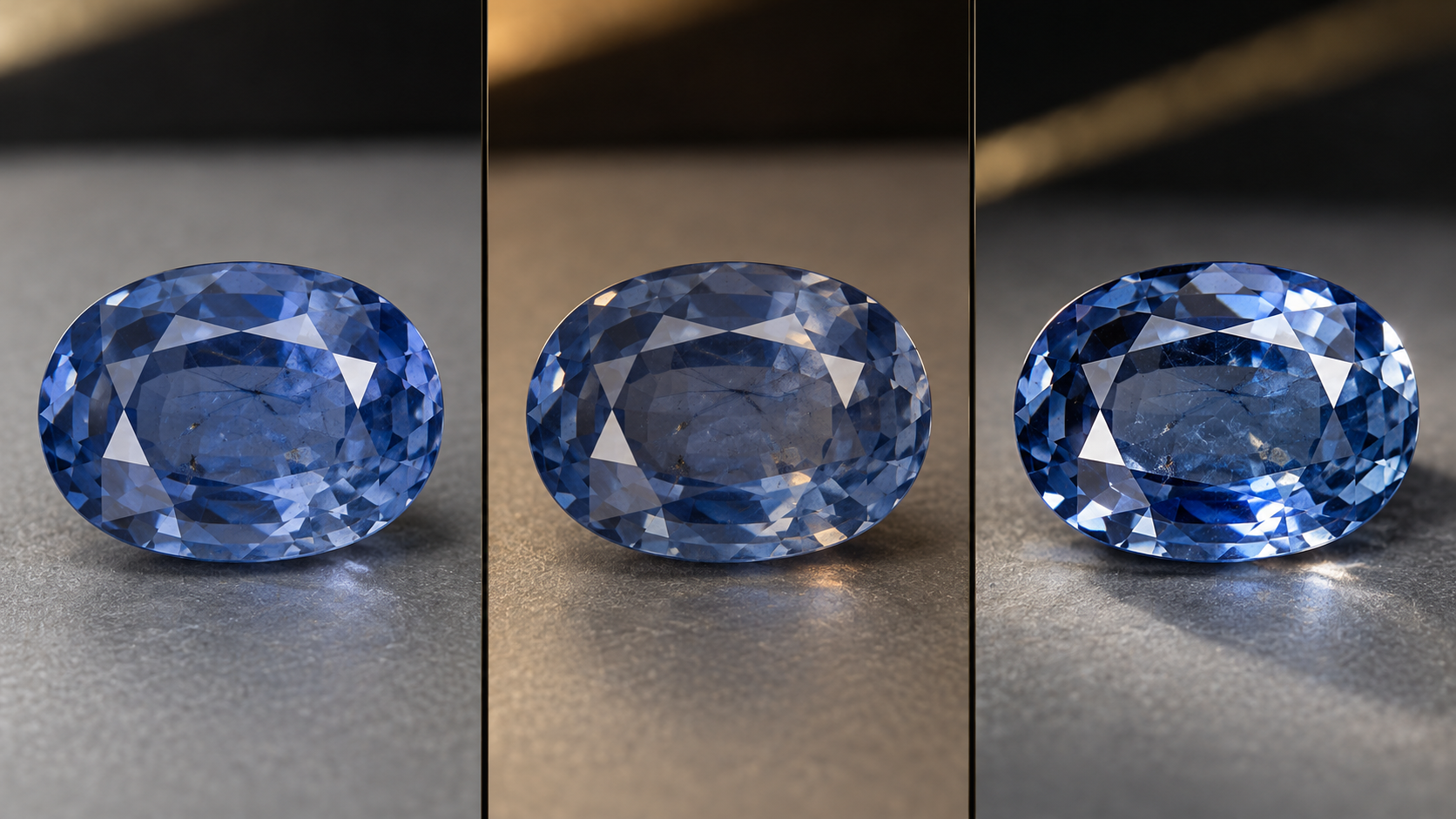
25. A Practical Example: Two Photographs of the Same Sapphire
Consider a hypothetical natural blue sapphire.
The gemstone has:
- A medium-blue body colour
- Moderate to strong saturation
- Good transparency
- Several small natural inclusions
- An oval mixed cut
The first photograph is taken under carefully diffused daylight-equivalent illumination.
The sapphire appears medium blue.
Its colour is relatively even.
The facets are visible without excessive reflections.
The second photograph is taken under concentrated lighting against a dark background.
The sapphire appears more dramatic.
Certain facets produce bright reflections.
Other areas appear darker.
The contrast between light and dark regions becomes stronger.
A buyer might interpret the second photograph as showing a gemstone with greater saturation or optical performance.
However, the gemstone has not changed.
Only the photographic conditions have changed.
This illustrates why several complementary images are more informative than one highly dramatic photograph.
26. How to Evaluate Gemstone Photographs Before Buying
A practical evaluation should begin with the complete product presentation.
Examine the main photograph
Does the gemstone appear clearly focused?
Are its proportions visible?
Is the colour reasonably consistent with the written description?
Examine additional angles
Do the photographs show the gemstone from more than one direction?
Can the pavilion or side profile be evaluated?
Consider the lighting
Does the photograph contain unusually strong reflections?
Could the background be influencing the apparent brightness?
Look for consistency
Does the gemstone appear reasonably consistent across different images?
Some variation is normal.
However, major unexplained differences deserve attention.
Examine the clarity description
Does the seller provide a meaningful description of inclusions or natural characteristics?
A photograph alone may not reveal everything.
Check physical measurements
Do not estimate size solely from image magnification.
Review treatment information
Treatment status should be disclosed separately from photographic appearance.
Consider video evidence
Where available, video can help demonstrate movement-dependent optical characteristics.
Review supporting documentation
For valuable gemstones, appropriate laboratory information may provide additional confidence.
The objective is to evaluate several independent characteristics rather than relying on visual attraction alone.
27. When Should Buyers Request Additional Photographs?
Additional photographs may be useful when a gemstone possesses characteristics that are difficult to evaluate.
Examples include:
A dark sapphire whose transparency is unclear.
An emerald with potentially significant fractures.
A moonstone with a strong directional sheen.
An opal displaying multiple play-of-colour patterns.
A gemstone with noticeable colour zoning.
A faceted stone whose pavilion proportions are not visible.
A collector’s specimen with important crystal surfaces or matrix relationships.
In these circumstances, requesting an additional image under different lighting or from another angle may provide useful information.
However, additional photographs cannot resolve every uncertainty.
If the question concerns gemstone identity, treatment or geographic origin, appropriate gemmological analysis may be necessary.
28. The Difference Between Attractive Photography and Documentary Photography
Gemstone photography can serve different purposes.
Editorial photography
Editorial photographs are designed to attract attention.
They may use dramatic lighting, elegant backgrounds and carefully selected compositions.
These images can communicate beauty effectively.
Documentary photography
Documentary photographs aim to record the gemstone’s characteristics as accurately as practical.
They generally prioritise clarity, consistency and reproducibility.
Scientific photography
Scientific photographs may be designed to document specific features.
These could include inclusions, growth structures or optical phenomena.
The lighting and magnification are selected according to the characteristic being examined.
All three approaches can be legitimate.
However, they should not be confused.
A dramatic editorial photograph is not necessarily the best image for evaluating clarity.
A microscopic image may reveal valuable scientific information but provide little indication of ordinary face-up appearance.
An effective gemstone product presentation can use complementary photographic approaches while maintaining accurate descriptions.
29. Why Transparent Photography Matters in Online Gemstone Commerce
Online gemstone buyers cannot usually examine the physical gemstone before purchasing it.
They depend on information supplied through the product listing.
Photographs are therefore commercially important.
However, the overall presentation should not create a misleading impression.
In the European Union, Directive 2005/29/EC addresses unfair commercial practices.
Its provisions concerning misleading actions and omissions are relevant to how products are presented to consumers.
These rules are not a gemstone-specific photographic standard.
Nevertheless, they establish a broader consumer-protection framework concerning misleading product information and presentation.
For gemstone sellers, responsible practice means avoiding photographic alterations or descriptions that materially misrepresent the product.
The aim should be to help customers understand the gemstone’s actual characteristics.
30. The Natural Gems Belgium Approach to Visual Transparency
Natural Gems Belgium focuses on natural gemstones and individual product descriptions.
For finished faceted gemstones, the NGB grading framework evaluates five characteristics.
| Evaluation category | Maximum score |
|---|---|
| Colour | 20 |
| Clarity | 20 |
| Cut | 20 |
| Optical Performance | 20 |
| Overall Appeal | 20 |
| Total | 100 |
These categories describe different aspects of gemstone quality.
Photographs can help illustrate them.
However, photographs do not independently establish the complete evaluation.
For example, a photograph may demonstrate attractive colour.
It may not accurately reveal every clarity characteristic.
A video may show optical performance during movement.
It may still be influenced by the lighting conditions used during recording.
The purpose of individual grading is to provide an additional structured evaluation of the gemstone.
This is particularly valuable when photographic representation has unavoidable limitations.
The NGB grading score should complement photographs and gemmological descriptions rather than replace them.
31. A More Complete Way to Present Natural Gemstones Online
An informative gemstone listing benefits from several complementary elements.
Accurate product photographs
Images should show the actual gemstone and its principal visual characteristics.
Multiple viewing angles
Additional photographs can help demonstrate shape, proportions and internal features.
Video documentation
Where available, video can illustrate optical behaviour during movement.
Physical measurements
Dimensions provide a more reliable indication of size than photographic magnification.
Gemmological information
Relevant physical and optical properties help establish the material’s identity and characteristics.
Treatment disclosure
Known treatments should be communicated separately from visual appearance.
Individual quality evaluation
A structured grading assessment can help buyers understand the gemstone beyond its photographic presentation.
Natural characteristics
Descriptions of inclusions, growth features and other natural characteristics provide important context.
Together, these elements create a more informative product presentation.
No single photograph needs to communicate every characteristic.
Instead, the different forms of information support one another.
32. Can a Photograph Ever Be Completely Colour Accurate?
The answer depends on what is meant by completely accurate.
Under controlled conditions, digital imaging systems can achieve high levels of colour fidelity.
However, perfect reproduction across every lighting environment, viewing direction and display is not realistically achievable.
Several limitations remain.
The original gemstone may exhibit directional optical behaviour.
The illumination used for photography may differ from the buyer’s lighting.
The camera’s spectral response differs from human vision.
Digital colour encoding has limitations.
The display may not reproduce every recorded colour.
The buyer’s screen may not be calibrated.
Human colour perception also varies with viewing conditions.
Therefore, the practical objective is not absolute reproduction under every possible circumstance.
It is a faithful, consistent and informative representation under clearly understood conditions.
Accurate gemstone photography is an exercise in controlling uncertainty, not eliminating every difference between a photograph and physical observation.
33. What Buyers Should Remember
When evaluating gemstones online, several principles are especially useful.
First: Lighting can influence gemstone colour and apparent brilliance.
Second: A gemstone’s appearance may change with viewing direction.
Third: Digital cameras and computer screens do not reproduce colour identically.
Fourth: Higher resolution does not automatically mean greater colour accuracy.
Fifth: Background selection and image processing can influence the apparent quality of a gemstone.
Sixth: Videos provide additional information but remain subject to photographic limitations.
Seventh: Photographs cannot independently establish every gemmological characteristic.
Eighth: Reliable purchasing decisions should combine visual evidence with accurate descriptions, measurements, treatment information and appropriate documentation.
These principles apply to both inexpensive gemstones and high-value collector material.
Conclusion: Understanding the Difference Between a Gemstone and Its Image
A natural gemstone is a three-dimensional optical object.
A digital photograph is a two-dimensional representation produced under specific conditions.
The relationship between the two is complex.
Lighting influences colour.
Camera position affects facet reflections.
Exposure changes the visibility of details.
White balance influences colour reproduction.
Backgrounds alter contrast.
Digital processing transforms recorded information.
Screens introduce additional differences.
Human vision contributes its own perceptual characteristics.
These factors explain why a gemstone may appear different in photographs and in person without necessarily having been misrepresented.
However, they also explain why responsible photographic practices are essential.
Gemstone photographs should help buyers understand the material.
They should not create characteristics that are absent from the physical gemstone.
The most reliable online presentation combines accurate photographs with meaningful gemmological information.
Multiple viewing angles, video documentation, physical measurements, treatment disclosure and individual quality evaluation all contribute to a more complete understanding.
For buyers, the objective should be to look beyond a single attractive image.
For sellers, the objective should be to communicate the gemstone’s characteristics as faithfully as possible.
Ultimately, gemstone photography is most valuable when it serves the same principle as responsible gemmology:
Observe carefully.
Describe accurately.
Distinguish evidence from interpretation.
And provide enough information for an informed decision.
A beautiful gemstone deserves beautiful photography.
But its description must remain faithful to the natural material itself.
References & Further Reading
The following references are authoritative educational, scientific and standards-based resources. They have been selected for their relevance to gemstone photography, colour science, optical phenomena and responsible product representation.
No commercial gemstone product listings are included.
1. Gemological Institute of America — How to Photograph Gems & Jewelry
Robert Weldon and Denise Conrad.
Published 30 September 2015.
A practical educational reference explaining the importance of lighting, camera positioning, background selection and image processing in gemstone photography.
Particularly relevant to the differences between direct and diffused illumination.
https://www.gia.edu/gem-photography
2. Gemological Institute of America — Colored Gemstone Value Factors
GIA educational publication.
Explains the importance of hue, tone, saturation and colour uniformity when evaluating coloured gemstones.
Also discusses the relationship between gemstone appearance, cutting and commercial value.
3. International Commission on Illumination — Colorimetry, Fourth Edition
CIE 015:2018.
A technical reference covering colour measurement, standard illuminants, standard observers, colour spaces and colour-difference calculations.
Provides the scientific framework for understanding why perceived colour depends on illumination and observation.
https://www.cie.co.at/publications/colorimetry-4th-edition
4. International Commission on Illumination — Standard Illuminants for Colorimetry
ISO/CIE 11664-2:2022.
Defines standard illuminants, including D65 and Illuminant A.
Explains their intended use in colour calculations and standardised colour evaluation.
https://www.cie.co.at/publications/colorimetry-part-2-cie-standard-illuminants-0
5. International Commission on Illumination — Assessing the Spectral Quality of Daylight Simulators
ISO/CIE 23603:2024.
An international standard addressing the suitability of daylight simulators for colour evaluation.
Particularly relevant to understanding why matching colour temperature alone does not guarantee equivalent illumination.
6. International Color Consortium — Display Calibration
ICC technical guidance.
Explains how display calibration and colour profiling work together to improve colour consistency.
Discusses working colour spaces, display characteristics and the limitations of colour reproduction across different devices.
https://www.color.org/displaycalibration
7. International Color Consortium — sRGB Profiles
ICC colour-management reference.
Explains the use of sRGB profiles and their role in digital colour reproduction.
Useful for understanding how colour information is communicated between imaging systems and displays.
https://registry.color.org/rgb-registry/srgbprofiles
8. International Color Consortium — Browser Color Management Test
ICC technical resource.
Provides a method for investigating whether a web browser correctly interprets colour-managed images.
Relevant to differences in gemstone appearance across digital devices.
https://www.color.org/browsertest
9. Gemological Institute of America — Pleochroism and Color Change in Faceted Alexandrite
Karl Schmetzer.
Gems & Gemology, Spring 2019.
A scientific investigation of how crystallographic orientation, cutting and viewing conditions influence the colour appearance of alexandrite.
10. Gemological Institute of America — Optical Effects of Phenomenal Cabochons
GIA educational research.
Explains optical phenomena including adularescence, labradorescence and play-of-colour.
Provides useful scientific context for understanding why certain gemstones are difficult to represent in a single photograph.
https://www.gia.edu/gia-news-research/optical-effects-phenomenal-cabochons
11. Gemological Institute of America — Guide to Phenomenal Gems
GIA research publication, 2026.
An educational overview of optical phenomena in gemstones, including asterism, chatoyancy, adularescence and iridescence.
Particularly useful for understanding the role of microscopic structures and viewing geometry.
https://www.gia.edu/articles/gems-gemology-summary-guide-to-phenomenal-gems
12. European Union — Directive 2005/29/EC on Unfair Commercial Practices
Official European Union legislation.
Establishes the framework addressing misleading commercial practices and omissions of material information.
Relevant to the accurate representation of products offered to consumers.
[…] professionally illuminated tanzanite may appear intensely blue in one photograph and noticeably more violet in […]