Nature is never completely still.
Even when a landscape appears unchanged, countless small transformations are taking place.
A new leaf begins to unfold.
A flower approaches the end of its season.
A tree prepares for winter.
A patch of moss responds to changing moisture.
The movement of the natural world is continuous, yet much of it happens so gradually that we barely notice.
Modern life can make these changes even easier to overlook.
We move between buildings, vehicles and digital environments, often following routines that remain remarkably similar regardless of the season.
But what happens when we deliberately begin paying attention again?
Within contemporary crystal spirituality, Moss Agate is frequently associated with growth, renewal, patience and connection to nature.
Its distinctive appearance makes it particularly appealing to practitioners who enjoy working with the symbolism of landscapes, plants and natural cycles.
These associations are spiritual interpretations rather than scientifically established energetic properties.
Nevertheless, the stone can become the centre of a meaningful contemporary practice.
A seasonal crystal grid.
Not a magical arrangement intended to influence the weather or accelerate plant growth.
Instead, a small contemplative composition designed to encourage observation, appreciation and a more thoughtful relationship with the natural environment.
This article explores how to create such a grid, how to adapt it throughout the year and how to connect the practice with established research on nature connectedness.
Table of Contents
Why Moss Agate?
Many gemstones inspire spiritual interpretations through their colour, appearance or historical associations.
Moss Agate offers a particularly interesting visual connection with the natural world.
Its characteristic patterns can resemble miniature landscapes.
Delicate branches.
Floating vegetation.
Small forests.
Or fragments of a garden preserved within stone.
These appearances are naturally suggestive.
They invite the imagination to recognise familiar forms.
For contemporary crystal practitioners, this has contributed to associations with nature, growth, renewal and the patient development of living things.
Moss Agate is sometimes described in modern spiritual literature as a stone of abundance or new beginnings.
Such descriptions belong to contemporary metaphysical belief systems.
They should not be confused with scientifically demonstrated effects.
There is no established evidence that Moss Agate influences plant growth, alters personal energy or attracts prosperity.
However, a stone whose appearance reminds us of vegetation can serve as an effective personal symbol.
It can encourage a simple question:
What is changing in the natural world around me?
That question becomes the foundation of our seasonal grid.
What Is a Crystal Grid?
Within contemporary crystal spirituality, a crystal grid is an arrangement of stones placed in a deliberate pattern.
Some practitioners create grids around a central gemstone.
Others use several stones arranged in circles, geometric forms or symmetrical compositions.
Different contemporary traditions assign different meanings to these arrangements.
Some describe them as methods of directing spiritual energy.
Others associate them with manifestation, intention setting or meditation.
These energetic interpretations are matters of spiritual belief.
There is no reliable scientific evidence that arranging gemstones in geometric patterns creates a measurable healing field or changes external events through supernatural influence.
Yet crystal grids can also be understood in a simpler way.
They are intentional arrangements of meaningful objects.
Their visual structure provides a focus for contemplation.
Their creation requires attention.
And their repeated use can become part of a personal ritual.
For our Moss Agate practice, the grid represents the relationship between continuity and change.
The central stone remains familiar.
The surrounding arrangement changes with the seasons.
A Different Understanding of Growth
Growth is frequently presented as something that must always move forward.
More progress.
More achievement.
More activity.
More results.
But the natural world offers a more complex picture.
Growth does not occur at the same rate throughout the year.
Some periods are characterised by visible development.
Others involve flowering, fruiting, dispersal or dormancy.
A tree does not produce new leaves continuously.
A meadow does not remain in bloom throughout every season.
Many living organisms respond to changes in temperature, daylight and environmental conditions.
The USA National Phenology Network studies these recurring seasonal events through the scientific discipline known as phenology.
Phenology examines the timing of biological events such as flowering, leaf emergence, fruit development and animal migration.
These observations help researchers understand seasonal patterns and environmental change.
For our contemporary spiritual practice, this offers a valuable metaphor.
Change does not always mean visible growth.
Sometimes a period of apparent stillness is part of a larger natural cycle.
The Moss Agate grid becomes a symbolic reminder that different seasons have different characteristics.
The Importance of Nature Connection
A seasonal crystal grid becomes more meaningful when it encourages genuine attention to the natural world.
Research into nature connectedness provides an interesting foundation.
The University of Derby has investigated how people develop a closer psychological relationship with nature.
Its research identifies five pathways that can strengthen this connection:
Senses, Emotion, Beauty, Meaning and Compassion.
These pathways encourage people to engage with nature through direct sensory experience, emotional appreciation, recognition of beauty, personal meaning and actions that support the natural environment.
The university emphasises that developing a meaningful relationship with nature is not simply a matter of spending more time outdoors.
The quality of attention matters.
A person may walk through a park every day without noticing the changing plants.
Another person may spend five minutes observing a tree outside a window and become deeply interested in its seasonal development.
This distinction is important.
The goal of our crystal grid is not to replace nature with a collection of stones.
It is to encourage us to notice nature more carefully.
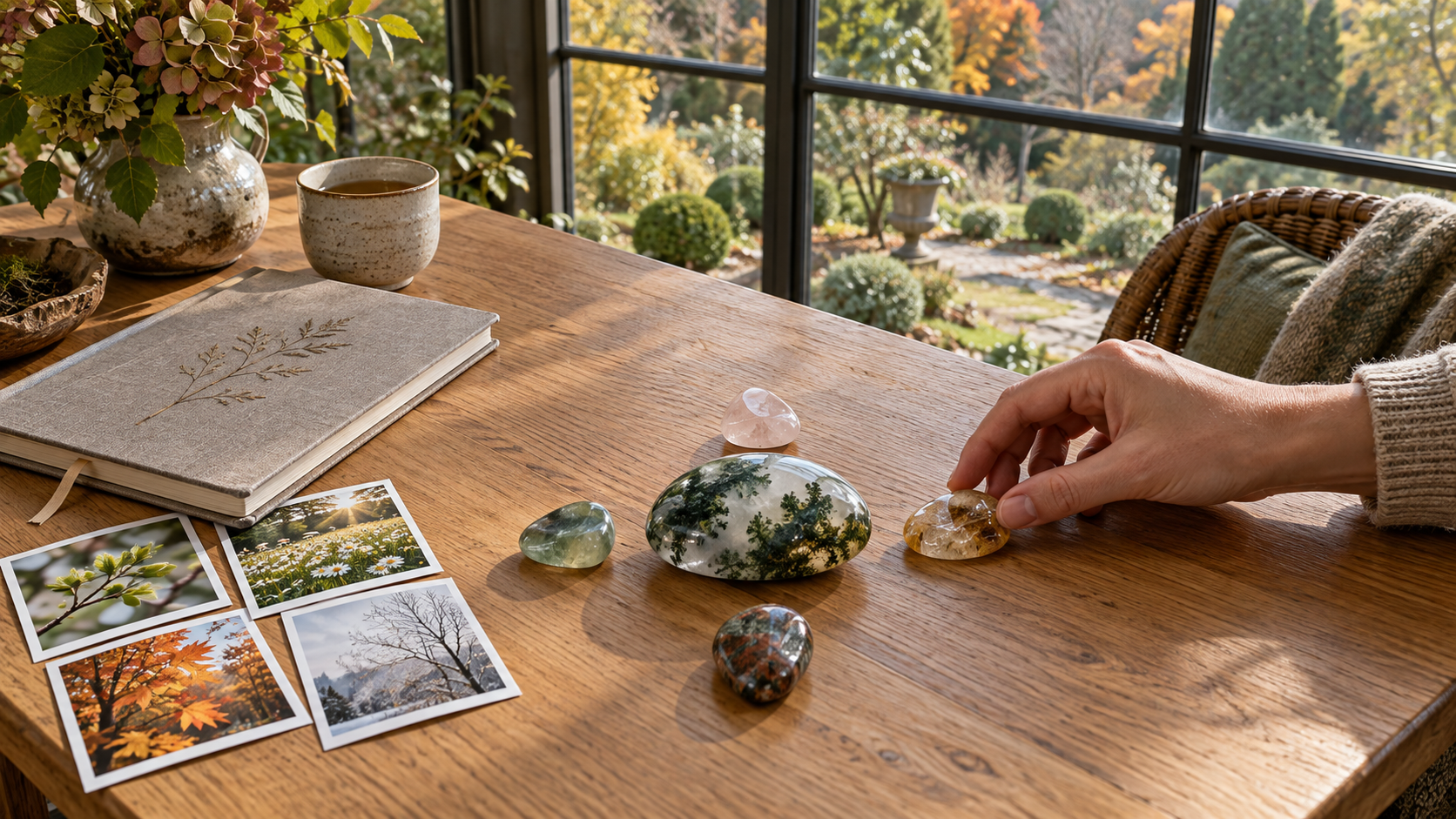
Creating a Seasonal Nature Grid
The basic arrangement is deliberately simple.
You will need one Moss Agate stone.
This becomes the centre of the composition.
You may also use four smaller stones, representing the four seasons.
These can be small polished gemstones or ordinary stones already in your collection.
There is no requirement to purchase additional crystals.
Choose a stable surface where the arrangement can remain undisturbed.
A small wooden table.
A shelf.
A natural-stone tray.
Or a dedicated space beside a window.
Avoid placing the grid where it might fall, obstruct movement or become accessible to young children or pets who could swallow small stones.
The arrangement should be comfortable to observe.
It does not need to resemble an elaborate ceremonial altar.
Its simplicity is part of the practice.
The Central Stone: Continuity
Place the Moss Agate in the centre.
Look at its natural patterns.
Notice the shapes that remind you of vegetation or landscapes.
Now consider the idea of continuity.
The seasons change.
Plants grow and decline.
Weather patterns shift.
But the natural world continues through these transformations.
For this contemporary exercise, the Moss Agate represents that continuity.
It does not symbolise a supernatural force.
It represents a relationship we wish to develop.
The intention to remain attentive to nature throughout the year.
The stone remains in the same position as the surrounding arrangement changes.
The Four Directions of the Grid
Place four smaller stones around the central Moss Agate.
One above.
One to the right.
One below.
One to the left.
Together, they create a simple cross-shaped arrangement.
For this modern ritual, each position represents a season.
The arrangement is symbolic.
It is not based on a historically documented universal system of crystal-grid directions.
Nor does it claim to reproduce an ancient religious ceremony.
Its purpose is to provide a clear visual structure for reflection.
The four positions can be associated with spring, summer, autumn and winter.
As the year progresses, your attention moves from one position to another.
The central Moss Agate remains unchanged.
Spring: The Season of Emergence
Spring is often associated with renewal.
But rather than treating this as a vague spiritual concept, consider what actually happens around you.
New leaves appear.
Some plants begin flowering.
Bird activity changes.
Gardens gradually develop new colours.
These events vary according to region, climate and species.
The USA National Phenology Network emphasises the importance of observing specific biological events rather than assuming that every organism follows the same seasonal schedule.
For the spring position of your grid, choose a small stone that personally reminds you of emergence.
A pale green stone may feel appropriate.
But the colour is not essential.
The symbolic question is more important:
What new development have I noticed in nature?
Perhaps the first leaves on a familiar tree.
A flower appearing in a garden.
Or a change in the behaviour of local birds.
Spend a few moments recalling the observation.
Then return your attention to the grid.
The stone becomes a reminder of something you genuinely witnessed.
Summer: The Season of Activity
Summer often brings more visible biological activity.
Gardens may contain flowering plants.
Insects become particularly noticeable.
Trees provide extensive foliage.
The natural world can appear abundant.
But abundance should not be understood only as quantity.
It can also involve relationships.
Flowers and pollinators.
Plants and sunlight.
Animals and their habitats.
For the summer position, choose a stone that reminds you of vitality or activity.
Then ask:
What relationships within nature have I noticed?
Perhaps you observed a bee visiting flowers.
Birds using a garden hedge.
Or plants responding to changing weather.
The purpose is not to create a romanticised image of nature.
It is to recognise that living environments contain many interacting organisms.
Your grid becomes a small reminder of those relationships.
Autumn: The Season of Transformation
Autumn offers a particularly interesting subject for reflection.
Leaves change colour.
Some plants release seeds.
Certain animals prepare for colder conditions.
Other species begin migration.
The landscape changes visibly.
But these changes should not automatically be interpreted as decline.
Many autumn events are essential parts of natural life cycles.
A tree losing its leaves is not necessarily failing.
It may be responding normally to seasonal conditions.
For the autumn position of your grid, choose a stone that reminds you of transformation.
Perhaps one with warm brown, yellow or orange tones.
Then consider:
What natural change have I observed recently?
Look beyond the obvious.
Perhaps a familiar tree has begun losing its leaves.
Perhaps fewer flowers remain in the garden.
Perhaps the light reaches a different part of your room.
Record one observation.
The exercise encourages attention to the present season rather than abstract ideas about what autumn is supposed to mean.
Winter: The Season of Quiet Observation
Winter is often described in spiritual literature as a period of rest and introspection.
That symbolism can be meaningful.
But the natural world remains active in many ways.
Some animals continue feeding and moving.
Evergreen plants retain their foliage.
Buds may already be present on certain trees.
Other organisms remain less visible.
For the winter position, choose a stone that represents quiet attention.
It might be pale.
Dark.
Or simply a stone you find visually peaceful.
Then ask:
What continues in nature even when little appears to be happening?
Look carefully.
Perhaps you notice the structure of bare branches.
A bird visiting the same location.
A change in frost patterns.
Or the gradual lengthening of daylight after the winter solstice.
Winter observation can reveal details that are hidden during other seasons.
The practice becomes less about waiting for spring and more about appreciating the present environment.
The First Seasonal Grid Ritual
Once the stones are arranged, sit comfortably beside the grid.
Allow approximately ten minutes.
Begin by looking at the central Moss Agate.
Notice its patterns without attempting to interpret them as supernatural messages.
Then direct your attention toward the stone representing the current season.
Consider one natural change you have recently observed.
It may be something very small.
A different bird call.
A new flower.
A change in the colour of leaves.
A shift in daylight.
Now ask:
What did I actually observe?
This question is important.
It separates direct observation from interpretation.
For example:
Observation:
The leaves on the tree outside my window have begun changing colour.
Interpretation:
Autumn reminds me that change is unavoidable.
Both statements can be meaningful.
But they are different.
The first describes the natural world.
The second describes your personal response.
A thoughtful ritual makes room for both.
The Five Pathways to Nature Connection
The University of Derby’s research provides a particularly useful framework for expanding this practice.
Its five pathways can be incorporated into the grid without introducing unsupported supernatural claims.
Senses
Choose one natural detail you can experience directly.
The sound of rain.
The texture of tree bark.
The smell of a garden after rainfall.
The appearance of clouds.
Allow yourself to notice it carefully.
Emotion
Consider how the observation makes you feel.
Perhaps peaceful.
Curious.
Surprised.
Or simply interested.
There is no required emotional response.
Beauty
Identify one detail you find beautiful.
It might be a flower.
A leaf.
The shape of a branch.
Or the way light falls across a familiar landscape.
Beauty does not require dramatic scenery.
Meaning
Ask whether the observation connects with something personally significant.
Perhaps a memory.
A season you particularly enjoy.
Or an appreciation of continuity and change.
Compassion
Finally, consider whether there is a small action you could take to care for the natural environment.
This last pathway is particularly important.
A relationship with nature should not be limited to enjoying its appearance.
It can also involve responsibility.
From Crystal Ritual to Environmental Care
Contemporary crystal spirituality frequently speaks about connecting with the Earth.
But what does that connection mean in practical terms?
It may be expressed through ordinary actions.
Respecting wildlife.
Avoiding unnecessary disturbance.
Protecting plants.
Reducing litter.
Supporting suitable habitats.
The United States National Park Service promotes the Leave No Trace principles, which encourage people to minimise their impact on natural environments.
One particularly relevant principle is:
Leave What You Find.
The National Park Service explains that rocks, plants, shells and other natural objects often play important roles in their environments.
Removing them can damage habitats or reduce the experience available to future visitors.
This is especially important for crystal practitioners.
A meaningful relationship with nature does not require collecting every beautiful object encountered outdoors.
Sometimes appreciation means leaving something exactly where it belongs.
For your seasonal grid, use stones you already own.
If you wish to include natural decorations, consider photographs or drawings rather than removing living plants, moss, protected materials or objects from public natural areas.
The ritual should encourage care rather than unnecessary collection.
A Grid That Changes Without Collecting Nature
A seasonal grid does not need to become a growing collection of objects.
Instead, change its visual presentation through observation.
In spring, place a small photograph of emerging leaves beside the arrangement.
In summer, add a photograph of a flower or insect you observed.
In autumn, use a drawing of a changing tree.
In winter, add a photograph of bare branches or a frosty landscape.
The photographs can be your own.
They do not need to be professionally composed.
Their purpose is to document something you noticed.
This approach creates a personal seasonal record without disturbing the environment.
Over time, the grid becomes connected with real places and experiences.
Not merely with abstract spiritual meanings.
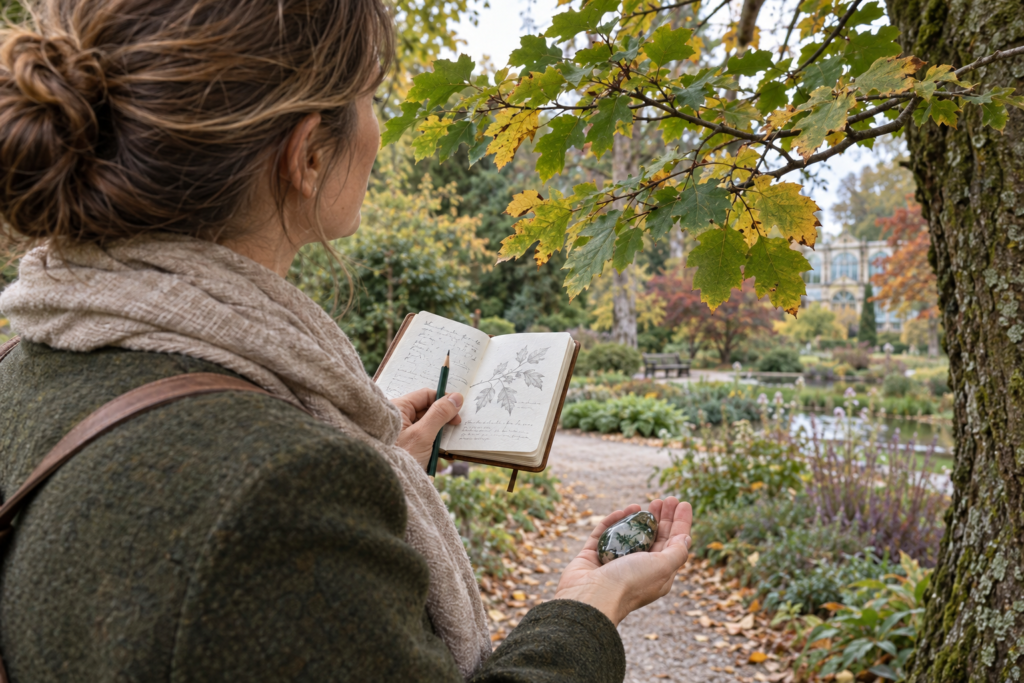
The Role of Nature Journaling
The Natural History Museum in London encourages people to observe and record wildlife in their local environments.
Its Nature Recording Hub provides educational resources for documenting wildlife in urban spaces and participating in biodiversity monitoring.
This offers an interesting extension of the crystal-grid practice.
Keep a small notebook beside the arrangement.
Each week, record three observations.
What changed?
What remained the same?
What would I like to observe next?
The answers do not need to be complicated.
For example:
The tree outside my window has fewer leaves than last week.
The same birds continue visiting the garden.
Next week, I want to observe whether the remaining leaves have changed colour.
This simple exercise develops attention over time.
It also creates a record of the natural environment that can be revisited in later seasons.
Understanding Seasonal Change Through Phenology
The scientific study of phenology provides a useful way to make nature observation more precise.
The USA National Phenology Network defines phenology as the study of recurring plant and animal life-cycle stages and their timing.
These events include leaf emergence, flowering, fruit development and animal migration.
Scientists use observations of these events to investigate relationships between organisms and environmental conditions.
For the Moss Agate grid, we do not need to conduct formal scientific research.
But we can borrow one important principle:
Observe the same natural subject repeatedly.
Choose a tree near your home.
A plant on your balcony.
Or a small area of garden.
Observe it once a week.
Notice what changes.
Over time, the observations become more meaningful because they are connected.
Instead of remembering one beautiful autumn leaf, you begin understanding how the tree changes across an entire year.
The grid becomes a visual reminder to continue observing.
Does Nature Connection Influence Wellbeing?
Research suggests that a stronger psychological connection with nature is associated with aspects of subjective wellbeing.
A meta-analysis published in Frontiers in Psychology examined research involving 8,523 participants across 30 samples.
The researchers identified a small but statistically significant positive association between nature connectedness and happiness-related measures.
The findings concerned people’s perceived relationship with nature.
They did not investigate gemstones or crystal grids.
They also do not establish that every nature-based activity produces the same psychological effect.
Nevertheless, the research supports the broader idea that our relationship with the natural environment may be relevant to wellbeing.
The University of California, Berkeley’s Greater Good Science Center also provides a practice called Noticing Nature.
It encourages people to pay attention to natural objects and experiences during everyday life.
The exercise includes observing natural details and recording experiences that evoke a meaningful response.
Our Moss Agate grid can serve as a personal reminder to engage in similar observation.
But the psychological evidence concerns nature connection and attention.
It does not demonstrate that Moss Agate itself produces therapeutic benefits.
The Difference Between Symbolic Growth and Biological Growth
Modern spiritual descriptions sometimes associate Moss Agate with fertility, plant development or the energetic support of gardens.
These are metaphysical beliefs.
They should not be confused with established biological processes.
Plants depend on environmental conditions such as light, water, nutrients and suitable growing conditions.
There is no reliable scientific evidence that placing Moss Agate beside a plant accelerates its growth.
Likewise, there is no established evidence that a crystal grid changes the biological timing of seasonal events.
For this practice, the stone represents growth symbolically.
It encourages us to notice development rather than claiming to cause it.
This distinction is important.
The natural world does not need gemstones to follow its cycles.
But a gemstone can become a personal reminder to pay attention to those cycles.
The Centre Stone as a Personal Anchor
Why place Moss Agate at the centre?
Within contemporary crystal-grid traditions, the central stone is often described as the focus of an intention.
Some practitioners refer to it as an energetic centre.
That interpretation belongs to modern spiritual belief.
In our practice, the central position has a simpler purpose.
It creates visual continuity.
The surrounding seasonal elements change.
The central stone remains familiar.
This makes the grid easy to recognise and revisit.
The Moss Agate becomes associated with a recurring question:
What is nature showing me today?
The answer changes throughout the year.
The question remains.
A Monthly Renewal Ritual
At the beginning of each month, spend approximately fifteen minutes reviewing the grid.
Clean the surrounding surface carefully.
Return the stones to their positions.
Look at the seasonal photographs or drawings you have collected.
Then review your nature journal.
Ask:
What changed during the past month?
Which observation surprised me?
What did I overlook?
What would I like to notice more carefully next month?
Choose one subject for continued observation.
Perhaps a particular tree.
A garden plant.
The birds visiting your neighbourhood.
Or the changing appearance of the sky.
Then return the Moss Agate to the centre.
The ritual is complete.
There is no need to cleanse the stone with smoke, salt or water as part of this exercise.
If you wish to care for the object physically, follow appropriate cleaning guidance for the particular stone and any treatments or jewellery settings.
The meaningful renewal concerns your attention, not an assumed energetic transformation of the gemstone.
Can the Grid Be Used in a Small Apartment?
Absolutely.
A relationship with nature does not require access to a large garden.
The University of Derby’s research emphasises that meaningful nature connection can develop through attention to ordinary natural experiences.
A windowsill may provide a view of changing daylight.
A balcony may contain a plant.
A nearby street may have several trees.
Clouds can be observed from almost anywhere with a view of the sky.
Even a small indoor plant can provide an opportunity to notice development over time.
Choose a suitable location for the grid.
Keep it simple.
The purpose is not to create an elaborate display.
It is to establish a connection between the arrangement and something you can genuinely observe.
What if the Seasons Are Not Clearly Defined?
Not every region experiences four strongly contrasting seasons.
Some climates are characterised more clearly by wet and dry periods.
Others have relatively subtle seasonal temperature changes.
The four-season arrangement is therefore a practical model rather than a universal description of nature.
Adapt it to your local environment.
If your region has a wet season and a dry season, you might create a two-part arrangement.
If seasonal changes are subtle, focus on recurring biological events.
Flowering.
Rainfall.
Bird activity.
Plant development.
The symbolism should follow the environment you actually experience.
It should not force the natural world into a pattern that does not fit.
A Grid for Families and Children
The seasonal nature grid can also become a shared activity.
Children may enjoy selecting a stone for each season.
They can draw plants they have observed.
Take photographs of a familiar tree.
Or record changes in a small notebook.
The activity should remain educational and age-appropriate.
Young children should not handle small stones without suitable supervision because of choking risks.
The emphasis should remain on observation rather than supernatural claims.
For example, ask:
What changed in the garden this week?
Which colours can you see outside?
What animals have you noticed?
Why should we leave wild plants where they are growing?
These questions encourage curiosity and respect for nature.
The gemstone arrangement simply provides an engaging visual centre.
When a Spiritual Practice Becomes an Ecological Commitment
There is an important difference between appreciating nature and caring for it.
A person may admire a beautiful landscape while remaining unaware of the pressures affecting its ecosystems.
A deeper relationship involves learning.
Recognising local species.
Understanding seasonal patterns.
Respecting habitats.
And considering how everyday actions affect the environment.
The University of Derby includes compassion toward nature among its five pathways to nature connectedness.
This is a particularly valuable principle for contemporary crystal spirituality.
A practice that celebrates the Earth should also encourage responsibility toward it.
For the Moss Agate grid, consider choosing one small environmental action each season.
It might involve reducing unnecessary waste.
Supporting suitable native plants in a garden.
Participating in a local conservation activity.
Or learning more about the wildlife in your neighbourhood.
The action should be appropriate to your circumstances.
The grid becomes a reminder that spiritual appreciation and practical care can support one another.
A Stone That Reminds Us to Look Outside
A crystal grid can be visually beautiful.
The arrangement of stones.
The symmetry.
The natural colours.
The changing photographs.
But the most important part of this particular practice is not the arrangement itself.
It is what happens afterwards.
You notice the tree outside your home.
You recognise that a familiar plant has begun flowering.
You become curious about a bird you have seen repeatedly.
You observe how daylight changes across your living space.
And perhaps you begin to understand your local environment more carefully.
The Moss Agate has not altered nature.
It has become part of a personal routine that encourages you to pay attention.
That is a meaningful distinction.
The Deeper Symbolism of Renewal
Renewal is often imagined as a dramatic transformation.
A new beginning.
A complete change.
A sudden improvement.
But natural renewal is frequently gradual.
A bud develops.
A leaf unfolds.
A plant responds to the conditions around it.
Seasonal change rarely follows a single simple pattern.
Some changes are rapid.
Others take months.
Still others become visible only when we compare observations over several years.
The Moss Agate grid invites a similar understanding of personal reflection.
Not every period needs to produce visible progress.
Not every season needs to feel productive.
Sometimes the most meaningful development is simply becoming more attentive.
More curious.
More patient.
And more aware of the environment we share with other living things.
These are contemporary symbolic interpretations, not scientifically established effects of Moss Agate.
But they can provide thoughtful subjects for personal contemplation.
A Seasonal Ritual That Continues Throughout the Year
The beauty of this practice lies in its continuity.
You do not need to recreate the entire grid every week.
The central Moss Agate remains.
The surrounding seasonal arrangement changes when appropriate.
Your photographs and observations accumulate.
Your understanding of the local environment gradually develops.
After one year, you may have a small collection of seasonal notes.
After two years, you may begin noticing differences between them.
Perhaps a tree flowered earlier.
Perhaps the autumn colours appeared later.
Perhaps you noticed a species you had never observed before.
The grid becomes associated with a continuing relationship.
Not with supernatural control over natural processes.
But with a commitment to observe and appreciate them.
The Meaning of Moss Agate in a Changing World
Moss Agate’s association with growth and nature belongs largely to contemporary crystal spirituality.
Its appearance invites comparisons with vegetation and landscapes.
Those comparisons can inspire meaningful personal symbolism.
But the deeper value of a seasonal grid does not depend on believing that gemstones transmit invisible energies.
It depends on what the practice encourages us to do.
Look more carefully.
Recognise change.
Appreciate natural beauty.
Understand seasonal patterns.
And act with greater consideration toward the environment.
The research discussed in this article concerns nature connectedness, environmental observation and wellbeing.
It does not demonstrate that Moss Agate or crystal grids possess therapeutic powers.
Yet the symbolic practice can still have personal meaning.
A small stone can remind us of a larger world.
A simple arrangement can encourage a recurring moment of attention.
And a familiar window can become a place from which we begin noticing the extraordinary complexity of ordinary nature.
The grid remains indoors.
The living world continues outside.
The purpose is to strengthen the relationship between them.
One observation.
One season.
One small act of care at a time.
References & Further Reading
1. University of Derby — New Guide Shows the Pathways to a Stronger Connection With Nature
Institution: University of Derby
Published: 2021
An authoritative university resource discussing research into nature connectedness and the five pathways that can strengthen people’s relationship with the natural world.
The five pathways are Senses, Beauty, Emotion, Meaning and Compassion.
This research provides the principal conceptual foundation for the seasonal Moss Agate grid.
https://www.derby.ac.uk/news/2021/new-guide-shows-the-pathways-to-a-stronger-connection-with-nature
2. University of California, Berkeley — Noticing Nature
Institution: Greater Good Science Center
Resource: Greater Good in Action
A research-informed educational practice encouraging people to pay attention to natural objects, observe their emotional responses and record meaningful encounters with nature.
The exercise supports the article’s emphasis on deliberate nature observation rather than supernatural gemstone effects.
https://ggia.berkeley.edu/practice/noticing_nature
3. USA National Phenology Network — Why Phenology?
Institution: USA National Phenology Network
An educational introduction to phenology, the scientific study of recurring seasonal biological events.
The resource explains how observing leaf emergence, flowering, fruit development and animal activity can help researchers understand seasonal patterns and environmental change.
It provides the scientific foundation for the article’s seasonal observation exercises.
https://nps.usanpn.org/about/phenology
4. Natural History Museum, London — Nature Recording Hub
Institution: Natural History Museum, London
An educational resource explaining how members of the public can observe and record wildlife in urban environments.
The museum provides guidance on biodiversity monitoring, local wildlife observations and participation in scientific recording programmes.
This source supports the article’s nature-journaling and environmental observation recommendations.
https://www.nhm.ac.uk/take-part/monitor-and-encourage-nature/nature-recording-hub.html
5. United States National Park Service — Leave What You Find
Institution: U.S. National Park Service
Resource: Leave No Trace Educational Series
An authoritative environmental education article explaining why natural objects should generally remain undisturbed in their original environments.
The resource discusses the ecological and cultural importance of leaving rocks, plants, fossils and other natural materials where they belong.
It provides the ethical foundation for the article’s recommendation to use existing stones, photographs and drawings rather than collecting materials from protected natural areas.
https://www.nps.gov/articles/000/idkt_lnt4.htm
6. Capaldi, Passmore, Nisbet, Zelenski & Dopko (2014) — The Relationship Between Nature Connectedness and Happiness: A Meta-Analysis
Journal: Frontiers in Psychology
Volume: 5
Article: 976
A peer-reviewed meta-analysis examining the relationship between subjective nature connectedness and happiness-related outcomes.
The research analysed 30 samples involving 8,523 participants and identified a small positive association between nature connectedness and measures of subjective wellbeing.
The findings concern psychological relationships with nature, not gemstones or crystal grids.
https://doi.org/10.3389/fpsyg.2014.00976
7. Natural History Museum, London — Survey Calendar for Beginners
Institution: Natural History Museum, London
An educational guide to seasonal wildlife observation and beginner-friendly biodiversity surveys.
The resource organises opportunities to observe nature throughout the year and provides practical suggestions for recording plants and animals.
It supports the article’s recommendation to revisit the same natural environment during different seasons.
The associations between Moss Agate, growth, renewal and nature connection are contemporary spiritual interpretations. They are not scientifically established energetic or therapeutic properties.
The seasonal crystal grid described in this article is an original contemporary contemplative exercise. It is not presented as an ancient ceremony or a historically documented universal spiritual tradition.
Research concerning nature connectedness, mindfulness and environmental observation does not demonstrate that Moss Agate or crystal grids produce additional psychological or medical benefits.
Gemstones and spiritual practices should not replace appropriate professional healthcare or evidence-based treatment. Nature-based activities should be conducted safely and with respect for local environmental regulations and protected habitats.