

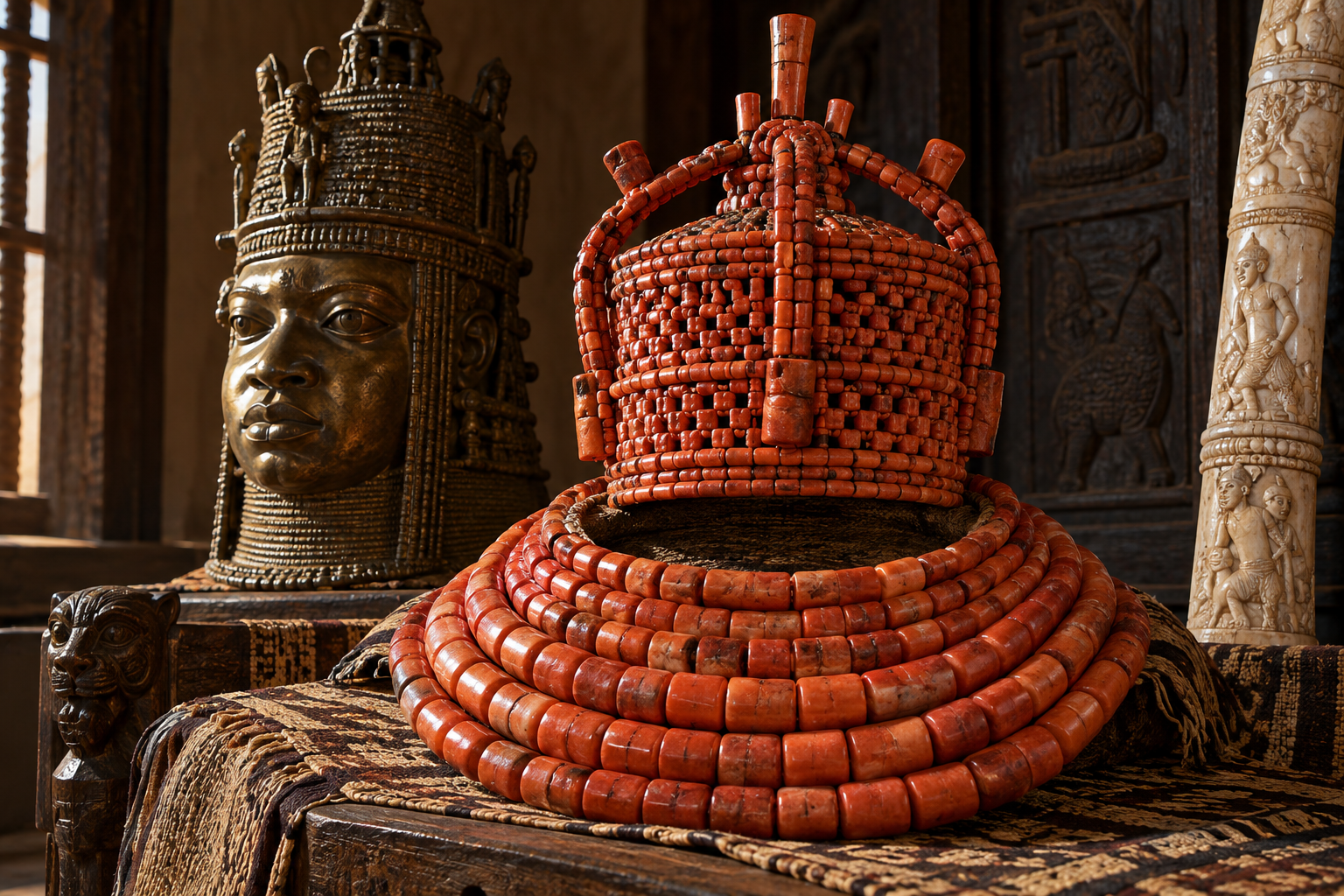
Imagine a ruler whose authority is expressed not through a golden crown but through thousands of carefully arranged red coral beads.
They surround his neck.
They cover his head.
They form elaborate ceremonial garments.
They distinguish him from everyone standing nearby.
The material comes from the sea, yet the ruler presides over a powerful inland kingdom.
Its colour is striking.
Its rarity communicates wealth.
Its distribution reflects political authority.
And its marine origins connect it with a spiritual world associated with water, prosperity and divine power.
This was the extraordinary role of coral in the historic Kingdom of Benin, centred on present-day Benin City in southern Nigeria.
For the Edo people, coral became one of the most recognisable materials associated with the Oba, the kingdom’s ruler.
But its significance extended far beyond decoration.
Coral participated in a sophisticated system connecting political authority, religious belief, ancestral relationships, international trade and ceremonial life.
Unlike many modern descriptions of gemstones, which assign a fixed spiritual meaning to each material, Benin’s coral traditions demonstrate something more complex.
The significance of a precious material can depend upon who possesses it, who has the authority to distribute it, where it originated and how it participates in ritual life.
To understand the spiritual meaning of coral in the Kingdom of Benin, we must therefore begin not with a modern crystal-healing chart but with the kingdom itself.
Table of Contents
The Kingdom of Benin: A Centre of Art, Authority and Religion
The historic Kingdom of Benin developed in the region now known as Edo State, Nigeria.
It should not be confused with the modern Republic of Benin, a separate country to the west.
The kingdom became one of West Africa’s most important political and artistic centres.
Its rulers, known as obas, presided over a highly organised court supported by titled officials, specialised craft guilds and elaborate ceremonial institutions.
Benin became internationally renowned for its exceptional metalwork, ivory carving and other court arts.
Cast-brass commemorative heads, sculptural plaques and ceremonial ornaments preserve remarkably detailed representations of royal life.
These objects are particularly important because they document how political authority was made visible.
The ruler’s body became a carefully constructed expression of kingship.
And coral played a central role in that transformation.
Coral Was Not Simply Jewellery
In many contemporary jewellery markets, coral is classified primarily according to its physical appearance.
Colour.
Size.
Shape.
Surface quality.
Natural characteristics.
Treatment.
Origin.
These are useful gemmological categories.
But they cannot explain the role coral played in Benin’s royal court.
The Metropolitan Museum of Art explains that coral beads imported from the Mediterranean became important commodities in European trade with Benin from the late fifteenth century onward.
Coral and red stone beads entering the kingdom were treated as royal property.
The Oba controlled their distribution.
This arrangement transformed coral into something more than a luxury commodity.
It became a visible expression of political relationships.
The Right to Wear Coral
One of the most remarkable features of Benin’s coral traditions was the relationship between adornment and authority.
According to The Metropolitan Museum of Art, the Oba possessed the exclusive right to wear a complete costume of coral beadwork.
Such an ensemble could include:
A crown.
Elaborate necklaces.
A high collar.
Beaded garments.
And even beaded footwear.
Other court officials could also wear coral, but the extent and form of their adornment reflected their status and relationship with the ruler.
Coral therefore communicated hierarchy.
A person wearing particular forms of coral regalia was not simply displaying personal wealth.
The jewellery could identify an officially recognised position within the political order.
A Gift from the King Was More Than a Gift
The Smithsonian Institution’s National Museum of African Art explains that coral beads could be bestowed by the Oba as emblems of rank and office.
This is an important distinction.
A coral bead acquired through royal permission was not equivalent to an ordinary decorative bead.
Its significance included the authority of the person who granted it.
The object could become evidence of a recognised relationship with the court.
In this context, the value of coral was not limited to the material itself.
The bead also represented permission.
Recognition.
Rank.
And proximity to power.
Why Did Coral Become So Important?
Several factors contributed to coral’s exceptional status.
Its striking colour made it visually distinctive.
Its marine origin connected it with religious symbolism.
Its importation required participation in international trade.
Its relative rarity made it desirable.
And royal control over its distribution reinforced political hierarchy.
These factors operated together.
It would therefore be misleading to identify one supposedly universal spiritual property of coral and use it to explain the entire tradition.
The material’s importance emerged from the interaction of economy, religion and political authority.
What Is Coral?
Coral is an organic gem material produced by marine animals.
Corals belong to the phylum Cnidaria, which also includes jellyfish and sea anemones.
Many corals live as colonies of small organisms called polyps.
Certain species produce hard skeletal structures containing calcium carbonate.
Over time, these structures can become substantial.
The red and pink coral traditionally used in fine jewellery commonly comes from precious-coral groups such as Corallium and related taxa.
Their skeletons are composed predominantly of calcium carbonate, commonly in the mineral form calcite.
This is an important distinction from many reef-building stony corals, whose skeletons are principally aragonite.
Both calcite and aragonite have the chemical composition:
CaCO₃
But they possess different crystal structures.
Coral is therefore not a conventional crystalline gemstone in the same sense as sapphire or garnet.
It is a biologically produced material.
The Colour of Precious Coral
Natural precious coral occurs in several colours.
Red.
Pink.
Orange-red.
Pale pink.
White.
And intermediate shades.
Its colour can depend on organic pigments and the biological characteristics of the coral.
Fine red coral became particularly desirable in many historical jewellery traditions.
However, not every red bead is necessarily coral.
Glass, dyed organic materials and other substances can resemble natural coral.
The Gemological Institute of America documents the identification of coral imitations and treated materials.
Consequently, historic descriptions of red beads should not automatically be interpreted as proof of a particular coral species unless the material has been reliably identified.
This distinction is especially important when studying museum collections.
Coral Came from the Sea
The marine origin of coral is central to understanding its significance in Benin.
The kingdom’s political centre was inland.
Yet the Oba’s ceremonial regalia prominently displayed material originating from the marine environment.
This relationship was not merely geographical.
The sea occupied an important place within Edo religious thought.
And one of the most significant figures associated with it was Olokun.
Olokun: The Spiritual Significance of the Sea
Olokun is a deity associated with the sea and its wealth within Edo religious traditions.
The Metropolitan Museum of Art describes Olokun as the spiritual counterpart of the Oba.
The museum’s exhibition The Regal Body explains that coral’s marine origins connected it with Olokun and the prosperity associated with the sea.
This provides a historically specific explanation for the spiritual importance of coral.
The material came from a realm associated with a powerful deity.
Its presence on the ruler’s body helped express a relationship between earthly kingship and the spiritual domain of the sea.
Olokun Is Not a Universal African Deity
It is important to distinguish the Edo traditions discussed here from other West African religious systems.
Olokun also appears in Yoruba religious contexts and in traditions shaped by the African diaspora.
However, interpretations, relationships and ritual practices are not necessarily identical.
The Kingdom of Benin possessed its own historical institutions and religious traditions.
The coral symbolism discussed in this article concerns primarily the Edo court of Benin.
It should not automatically be applied to every community that recognises a deity called Olokun.
Cultural specificity is essential.
The Sea as a Source of Wealth
The sea was associated with resources that could transform political power.
Trade brought valuable materials into the kingdom.
Among these were coral and other prestigious imported goods.
The sea therefore possessed both practical and spiritual significance.
Its importance was not abstract.
International commerce could strengthen the kingdom.
Imported materials could reinforce royal prestige.
Religious symbolism could connect that prosperity with Olokun.
These relationships helped make coral an unusually powerful material.
Oba Ewuare and the Development of Royal Coral Regalia
The Metropolitan Museum of Art identifies Oba Ewuare, who ruled approximately 1440–1473, as an important figure in the development of Benin’s royal ceremonial traditions.
According to the museum, he likely established annual palace rituals associated with renewing the spiritual powers of kingship.
The museum also attributes the introduction of vibrant Mediterranean coral beads into courtly adornment to his reign.
These historical attributions should be understood within the evidence and traditions used by scholars.
They do not mean that every subsequent detail of coral regalia originated at one identifiable moment.
Nevertheless, Ewuare occupies an important place in accounts of Benin’s royal institutions.
International Trade and Local Meaning
Coral imported from the Mediterranean reached West Africa through long-distance commercial networks.
European merchants played an important role in supplying coral to Benin from the late fifteenth century.
But the fact that a material arrived through European trade does not mean that Europeans determined its cultural meaning.
Benin’s rulers and court institutions incorporated imported coral into an existing system of authority and religious thought.
The material became part of a specifically Edo visual language.
This distinction matters.
Trade explains how an object travelled.
It does not, by itself, explain what the receiving society made of it.
From Commodity to Royal Symbol
Consider the transformation.
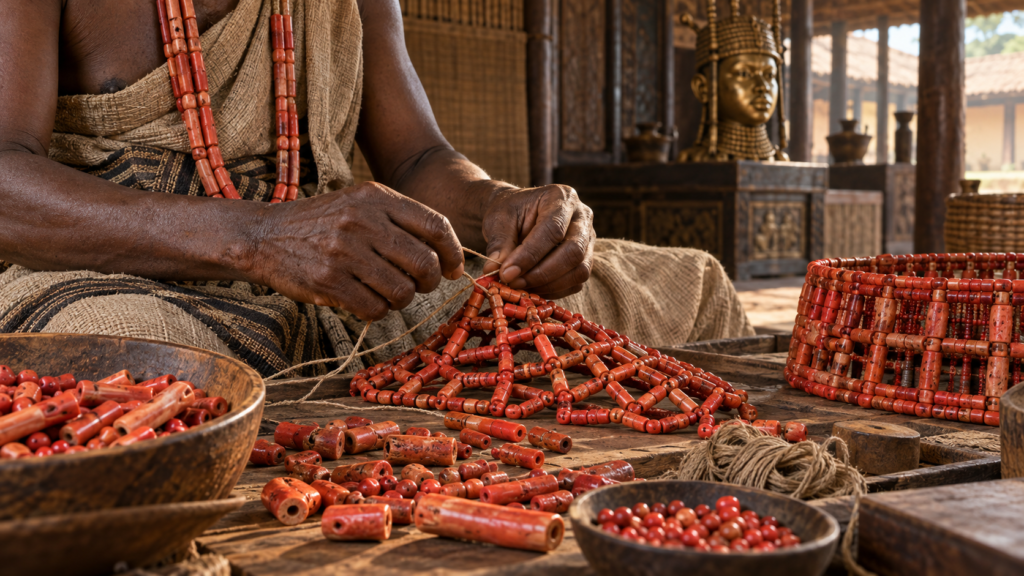
A coral branch originates in a marine environment.
It is collected.
Worked into beads.
Transported across considerable distances.
Introduced into commercial exchange.
Acquired through royal networks.
Distributed according to political authority.
And finally incorporated into ceremonial regalia.
At each stage, the material enters a different relationship.
By the time it forms part of an Oba’s crown, its significance extends far beyond its biological origin.
It has become part of the visual and ceremonial structure of kingship.
The Coral Crown
Among the most distinctive forms of Benin royal adornment is the coral-beaded crown.
The British Museum preserves a coral mesh crown identified as an ede.
Its construction consists of an elaborate network of coral beads.
The museum explains that coral mesh headwear has been associated with Benin royalty since at least the sixteenth century.
The crown is important because it transforms the ruler’s appearance.
It does not merely sit upon the head as a separate decorative object.
Its beadwork visually incorporates the head into the ceremonial costume.
The royal body becomes an expression of office.
Why the Head Matters
The head possesses particular importance in Benin royal imagery.
Cast-brass commemorative heads are among the kingdom’s most celebrated artistic achievements.
These objects were associated with royal ancestral altars.
They were not simply portraits intended for ordinary domestic decoration.
The Metropolitan Museum preserves a commemorative head dating from the early fifteenth to mid-sixteenth century.
It depicts an idealised Oba wearing a coral-beaded cap and strands of beads around the face.
A circular opening at the top originally accommodated a carved ivory tusk.
The object therefore combines representations of royal identity, coral adornment and ancestral commemoration.
Coral in Ancestral Art
The presence of coral in commemorative royal sculpture reveals something important.
The beads were not meaningful only when physically worn.
They could also be represented in art.
A brass sculpture could depict coral regalia even though the sculpture itself contained no coral.
The material’s meaning was therefore recognisable through its form.
A sculpted bead collar could communicate royal authority.
A beaded crown could identify the figure’s status.
The visual language of coral extended beyond the actual gemstone material.
Why Were Royal Heads Placed on Altars?
Royal commemorative heads formed part of Benin’s traditions of honouring deceased rulers.
Ancestral relationships were important to the legitimacy and continuity of kingship.
The Oba’s authority was connected with the royal lineage.
Ancestral altars provided ceremonial settings in which that relationship could be maintained.
The Metropolitan Museum identifies its early commemorative brass head as an object intended for a place of honour on a palace altar.
Coral imagery therefore participated in the representation of kingship across generations.
The beads helped identify the royal status of an ancestral figure.
A Material That Connected the Living and the Dead
This is a particularly significant aspect of Benin’s coral symbolism.
The living Oba wore coral regalia.
Commemorative sculptures of earlier rulers depicted similar adornment.
The material became part of a visual continuity between past and present.
But this should not be interpreted as evidence that coral itself contained the spirits of ancestors.
The documented significance lies in the royal imagery, ceremonial context and ancestral institutions.
The relationship was cultural and religious, not a scientifically established property of calcium carbonate.
Coral and the Royal Body
The Metropolitan Museum’s study Beadwork in the Arts of Africa and Beyond explains how coral regalia distinguished the Oba from other members of the court.
The king could wear a complete costume of beads.
Other officials wore forms appropriate to their rank.
This arrangement transformed the body into a visible representation of hierarchy.
The more elaborate the regalia, the more clearly the wearer could communicate a particular position.
The body itself became part of the political language of the kingdom.
The Importance of the Neck
Benin royal sculptures frequently depict multiple rows of coral beads surrounding the neck.
In later examples, the collars can become extraordinarily elaborate.
The Metropolitan Museum compares sixteenth-century and nineteenth-century commemorative heads.
The earlier example displays a relatively restrained arrangement of beadwork.
The later example shows a much more extensive accumulation of beads around the face and neck.
This comparison demonstrates that royal adornment changed over time.
The tradition was not static.
Coral Regalia Was Not One Unchanging Costume
The Kingdom of Benin existed across centuries.
Its political circumstances changed.
Its artistic traditions developed.
Its international relationships evolved.
The forms of coral regalia also changed.
It would therefore be inaccurate to imagine that every Oba wore precisely the same crown, collar and ceremonial costume.
Historical representations show continuity, but also development.
This is another reason to approach traditional gemstone symbolism through dated objects rather than timeless generalisations.
Ritual Renewal and the Power of Kingship
The Metropolitan Museum explains that Benin’s palace ceremonies were intended, among other purposes, to purify the kingdom and renew the spiritual powers associated with the Oba.
Such ceremonies expressed relationships between the ruler, titled officials and the wider political community.
Royal regalia played an important role.
Coral was therefore not restricted to ceremonial decoration.
It participated in occasions where kingship itself was ritually affirmed.
Ugie Ivie: The Ceremony of Beads
The British Museum discusses Ugie Ivie, a ceremonial tradition associated with coral beads and the renewal of their spiritual significance.
Its collection records describe practices intended to purify and reinvigorate the coral regalia of the Oba and chiefs.
The museum connects these ceremonies with the shrine of Oba Ewuare.
This is important evidence that coral could possess explicitly ritual significance within Benin court traditions.
However, the exact interpretation of individual practices should be approached carefully.
Museum descriptions sometimes rely on historical scholarship produced outside the communities concerned.
Living Edo religious and court traditions should not be reduced to a single museum explanation.
Was Coral Believed to Be Protective?
The British Museum describes protective and other spiritual associations of coral within Benin’s royal traditions.
But it also suggests that some protective interpretations may have been influenced by earlier European beliefs concerning coral.
That proposed transmission should not be treated as conclusively established.
Similar symbolic uses of a material can emerge through several historical processes.
Trade may transmit objects.
Ideas may travel with them.
Local traditions may reinterpret them.
And different societies may independently associate a material with particular qualities.
For Benin, the strongest evidence concerns coral’s role in royal authority, its connection with Olokun and its participation in ceremonial practice.
The Danger of Explaining Everything Through Europe
European observers sometimes interpreted African traditions through concepts familiar from their own societies.
Coral had protective associations in parts of European history.
But it would be a mistake to assume that Benin’s coral symbolism was simply borrowed from Europe.
The Kingdom of Benin possessed a sophisticated political and religious system.
Imported coral was incorporated into that system.
Its meanings were shaped by Edo institutions, religious relationships and royal authority.
The presence of a European trade connection does not erase local cultural agency.
Coral, Olokun and the Royal Relationship with Water
The relationship between the Oba and Olokun is particularly important because it connects a material’s physical origin with religious interpretation.
Coral comes from the sea.
Olokun is associated with the sea.
The Oba’s regalia incorporates coral.
The ruler’s ceremonial identity therefore becomes connected with the marine spiritual domain.
This relationship is more specific than the modern metaphysical statement that coral possesses “ocean energy.”
The Edo tradition identifies a particular deity and a particular political institution.
It is not simply a universal belief that all coral carries the same spiritual vibration.
Mudfish: Between Land and Water
Another important symbol in Benin royal art is the mudfish.
Mudfish can move within aquatic environments and survive conditions that would be difficult for many other fish.
In Benin visual symbolism, the creature’s relationship with land and water became meaningful.
The British Museum explains that mudfish imagery could represent the Oba’s relationship with both human and spiritual domains.
The mudfish therefore complements coral’s marine associations.
Both participate in a broader symbolic system connecting kingship with water.
The Oba and the Two Worlds
The symbolic relationship between land and water is particularly striking.
The ruler governs an earthly political community.
Yet his ceremonial identity also expresses relationships with spiritual powers.
The mudfish provides one visual expression of this connection.
Coral provides another.
Neither material nor animal symbolism can be understood adequately without the religious framework surrounding it.
The meaning emerges through a system of relationships.
The Smithsonian’s Olokun Necklace
One of the most revealing objects is preserved by the Smithsonian Institution’s National Museum of African Art.
It is a necklace made by an Edo artist in the late twentieth century.
The necklace combines:
A coral bead.
Cowrie shells.
A brass bell.
And cord.
The museum identifies it as part of the regalia of a priest or priestess of Olokun.
Its interpretation is particularly valuable because it demonstrates that coral symbolism was not confined to the royal court.
The material also participated in religious contexts associated directly with Olokun.
Cowrie Shells and Coral
The Smithsonian explains that the cowrie shells and coral bead on this necklace are emblems of wealth.
This combination is significant.
Both materials originate from marine environments.
Both can participate in systems of value and religious meaning.
The necklace therefore connects the sea, prosperity and spiritual practice through several materials.
It would be misleading to isolate the coral bead and claim that the entire necklace’s significance comes from coral alone.
The meaning belongs to the complete object and its ritual context.
A Living Religious Tradition
The Smithsonian necklace dates to the late twentieth century.
It is not an archaeological object from the sixteenth century.
This distinction matters.
It demonstrates that Edo religious material culture continued into the modern period.
But it should not be used to assume that every aspect of contemporary practice existed unchanged hundreds of years earlier.
Traditions develop.
Objects change.
Interpretations evolve.
A living religious tradition cannot be treated as a fossilised version of its historical past.
Coral and the Spiritual Meaning of Wealth
In modern crystal-healing literature, coral is sometimes associated with prosperity.
It is tempting to connect that idea directly with Benin’s coral traditions.
But the historical evidence is more specific.
Coral was associated with wealth because it was valuable, imported and controlled through royal institutions.
Its marine origin also connected it with Olokun.
The material participated in a system in which prosperity, political authority and spiritual relationships were intertwined.
This does not demonstrate that coral automatically attracts money to its owner.
The distinction is fundamental.
Political Authority Is Not a Crystal Property
A bead could signify rank because the Oba had bestowed it.
A collar could identify an official.
A crown could distinguish the ruler.
These meanings depended upon recognised social institutions.
They were not inherent chemical properties of calcium carbonate.
If the same bead were removed from its cultural setting, its material composition would remain unchanged.
Its political significance would not necessarily remain the same.
This is one of the clearest examples of why gemstone symbolism cannot be reduced to mineralogy.
What a Gemmologist Can Establish
A gemmologist examining a coral bead may investigate its composition, structure, colour and surface characteristics.
Microscopy can reveal growth structures.
Raman spectroscopy may help identify mineral phases and pigments.
Other analytical methods can assist in distinguishing natural coral from imitations.
The Gemological Institute of America has published research demonstrating how Raman spectroscopy can distinguish certain coral groups.
These methods can help establish material identity.
They cannot determine whether a bead was bestowed by an Oba.
Nor can they establish its ceremonial authority.
Those questions require historical and cultural evidence.
Not All Red Coral Is the Same
The term “red coral” can conceal considerable biological diversity.
Different coral groups may possess different skeletal structures and chemical characteristics.
The Gemological Institute of America distinguishes precious corals such as Corallium from certain Stylaster corals.
The distinction can matter for identification and conservation.
Some coral groups are subject to international trade controls.
Historical museum records may not always provide species-level identification.
Therefore, when discussing Benin coral regalia, it is more responsible to identify the material as coral unless reliable analysis supports a more precise classification.
The Environmental Dimension of Coral
Modern coral jewellery also raises environmental questions.
Coral is produced by living marine organisms.
Many coral species grow slowly.
Some populations are vulnerable to overharvesting and environmental change.
The conservation situation differs substantially among species.
Not every coral used in jewellery comes from a reef-building species.
Not every coral group is regulated in the same way.
Responsible sourcing therefore requires species identification, geographic information and attention to applicable conservation and trade rules.
The historical importance of coral does not eliminate modern environmental responsibilities.
The Ethical Problem of Historical Collections
Any serious discussion of Benin royal objects must also address the history of their removal from Nigeria.
In February 1897, British forces attacked Benin City.
The city was occupied and extensively looted.
Large numbers of royal and ceremonial objects were taken.
Many subsequently entered European and North American collections.
The Metropolitan Museum of Art documents this history in its research concerning Benin artworks and historical auction catalogues.
The British Museum also acknowledges that objects from the royal palace were looted during the expedition.
This history is essential to understanding why important Benin objects are now dispersed internationally.
A Museum Object Is Not Necessarily an Innocent Souvenir
A coral crown or royal ornament in a museum may possess a complicated history.
It may have been made for ceremonial use.
It may have belonged to a royal institution.
It may have been removed during colonial violence.
It may later have been sold, exchanged or donated.
Its present location therefore does not necessarily reflect the wishes of the community from which it originated.
Responsible interpretation should distinguish between the object’s original cultural significance and its later collecting history.
Why Provenance Matters
Provenance is important in gemmology because it helps establish the history and authenticity of an object.
In the case of Benin royal regalia, provenance can also involve questions of cultural ownership and restitution.
Who originally possessed the object?
How did it leave Benin?
Was it acquired through legitimate exchange?
Was it taken during the 1897 expedition?
What claims exist concerning its return?
These questions are not secondary to the object’s history.
They are part of it.
Modern Crystal Beliefs About Coral
Contemporary metaphysical literature frequently associates coral with several spiritual qualities.
These may include:
Emotional stability.
Protection.
Vitality.
Courage.
Prosperity.
Grounding.
Creativity.
And the balancing of personal energy.
Different colours may receive different interpretations.
Red coral is sometimes associated with strength and vitality.
Pink coral may be linked with emotional harmony.
White coral may be associated with calm or purity.
These are contemporary metaphysical interpretations.
They should not be presented as universal ancient knowledge.
Does Coral Emit Protective Energy?
There is no established scientific evidence that coral emits an invisible field capable of preventing misfortune, attracting prosperity or protecting someone from supernatural danger.
Coral has measurable physical and chemical properties.
Its calcium carbonate structure can be investigated.
Its colour can be studied.
Its biological origin can be established.
But these properties do not demonstrate the existence of metaphysical protective energy.
The spiritual importance of coral in Benin is a documented cultural and religious phenomenon.
It is not scientific evidence that coral possesses supernatural powers.
Coral and the Root Chakra
Modern crystal-healing systems sometimes associate red coral with the Root Chakra.
Other interpretations connect it with the Sacral Chakra.
These associations belong to contemporary metaphysical systems influenced by modern interpretations of South Asian chakra traditions.
They should not be projected onto Edo religious practice.
The Kingdom of Benin’s coral symbolism developed within a different cultural and religious framework.
Its connections with Olokun and royal authority cannot accurately be translated into chakra terminology.
A More Historically Responsible Interpretation
Instead of asking:
“What universal energy does coral possess?”
the history of Benin encourages more precise questions.
Why was coral valuable?
Who controlled it?
Where did it originate?
Who could wear it?
Which religious relationships did it express?
How did it participate in royal ceremony?
Why was it represented on ancestral sculptures?
These questions produce answers grounded in documented cultural practice.
They reveal a far more sophisticated history than a generic list of spiritual properties.
The Material and the Meaning
One of the most interesting aspects of Benin coral regalia is the relationship between physical material and cultural interpretation.
Coral is biologically produced.
Its red colour makes it distinctive.
Its marine origin connects it with the sea.
Its rarity made it valuable.
Its importation linked Benin with international trade.
Its distribution reflected royal authority.
Its ceremonial use connected it with spiritual traditions.
None of these dimensions alone explains the complete meaning.
Together, they reveal how a natural material can become embedded within a complex cultural system.
A Historically Inspired Reflection on Coral
A modern reader interested in the symbolism of natural materials can learn from this history without attempting to reproduce Edo religious ceremonies.
Consider a piece of natural coral or a responsibly sourced coral specimen.
Begin with its biological origin.
It was produced by marine life.
Then consider its movement through human society.
It may have been collected.
Worked.
Transported.
Traded.
Gifted.
Or incorporated into jewellery.
Now ask:
What gives a material value beyond its physical appearance?
Is it rarity?
Craftsmanship?
History?
Cultural recognition?
The identity of the person who gives it?
Or the meaning attached to the occasion on which it is worn?
This approach respects the distinction between historical tradition and personal contemporary reflection.
It does not require claims about supernatural energy.
A Crown Is More Than the Material It Contains
A gold crown is not royal merely because gold possesses certain physical properties.
Its authority depends upon institutions and cultural recognition.
The same principle applies to coral.
In Benin, the meaning of royal coral regalia depended upon the Oba, the court, the ceremonies and the religious relationships surrounding kingship.
The beads were important.
But the system that gave them meaning was equally important.
The Continuing Importance of Benin’s Cultural Heritage
The Kingdom of Benin should not be treated as a civilisation that simply disappeared.
The Benin monarchy and Edo cultural traditions continue to hold significance in contemporary Nigeria.
Royal ceremonies, artistic heritage and ancestral relationships remain important.
The historical coral traditions discussed here therefore belong to a broader living cultural landscape.
External interpretations should recognise that living communities have their own knowledge, perspectives and authority concerning their heritage.
Museum scholarship can provide valuable evidence.
But it should not be mistaken for the only legitimate interpretation.
What Can We Say with Confidence?
The available museum, historical and gemmological evidence supports several conclusions.
Coral was an important material in the historic Kingdom of Benin.
Imported Mediterranean coral became particularly significant in royal adornment from the late fifteenth century onward.
The Oba controlled the distribution of coral and red stone beads within the kingdom’s royal system.
Elaborate coral regalia communicated rank and political authority.
Coral crowns, collars and other ornaments became defining features of royal imagery.
Cast-brass commemorative heads frequently represented rulers wearing coral regalia.
Such sculptures participated in traditions of royal ancestral commemoration.
Coral’s marine origin contributed to its association with Olokun, a deity connected with the sea and prosperity.
Royal ceremonies included practices associated with the renewal of spiritual authority.
The British Museum documents ritual traditions involving the purification and reinvigoration of coral regalia.
The Smithsonian preserves an Edo religious necklace incorporating coral, cowrie shells and a brass bell, associated with a priest or priestess of Olokun.
These traditions demonstrate coral’s substantial religious and cultural significance.
They do not establish that coral emits scientifically measurable healing energy or possesses universal supernatural powers.
Conclusion: When the Sea Became a Symbol of Kingship
The history of coral in the Kingdom of Benin is remarkable because it reveals how an organic material from the sea became part of a sophisticated system of political and spiritual authority.
Coral travelled across considerable distances.
It entered royal networks.
It became an emblem of rank.
It adorned the ruler’s body.
It appeared in ancestral sculpture.
And it participated in ceremonies associated with the renewal of kingship.
Its significance was closely connected with Olokun and the spiritual importance of the sea.
Yet coral’s meaning cannot be explained through one simple metaphysical property.
It was not merely a stone of prosperity.
Not simply a protective charm.
Not simply a symbol of wealth.
It was part of a system connecting material resources, royal authority, religious relationships and cultural identity.
Modern crystal-healing traditions may associate coral with vitality, protection or emotional balance.
Those beliefs should be distinguished from the historically documented practices of the Edo people.
At Natural Gems Belgium, the story of Benin coral offers a particularly important lesson.
The spiritual meaning of a gemstone or organic gem material is not always something imagined to exist inside the material itself.
Sometimes its significance emerges from the relationships surrounding it.
From the sea where it originated.
From the journeys through which it travelled.
From the institutions that controlled it.
From the people authorised to wear it.
And from the religious traditions through which it acquired meaning.
Coral did not become a symbol of kingship because calcium carbonate possesses a scientifically measurable royal energy.
It became a symbol of kingship because the people of Benin incorporated it into one of West Africa’s most extraordinary systems of political and spiritual expression.
The material was precious.
But the meaning was created through history.
References & Further Reading
The following references prioritise authoritative museum collections, historical scholarship, gemmological research and marine science. They are informational sources rather than commercial gemstone or crystal-healing websites.
1. The Metropolitan Museum of Art — The Regal Body
https://www.metmuseum.org/exhibitions/listings/2018/jewelry/regal-body
Source description: Major museum exhibition examining jewellery as an expression of political and spiritual authority. Its section on the Kingdom of Benin discusses Oba Ewuare, the introduction of Mediterranean coral beads, the relationship between coral and Olokun, royal regalia and ancestral commemorative sculpture.
This is one of the most important references for understanding the religious significance of coral in Benin’s royal traditions.
2. The Metropolitan Museum of Art — Beadwork in the Arts of Africa and Beyond
https://www.metmuseum.org/perspectives/beadwork-in-arts-of-africa-and-beyond
Source description: Scholarly museum article by James Green, published 26 July 2018. It examines the global history of beadwork and includes a substantial discussion of Mediterranean coral imports into Benin, royal control over bead distribution and the use of elaborate coral regalia to communicate political hierarchy.
Particularly valuable for understanding the distinction between material value and socially recognised authority.
3. The Metropolitan Museum of Art — Ùhúnmwèlaò, Head of an Oba
https://www.metmuseum.org/art/collection/search/312290
Source description: Collection record for an early fifteenth- to mid-sixteenth-century commemorative brass head produced by Edo artists associated with the Benin court. The sculpture depicts an Oba wearing a coral-beaded crown and strands of beads around the face. It was intended for an ancestral altar.
This provides direct visual evidence for the importance of coral regalia in royal commemorative art.
4. The Metropolitan Museum of Art — Hip Ornament with Face
https://www.metmuseum.org/art/collection/search/316520
Source description: Sixteenth- to seventeenth-century brass court ornament. The museum explains how palace rituals renewed the spiritual powers associated with kingship and how coral beads, ivory and brass formed part of elaborate ceremonial costumes.
Useful for connecting jewellery and precious materials with the wider ritual structure of Benin’s court.
5. British Museum — Coral Crown, Benin Kingdom
https://www.britishmuseum.org/collection/object/E_Af1898-0630-5
Source description: Collection record for a coral mesh crown associated with the Oba of Benin. The museum discusses the historical importance of coral headwear, the role of specialist palace attendants and the Ugie Ivie ceremonial tradition.
The record also documents the object’s acquisition history following the British expedition of 1897.
6. British Museum — Coral Beaded Apron, Benin Kingdom
https://www.britishmuseum.org/collection/object/E_Af1898-0630-4
Source description: Museum documentation for an elaborate coral-beaded ceremonial apron. The curatorial commentary examines royal dress, restrictions associated with particular forms of regalia and traditional beliefs concerning coral.
Also valuable for understanding how historical royal objects entered European museum collections.
7. Smithsonian Institution, National Museum of African Art — Olokun Priest or Priestess Necklace
https://africa.si.edu/collection/object/nmafa_2008-9-9
Source description: Collection record for a late twentieth-century Edo necklace combining coral, cowrie shells, a brass bell and cord. The museum identifies the necklace as part of the regalia of a priest or priestess of Olokun and explains the association of coral and cowries with wealth.
Especially important because it documents coral within a religious context beyond the royal costume itself.
8. Smithsonian Institution, National Museum of African Art — Commemorative Head
https://africa.si.edu/collection/object/nmafa_2005-6-133
Source description: Museum record for an Edo commemorative head displaying representations of coral regalia. The accompanying interpretation explains that coral beads were bestowed by the Oba as emblems of rank and office.
Provides evidence for the relationship between royal adornment, ancestral representation and political authority.
9. British Museum — Ceremonial Arm Cuff, Benin Kingdom
https://www.britishmuseum.org/collection/object/E_Af1910-0513-3
Source description: Collection record for an elaborate ivory arm cuff associated with Benin royal ceremony. The museum discusses mudfish symbolism, the relationship between the Oba and Olokun and the practical role of ceremonial ornaments during royal dancing.
Particularly useful for understanding how marine symbolism extended beyond coral itself.
10. The Metropolitan Museum of Art — Benin Art in Auction Catalogs
https://www.metmuseum.org/ko/perspectives/library-benin-auction-catalogs
Source description: Museum research article by Amy Hamilton, published 19 February 2025. It documents the British attack on Benin City in February 1897, the looting of royal artworks and the subsequent circulation of Benin objects through European and North American art markets.
Essential historical context for discussions of provenance, colonial collecting and restitution.
11. Gemological Institute of America — Identification of Endangered Pink-to-Red Stylaster Corals by Raman Spectroscopy
https://www.gia.edu/gems-gemology/spring-2009-stylaster-corals-karampelas
Source description: Peer-reviewed gemmological research examining the identification of different coral groups through Raman spectroscopy. It distinguishes Stylaster corals from Corallium-type precious corals and discusses their differing mineral compositions and international trade regulations.
Useful for establishing the scientific distinction between coral materials and avoiding unsupported species-level identifications of historical beads.
12. Gemological Institute of America — Dyed Bone as a Red Coral Imitation
https://www.gia.edu/gems-gemology/summer-2014-gemnews-red-coral-imitation
Source description: Gemmological case study demonstrating how dyed bone can imitate red coral. The article discusses microscopic characteristics and identification methods.
Relevant to the distinction between visually similar red beads and scientifically identified natural coral.
13. NOAA Fisheries — Corals
https://www.fisheries.noaa.gov/corals
Source description: United States National Oceanic and Atmospheric Administration educational resource explaining coral biology, coral polyps, skeletal formation and the diversity of coral groups.
Provides authoritative biological context for understanding coral as an organic material produced by marine animals.
Historical Tradition, Spiritual Symbolism and Scientific Evidence
The Kingdom of Benin provides strong historical evidence that coral could possess important religious, ceremonial and political significance.
The documented traditions include:
Royal authority: Coral regalia identified the Oba and communicated distinctions of rank within the court.
Controlled distribution: Coral beads could be bestowed by the ruler as recognised emblems of office.
Religious association: Coral’s marine origin connected it with Olokun and the spiritual significance of the sea.
Ceremonial renewal: Coral regalia participated in palace rituals associated with the renewal of royal authority.
Ancestral commemoration: Royal sculptures depicted coral crowns and collars within the context of ancestral altars.
Religious practice: Coral appeared in objects associated with priests and priestesses of Olokun.
Historical trade: Imported coral acquired local significance through the institutions and traditions of the Kingdom of Benin.
These cultural meanings are historically important.
They should not be confused with scientifically established properties of coral.
Coral is an organic gem material produced by marine organisms. Its composition, structure and biological origin can be investigated through established scientific methods.
There is no established scientific evidence that coral emits protective spiritual energy, automatically attracts wealth, activates chakras or treats physical or psychological conditions.
Likewise, the Edo concept of royal spiritual authority should not be translated automatically into modern crystal-healing terminology.
The historically responsible interpretation distinguishes:
The biological and gemmological properties of coral.
Its economic importance as an imported luxury material.
Its documented ceremonial and religious significance within Edo traditions.
Its role in expressing political authority and ancestral continuity.
Contemporary metaphysical beliefs about coral.
This distinction does not diminish the spiritual importance of coral in Benin.
It allows that importance to be understood within its own historical and cultural context.
The result is a more accurate and meaningful account of how natural materials become embedded within human systems of belief, authority and identity.
Related Products
-

Ruby Zoisite Bead Bracelet 6 mm · Natural Ruby in Zoisite Gemstone Bracelet
$33.51 -
Ruby Zoisite Bead Bracelet 10 mm · Natural Ruby in Zoisite Gemstone Bracelet
$55.88 -
Red Fire Quartz Bead Bracelet 10 mm · Natural Hematoid Quartz Gemstone Bracelet
$34.96 -
Natural Lemon Jade Beaded Bracelet · 8 mm · 19 cm
$25.68