Introduction: One Gemstone, Two Different Colours
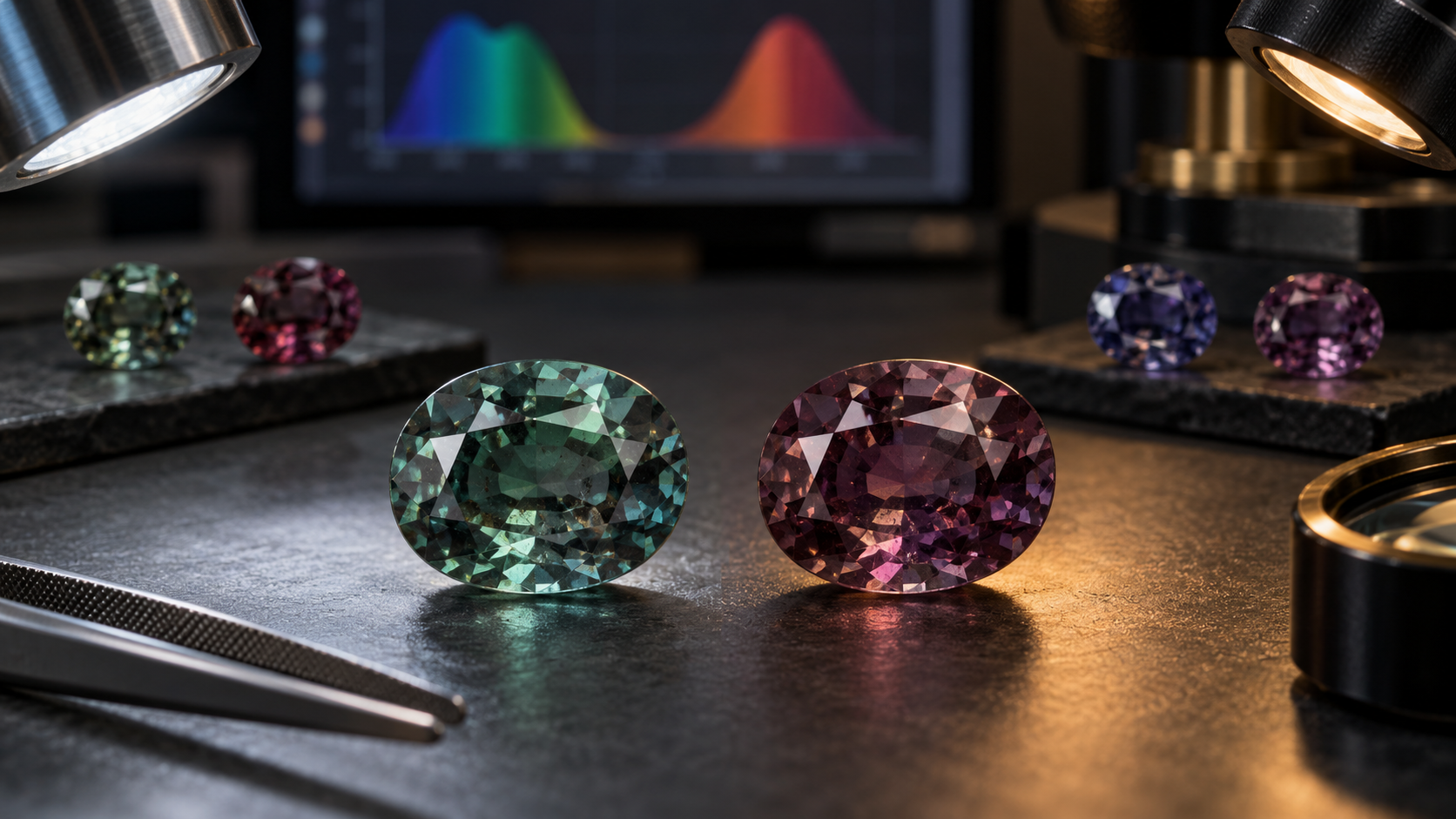
Imagine examining a gemstone in natural daylight.
It appears beautifully green.
Later that evening, you look at the same stone beneath a warm incandescent lamp.
The green has disappeared.
The gemstone now appears reddish purple.
Nothing has been added to the stone. Its chemical composition has not changed. No treatment has taken place between the two observations.
Yet the colour appears remarkably different.
This is one of the most fascinating optical phenomena encountered in gemmology:
The colour-change phenomenon, commonly associated with the alexandrite effect.
Although alexandrite is the best-known example, genuine colour change can also occur in certain sapphires, garnets, spinels and other gem materials.
Understanding why gemstones change colour helps appreciate the beauty and complexity of these natural treasures.
The explanation lies in a remarkable interaction between three factors:
- The spectral composition of the light illuminating the gemstone.
- The wavelengths absorbed and transmitted by the gemstone.
- The way the human visual system interprets the remaining light.
Understanding these factors reveals why some gemstones display dramatic transformations while others merely appear slightly warmer or cooler under different lighting.
It also explains why colour change must be distinguished from other optical phenomena, including pleochroism, fluorescence and photochromism.
Table of Contents
1. What Is Genuine Gemstone Colour Change?
In gemmology, colour change describes a phenomenon in which a gemstone displays a different principal hue when observed under different specified illumination conditions.
The classic comparison is between:
Daylight-equivalent illumination
and
Incandescent illumination.
The Laboratory Manual Harmonisation Committee (LMHC) provides standardised terminology for reporting this phenomenon.
Under its guidance, a gemstone qualifies as colour-changing when its main hue under standardised daylight differs from its main hue under standardised incandescent lighting.
The distinction concerns a change in the dominant colour impression, not simply a small difference in brightness or saturation.
For example, a gemstone that appears blue in daylight and distinctly purple under incandescent lighting may exhibit genuine colour change.
A gemstone that appears medium blue in daylight and slightly darker blue indoors does not necessarily qualify.
The latter may simply be responding to differences in illumination intensity or spectral distribution.
This distinction is essential when evaluating gemstones described commercially as colour-changing.
2. Why the Colour of Light Matters
To understand gemstone colour change, we must first understand that white light is not always spectrally identical.
Visible light consists of electromagnetic radiation covering approximately 380–780 nanometres.
Different wavelengths contribute to the colours perceived by the human eye.
Although two light sources may both appear white, they can contain very different proportions of individual wavelengths.
Consider two familiar examples.
Natural daylight
Daylight contains a broad distribution of visible wavelengths.
Its exact spectral composition changes with atmospheric conditions, time of day and whether the observer is in direct sunlight or shade.
Compared with traditional incandescent illumination, daylight generally contains a relatively greater proportion of shorter-wavelength blue and green light.
Incandescent illumination
Traditional incandescent lamps produce light by heating a filament.
Their emission is comparatively rich in longer wavelengths, particularly orange and red.
The result is a warmer overall illumination.
This difference is fundamental.
A gemstone does not receive exactly the same spectral mixture from these two light sources.
Consequently, it cannot transmit or reflect precisely the same combination of wavelengths toward the observer.
For most gemstones, the resulting colour difference is relatively modest.
For certain minerals with highly selective absorption characteristics, however, the difference can be dramatic.
3. A Gemstone Does Not Create Its Own Visible Colour
The colour observed in a transparent gemstone depends largely on the wavelengths of light that survive absorption within the material.
When white light enters a gemstone, some wavelengths are absorbed more strongly than others.
The remaining wavelengths can emerge from the stone and reach the observer.
For example, a blue sapphire commonly appears blue because its absorption characteristics allow a significant proportion of blue light to contribute to the observed colour while absorbing other parts of the visible spectrum.
The situation becomes more interesting when a gemstone transmits significant amounts of light in two different spectral regions.
Imagine a gemstone with relatively strong transmission in:
- the blue-green region;
- the red region.
Between these regions, the gemstone absorbs a substantial proportion of yellow and orange-yellow wavelengths.
Under daylight, the blue-green contribution may dominate the visual impression.
Under incandescent light, the stronger availability of red wavelengths may cause the red contribution to dominate.
The gemstone appears to change colour.
In reality, the gemstone’s absorption properties have remained essentially unchanged.
What changes is the spectral composition of the light entering it.
4. The Scientific Basis of the Alexandrite Effect
The classic alexandrite effect is associated with a characteristic visible absorption pattern.
Research by Eduard Gübelin and Karl Schmetzer established that gemstones displaying alexandrite-like colour change commonly possess two important transmission regions separated by substantial absorption in the yellow portion of the spectrum.
In simplified terms, the material transmits useful amounts of both:
blue-green light
and
red light.
A strong absorption region between them helps create the conditions necessary for the two different colour impressions.
For alexandrite, an important absorption feature occurs around 580 nanometres.
This feature is closely associated with its distinctive behaviour under different illuminants.
However, the presence of an absorption band at a particular wavelength does not alone guarantee a spectacular colour change.
The final appearance depends on the entire absorption spectrum, the illumination, the gemstone’s thickness and the observer.
This is why two alexandrites can show substantially different colour-change strength.
5. Alexandrite: The Most Famous Colour-Changing Gemstone
Alexandrite is the colour-change variety of the mineral chrysoberyl.
Its chemical formula is:
BeAl₂O₄
Chrysoberyl belongs to the orthorhombic crystal system.
Ordinary chrysoberyl may occur in yellow, yellow-green, brownish or other colours.
Alexandrite is distinguished by its characteristic colour-change behaviour, commonly associated with chromium incorporated into the crystal structure.
The best-known appearance is:
Bluish green or green in daylight
changing to:
Red, purplish red or reddish purple under incandescent light.
This remarkable transformation gave rise to the traditional description:
“Emerald by day, ruby by night.”
The expression is descriptive rather than mineralogical.
Alexandrite is neither emerald nor ruby.
It is chrysoberyl.
6. Why Chromium Is So Important
Chromium is a transition metal capable of producing intense colour in several gemstone species.
However, chromium does not create the same visible colour in every mineral.
In ruby, chromium contributes to the characteristic red colour.
In emerald, chromium can contribute to green coloration.
In alexandrite, chromium produces an absorption pattern that can generate a striking green-to-red colour change.
Why the difference?
Because the electronic behaviour of chromium ions depends partly on their surrounding crystal structure.
The local arrangement of neighbouring atoms influences the energies of electronic transitions.
Those transitions determine which wavelengths of visible light are absorbed.
Consequently, the same colour-causing element can produce different optical results in different host minerals.
This is a fundamental principle of gemstone colour science:
The colour of a gemstone depends not only on which trace elements are present, but also on the crystal structure in which those elements occur.
In alexandrite, chromium generally substitutes for aluminium within the chrysoberyl structure.
Vanadium and iron may also influence the final colour and absorption behaviour.
7. The Discovery of Alexandrite
Alexandrite became known to mineralogists during the nineteenth century.
The gemstone was discovered in Russia’s Ural Mountains during the early 1830s.
It was subsequently named in honour of the future Russian emperor Alexander II.
The historical association between alexandrite and imperial Russia contributed significantly to its reputation.
Its green and red colour combination also became symbolically associated with Russian imperial colours.
However, the scientific importance of alexandrite extends far beyond its historical reputation.
It became the classic example of a mineral whose perceived colour depends strongly on the spectral characteristics of the illuminating light.
Today, natural alexandrite is also known from countries including Brazil, Sri Lanka and several African localities.
Fine material displaying strong, attractive colour change remains uncommon.
8. Not Every Alexandrite Displays the Same Colours
The familiar green-to-red transformation represents the classic ideal, but natural alexandrite does not always display those exact hues.
Some specimens appear:
- yellowish green in daylight;
- bluish green in daylight;
- brownish green in daylight;
- reddish purple under incandescent light;
- purplish brown under incandescent light.
The strength and attractiveness of the phenomenon vary considerably.
A gemstone may technically display colour change while having relatively subdued colours.
Another may exhibit highly saturated colours in both lighting environments.
Therefore, evaluating alexandrite requires more than simply establishing that a change occurs.
The quality of the colours themselves also matters.
9. Colour Change and Pleochroism Are Not the Same Phenomenon
Alexandrite is especially interesting because it can exhibit both:
Colour change
and
These phenomena are related to selective absorption, but they are not identical.
Pleochroism occurs in optically anisotropic minerals when light experiences different absorption depending on crystallographic direction and polarisation.
Alexandrite is strongly pleochroic.
Its characteristic pleochroic colours can include:
- green;
- orange;
- purple-red.
When a crystal is examined along different directions, these components can contribute differently to its appearance.
Colour change, by contrast, is identified by comparing the gemstone under different illuminants.
A gemstone can therefore exhibit strong pleochroism without necessarily displaying the classic alexandrite effect.
Likewise, the alexandrite effect should not be explained merely as pleochroism.
GIA explicitly distinguishes these two properties.
10. Why the Faceter’s Decisions Matter
The orientation of a gemstone during cutting can influence its visible colour.
This is particularly relevant for anisotropic minerals such as chrysoberyl.
A faceter must consider:
- crystal orientation;
- pleochroism;
- optical path length;
- inclusion position;
- final proportions;
- expected weight retention.
Scientific research has demonstrated that alexandrite’s apparent colours can depend on orientation and the path travelled by light through the crystal.
However, the relationship is not as simple as claiming that one cutting direction always produces the strongest colour change.
Complex brilliant and mixed cuts produce multiple internal reflections.
These reflections can mix light travelling through different crystallographic directions, reducing some of the orientation-dependent differences observed in simpler optical arrangements.
The faceter must therefore balance several competing objectives.
A cutting orientation that improves one aspect of colour may reduce usable weight or create less desirable proportions.
This makes fine alexandrite cutting a demanding combination of mineralogical knowledge and practical craftsmanship.
11. Colour-Change Sapphire
Alexandrite is not the only important gemstone displaying genuine colour change.
Certain sapphires also exhibit this phenomenon.
Sapphire belongs to the mineral species corundum.
Its chemical formula is:
Al₂O₃
Corundum crystallises in the trigonal crystal system.
Colour-change sapphires commonly display combinations such as:
Blue or violet in daylight
changing to:
Purple, purplish pink or reddish purple under incandescent light.
The precise colours vary between specimens.
GIA describes blue-to-purple as a common colour-change combination in sapphire.
Some unusual specimens exhibit different transformations.
12. What Causes Colour Change in Sapphire?
The colour of corundum can be influenced by several different chromophores.
Important contributors include:
- chromium;
- vanadium;
- iron;
- iron–titanium interactions;
- certain lattice-related colour centres.
A chromophore is a colour-producing atomic or electronic feature.
In ordinary blue sapphire, interactions involving iron and titanium are particularly important.
In some colour-change sapphires, vanadium can contribute substantially to the absorption characteristics.
Chromium may also play a role.
The actual colour depends on the combined absorption behaviour of the different chromophores present.
Therefore, it would be incorrect to claim that every colour-change sapphire owes its phenomenon to one specific element.
The chemistry can vary considerably.
13. A Scientific Example: Vanadium-Rich Sapphire from Myanmar
In 2019, GIA documented an unusual 5.68-carat colour-change sapphire submitted for examination.
The gemstone displayed:
Grayish violet under fluorescent illumination
and:
Purple-pink under incandescent illumination.
Advanced chemical analysis revealed an unusual combination of very low iron content and relatively high vanadium concentration.
The vanadium concentration was approximately 300 parts per million atomic.
The researchers compared the gemstone’s chemistry with reference material from Myanmar.
The study demonstrated the importance of detailed chemical analysis when investigating both colour mechanisms and geographic origin.
It also illustrated how unusual trace-element concentrations can produce distinctive optical behaviour.
14. Colour-Change Garnet
Garnet is another important gemstone group capable of displaying dramatic colour change.
Unlike alexandrite and sapphire, garnet is not one mineral species with one fixed chemical composition.
The garnet group includes several related species and extensive solid-solution relationships.
Colour-change garnets are frequently associated with compositions involving:
- pyrope;
- spessartine;
- almandine;
- sometimes additional garnet components.
Some examples appear:
Blue-green or green in daylight
and:
Purple, reddish purple or red under incandescent light.
Others display more subtle transformations.
Certain garnets from Madagascar and East Africa are particularly well known for their unusual colour-change behaviour.
15. Why Vanadium Matters in Garnet
Vanadium is an important colour-producing element in several colour-change garnets.
Research published in Gems & Gemology in 1999 examined blue-green colour-change garnets from the Bekily region of Madagascar.
The material belonged principally to the pyrope–spessartine solid-solution series.
Chemical analysis identified significant vanadium concentrations.
The specimens displayed an alexandrite-like transformation from blue-green under daylight to purple under incandescent illumination.
This research was particularly significant because it documented commercially available garnets with an unusual blue appearance.
The discovery challenged the common assumption that garnet must be red, orange, green or brown.
It demonstrated that the garnet group possesses a much broader range of optical possibilities than many consumers realise.
16. Garnet and Pleochroism: An Important Difference
Garnets crystallise in the cubic crystal system.
In their normal optical behaviour, cubic garnets are isotropic.
Consequently, they do not exhibit ordinary crystallographic pleochroism in the same way as alexandrite or sapphire.
Yet some garnets display exceptionally strong colour change.
This is scientifically important.
It demonstrates that:
Pleochroism is not required for genuine colour change.
The essential phenomenon arises from the interaction between the gemstone’s wavelength-dependent absorption and the spectral composition of the light source.
This distinction provides a particularly clear demonstration of the underlying physics.
17. The Usambara Effect: When Light Path Length Changes Colour
Another optical phenomenon can complicate the appearance of certain gemstones.
It is known as the:
Usambara effect.
This phenomenon involves a change in apparent colour associated with the distance light travels through a material.
In simplified terms, light passing through a thicker section of a gemstone experiences greater absorption than light passing through a thinner section.
Because absorption varies with wavelength, increasing the optical path length can change the relative contributions of different colours.
Some gemstones may therefore display different colours in thin and thick sections even under the same illumination.
SSEF has documented exceptional colour-change garnets from Tanzania that also exhibited the Usambara effect.
In these stones, reddish reflections could appear near the girdle while other portions of the gemstone appeared greenish under daylight.
The effect was associated with longer optical paths created by internal reflections.
This phenomenon must be distinguished from the classic alexandrite effect.
The alexandrite effect depends on changing the illumination spectrum.
The Usambara effect depends on changing the optical path length.
Both may occur in the same gemstone.
18. Colour Change Versus Ordinary Colour Shift
The term colour shift is frequently encountered in gemstone descriptions.
However, it should not automatically be treated as equivalent to laboratory-defined colour change.
A gemstone may appear:
- slightly bluer in daylight;
- slightly more violet indoors;
- warmer under yellowish lighting;
- less saturated under weak illumination.
These differences may be visually noticeable without representing a clear change in the principal hue under standardised comparison conditions.
The distinction is particularly important for commercial descriptions.
A seller should not automatically advertise every lighting-dependent colour difference as a strong colour-change phenomenon.
For rigorous documentation, the main hue should be evaluated under defined lighting conditions.
If the effect is subtle, that should be stated accurately.
19. Colour Change Versus Photochromism
There is another phenomenon that can cause a gemstone to change appearance:
Photochromism.
Photochromism involves a light-induced change in the material’s absorption properties.
This is fundamentally different from the classic alexandrite effect.
In an alexandrite-type colour change, the gemstone’s absorption characteristics remain essentially the same while the illumination spectrum changes.
In photochromism, exposure to particular radiation can alter electronic states or colour centres within the material.
The gemstone may temporarily develop a different colour.
That colour can subsequently fade or reverse.
A particularly interesting example was documented by GIA in 2026.
Researchers examined a heat-treated Sri Lankan sapphire that changed from very light blue to light yellow after exposure to short-wave ultraviolet radiation.
The yellow colour gradually faded, and the gemstone returned to an appearance similar to its original colour.
The researchers attributed the behaviour to an unstable colour centre activated by ultraviolet radiation.
This is not the same phenomenon as the alexandrite effect.
It also demonstrates why the term colour change must always be interpreted in its scientific context.
20. Fluorescence Is Different Again
Fluorescence occurs when a material absorbs radiation and emits light at other wavelengths.
Certain gemstones fluoresce under ultraviolet illumination.
Ruby is a familiar example.
Chromium can produce red fluorescence in some corundum.
However, fluorescence is not equivalent to the alexandrite effect.
A gemstone may:
- fluoresce without displaying colour change;
- display colour change without strong fluorescence;
- exhibit both phenomena.
The mechanisms are different.
A gemstone that appears more vivid under ultraviolet-rich lighting is not automatically a genuine colour-change gemstone.
The distinction matters when evaluating stones under specialised lamps.
21. Why Modern LED Lighting Complicates Colour Evaluation
Traditional colour-change comparisons often involve daylight and incandescent illumination.
Modern environments increasingly use LED lighting.
This creates an important complication.
Two LED lamps can have the same correlated colour temperature while possessing different spectral power distributions.
For example, two lamps labelled:
3000 K
may both appear warm white.
However, they may not emit identical proportions of individual wavelengths.
Because colour-changing gemstones respond strongly to spectral composition, the same stone can look different under those two lamps.
Therefore:
Colour temperature alone does not fully describe the spectral quality of a light source.
This is one reason professional colour evaluation requires controlled illumination rather than simply choosing any warm and cool household lamps.
22. Standardised Lighting Conditions
The Laboratory Manual Harmonisation Committee provides guidance for examining colour-changing gemstones.
Its February 2023 information sheet specifies daylight-equivalent illumination within approximately:
5500–6500 K
and incandescent or equivalent illumination within approximately:
2700–3600 K.
The document also describes an observation arrangement involving approximately 30 centimetres between the gemstone and lamp and a similar distance between gemstone and observer.
These values provide a framework for consistent comparison.
However, equivalent LED sources must also reproduce suitable spectral characteristics.
Simply selecting a lamp with the correct advertised colour temperature does not guarantee identical results.
For reliable professional evaluation, the spectral suitability of the illumination remains important.
23. How to Observe Colour Change Correctly
A useful observation procedure involves several steps.
Step 1 — Use a neutral background
A neutral grey or white background reduces interference from strongly coloured surroundings.
Step 2 — Establish daylight-equivalent illumination
Observe the gemstone under a suitable daylight-equivalent source.
Record the dominant hue.
Step 3 — Maintain consistent viewing geometry
Keep the gemstone’s orientation and viewing position as consistent as possible.
This is especially important for pleochroic materials.
Step 4 — Change the illumination
Use a suitable incandescent or incandescent-equivalent source.
Avoid mixing the two light sources.
Step 5 — Observe the principal hue
Determine whether the dominant colour changes.
Step 6 — Record both colours
A useful description might be:
Bluish green in daylight-equivalent illumination; purplish red under incandescent-equivalent illumination.
Step 7 — Evaluate the strength of the change
Consider whether the transformation is:
- weak;
- moderate;
- strong;
- exceptionally pronounced.
These descriptive terms should not be mistaken for a universally standardised numerical grading scale.
24. Why Photographs Can Be Misleading
Photographing colour-changing gemstones is surprisingly difficult.
A camera does not interpret colour in exactly the same way as the human visual system.
Several factors can distort the result:
- automatic white balance;
- camera sensor characteristics;
- exposure;
- light-source spectrum;
- colour correction;
- display calibration;
- image compression.
A camera may automatically compensate for the warm appearance of incandescent lighting.
That correction can reduce the apparent difference between the two gemstone photographs.
Alternatively, inappropriate colour processing can exaggerate the effect.
Therefore, a photograph showing dramatic colour change should not automatically be accepted as an accurate representation of the phenomenon.
For responsible documentation, photographs should be taken under clearly identified lighting conditions with consistent camera settings.
Even then, the final image may not reproduce the exact appearance seen by the human eye.
25. Colour Change Does Not Automatically Mean High Quality
A gemstone may exhibit genuine colour change but still possess undesirable visual characteristics.
For example, an alexandrite might change from:
Brownish green
to:
Brownish red.
The transformation may be scientifically genuine.
However, the colours may be less attractive than those of a gemstone displaying saturated bluish green and vivid purplish red.
Similarly, a colour-change sapphire may possess:
- visible inclusions;
- poor transparency;
- excessive extinction;
- weak saturation;
- poor cutting proportions.
The presence of an optical phenomenon is therefore only one aspect of overall gemstone quality.
26. Evaluating the Quality of Colour Change
Several factors deserve attention.
Strength of the transformation
How clearly does the principal hue change?
A strong green-to-red transformation is generally more visually dramatic than a subtle blue-to-violet difference.
Quality of the daylight colour
Is the colour attractive, well saturated and sufficiently bright?
Quality of the incandescent colour
Does the second colour possess similar visual appeal?
Consistency across the gemstone
Does most of the gemstone display the phenomenon, or is it restricted to a few facets?
Optical performance
Does the cut allow the gemstone to display its colours effectively?
Transparency and inclusions
Do inclusions or excessive darkness interfere with the visual effect?
These characteristics should be evaluated together.
A dramatic colour change cannot compensate automatically for every other quality weakness.
27. The Importance of Cutting and Optical Path Length
The distance light travels through a gemstone affects absorption.
In simplified form, transmission decreases as the optical path length and absorption strength increase.
This relationship is described by the Beer–Lambert law.
A basic expression is:
T = e^(−αL)
where:
T = transmitted fraction of light;
α = absorption coefficient;
L = optical path length.
In actual faceted gemstones, multiple reflections and different propagation directions complicate the optical behaviour.
Nevertheless, the principle is important.
A deeper stone may produce a darker colour because light travels through more absorbing material.
A shallower stone may appear lighter.
For certain gemstones, these differences can also influence the apparent balance between colour components.
This is why cutting decisions can affect both the visual quality and apparent strength of a colour-change phenomenon.
28. Can Other Gemstones Change Colour?
Yes.
Although alexandrite, sapphire and garnet are among the best-known examples, research has documented colour-change behaviour in several other gem materials.
Examples include certain:
- spinels;
- kyanites;
- fluorites;
- diaspores;
- zircons;
- kornerupines.
The exact mechanism and strength vary between materials.
Not every specimen of these minerals exhibits colour change.
A normal blue spinel, for example, should not automatically be described as colour-changing.
The phenomenon must be demonstrated in the individual stone.
This distinction is particularly important for collectors.
Gemstone species names alone do not establish the presence of an optical phenomenon.
29. Does Colour Change Prove That a Gemstone Is Natural?
No.
This is an important consumer-protection issue.
Laboratory-grown gemstones can also display colour change.
Synthetic alexandrite is a well-established example.
Some synthetic corundum can also exhibit colour-changing behaviour.
Consequently, observing a dramatic green-to-red transformation does not prove that the gemstone formed naturally.
The identification of natural versus laboratory-grown material requires appropriate gemmological examination.
Colour change is an optical property.
Natural origin is a separate question.
The two should never be confused.
30. Can Colour Change Be Used to Identify a Gemstone?
Colour change can provide useful diagnostic information.
However, it is not sufficient for definitive identification.
Several unrelated minerals can exhibit similar colour-change behaviour.
A green-to-red transformation might suggest alexandrite, but it does not establish that the gemstone is chrysoberyl.
Other possibilities must be considered.
Professional identification relies on multiple independent characteristics.
These may include:
- refractive properties;
- optical character;
- absorption characteristics;
- inclusions;
- chemical composition;
- advanced analytical results where necessary.
The colour-change phenomenon contributes to the evidence.
It does not replace complete identification.
31. What Should a Gemstone Laboratory Report Say?
When a laboratory identifies a genuine colour-changing gemstone, the report may describe the colours observed under different lighting conditions.
For example:
Colour: Bluish green in daylight; purplish red in incandescent light.
The LMHC recommends reporting the two colour appearances separately.
For alexandrite, the report may identify:
Species: Chrysoberyl
Variety: Alexandrite
For another mineral, the report may use terminology such as:
Colour-change sapphire
or:
Colour-change garnet.
The exact wording depends on the laboratory and its reporting system.
A laboratory report may also include information about:
- natural or laboratory-grown status;
- treatments;
- geographic origin, where determinable and included in the service.
These are separate analytical conclusions.
32. A Practical Comparison of Three Major Colour-Change Gemstones
| Characteristic | Alexandrite | Colour-Change Sapphire | Colour-Change Garnet |
|---|---|---|---|
| Mineral classification | Chrysoberyl variety | Corundum variety | Garnet group |
| Common daylight appearance | Green to bluish green | Blue to violet | Green, blue-green or purple |
| Common incandescent appearance | Red to purplish red | Purple to purplish pink | Purple, reddish purple or red |
| Important chromophores | Primarily chromium; other elements may contribute | Variable combinations including vanadium, chromium, iron and titanium | Often vanadium and chromium |
| Crystal system | Orthorhombic | Trigonal | Cubic |
| Ordinary pleochroism | Yes | Yes | No |
| Can laboratory-grown examples exist? | Yes | Yes | Colour-change behaviour alone cannot establish natural origin |
| Principal evaluation concern | Strength and quality of both colours | Hue transformation and overall gem quality | Strength of change, colour quality and correct species identification |
These are representative tendencies, not universal descriptions of every specimen.
33. What Colour Change Means for Gemstone Collectors
Colour-changing gemstones occupy a particularly interesting position within mineral collecting.
They demonstrate that gemstone appearance is not determined solely by chemical composition.
Instead, the observer sees the combined result of:
Mineral structure
Trace-element chemistry
Selective absorption
Illumination spectrum
Optical path length
Human visual perception.
This makes colour-changing gemstones especially valuable as educational specimens.
A single stone can demonstrate several principles of mineral physics.
For collectors, the phenomenon also provides an opportunity to compare materials that are mineralogically very different but optically similar.
Alexandrite and colour-change garnet, for example, belong to different mineral groups and possess different crystal structures.
Yet both can display a dramatic response to changes in illumination.
34. What Colour Change Means for Gemstone Buyers
A buyer considering a colour-changing gemstone should ask several specific questions.
Has the gemstone been examined under appropriate lighting?
What are its actual daylight and incandescent colours?
How strong is the transformation?
Are both colours attractive?
Is the phenomenon visible across most of the gemstone?
Has the gemstone been correctly identified?
Is the material natural or laboratory-grown?
Are any treatments disclosed?
Do photographs accurately represent the effect?
A seller should ideally provide a clear description of both colour appearances.
Where appropriate, photographs or video under different lighting conditions can help illustrate the phenomenon.
However, visual media should supplement accurate gemmological information rather than replace it.
35. How Natural Gems Belgium Approaches Optical Phenomena
At Natural Gems Belgium, gemstone evaluation is based on the characteristics of the individual stone.
For faceted gemstones, the NGB grading framework considers:
- Colour;
- Clarity;
- Cut;
- Optical Performance;
- Overall Appeal.
When a gemstone displays an optical phenomenon such as genuine colour change, that characteristic should be documented accurately.
The presence of the phenomenon may influence the gemstone’s colour evaluation, optical performance and overall appeal.
However, the effect should not automatically produce a high grade.
Its strength, consistency and visual quality must still be considered.
A weak or unattractive colour change is not equivalent to an exceptional transformation.
Likewise, an attractive colour-changing gemstone must still be evaluated for its other gemmological characteristics.
The objective is transparency.
A gemstone should be described according to what it demonstrably exhibits, not according to the most commercially attractive terminology available.
36. The Difference Between Scientific Description and Marketing
Colour-changing gemstones are naturally appealing subjects for gemstone marketing.
A dramatic transformation is visually memorable.
However, marketing language should not exceed the available evidence.
Descriptions such as:
“Changes from green to red”
should be supported by actual observation under appropriate illumination.
A gemstone that merely becomes slightly more violet under warm lighting should not automatically be promoted as exhibiting a strong alexandrite effect.
Similarly, terms such as:
“100% colour change”
require caution unless the methodology used to determine that percentage is clearly defined.
There is no single universally adopted numerical grading system that makes every commercial percentage directly comparable.
The most informative description remains one that identifies:
- the daylight colour;
- the incandescent colour;
- the strength of the change;
- the lighting conditions used.
Scientific accuracy ultimately provides greater long-term value than exaggerated claims.
37. The Deeper Scientific Lesson
Colour-changing gemstones reveal an important principle about the nature of colour itself.
Colour is not simply a permanent property that exists independently of illumination and observation.
A gemstone has measurable optical properties.
It absorbs and transmits different wavelengths according to its structure and composition.
But the colour perceived by a human observer also depends on the spectrum of the light source and the response of the visual system.
This is why the same gemstone can appear different in two environments without undergoing any physical alteration.
The gemstone has not become a different mineral.
Its chemical formula has not changed.
Its crystal structure has not changed.
Instead, the balance of light reaching the observer has changed.
The alexandrite effect is therefore an elegant demonstration of the relationship between:
Matter, light and perception.
Conclusion: The Science Behind Nature’s Changing Colours
Few gemstone phenomena are as visually surprising as genuine colour change.
An alexandrite may appear green in daylight and reddish purple under incandescent light.
A sapphire may shift from blue or violet to purple or purplish pink.
A garnet may transform from blue-green to purple or red.
These effects are not illusions in the sense of being imaginary.
They are genuine consequences of the interaction between the gemstone’s optical properties and the illumination under which it is observed.
The fundamental mechanism involves selective absorption.
Certain gemstones transmit light in different regions of the visible spectrum while strongly absorbing wavelengths between them.
When the spectral composition of the illumination changes, the relative contributions of the transmitted colours also change.
The observer consequently perceives a different dominant hue.
Yet not every change in appearance represents the same phenomenon.
Colour change depends on differences between illumination spectra.
Pleochroism depends on direction-dependent absorption in anisotropic crystals.
The Usambara effect depends on changes in optical path length.
Photochromism involves light-induced changes in the material’s absorption properties.
Fluorescence involves the emission of light following excitation.
Distinguishing these phenomena is essential for accurate gemmology.
It is equally important for responsible gemstone evaluation and transparent commercial descriptions.
Ultimately, a colour-changing gemstone is more than an unusual collector’s item.
It is a natural demonstration of sophisticated optical physics.
A small crystal can reveal how trace elements, crystal structure, light and human vision interact.
And perhaps that is what makes these gemstones so extraordinary.
They remind us that the beauty of a gemstone does not exist in isolation.
It emerges from the remarkable relationship between:
The Earth that formed it, the light that illuminates it, and the observer who sees it.
References & Further Reading
The following references are scientific, educational or laboratory-standardisation resources. They do not link to gemstone product listings or commercial crystal-healing retailers.
1. Gübelin, E. J. & Schmetzer, K. — Gemstones with Alexandrite Effect
Gems & Gemology, Winter 1982, Volume 18, Number 4.
A foundational scientific study examining the alexandrite effect in different mineral species. The authors explain how transmission regions in the blue-green and red portions of the visible spectrum, separated by substantial absorption in the yellow region, contribute to colour change under different illumination.
Gemological Institute of America.
https://www.gia.edu/gems-gemology/winter-1982-alexandrite-effect-gubelin
2. Schmetzer, K. — Pleochroism and Color Change in Faceted Alexandrite: Influence of Cut and Sample Orientation
Gems & Gemology, Spring 2019, Volume 55, Number 1.
A detailed experimental investigation of how crystal orientation, pleochroism, trace-element concentrations, optical path length and cutting style influence the appearance of faceted alexandrite.
Particularly valuable for understanding why colour change and pleochroism must be distinguished.
Gemological Institute of America.
3. Laboratory Manual Harmonisation Committee — Information Sheet No. 9: Description of Colour-Change in Gemstones
Version 4, February 2023.
Official standardised nomenclature for colour-changing gemstones.
Defines the distinction between daylight and incandescent observations, provides recommended lighting conditions and establishes reporting terminology for alexandrite and other colour-changing gemstones.
https://www.lmhc-gemmology.org/wp-content/uploads/2023/06/LMHC-Information-Sheet_9_V4_2023.pdf
4. Gemological Institute of America — Alexandrite Description
An accessible scientific overview of alexandrite as the chromium-bearing colour-change variety of chrysoberyl.
Explains its characteristic daylight and incandescent colours, the importance of selective absorption and the distinction between colour change and pleochroism.
https://www.gia.edu/alexandrite-description
5. Schmetzer, K. & Bernhardt, H.-J. — Garnets from Madagascar with a Color Change of Blue-Green to Purple
Gems & Gemology, Winter 1999, Volume 35, Number 4.
An important scientific investigation of blue-green colour-change garnets from Madagascar.
The research examines pyrope–spessartine compositions and identifies vanadium as a major contributor to the unusual colour-change behaviour.
Gemological Institute of America.
https://www.gia.edu/gems-gemology/winter-1999-color-change-garnets-madagascar-schmetzer
6. Tsang, R. — Low-Fe, High-V Color-Change Burmese Sapphire
Gems & Gemology, Spring 2019, Volume 55, Number 1.
A laboratory investigation of a 5.68-carat sapphire exhibiting strong colour change.
The study documents unusually low iron and relatively high vanadium concentrations, illustrating the importance of trace-element chemistry in the optical behaviour of corundum.
Gemological Institute of America.
https://www.gia.edu/gems-gemology/spring-2019-labnotes-low-fe-high-v-color-change-burmese-sapphire
7. Dubinsky, E. V., Stone-Sundberg, J. & Emmett, J. L. — A Quantitative Description of the Causes of Color in Corundum
Gems & Gemology, Spring 2020, Volume 56, Number 1.
A substantial peer-reviewed investigation of the principal chromophores responsible for colour in corundum.
The study provides quantitative absorption data and explains the contributions of chromium, vanadium, iron, titanium and lattice-related colour centres.
Especially useful for readers interested in the underlying physics of sapphire colour.
https://www.gia.edu/gems-gemology/spring-2020-corundum-chromophores
8. Krzemnicki, M. S. — Exceptional Colour Change Garnets Showing the Usambara Effect
Swiss Gemmological Institute SSEF.
Originally published in Facette, February 2014.
A detailed discussion of exceptional colour-change garnets displaying both the alexandrite effect and the Usambara effect.
Explains the distinction between illumination-dependent colour change and changes related to optical path length.
9. Semapongpan, A. — Reversible Photochromism in a Heat-Treated Sri Lankan Sapphire
Gems & Gemology, Summer 2026, Volume 62, Number 2.
A recent laboratory investigation documenting a Sri Lankan sapphire whose colour temporarily changed following short-wave ultraviolet exposure.
The study provides a useful scientific contrast between photochromism and the classical alexandrite effect.
Gemological Institute of America.
https://www.gia.edu/gems-gemology/summer-2026-lab-notes-reversible-photochromism
10. Gemological Institute of America — Alexandrite Quality Factors
An educational reference explaining how colour-change strength, saturation, clarity, cutting and carat weight contribute to the quality and commercial evaluation of alexandrite.
Useful for distinguishing the scientific existence of a phenomenon from the quality of its visual expression.