Hold a piece of fine Baltic amber against sunlight and something remarkable happens.
The material does not merely reflect the light.
It seems to contain it.
Golden amber can appear almost illuminated from within. Darker specimens reveal suspended clouds, microscopic debris or plant fragments. Occasionally, an insect that lived tens of millions of years ago remains preserved inside.
To ancient Europeans, this unusual substance must have seemed extraordinary.
Amber could be collected from beaches.
It was lightweight.
Warm to the touch.
Combustible.
Capable of developing static electricity when rubbed.
And unlike ordinary stone, it could contain recognisable remnants of once-living organisms.
By the Roman period, amber originating largely from northern Europe was travelling enormous distances southward, ultimately reaching workshops, markets, households, temples and graves throughout the Roman world.
It became jewellery.
It became sculpture.
It became an amulet.
It entered ancient medical literature.
And it became surrounded by stories about sunlight, protection and distant northern lands.
Today amber is commonly described in crystal traditions as a material of healing, purification, protection, warmth and solar energy.
Yet amber is not actually a crystal.
And its ancient meanings were more complex than a modern list of metaphysical properties suggests.
Its story begins not with spirituality, but with trees.
Table of Contents
Amber Is Not a Mineral
Amber occupies an unusual position in the gemstone world because it is an organic gem material rather than a mineral.
It originates from plant resin.
Ancient trees produced sticky resin that could flow down bark or accumulate within plant tissues. Under exceptional geological conditions, some resin was buried, preserved and chemically transformed over millions of years.
The resulting fossilised material is amber.
This means that an amber object can have several very different ages.
The resin itself may be tens of millions of years old.
Humans may have shaped it only a few thousand years ago.
A Roman amber pendant therefore combines deep geological-biological time with comparatively recent human history.
Baltic Amber
The Baltic region contains the world’s most famous major deposits of amber.
Much Baltic amber is classified as succinite, a fossil resin characterised in part by its chemistry and succinic-acid content.
Large quantities have historically been recovered around the southeastern Baltic coast.
Erosion can release amber from ancient geological deposits.
Rivers and the sea then transport pieces.
Because amber is relatively light, storm activity can redistribute it and eventually cast it onto beaches.
Humans therefore did not necessarily need underground mines to encounter it.
The sea itself could deliver the material.
This unusual origin contributed to amber’s mystery.
A golden substance could quite literally appear along the shore after a storm.
Before Rome: Amber in Prehistoric Europe
Human fascination with amber began long before the Roman Empire.
The fascination with amber also extends to its spiritual significance, particularly in understanding the amber spiritual meaning in ancient Europe.
Today, many seek to understand the amber spiritual meaning in ancient Europe, exploring its significance and the legends that surrounded it.
Amber ornaments occur in European prehistoric contexts stretching back thousands of years.
Neolithic and Bronze Age communities transported amber far beyond its natural source areas.
The material appears in graves, jewellery and elite assemblages across Europe.
This tells us something important.
The later Roman fascination with Baltic amber was not the beginning of its cultural history.
Rome inherited and expanded much older networks of movement and meaning.
By the time Roman authors wrote about amber, Europeans had already been collecting, exchanging and wearing it for millennia.
The “Amber Road”
Modern historians often use the term Amber Road for the network of exchange routes connecting northern amber-producing regions with Central Europe, the Mediterranean and ultimately the Roman world.
The name can be misleading if imagined as one paved highway running directly from the Baltic to Rome.
There was no single ancient motorway labelled Amber Road.
Instead, amber moved through interconnected river valleys, overland routes, regional trading communities and intermediaries.
Different routes were important at different periods.
The Adriatic region became particularly significant for amber entering Italy.
One important Roman-period centre was Aquileia, near the northern Adriatic.
Its geographic position helped connect Mediterranean markets with routes leading northward.
Amber reaching Roman consumers had therefore already participated in a remarkable chain of human exchange.
A Gemstone That Floated Through Cultures
Imagine the journey of one piece.
It begins as resin in an ancient forest millions of years before humans exist.
Geological processes preserve it.
Eventually erosion releases it.
Much later, someone collects it along a Baltic shore.
It passes from one community to another.
It moves south.
Perhaps it travels along rivers.
Perhaps merchants exchange it several times.
Eventually it reaches an Italian workshop.
There, an artisan carves it into a miniature human figure.
Someone buys it.
Someone wears it.
Finally, it is placed in a Roman grave.
The object now contains at least three histories:
natural history,
trade history,
and personal history.
That complexity helps explain why archaeological gemstones should never be treated as merely decorative.
What Did the Romans Think Amber Was?
Roman writers attempted to explain amber’s origin.
One of our most important sources is Pliny the Elder, whose Natural History was written in the first century CE.
Pliny correctly recognised amber as originating from tree resin.
This was a remarkably perceptive conclusion.
He described amber as a liquid discharged by pine-like trees that hardened through environmental processes and was transported toward the sea.
The botanical details were imperfect by modern standards, but the essential organic interpretation was far closer to reality than many mythological explanations.
Pliny even referred to insects visible inside amber as evidence that the substance had once been liquid enough to trap them.
Ancient natural history and modern palaeontology unexpectedly meet inside the same transparent piece.
The Greek Word Elektron
Amber possesses another remarkable physical property.
Rub a suitable piece against cloth or fur and it can develop an electrostatic charge.
Small lightweight materials may then be attracted toward it.
The ancient Greeks were aware of this phenomenon.
The Greek word for amber, ēlektron, ultimately contributed to the modern vocabulary of electricity.
This is one of the most extraordinary legacies of any gem material.
Modern electrical science does not derive from a mystical energy supposedly emitted by amber.
It derives linguistically from an observable physical phenomenon associated with the material.
Amber genuinely can accumulate electrostatic charge.
That fact requires no metaphysical explanation.
Amber and the Sun
Amber’s golden appearance naturally encouraged solar associations.
Greek myth developed one of the most famous stories.
Phaethon, son of the sun god Helios, attempted to drive his father’s solar chariot.
Unable to control it, he threatened cosmic catastrophe and was struck down by Zeus.
Phaethon’s sisters, the Heliades, mourned him.
According to versions of the myth preserved by classical authors, they were transformed into trees, and their tears became amber.
The image is extraordinarily poetic:
sunlight becomes grief; grief becomes resin; resin becomes golden stone.
This was myth, not geology.
But myth reveals how ancient observers interpreted natural materials emotionally and cosmologically.
Pliny Was Sceptical
One reason Pliny is such an important source is that he did not simply repeat every amber story as fact.
He discussed multiple traditions concerning its origin and rejected several fabulous explanations.
His account demonstrates that ancient societies were not intellectually uniform.
Some people accepted mythic explanations.
Others attempted naturalistic ones.
Some traditions overlapped.
The modern opposition between “ancient superstition” and “modern rationality” therefore oversimplifies the past.
Ancient authors themselves debated evidence.
Amber as Medicine
Pliny also records medicinal uses attributed to amber.
According to his account, amber was worn around the neck and recommended for certain disorders, including ailments of the throat.
Powdered or prepared amber also appeared in remedies.
These claims are historically important because they document actual ancient belief.
But historical documentation is not the same as medical validation.
Pliny’s description demonstrates that Romans attributed therapeutic properties to amber.
It does not establish that amber effectively treats disease.
That distinction is fundamental to responsible crystal-history writing.
Amber as an Amulet
Amber’s use as a worn object also crossed the boundary between ornament and amulet.
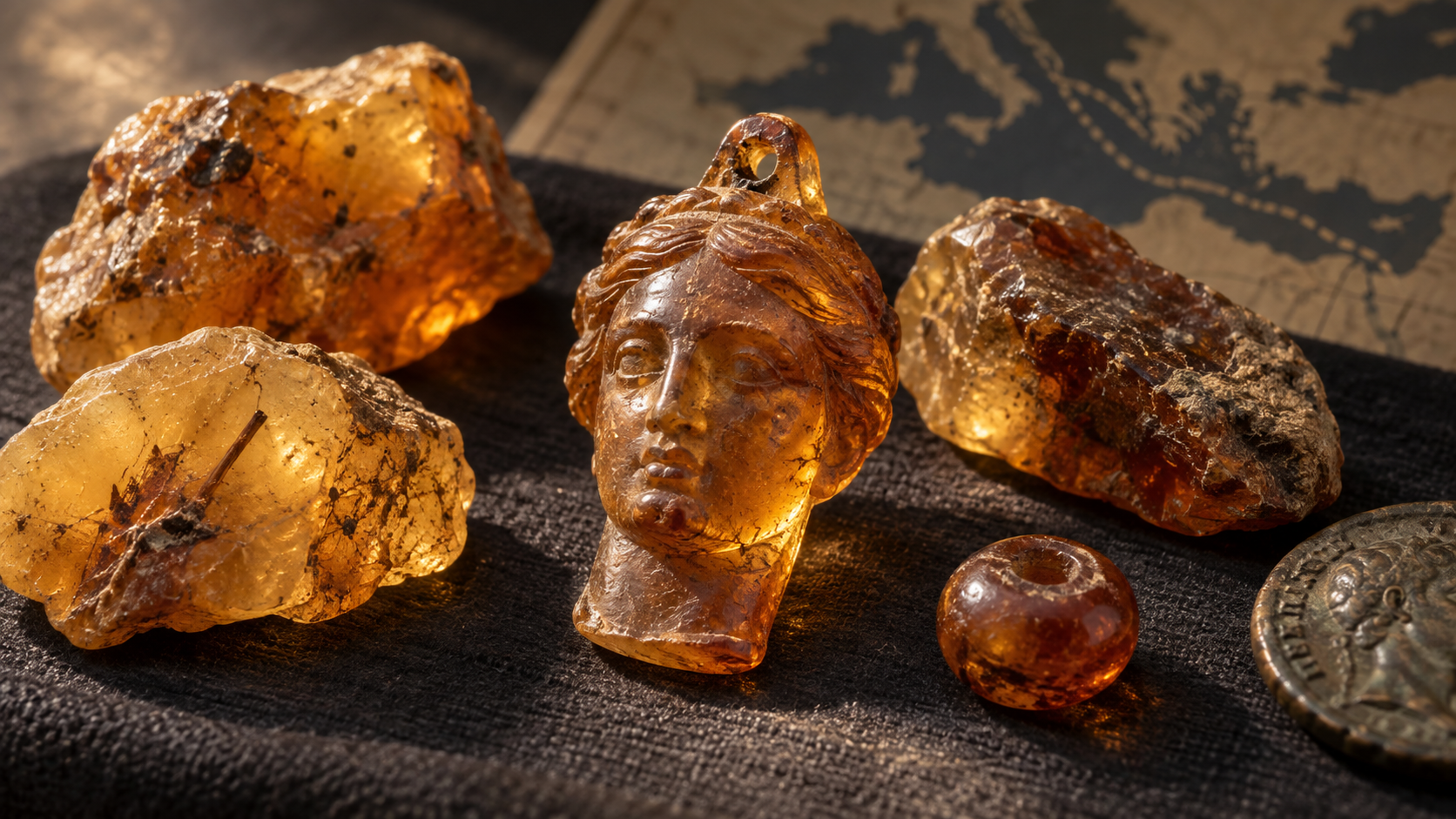
Roman amber pendants and carved objects sometimes took forms that carried protective, erotic, fertility-related or identity-related meanings.
The J. Paul Getty Museum preserves Roman amber pendants in the shape of heads and figures, including examples whose form and suspension indicate personal use.
The Metropolitan Museum likewise preserves Roman amber objects from the imperial period.
When amber was carved into a meaningful image and worn on the body, its significance depended on much more than material alone.
Shape mattered.
Placement mattered.
Cultural beliefs surrounding the image mattered.
The same principle encountered in Egyptian lapis and Byzantine rock crystal appears again:
a gem’s meaning is relational.
Amber and Children
Ancient sources associate amber amulets particularly with children.
Pliny records amber being worn around the neck, including in contexts involving childhood.
Amulets were common throughout the Roman world.
Children were perceived as particularly vulnerable to illness, accident and harmful supernatural forces.
Protective objects could therefore become important components of childhood dress.
But we should be precise.
An amber bead worn by a Roman child may have functioned simultaneously as:
jewellery,
status marker,
family gift,
medical object,
and protective amulet.
Modern categories do not always map neatly onto ancient practice.
The Warmth of Amber
Amber has a tactile characteristic that distinguishes it immediately from most stones.
Touch a piece of quartz and it often feels cool.
Touch amber and it feels comparatively warm.
The reason is physical.
Amber has low thermal conductivity compared with many mineral gemstones.
It does not draw heat from the skin as rapidly.
Ancient people did not need modern thermodynamics to notice the sensation.
Combined with its golden colour and organic origin, this warmth may have contributed to amber’s appeal.
But we should avoid turning plausible sensory experience into undocumented symbolism.
We can say Romans experienced amber as unusually warm and light.
We cannot automatically conclude that every Roman interpreted that warmth as “solar energy.”
Roman Luxury
Amber could also become conspicuous luxury.
Pliny describes extraordinary enthusiasm for the material in Rome.
During the reign of Nero, according to his account, a Roman expedition travelled north to obtain amber for gladiatorial games.
Pliny claims that amber decorated equipment and even the barriers surrounding the arena.
Whether every detail should be read literally, the passage demonstrates something unmistakable:
amber could function as a material of extravagant display.
Its exotic northern origin enhanced its prestige.
A Material More Valuable Than a Slave?
Pliny makes an especially striking remark.
He states that a small amber figurine could command a price greater than that of a living human being.
The comparison is morally disturbing to modern readers, and it should be.
Roman society was built partly upon slavery.
But the statement also reveals the extraordinary luxury value amber could acquire.
A natural material from the distant north, transformed through skilled carving, could become an object of elite desire worth an astonishing amount.
Spiritual meaning and economic value existed within the same cultural world.
Aquileia and Amber Craftsmanship
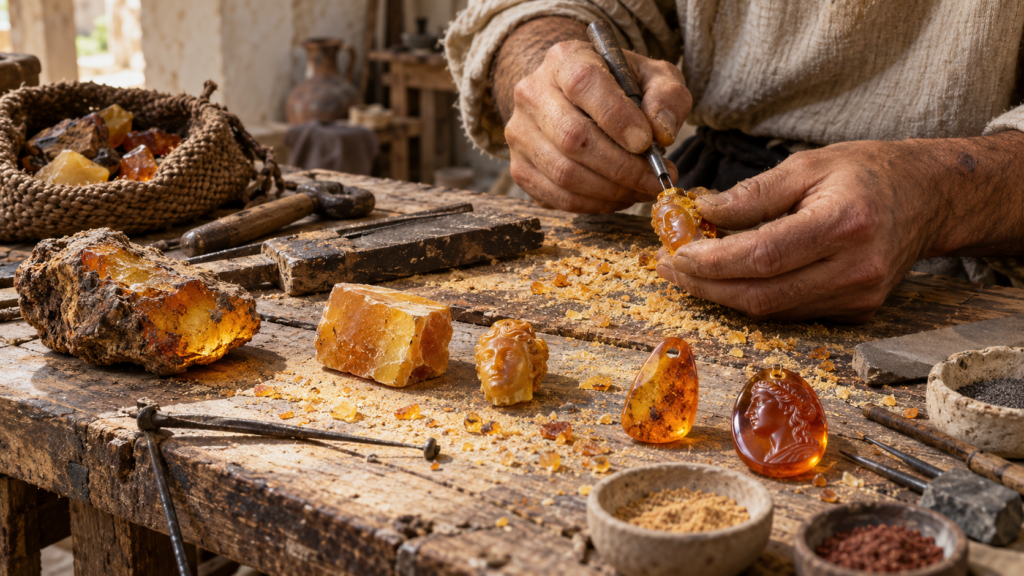
Northern Italy became an important centre for Roman amber working.
Aquileia is particularly associated with sophisticated amber carving.
Roman artisans transformed the material into:
rings,
pendants,
beads,
spindle-related objects,
small vessels,
miniature figures,
and elaborate jewellery.
The softness of amber relative to many mineral gemstones made intricate carving possible.
Yet amber is also brittle and can fracture.
Successful work still required considerable skill.
The resulting objects reveal an aesthetic very different from the untouched amber pieces familiar from modern crystal shops.
Romans did not merely admire amber as nature made it.
They transformed it.
Women, Beauty and Personal Objects
Many Roman amber objects are associated archaeologically with female adornment and burial.
Some depict women.
Others belong to jewellery or personal equipment.
Erotic and fertility-related imagery also occurs.
This has encouraged interpretations connecting amber with femininity, marriage and sexuality in some Roman contexts.
But caution remains necessary.
Not every amber object belonged to a woman.
Not every female-form amber carving was a fertility charm.
And not every grave assemblage reveals exactly what its owner believed.
Archaeological context should always outrank modern expectation.
The Amber Cup with Gladiators
One of the most spectacular Roman amber objects in the Getty Museum is a small vessel carved with gladiatorial combat.
Dated to the late first or early second century CE, it demonstrates the technical possibilities of amber carving.
The imagery is not obviously “spiritual.”
That matters.
If we only select ancient amber objects that look like amulets, we risk creating a false impression that amber was exclusively sacred.
It was also:
luxury,
art,
entertainment culture,
jewellery,
and conspicuous consumption.
Ancient gemstone histories become more accurate when mundane and sacred uses are allowed to coexist.
Amber in Roman Death
Amber objects also appear in Roman graves.
Burial transforms the interpretive context.
An object placed with the dead might preserve:
personal identity,
social status,
affection,
protective symbolism,
religious expectation,
or simply possessions associated with the deceased.
The temptation is to interpret every grave good as a magical device for the afterlife.
Archaeology does not justify that assumption.
Funerary objects can have many meanings.
Nevertheless, repeated deposition of jewellery and amuletic forms demonstrates that amber could accompany individuals beyond ordinary daily life.
Baltic People Were Not One Culture
Another important caution concerns the phrase “Baltic amber beliefs.”
The Baltic region has been inhabited by numerous peoples across thousands of years.
Neolithic communities, Bronze Age societies, Iron Age groups and later historically documented Baltic peoples cannot be treated as one unchanging spiritual culture.
The fact that amber originated geographically in the Baltic does not mean every piece carried a single “Baltic spiritual meaning.”
Archaeological evidence varies dramatically by period and location.
This article therefore distinguishes geological source from cultural interpretation.
Amber could begin in the Baltic and acquire entirely different meanings in Italy.
The Stone That Wasn’t a Stone
Amber’s organic origin gives it a unique symbolic potential.
It comes from trees.
It can contain life.
It burns.
It floats in salt water under appropriate conditions.
It attracts lightweight materials after rubbing.
It feels warm.
It can be translucent like a gemstone while weighing surprisingly little.
These properties made amber unusually mysterious long before modern chemistry explained them.
Yet recognising the physical explanations does not make amber less fascinating.
It makes the ancient fascination easier to understand.
Amber Inclusions: Life Preserved
One of amber’s most extraordinary features is its ability to preserve organisms.
Insects, spiders, plant material and other tiny organisms can become trapped in resin before fossilisation.
These inclusions are scientifically important.
They provide palaeontologists with exceptional windows into ancient ecosystems.
But they also require caution in the gemstone trade.
Not every supposed insect-bearing amber specimen is genuine.
Modern resins, plastics and reconstructed amber can contain deliberately inserted insects.
Scientific identification may require careful examination.
For ancient people, however, the sight of a perfectly recognisable insect suspended inside transparent golden material must have been extraordinary.
Pliny explicitly noticed it.
Protection: Historical and Modern
Modern amber spirituality strongly emphasises protection.
Ancient evidence gives this association genuine historical depth.
Amber was worn amuletically.
Ancient authors describe medicinal and protective practices.
Children could wear amber around the neck.
Yet this does not establish a scientifically measurable protective field around the material.
Historical protection belongs to the study of religion, medicine, magic and social practice.
Scientific protection requires demonstrable mechanisms.
Both concepts can be discussed without confusing them.
Modern Amber Spirituality
Contemporary crystal traditions commonly associate amber with:
- protection
- purification
- warmth
- optimism
- vitality
- grounding
- emotional comfort
- solar energy
- manifestation
It is sometimes associated with the Solar Plexus Chakra or Sacral Chakra, depending on colour and practitioner.
These chakra associations should not be described as ancient European traditions.
The chakra systems originated in South Asian religious contexts.
The modern colour-coded mapping of yellow or orange gemstones onto specific chakras developed much later.
Romans did not use Baltic amber to “balance the Solar Plexus Chakra.”
That is a contemporary synthesis.
Amber and Modern Health Claims
Amber is also surrounded by modern health claims, especially regarding amber teething necklaces.
Such products have been promoted with claims that body warmth releases succinic acid through the skin and that this reduces teething pain or inflammation.
Reliable medical evidence does not establish these benefits.
More importantly, necklaces and beads worn by infants can create strangulation and choking hazards.
Historical use of amber around children’s necks should never be used as evidence that amber teething necklaces are medically effective or safe.
Ancient practice is not a substitute for modern clinical evidence.
Static Electricity Is Real—“Energy Healing” Is Different
Amber genuinely interacts with electrical charge.
This fact sometimes becomes incorporated into metaphysical arguments.
The reasoning can sound persuasive:
amber produces static electricity;
therefore amber affects energy;
therefore amber can influence the body’s spiritual energy field.
The conclusion does not follow from the premise.
Electrostatic charge is a measurable physical phenomenon.
A metaphysical aura is a different claim requiring independent evidence.
The same caution applies to quartz piezoelectricity.
Interesting physical properties should not be repurposed as scientific proof for unrelated healing claims.
A Historically Inspired Amber Reflection
Amber does, however, offer a beautiful basis for contemporary contemplation.
Take a piece of natural amber.
Hold it in daylight.
Notice its low weight.
Feel how quickly it warms in your hand.
Look for internal clouds, fractures or organic debris.
If inclusions are present, observe them without assuming they are insects until properly identified.
Then consider the journey represented by ancient Baltic amber.
A material formed millions of years ago.
Released from geological deposits.
Collected beside a northern sea.
Passed through many human hands.
Transported across Europe.
Carved in a Roman workshop.
Worn by someone whose name has disappeared from history.
Ask:
Which objects in my own life connect me with places I have never seen?
Then:
What do I carry because of its meaning rather than its utility?
Finally:
Which stories have I inherited without asking where they originated?
The amber does not provide mystical answers.
Its history gives the questions unusual depth.
A Different Kind of Solar Stone
There is no need to claim that amber stores literal solar energy.
Its relationship with sunlight is already extraordinary.
Ancient resin began with trees.
Trees depended on sunlight.
Resin became buried.
Millions of years passed.
Humans later discovered the resulting fossil substance and interpreted its golden appearance through stories of the sun.
The material therefore connects sunlight, biology, geology and mythology in ways that are real without being supernatural.
That may be more compelling than any claim of invisible vibration.
What Can We Say with Confidence?
Several conclusions are historically secure.
Amber is fossilised plant resin rather than a mineral crystal.
The Baltic region supplied enormous quantities of amber to prehistoric and historical European exchange networks.
Amber travelled over very long distances before and during the Roman period.
Romans carved it into jewellery, amulets, figurines, vessels and luxury objects.
Pliny the Elder correctly connected amber with tree resin and recorded both mythological stories and medicinal beliefs surrounding it.
Amber’s electrostatic behaviour was known in antiquity and ultimately contributed to the vocabulary of electricity.
Some ancient amber objects had amuletic or protective functions.
Amber could also function simply as luxury, personal ornament and artistic material.
Modern chakra associations and many contemporary healing claims should not be projected backwards into antiquity.
Conclusion
The history of amber spiritual meaning in ancient Europe is not the story of one universal crystal property.
It is the story of transformation.
Resin became fossil.
A northern natural material became Mediterranean luxury.
A beach find became jewellery.
A golden substance became a mythological tear.
A carved pendant became an amulet.
An observable electrostatic phenomenon eventually gave its name to electricity.
And Roman writers attempted to distinguish natural history from myth even while recording medical and magical beliefs surrounding the material.
Amber therefore occupies an unusual position between worlds:
organic and geological
northern and Mediterranean
scientific and mythological
ornamental and protective
ancient and modern
Contemporary crystal traditions continue to associate amber with protection, warmth and solar vitality. Those beliefs form part of amber’s evolving cultural biography, but they should remain distinct from documented Roman practice and from scientifically established properties.
At Natural Gems Belgium, we believe amber offers a particularly important lesson.
A natural material does not need to emit an invisible healing force to possess extraordinary power as a cultural object.
Amber can preserve an insect for tens of millions of years.
It can record prehistoric exchange.
It can reveal Roman luxury.
It can carry myth across millennia.
And when rubbed, it can demonstrate the physical phenomenon that ultimately gave electricity its name.
The ancient world saw sunlight in amber.
Modern science sees fossilised resin.
History allows us to appreciate both.
References & Further Reading
Gemmology & Natural History
Gemological Institute of America (GIA) — Amber
Authoritative gemmological overview of amber as an organic gem material, including formation, appearance, inclusions, geographic sources and quality factors.
Gemological Institute of America (GIA) — Amber History and Lore
Overview of amber’s long history in jewellery and trade, including ancient Greek and Roman traditions and the historical importance of Baltic material.
Gemological Institute of America (GIA) — Amber Description
Detailed explanation of amber’s organic origin, fossilisation and gemmological characteristics.
Pliny the Elder: Amber in the Roman World
Perseus Digital Library — Pliny the Elder, Natural History, Book XXXVII
Primary Roman literary source for amber. Pliny discusses its northern origin, resinous nature, insects trapped inside it, myths concerning amber, trade, Roman luxury and medicinal beliefs.
University of Chicago, LacusCurtius — Pliny the Elder, Natural History, Book XXXVII
Alternative scholarly presentation of the Latin text and translation. Particularly useful for Pliny’s extended discussion of amber and his attempts to distinguish natural explanations from mythical accounts.
Greek Myth & the Heliades
Theoi Classical Texts — Heliades
Collection of translated Greek and Roman literary passages concerning the daughters of Helios, their mourning for Phaethon and traditions in which their tears become amber.
This literary tradition documents ancient mythological symbolism. It should not be treated as an ancient geological explanation validated by science.
Roman Amber Objects
J. Paul Getty Museum — Pendant with Head of a Woman
Roman amber pendant dated to the first–second century CE. A direct example of amber being transformed into personal figurative ornament within the Roman world.
J. Paul Getty Museum — Pendant with Head of a Youth
Roman carved amber pendant illustrating the sophistication of imperial-period amber craftsmanship and its use in personal adornment.
J. Paul Getty Museum — Cup with Gladiators
Exceptional Roman amber vessel decorated with gladiatorial imagery, demonstrating that amber’s ancient role extended beyond amulets into luxury art and elite material culture.
The Metropolitan Museum of Art — Roman Amber Objects Collection Search
The Met’s searchable collection provides comparative Roman amber jewellery, carved ornaments and personal objects useful for studying amber within the wider material culture of the Roman Empire.
Baltic Amber & Ancient Exchange
The Metropolitan Museum of Art — Heilbrunn Timeline: Trade between the Romans and the Empires of Asia
Broader scholarly context for the enormous long-distance exchange systems operating during the Roman period. Amber participated in a world in which luxury materials could travel across extensive interconnected networks.
Encyclopaedia Britannica — Amber Routes
Historical overview of the trade routes through which Baltic amber moved south toward Mediterranean markets in antiquity.
The term “Amber Road” is best understood as shorthand for changing networks of exchange rather than one single permanent ancient highway.
Amber, Electricity & Physical Properties
Encyclopaedia Britannica — Amber
Reference overview covering amber’s fossil-resin origin, physical characteristics, historical use and the relationship between the Greek word for amber and the later vocabulary of electricity.
The electrostatic attraction produced when amber is rubbed is a genuine physical phenomenon. It should not be confused with claims concerning metaphysical healing energy.
Amber Teething Necklaces: Medical Evidence & Safety
U.S. Food and Drug Administration — FDA Warns About Safety Risks of Teething Necklaces and Bracelets
Official medical safety warning concerning jewellery marketed for infant teething, including amber necklaces. The FDA identifies risks including choking and strangulation.
American Academy of Pediatrics / HealthyChildren.org — Amber Teething Necklaces: Are They Safe?
Evidence-based paediatric guidance explaining that claims made for amber teething jewellery are unsupported and that necklaces can present significant safety hazards.
Historical Belief Versus Scientific Evidence
Ancient literary and archaeological evidence demonstrates that amber could function as jewellery, luxury material, amulet and medicinal substance within historical belief systems.
Those traditions are historically real.
They do not demonstrate that amber possesses scientifically established healing, anti-inflammatory or metaphysical properties.
Likewise:
documented electrostatic charge ≠ proof of spiritual energy
and
ancient medicinal use ≠ modern clinical evidence.
The strongest historical interpretation therefore distinguishes between amber’s measurable physical properties, documented ancient beliefs and contemporary metaphysical traditions.