Separating Two Historically Confused Red Gemstones
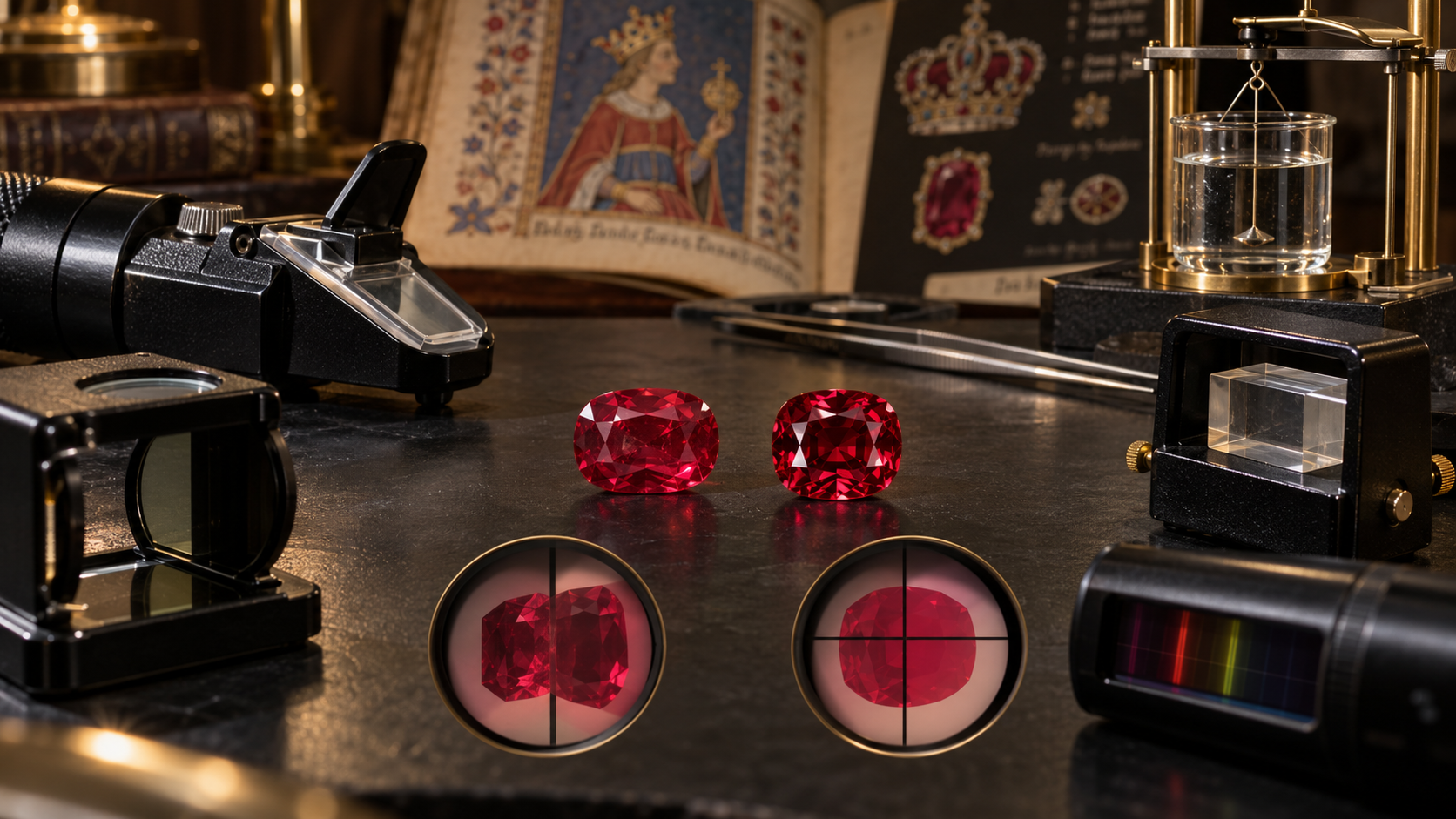
Two transparent red gemstones arrive at the laboratory.
Both are intensely coloured.
Both are natural.
Both are attractive enough to have been called:
ruby
by an observer relying only on appearance.
But only one is ruby.
The other is:
red spinel.
Today, distinguishing them can be straightforward with basic gemmological instruments.
Historically, however, the distinction was far less obvious.
Some of the world’s most celebrated “rubies” eventually proved not to be ruby at all.
That makes this workshop more than an identification exercise.
It demonstrates how:
mineralogy changed the language of gemstones.
Table of Contents
Understanding ruby vs red spinel identification is crucial for gem enthusiasts and professionals alike.
Welcome to:
UNKNOWN STONE WORKSHOP 4
Ruby or Red Spinel?
THE TWO UNKNOWN STONES
We will call them:
SAMPLE A
and:
SAMPLE B.
Both are transparent red faceted gemstones.
They are similar in:
- apparent size;
- saturation;
- transparency;
- visual appeal.
No supplier declaration will be considered.
No price information will be considered.
No assumptions will be made from colour alone.
Our task is:
IDENTIFY THE MINERAL SPECIES.
Unlike the previous emerald workshop, we are not initially distinguishing natural from synthetic versions of the same material.
Here we are separating:
two different minerals.
PART I — WHAT IS RUBY?
Ruby is the red variety of:
CORUNDUM
Corundum has the essential chemical composition:
Al₂O₃
—aluminium oxide.
Pure corundum would be essentially colourless.
Ruby’s red colour results principally from:
chromium substituting for aluminium within the crystal structure.
GIA gives representative ruby properties of approximately:
Refractive Index: 1.762–1.770
Birefringence: 0.008–0.010
Specific Gravity: 4.00
Mohs Hardness: 9
Crystal system:
Trigonal
Optical character:
Uniaxial
Ruby is therefore:
anisotropic and doubly refractive.
Remember that phrase.
It will become one of our strongest clues.
PART II — WHAT IS SPINEL?
Gem spinel is a different mineral.
Its idealised formula is:
MgAl₂O₄
—magnesium aluminium oxide.
Spinel occurs naturally in numerous colours, including:
- red;
- pink;
- orange;
- violet;
- blue;
- grey;
- black.
Red spinel can be coloured predominantly by:
chromium.
That shared chromium-related coloration helps explain why fine red spinel can resemble ruby so convincingly.
GIA gives representative spinel properties of approximately:
Refractive Index: 1.718
Specific Gravity: 3.60
Mohs Hardness: 8
Crystal system:
Cubic
And therefore:
singly refractive / isotropic.
This is fundamentally different from ruby.
PART III — WHY WERE THEY CONFUSED?
Before modern mineralogical classification and gemmological instrumentation, gemstones were often grouped primarily according to:
- colour;
- appearance;
- geographic source;
- traditional terminology.
Transparent red stones could therefore be described under terminology that did not correspond to modern mineral species.
A particularly important historical term was:
balas ruby.
This name became associated with red spinel, especially material historically linked to the Badakhshan region of Central Asia.
The word “ruby” in a historical document therefore does not necessarily mean:
corundum ruby
in the modern mineralogical sense.
PART IV — THE BLACK PRINCE’S “RUBY”
One of the most famous examples sits in Britain’s Imperial State Crown.
Above the Cullinan II diamond is a large irregular red gemstone traditionally known as:
THE BLACK PRINCE’S RUBY.
Despite its historic name, the stone is:
spinel.
The Royal Collection Trust describes it as a large irregular cabochon red spinel weighing:
170 carats.
Its documented royal history extends back centuries.
Its traditional name survived even after mineralogical knowledge established that the stone was not corundum ruby.
The quotation marks around historical “ruby” matter.
PART V — THE TIMUR “RUBY”
Another extraordinary example belongs to the Royal Collection.
The:
TIMUR RUBY
is also not ruby.
It is a:
spinel.
The Royal Collection Trust describes the stone as a polished irregular spinel weighing:
352.50 carats.
It carries inscriptions recording several historical owners.
Its traditional name again preserves an older gemstone vocabulary.
These famous examples show that the ruby–spinel distinction is not merely an academic laboratory problem.
It changed how historically important royal gemstones were understood.
PART VI — VISUAL EXAMINATION
Return to Samples A and B.
Under neutral white illumination, both appear:
red.
Sample A may show a slightly purplish-red tone.
Sample B may appear somewhat more vivid.
Can colour identify ruby?
NO.
Can colour identify spinel?
NO.
Fine ruby and fine red spinel occupy overlapping visual territory.
Chromium can contribute strongly to colour in both.
Therefore:
red colour is evidence of colour—not mineral species.
PART VII — THE FIRST PROFESSIONAL HABIT
Before reaching for an advanced instrument, write:
OBSERVATION: transparent red gemstone.
Do not write:
IDENTIFICATION: ruby.
This distinction between:
observation
and:
interpretation
is fundamental to good gemmology.
PART VIII — 10× MAGNIFICATION
Inspect both samples with a loupe.
Look for:
- facet junctions;
- surface-reaching fractures;
- inclusions;
- colour zoning;
- cavities;
- doubling;
- polishing features.
Both stones appear natural.
But suppose no immediately diagnostic inclusion is visible.
What next?
Use measurable properties.
PART IX — REFRACTIVE INDEX
Place Sample A on the refractometer.
Suppose the readings are approximately:
1.762
and:
1.770.
The difference is:
0.008.
This is highly significant.
The readings are consistent with:
corundum.
They also demonstrate:
birefringence.
Sample A has now given us strong evidence for:
RUBY.
But continue the investigation.
PART X — SAMPLE B ON THE REFRACTOMETER
Now measure Sample B.
The shadow edge appears around:
1.718.
Rotate the stone.
The reading remains essentially:
single.
That result is characteristic of normal gem spinel.
Sample B therefore provides strong evidence for:
SPINEL.
Already, one basic gemmological instrument has separated the stones very effectively.
PART XI — WHY THE RI DIFFERENCE MATTERS
Ruby:
RI approximately 1.762–1.770
Spinel:
RI approximately 1.718
The values are sufficiently separated that a good refractometer reading can provide powerful evidence.
This is quite different from yesterday’s natural-versus-synthetic emerald problem, where natural and synthetic stones share the same mineral identity and can have overlapping physical properties.
Here:
different mineral structures produce distinctly different optical behaviour.
PART XII — DOUBLE REFRACTION
Ruby belongs to the trigonal crystal system.
It is:
anisotropic.
Light entering ruby generally experiences two principal refractive indices.
This produces:
double refraction.
The difference between those indices is:
birefringence.
GIA gives ruby birefringence at approximately:
0.008–0.010.
This is measurable with a refractometer.
PART XIII — SPINEL IS ISOTROPIC
Spinel belongs to the:
cubic crystal system.
Normal spinel is:
isotropic.
Its optical behaviour therefore differs fundamentally from ruby.
Instead of two principal refractive indices, spinel ordinarily gives:
one refractive index.
This single-refractive behaviour provides another route to separation.
PART XIV — THE POLARISCOPE
Now place Sample A between crossed polars.
Rotate it.
An anisotropic gemstone generally alternates between:
light
and:
dark
positions during rotation.
Ruby should show doubly refractive behaviour.
Now test Sample B.
Normal spinel should remain:
dark throughout rotation
because it is singly refractive.
This is a powerful classical separation.
But there is a complication.
PART XV — ANOMALOUS DOUBLE REFRACTION
Some cubic gemstones can display:
anomalous double refraction
caused by internal strain.
Spinel is one of them.
Under crossed polars, a strained spinel may therefore show anomalous light patterns instead of remaining perfectly dark.
These can sometimes appear as:
- irregular illumination;
- cross-like patterns;
- strain effects.
Therefore:
light under crossed polars does not automatically prove ruby.
Interpret the pattern.
Then combine it with RI.
Again:
EVIDENCE CONVERGENCE.
PART XVI — THE DICHROSCOPE
Ruby is pleochroic.
Because it is anisotropic, differently oriented light can experience different absorption.
Ruby commonly displays two red components such as:
orangy red
and:
purplish red.
Exact appearance depends on colour, orientation and lighting.
Spinel is cubic.
It should not display true pleochroism.
Therefore the dichroscope can provide another useful separation:
Ruby
dichroic
Spinel
non-pleochroic
But weak colour differences should never be overinterpreted.
PART XVII — SPECIFIC GRAVITY
Now perform hydrostatic weighing.
Suppose:
Sample A
SG ≈ 4.00
Sample B
SG ≈ 3.60
These values align strongly with:
corundum
and:
spinel
respectively.
We now have several independent properties pointing in the same direction.
PART XVIII — BUILD THE EVIDENCE TABLE
| Property | Sample A | Sample B |
|---|---|---|
| Colour | Red | Red |
| RI | ~1.762–1.770 | ~1.718 |
| Birefringence | ~0.008 | None normally |
| Optical character | Doubly refractive | Singly refractive |
| Pleochroism | Present | Absent |
| SG | ~4.00 | ~3.60 |
| Working ID | Ruby | Spinel |
Notice what did not separate them reliably:
colour.
What did?
measured physical and optical properties.
PART XIX — UV FLUORESCENCE
Now examine both stones under ultraviolet radiation.
Chromium-bearing ruby can show:
strong red fluorescence, particularly under long-wave UV.
Fine red spinel can also fluoresce:
red.
Therefore:
RED FLUORESCENCE DOES NOT EQUAL RUBY.
This is a crucial lesson.
The same chromophore can produce broadly related luminescent behaviour in different host minerals.
PART XX — WHY IRON MATTERS
Iron can suppress chromium-related fluorescence.
Consequently, rubies with significant iron content may fluoresce much less strongly than low-iron rubies.
GIA research on Mozambique ruby, for example, documents how iron content influences fluorescence.
Therefore:
weak fluorescence does not eliminate ruby.
Likewise:
strong red fluorescence does not eliminate spinel.
Fluorescence is supporting evidence.
PART XXI — THE SPECTROSCOPE
A handheld spectroscope can reveal selective absorption related to chromium.
Ruby produces a characteristic chromium-related spectrum.
Red spinel can also show chromium-related absorption.
The patterns are not identical because chromium occupies different structural environments in:
corundum
and:
spinel.
Spectroscopy therefore provides another useful layer of evidence.
But for this particular separation, RI and optical character are usually simpler and more direct.
PART XXII — RUBY’S CHROMIUM SPECTRUM
Ruby’s visible spectrum can show:
- absorption in the violet/blue region;
- absorption in the yellow-green region;
- transmission in red;
- characteristic sharp chromium features in the red region.
These spectral characteristics are related to Cr³⁺ in corundum.
The same chromium responsible for ruby’s red colour also produces its famous red fluorescence.
PART XXIII — CHROMIUM IN RED SPINEL
Chromium can also substitute into spinel.
But chromium exists in a different crystal-field environment.
Therefore its absorption and luminescence characteristics differ from those in corundum.
Modern spectroscopy can exploit these structural differences.
This illustrates an important principle:
the same trace element can behave differently in different host crystals.
PART XXIV — MICROSCOPY: SAMPLE A
Return Sample A to the microscope.
Possible natural-ruby features depend strongly on geological origin.
They may include:
- rutile needles;
- healed fissures;
- mineral crystals;
- growth zoning;
- negative crystals;
- fluid-related features.
Fine rutile needles are traditionally called:
silk.
But not every natural ruby contains visible rutile.
And heat treatment can alter rutile inclusions.
Therefore:
no silk ≠ synthetic ruby.
PART XXV — RUBY SILK
Rutile silk can form oriented needle-like inclusions within corundum.
When sufficiently dense and appropriately oriented, such inclusions can scatter light.
In cabochons, organised rutile silk can contribute to:
asterism
—the star effect.
Microscopically, unaltered rutile silk can provide useful information about natural growth and treatment history.
But its interpretation requires experience.
PART XXVI — MICROSCOPY: SAMPLE B
Natural red spinel can contain its own characteristic inclusion populations.
GIA literature documents features including:
- octahedral crystals;
- negative crystals;
- healed fractures;
- fingerprint-like inclusions;
- apatite;
- calcite;
- zircon;
- other mineral inclusions
depending on locality.
Some spinel inclusions can be extremely attractive under magnification.
Again:
an inclusion should be interpreted within a suite.
PART XXVII — OCTAHEDRAL CLUES
Spinel crystallises in the:
cubic system
and commonly forms:
octahedral crystals.
Octahedral negative crystals or included crystals can therefore provide useful clues.
Corundum does not share the same crystal structure.
But morphology alone should still be interpreted carefully.
A single geometric cavity is not a substitute for full testing.
PART XXVIII — HARDNESS
Ruby:
Mohs 9
Spinel:
Mohs 8
Could we scratch the stones to separate them?
Technically, their hardness differs.
Practically:
DO NOT DO THIS.
Destructive scratch testing is inappropriate for faceted gemstones when non-destructive methods are available.
The refractometer, polariscope and hydrostatic balance can solve the problem without damaging either stone.
PART XXIX — WHY “SCRATCHES GLASS” IS USELESS HERE
Both ruby and spinel are much harder than ordinary glass.
Therefore both can scratch glass.
If our test were:
“Does it scratch glass?”
both stones could pass.
We would have damaged or risked damaging material and learned almost nothing useful.
Professional gemmology replaces crude destructive tests with:
specific measurable properties.
PART XXX — NATURAL VERSUS SYNTHETIC IS A SECOND QUESTION
Suppose Sample A is conclusively identified as:
ruby.
Are we finished?
No.
We have established:
mineral species.
We have not necessarily established:
natural growth origin.
Synthetic ruby also exists.
Likewise:
synthetic spinel exists.
Therefore the complete identification workflow contains another layer.
PART XXXI — SYNTHETIC RUBY
Synthetic ruby has been commercially important since the development of flame-fusion production around the beginning of the twentieth century.
Auguste Verneuil’s process enabled synthetic corundum to be manufactured commercially.
Flame-fusion synthetic ruby may display:
- curved growth striae;
- gas bubbles;
- characteristic growth features.
Other synthetic ruby processes include:
- flux growth;
- hydrothermal growth;
- Czochralski pulling
and others.
Different growth processes produce different evidence.
PART XXXII — SYNTHETIC SPINEL
Synthetic spinel has also been manufactured commercially, particularly by flame fusion.
Its composition may differ from ideal natural spinel, which can alter measurable properties.
Synthetic spinel has historically been used both as:
- a gemstone in its own right;
- an imitation of other coloured gemstones.
Therefore once we identify:
spinel
we may still need to determine:
natural or synthetic?
PART XXXIII — SPECIES FIRST
This leads to an important laboratory sequence.
Do not begin with:
“Is it natural?”
Begin with:
“WHAT IS IT?”
For our samples:
Sample A
Species identification:
Corundum
Variety:
Ruby
Then:
Natural or synthetic?
Treatment?
Possible geographic origin?
Sample B
Species identification:
Spinel
Variety:
Red spinel
Then:
Natural or synthetic?
Treatment?
Possible geographic origin?
The order prevents conceptual confusion.
PART XXXIV — TREATMENT IS ANOTHER SEPARATE QUESTION
Natural ruby is frequently:
heat treated.
Some rubies may also be:
- fracture filled;
- diffusion treated;
- otherwise modified.
Spinel historically had a reputation as a gemstone commonly sold without treatment.
However, treatment detection should still be based on evidence rather than assumptions.
Therefore:
natural
does not mean:
untreated.
And:
ruby
does not mean:
heated.
Every conclusion requires its own evidence.
PART XXXV — THE IDENTIFICATION HIERARCHY
For an unknown red gemstone, use:
LEVEL 1 — MATERIAL IDENTITY
Ruby?
Spinel?
Garnet?
Tourmaline?
Glass?
Another red material?
↓
LEVEL 2 — GROWTH ORIGIN
Natural?
Synthetic?
↓
LEVEL 3 — TREATMENT
Heated?
Filled?
Diffused?
Other treatment?
↓
LEVEL 4 — GEOGRAPHIC ORIGIN
Only when scientifically supportable.
Each level asks a different question.
PART XXXVI — WHY GARNET ALSO ENTERS THE PROBLEM
Historically and visually, garnet can also resemble ruby or spinel.
Red garnets can be intensely saturated and transparent.
But classical gemmology again separates them.
Many garnets are:
singly refractive
like spinel.
So optical character alone would not separate every red garnet from spinel.
RI, SG, spectrum and other properties become necessary.
This demonstrates why identification trees must remain flexible.
PART XXXVII — THE LIMITS OF ONE TEST
Suppose an unknown red stone is singly refractive.
Is it spinel?
Not necessarily.
Possibilities could include:
- spinel;
- garnet;
- glass;
- cubic synthetic materials;
- other isotropic substances.
Therefore:
single refraction narrows the field.
It does not necessarily complete the identification.
Now add RI.
An RI around:
1.718
strongly supports spinel.
The evidence becomes much stronger.
PART XXXVIII — THE VALUE OF REDUNDANCY
Why measure SG if RI already indicates spinel?
Because professional identification benefits from:
independent confirmation.
If RI says:
spinel
and SG says:
3.60
and the stone is:
singly refractive
and microscopy is consistent with natural spinel:
the evidence converges.
If one result conflicts, investigate.
A discrepancy is not an inconvenience.
It is information.
PART XXXIX — WHAT IF RI SAYS RUBY BUT SG DOES NOT?
Suppose:
RI ≈ 1.76–1.77
but SG ≈ 3.60.
Those results conflict.
Do not average them.
Ask:
- Was the RI read correctly?
- Was the stone properly coupled?
- Was the SG measurement affected by bubbles?
- Is the balance calibrated?
- Is the stone mounted?
- Is it composite?
- Did we test the intended specimen?
Professional gemmology investigates disagreement.
PART XL — COMPOSITE STONES
An unknown red gemstone can also be:
composite.
Examples include assembled stones made from multiple components.
If different portions produce inconsistent:
- RI;
- colour;
- fluorescence;
- inclusions
inspect for:
- join planes;
- adhesive;
- differing lustre;
- differing inclusion populations.
Never force a homogeneous-mineral interpretation onto an assembled stone.
PART XLI — THE HISTORICAL LESSON
The Black Prince’s Ruby and Timur Ruby are not embarrassing historical mistakes.
They demonstrate something more interesting:
gemstone classification evolved.
Modern mineralogy separates gemstones according to:
- chemistry;
- crystal structure;
- optical properties;
- physical properties.
Earlier gemstone terminology often reflected:
- colour;
- appearance;
- locality;
- tradition.
The meaning of a gemstone name therefore depends partly on:
historical context.
PART XLII — WHEN DID THE DISTINCTION BECOME POSSIBLE?
The eighteenth century was a decisive period in distinguishing spinel from ruby scientifically.
As chemical and crystallographic understanding developed, spinel emerged as a mineral distinct from corundum.
This was part of a broader transformation:
gemstones stopped being classified mainly by appearance and increasingly became:
minerals defined by measurable structure and composition.
Modern gemmology grew from that intellectual shift.
PART XLIII — COLOUR NAMES ARE NOT MINERAL IDENTITIES
Consider:
red.
That colour can occur in:
- ruby;
- spinel;
- garnet;
- tourmaline;
- zircon;
- beryl;
- glass;
- synthetic materials.
Therefore:
colour describes appearance.
Mineral identity describes:
what the material actually is.
This distinction is one of the foundations of gemmology.
PART XLIV — SAMPLE A FINAL ANALYSIS
Let us assemble the evidence.
Visual appearance
Transparent saturated red.
Not diagnostic.
RI
1.762–1.770
Strongly consistent with corundum.
Birefringence
Approximately 0.008
Consistent with corundum.
Optical character
Doubly refractive / uniaxial.
Consistent with corundum.
Dichroism
Present.
Consistent with ruby.
SG
Approximately 4.00
Consistent with corundum.
Spectrum / fluorescence
Chromium-related behaviour compatible with ruby.
Microscopy
Natural inclusion suite.
Conclusion:
NATURAL RUBY
Treatment determination remains a separate step.
PART XLV — SAMPLE B FINAL ANALYSIS
Visual appearance
Transparent saturated red.
Not diagnostic.
RI
Approximately 1.718
Consistent with spinel.
Birefringence
None under normal behaviour.
Optical character
Singly refractive.
Consistent with cubic spinel.
Dichroism
Absent.
Consistent with spinel.
SG
Approximately 3.60
Consistent with spinel.
Spectrum / fluorescence
Chromium-related behaviour compatible with red spinel.
Microscopy
Natural inclusion suite.
Conclusion:
NATURAL RED SPINEL
PART XLVI — THE FASTEST RELIABLE CLASSICAL ROUTE
If an experienced gemologist receives two loose faceted red stones suspected to be ruby and spinel, a highly efficient sequence is:
1. REFRACTOMETER
↓
Ruby around 1.76–1.77
Spinel around 1.718
↓
2. POLARISCOPE / OPTICAL CHARACTER
↓
Ruby: doubly refractive
Spinel: normally singly refractive
↓
3. SG IF REQUIRED
↓
Ruby around 4.00
Spinel around 3.60
↓
4. MICROSCOPY
↓
Natural/synthetic/treatment evidence
This is often enough to solve the species question rapidly.
PART XLVII — A BLIND TEST
You receive a red gemstone.
Refractometer:
1.718
Polariscope:
singly refractive
SG:
3.59
Red fluorescence:
strong
What is the most logical working identification?
The fluorescence might tempt a beginner toward ruby.
But the decisive physical properties indicate:
SPINEL.
This demonstrates why fluorescence must not overrule stronger contradictory evidence.
PART XLVIII — BLIND TEST 2
Unknown red stone:
RI:
1.763–1.771
Birefringence:
0.008
SG:
4.01
Dichroism:
red / purplish red
Strong red fluorescence.
Working identification:
RUBY / CORUNDUM.
Now proceed to:
natural versus synthetic
and:
treatment determination.
PART XLIX — BLIND TEST 3
Unknown red stone:
RI:
above the standard refractometer range
SG:
approximately 4.2
Singly refractive.
Should you call it ruby?
No.
The evidence conflicts strongly with ruby.
A red garnet species may be a more appropriate direction to investigate.
The purpose of an identification workflow is not to confirm the first guess.
It is to:
eliminate incorrect hypotheses.
PART L — WHY THE REFRACTOMETER IS SO POWERFUL HERE
Yesterday’s emerald workshop demonstrated a situation where RI cannot easily answer natural versus synthetic origin.
Today’s workshop demonstrates the opposite.
When comparing two different minerals with sufficiently separated refractive indices:
RI can be decisive.
An instrument is not universally powerful or weak.
Its value depends on:
the question being asked.
PART LI — THE SAME PRINCIPLE APPLIES TO SG
Specific gravity could not reliably separate every natural emerald from every synthetic emerald.
But it contributes strongly here:
Ruby:
~4.00
Spinel:
~3.60
The difference is meaningful.
Again:
the usefulness of a property depends on the competing hypotheses.
PART LII — THIS IS HOW GEMMOLOGISTS THINK
The professional does not ask:
“What is the best gemmological instrument?”
The professional asks:
“Which measurement most efficiently separates the possibilities still remaining?”
For ruby versus spinel:
RI + optical character
are extremely efficient.
For diamond versus CZ:
thermal behaviour + SG + optical observations
may be powerful.
For natural versus synthetic emerald:
microscopy and advanced analysis
become much more important.
The test follows the problem.
PART LIII — THE NGB RUBY VS SPINEL WORKFLOW
UNKNOWN TRANSPARENT RED GEMSTONE
↓
VISUAL OBSERVATION
Red colour establishes no species.
↓
REFRACTIVE INDEX
Around 1.762–1.770?
→ Investigate corundum/ruby.
Around 1.718?
→ Investigate spinel.
Different?
→ Broaden possibilities.
↓
OPTICAL CHARACTER
Doubly refractive / uniaxial?
→ Supports ruby.
Singly refractive?
→ Supports spinel or another isotropic material.
↓
DICHROISM
Present?
→ Supports ruby.
Absent?
→ Compatible with spinel.
↓
SPECIFIC GRAVITY
~4.00?
→ Supports ruby.
~3.60?
→ Supports spinel.
↓
SPECTRUM + UV
Use as supporting evidence.
Do not identify from fluorescence alone.
↓
MICROSCOPY
Natural inclusion suite?
Synthetic growth features?
Treatment evidence?
↓
SPECIES CONCLUSION
Ruby or spinel.
↓
GROWTH ORIGIN
Natural or synthetic.
↓
TREATMENT
Where applicable.
↓
GEOGRAPHIC ORIGIN
Only if sufficiently supported.
PART LIV — THE CENTRAL LESSON
Two gemstones can share:
- colour;
- transparency;
- chromium coloration;
- strong red fluorescence;
- extraordinary beauty;
- centuries of shared terminology.
Yet they can be:
different minerals.
Modern gemmology does not separate ruby from spinel because one is more beautiful.
It separates them because their:
- crystal structures;
- optical properties;
- densities;
- chemistry
are different.
Conclusion
Our two unknown gemstones began as:
two red stones.
History demonstrates why that description once created confusion.
The Black Prince’s Ruby is actually:
red spinel.
The Timur Ruby is also:
spinel.
Their traditional names preserve an era when gemstone terminology did not correspond precisely to modern mineral species.
Today, the same problem can be solved systematically.
Ruby is:
red corundum.
Its characteristic properties include approximately:
RI 1.762–1.770
birefringence 0.008–0.010
SG 4.00
Mohs 9
and:
doubly refractive, uniaxial optical behaviour.
Red spinel is:
MgAl₂O₄ spinel.
Its characteristic properties include approximately:
RI 1.718
SG 3.60
Mohs 8
and:
singly refractive, isotropic optical behaviour.
Colour alone cannot reliably separate them.
Neither can red fluorescence.
Both can owe their vivid red colour to chromium.
Instead, the most efficient classical separation comes from:
REFRACTIVE INDEX
plus:
OPTICAL CHARACTER.
Specific gravity, dichroism, spectroscopy and microscopy provide additional confirmation.
But today’s exercise also introduced another important discipline.
Identification occurs in layers.
First:
WHAT IS THE MATERIAL?
Then:
IS IT NATURAL OR SYNTHETIC?
Then:
HAS IT BEEN TREATED?
And only when scientifically justified:
WHERE DID IT COME FROM?
Those questions must not be collapsed into one another.
A refractometer can establish strong evidence for corundum.
It cannot by itself prove that the ruby is natural.
A singly refractive stone with RI around 1.718 strongly supports spinel.
It does not by itself prove that the spinel grew naturally.
Every test answers a particular question.
And that leads to the most important principle of this workshop:
DO NOT ASK AN INSTRUMENT TO ANSWER A QUESTION IT DOES NOT MEASURE.
Ruby and red spinel may have deceived generations of observers relying on colour.
Modern gemmology replaces that ambiguity with something much stronger:
repeatable physical evidence.
That is the transition from:
looking at gemstones
to:
identifying gemstones.
References & Further Reading
Gemological Institute of America (GIA) — “Ruby.” Gem Encyclopedia.
Authoritative reference for ruby’s mineral identity and standard gemmological properties. GIA identifies ruby as corundum (Al₂O₃) and gives representative RI 1.762–1.770, birefringence 0.008–0.010, SG 4.00 and Mohs hardness 9.
https://www.gia.edu/ruby
Gemological Institute of America (GIA) — “Spinel.” Gem Encyclopedia.
Core reference for natural spinel, including its MgAl₂O₄ composition, cubic crystal system and representative gemmological properties. GIA gives spinel RI approximately 1.718, SG approximately 3.60 and Mohs hardness 8.
https://www.gia.edu/spinel
Royal Collection Trust — “The Imperial State Crown.”
Primary institutional reference for the British Imperial State Crown. The Royal Collection identifies the historically named Black Prince’s Ruby as a large irregular red spinel of approximately 170 carats positioned in the cross pattée above Cullinan II.
https://www.rct.uk/collection/31701/the-imperial-state-crown
Royal Collection Trust — “The Timur Ruby Necklace.”
Primary institutional source for the famous Timur “Ruby.” The central historic gemstone is actually a polished irregular spinel weighing 352.50 carats and carrying Persian inscriptions recording several historic owners.
https://www.rct.uk/collection/200187/the-timur-ruby-necklace
Gemological Institute of America (GIA) — “Ruby and Sapphire: A Gemologist’s Guide.”
GIA educational material providing broader scientific context for corundum, chromium coloration, inclusions, treatments and identification. Useful for extending the classical ruby properties discussed in this workshop into natural/synthetic and treatment determination.
https://www.gia.edu/ruby-sapphire
Gemological Institute of America (GIA) — “A Decade of Ruby from Mozambique: A Review.” Gems & Gemology, Spring 2019.
Comprehensive study of Mozambique ruby, including geology, inclusion characteristics, trace-element chemistry, fluorescence and treatment. Particularly useful for understanding why ruby fluorescence varies with composition and why geographic and treatment conclusions require considerably more evidence than species identification.
https://www.gia.edu/gems-gemology/spring-2019-ruby-mozambique
Gemological Institute of America (GIA) — “Spinel from Mogok, Myanmar: A Detailed Inclusion Study by Raman Microspectroscopy.” Gems & Gemology.
Detailed examination of inclusions in natural Burmese spinel using microscopy and Raman analysis. Useful for understanding natural spinel inclusion suites and the role of Raman spectroscopy in identifying included mineral phases.
https://www.gia.edu/gems-gemology/spinel-from-mogok-myanmar
Gemological Institute of America (GIA) — “Red and Pink Spinels from Mogok, Myanmar.” Gems & Gemology.
Scientific reference on the gemmological, spectroscopic and chemical characteristics of red and pink natural spinel from one of the world’s historically important sources. Useful for understanding chromium coloration and the variability of natural spinel.
https://www.gia.edu/gems-gemology/red-pink-spinel-mogok-myanmar
Gem-A — “Spinel: The Gemstone That Was Mistaken for Ruby.”
Gem-A educational material discussing the long historical confusion between red spinel and ruby and the development of modern mineralogical distinction. Particularly relevant to the historic “balas ruby” terminology and the changing classification of red gemstones.
https://gem-a.com/gem-hub/spinel/
Encyclopaedia Britannica — “Spinel.”
Independent mineralogical reference describing spinel’s composition, cubic crystallisation and historical confusion with ruby. Useful additional background for the mineralogical transition from colour-based gemstone nomenclature toward structural and chemical classification.
https://www.britannica.com/science/spinel