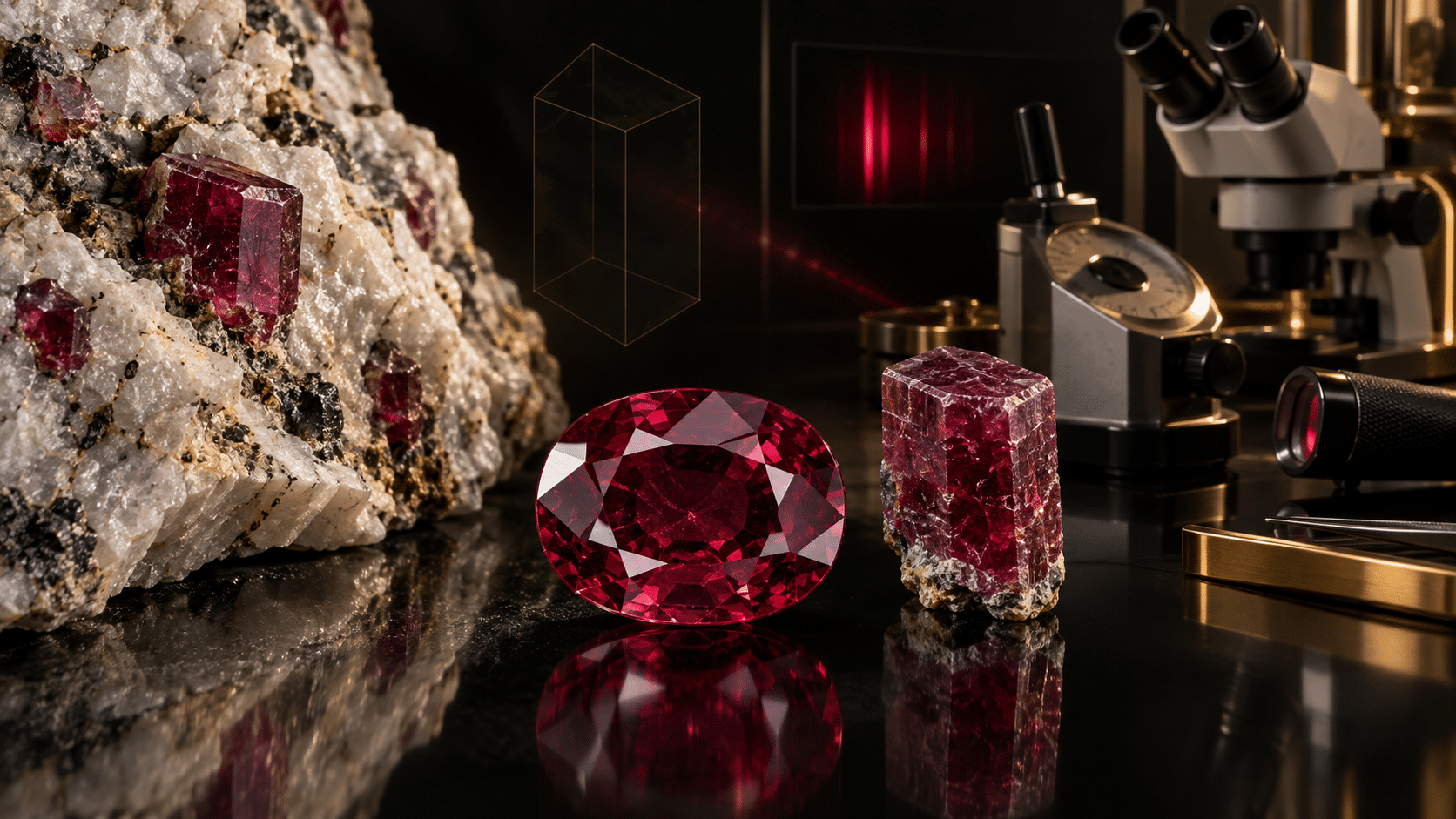
A Ruby Gemstone is the red gem variety of corundum, an aluminium oxide mineral whose exceptional hardness, optical properties and trace-element chemistry make it one of gemmology’s most important gemstones.
Yet identifying ruby involves considerably more than recognising a red stone. Its refractive indices, uniaxial optical character, birefringence, specific gravity, chromium absorption, pleochroism, fluorescence and microscopic inclusion features together provide a powerful diagnostic framework.
Its geological story is equally important. Ruby can form in markedly different geological environments, from metamorphosed carbonate rocks to deposits associated with mafic and ultramafic rocks. These environments influence trace-element chemistry, fluorescence and characteristic internal features.
In this Nadia Gemstone Academy guide, we examine ruby as a gemmologist would: beginning with its mineralogical classification and formation, then moving through its optical and physical constants, colour mechanisms, inclusions, treatments, synthetics and identification.
Table of Contents
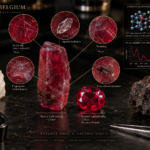
RUBY — TECHNICAL GEMMOLOGICAL DATA
Crystallography
Crystal System: Trigonal
Optical Character: Uniaxial negative
Typical Crystal Habit: Barrel-shaped, tabular or bipyramidal corundum crystals
Physical Properties
Mohs Hardness: 9
Specific Gravity: approximately 4.00; accepted gemmological values vary slightly with composition/inclusions
Tenacity: Brittle
Cleavage: No true cleavage
Parting: Basal/rhombohedral parting may occur
Fracture: Uneven to conchoidal
Lustre: Vitreous to subadamantine
Transparency: Transparent to translucent; some material may be opaque
Classification
Mineral Species: Corundum
Gem Variety: Ruby
Mineral Class: Oxide
Chemical Formula: Al₂O₃
Principal Colour Cause: Cr³⁺ substituting for Al³⁺
Optical Properties
Refractive Index: approximately 1.762–1.770
Birefringence: approximately 0.008–0.010
Dispersion: approximately 0.018
Pleochroism: Dichroic; commonly red/purplish-red to orangy-red components, intensity dependent upon material and orientation
Colour Range: Orangy red through red to purplish red
Spectroscopic Characteristics
Primary Chromophore: Cr³⁺
Typical visible absorption: strong chromium-related absorption in violet and yellow-green regions
Characteristic red-region chromium lines/emission around 694 nm
Transmission windows allow principally red, with some blue, light to pass
Fluorescence
Long-wave UV: commonly red; intensity highly variable
Short-wave UV: commonly weaker red or variable
Important: Fe can suppress chromium fluorescence; fluorescence is therefore NOT universally strong in ruby and is not by itself diagnostic.
Common Internal Features
Rutile needles or “silk”
Partially dissolved or altered silk in heated material
Healed fissures / fingerprints
Growth zoning
Twinning
Negative crystals
Mineral inclusions such as apatite, calcite, spinel and others depending on geological origin
Fluid inclusions
Surface-reaching fractures
Phenomena
Asterism may occur where appropriately oriented rutile or other inclusions produce a star effect in cabochon-cut material.
Principal Geological Environments
Marble-hosted metamorphic deposits
Metamorphosed mafic/ultramafic rock environments
Related secondary/alluvial deposits formed by weathering and erosion of primary sources
Important Sources
Myanmar
Mozambique
Vietnam
Afghanistan
Tajikistan
Madagascar
Tanzania
Sri Lanka
Thailand/Cambodia
Greenland and other occurrences
Treatments Encountered
Conventional heat treatment
Flux-assisted heat treatment / fracture healing
Glass fracture filling
Diffusion-related treatment in some corundum
Other specialised treatment processes
Synthetic Ruby
Flame-fusion / Verneuil
Flux-grown
Hydrothermal and other laboratory-growth methods
Important Imitations / Look-Alikes
Red spinel
Red garnet
Red tourmaline
Red glass
Synthetic red materials
Key Classical Identification Combination
RI + birefringence + uniaxial optical character + SG + dichroism + chromium spectrum + microscopic features
Advanced Identification Where Required
UV-Vis-NIR spectroscopy
FTIR spectroscopy
Raman spectroscopy
EDXRF
LA-ICP-MS trace-element chemistry
Advanced fluorescence imaging and microscopic analysis
Durability
Excellent hardness and generally very suitable for jewellery.
However, fractures, fillings and certain treatments can substantially alter practical durability and appropriate cleaning procedures.

Ruby: A Gemmological Reference Guide
Definition and Classification
Ruby is the red gem variety of the mineral species corundum. Corundum is crystalline aluminium oxide, Al₂O₃, and belongs to the oxide mineral group.
The distinction between species and variety is important in gemmology. Corundum is the mineral species. Ruby describes corundum whose colour falls within the accepted red range, while other gem-quality colours of corundum are generally classified as sapphire.
The boundary between pink sapphire and ruby is partly dependent upon colour assessment and nomenclature conventions rather than a change of mineral species.
Why Ruby Is Red
Chemically pure corundum is colourless.
Ruby’s red colour is principally produced by trivalent chromium, Cr³⁺, replacing a small proportion of Al³⁺ within the corundum lattice.
Interaction between chromium and the surrounding oxygen ions creates characteristic absorption within the visible spectrum. Strong absorption occurs particularly in portions of the violet and yellow-green region while transmission remains strong in the red part of the spectrum. The resulting transmitted and reflected light is perceived as red.
Chromium is also responsible for ruby’s famous red fluorescence.
Iron concentration is important because iron can suppress this chromium fluorescence. Consequently, relatively iron-poor rubies can exhibit considerably stronger fluorescence than iron-rich material.
This relationship between chromium, iron, absorption and fluorescence is one reason apparently similar rubies from different geological environments can possess noticeably different optical appearances.
Geological Formation
Ruby formation requires an unusual combination of geological conditions.
Aluminium must be sufficiently abundant for corundum to crystallise, while silica activity must be sufficiently restricted. If abundant silica is available, aluminium is preferentially incorporated into aluminosilicate minerals rather than corundum.
Chromium must also be available if red corundum is to develop.
Two broad geological families are particularly important.
Marble-Hosted Ruby
Some of the world’s historically important rubies occur in metamorphosed carbonate rocks.
Limestone subjected to heat and pressure during regional metamorphism recrystallises into marble. During appropriate metamorphic events, fluids and molten salts can mobilise chemical components including aluminium and chromium, allowing ruby to crystallise within the marble.
Many celebrated Asian deposits belong to this broad geological family.
These rocks are commonly poor in iron. Their rubies can consequently possess low iron concentrations and strong chromium-related red fluorescence.
The Himalayan collision played an important role in producing major marble-hosted ruby deposits across parts of South and Southeast Asia.
Mafic and Ultramafic Associations
Ruby also occurs in metamorphic environments associated with mafic and ultramafic rocks.
Important deposits belonging to this broader geological association occur within East Africa and Madagascar, including portions of the Mozambique Belt.
Their mineral assemblages and trace-element chemistry can differ substantially from those of classic marble-hosted ruby.
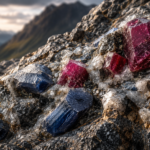
Weathering can subsequently release resistant ruby crystals from their host rocks. Because corundum is extremely hard and chemically durable, crystals may survive erosion and become concentrated in secondary or alluvial deposits.
Historical Importance
Ruby has been valued for centuries, long before mineralogical science established the modern definition of corundum.
Historically, not every famous “ruby” was actually ruby. Before modern gem testing, several transparent red gemstones were grouped together according to appearance. Red spinel, for example, was historically confused with ruby.
Development of mineralogical classification and subsequently refractometry, spectroscopy, microscopy and other gemmological techniques allowed these visually similar materials to be separated scientifically.
Myanmar’s Mogok region became particularly associated with exceptional ruby and remains one of gemmology’s classic localities.
Ruby also has an important place in scientific history. Synthetic ruby was used as the active medium in the first successful laser demonstrated in 1960, exploiting chromium-related luminescence in corundum.
Important Geographic Sources
Ruby occurs in numerous countries, but deposits differ considerably in geology, chemistry and historical significance.
Myanmar
Mogok is perhaps the most famous historical ruby district. Many Mogok rubies occur in marble-related geological environments and may possess low iron concentrations and strong fluorescence.
Mong Hsu became another important Myanmar source during the twentieth century.
Mozambique
Mozambique became one of the major modern sources of ruby following important discoveries in the Montepuez region.
Mozambican material covers a broad range of qualities and appearances. Detailed laboratory research has shown that trace-element chemistry and inclusion characteristics are important for separating different geological populations and evaluating geographic origin.
Vietnam
Northern Vietnam contains important marble-hosted ruby deposits associated with the same broad tectonic processes responsible for other Asian metamorphic ruby occurrences.
Afghanistan and Tajikistan
Marble-hosted ruby occurs in both regions. These deposits form part of the broader Central Asian geological context associated with metamorphosed carbonate rocks.
Other Sources
Ruby has also been recovered from Madagascar, Tanzania, Sri Lanka, Greenland and historically important deposits in Thailand and Cambodia, among numerous additional occurrences.
A geographic origin should never be assigned merely from colour. Modern origin determination combines microscopy, trace-element chemistry, spectroscopy and comparison with carefully documented reference collections.
Physical Properties
Ruby inherits the exceptional physical characteristics of corundum.
Its Mohs hardness is 9, making corundum one of the hardest common gem materials and the reference mineral immediately below diamond on the traditional Mohs scale.
Corundum has no true cleavage, although parting may occur along certain crystallographic directions.
Its fracture is generally uneven to conchoidal and its lustre is typically vitreous to subadamantine.
Gem ruby ranges from transparent through translucent, while lower-quality material can approach opacity.
Optical Properties
Ruby is trigonal and optically uniaxial negative.
Typical gemmological refractive indices are approximately:
1.762–1.770
Typical birefringence is approximately:
0.008–0.010
Specific gravity is close to:
4.00
Actual measured SG may vary slightly because inclusions, fractures and other characteristics influence hydrostatic measurements.
Ruby is dichroic. Depending upon crystal orientation and composition, a dichroscope can reveal different red, purplish-red or orangy-red components.
These properties form an important classical identification suite.
Absorption Spectrum
Ruby produces one of the classic spectra studied by gemmologists.
Chromium creates strong absorption in portions of the visible spectrum together with characteristic features in the red region.
Instrumental UV-Vis spectroscopy provides substantially more information than a handheld spectroscope and can characterise absorption associated with chromium and other trace-element-related defects.
The chromium emission near the red end of the spectrum is closely connected with ruby’s fluorescence.
Fluorescence
Many rubies fluoresce red under ultraviolet radiation.
The strength varies considerably.
Iron can quench or suppress chromium-related fluorescence, so relatively iron-poor marble-hosted ruby may fluoresce strongly while higher-iron ruby can react much more weakly.
Fluorescence must therefore be interpreted as one part of a larger gemmological dataset rather than as an independent identification test.
Microscopic Identification
The microscope is one of the most important instruments for ruby examination.
Possible natural internal features include:
• rutile needles or silk
• growth zoning
• twinning
• healed fractures
• negative crystals
• fluid inclusions
• mineral crystal inclusions
• oriented particles
• structural growth features
Specific inclusion assemblages can provide evidence concerning geological environment and sometimes geographic origin.
Rutile silk is particularly familiar in corundum. Dense, appropriately oriented inclusions can scatter light and, when suitable material is fashioned as a cabochon, may produce asterism.
However, no single inclusion should automatically be regarded as proof of geographic origin.
Heat Treatment
Heat treatment is widely encountered in ruby and sapphire.
Heating can alter colour and transparency and can modify or dissolve internal inclusions. Rutile silk, for example, may be partially or extensively altered depending upon treatment conditions.
Flux-assisted heating can promote healing of fractures. Residual flux may remain within healed fissures, while high-temperature processes can occasionally produce recrystallised synthetic corundum overgrowth on surfaces or cavities.
Determining heat-treatment status therefore requires careful interpretation of microscopic and spectroscopic evidence.
Advanced laboratories may employ FTIR and other analytical methods when classical observations are insufficient.
Fracture Filling
Heavily fractured ruby can be treated with glass or other filling materials.
The objective is commonly to reduce the visibility of fractures and, depending upon the process, improve apparent transparency or structural stability.
Under magnification, diagnostic evidence can include gas bubbles, flash effects, differences in surface lustre and concentrations of foreign material within fractures and cavities.
Glass-filled ruby should not be treated as equivalent in durability to high-quality untreated or conventionally heated ruby. The presence and extent of filling are important disclosure considerations.
Synthetic Ruby
Ruby was among the earliest gemstones successfully produced synthetically on a commercially significant scale.
Synthetic ruby has essentially the same fundamental chemical composition and crystal structure as natural ruby. Consequently, simply measuring RI or SG does not prove natural origin.
Important synthetic-growth methods include flame fusion and flux growth, while other experimental or commercial techniques have also been used.
Flame-fusion synthetic ruby may show curved growth structures and characteristic gas bubbles. Flux-grown material can contain residual flux and growth features that sometimes superficially resemble natural healed fissures.
Modern identification therefore relies on interpreting the entire inclusion and growth environment rather than searching for one supposedly universal diagnostic feature.
Imitations and Look-Alikes
Several red gemstones can visually resemble ruby.
Important possibilities include:
• red spinel
• red garnet
• red tourmaline
• red glass
• synthetic materials
A combination of refractive index, optic character, birefringence, specific gravity, spectroscopy and microscopy normally separates these materials.
For example, ruby’s doubly refractive uniaxial optical behaviour immediately distinguishes it from singly refractive spinel and most garnets when reliable optical testing is possible.
Geographic Origin Determination
Determining that a gemstone is natural ruby is fundamentally different from determining where it formed.
Modern laboratories build extensive reference collections containing samples acquired as close as possible to known mining sources.
Unknown stones can then be compared using microscopic inclusion features, UV-Vis-NIR and FTIR spectroscopy and trace-element chemistry, including techniques such as LA-ICP-MS.
Even sophisticated analysis can encounter overlapping characteristics between deposits.
Consequently, statements such as “Burmese appearance” or “Mozambique colour” are not scientifically sufficient to establish origin.
Durability and Care
With Mohs hardness 9 and no true cleavage, untreated ruby is exceptionally suitable for jewellery.
Nevertheless, hardness measures resistance to scratching rather than complete resistance to damage.
Fractures can reduce mechanical integrity, while fracture-filled stones require particular caution because the filling substance may react differently to heat, chemicals or cleaning processes than the corundum host.
Before repair, repolishing, ultrasonic cleaning or exposure to high temperatures, treatment status should therefore be considered.
The Gemmological Importance of Ruby
Ruby demonstrates why modern gemmology goes far beyond visual identification.
Its red colour records chromium substitution at the atomic level. Its fluorescence reflects interactions between chromium, iron and light. Its inclusions preserve evidence of crystal growth and geological processes. Altered inclusions can document human treatment, while trace-element chemistry can help laboratories investigate geographic origin.
A gemmologist consequently reads ruby on several scales simultaneously: crystal structure, optical behaviour, microscopic internal world and geological environment.
That combination makes ruby not simply one of the classic coloured gemstones, but also one of gemmology’s most instructive materials.
References & Further Reading
Gemological Institute of America — Ruby Gem Encyclopedia
https://www.gia.edu/ruby
Gemological Institute of America — Ruby Description
https://www.gia.edu/ruby-description
Giuliani, G. & Groat, L.A. — Geology of Corundum and Emerald Gem Deposits, Gems & Gemology, Winter 2019
https://www.gia.edu/gems-gemology/winter-2019-geology-of-corundum-and-emerald-gem-deposits
Palke, A.C. et al. — Geographic Origin Determination of Ruby, Gems & Gemology, Winter 2019
https://www.gia.edu/gems-gemology/winter-2019-ruby-geographic-origin-determination
Gemological Institute of America — GIA Research Activities: Treated Corundum and Geographic Origin
https://www.gia.edu/research-activities
Gem-A — Understanding Specific Gravity and Why It Is Vital to Gemmologists
https://gem-a.com/gem-hub/specific-gravity-gemstones-gemmology/