A Practical Evidence-Based Gemstone Identification Exercise
A loose red gemstone arrives on the gemmologist’s desk.
There is no laboratory report.
No reliable seller information.
No known origin.
No treatment declaration.
The only information available is the stone itself.
It is transparent.
Faceted.
Attractive.
And intensely red.
What is it?
A beginner may immediately think:
ruby.
But colour is not identification.
The stone could also be:
- red spinel;
- red garnet;
- coloured glass;
- synthetic ruby;
- synthetic spinel;
- another natural or manufactured red material.
In this workshop we will deliberately begin with four broad candidates:
Ruby
Spinel
Garnet
Glass
The objective is not to guess correctly from a photograph,but to identify a red gemstone scientifically.
Instead, we will work exactly as a gemmologist should:
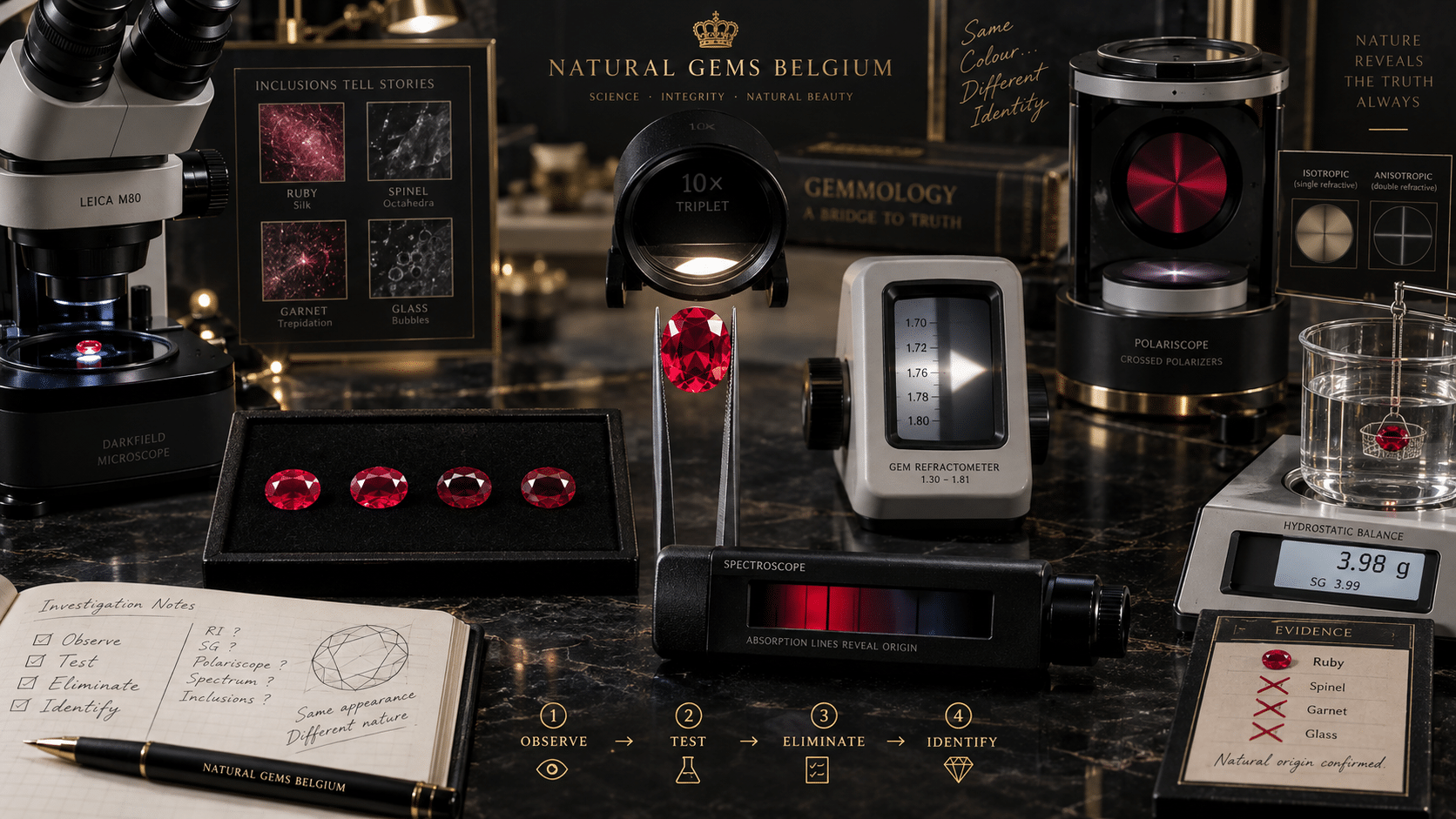
Observe → Test → Eliminate → Combine → Conclude
At every stage, ask one question:
Which possibilities remain compatible with the evidence?
Do not skip ahead.
The identity will emerge from the measurements.
Table of Contents
PART I — THE UNKNOWN STONE
1. Initial Observation
The specimen is a:
transparent medium-to-vivid red oval mixed-cut gemstone.
It shows:
- vitreous lustre;
- good transparency;
- strong red body colour;
- no obvious surface coating;
- no visible assembled layers;
- no obvious bubbles with the unaided eye.
Weight:
2.41 ct
Dimensions:
approximately 8.2 × 6.4 × 4.7 mm
These observations are useful.
But none identifies the stone.
2. Establish the Candidate List
For this workshop our initial candidates are:
Candidate A — Ruby
Ruby is the red variety of:
corundum.
Its red colour is principally associated with chromium.
Candidate B — Red Spinel
Spinel is a different mineral:
MgAl₂O₄
and fine red spinel can also be coloured by chromium.
Candidate C — Red Garnet
Several members and mixtures within the garnet group can produce red gemstones.
Candidate D — Red Glass
Manufactured glass can imitate the appearance of many coloured gemstones.
At first glance, all four remain possible.
3. Why Colour Cannot Solve This
Ruby and spinel provide one of gemmology’s classic lessons.
For centuries, beautiful red spinels were classified together with ruby.
The reason was simple:
before modern mineralogical and gemmological testing, colour and appearance dominated identification.
GIA notes that many famous historical “rubies” are actually spinels.
The best-known example is the:
Black Prince’s Ruby.
Despite its historic name, it is red spinel.
The confusion was scientifically understandable.
Ruby and red spinel can both be:
- transparent;
- strongly red;
- chromium-coloured;
- highly lustrous;
- durable;
- found in some of the same gem-producing regions.
Colour could not reliably separate them.
Measurement eventually could.
4. Historical Interlude — The “Balas Ruby”
For many centuries red and rose-red spinels from Central Asia were often called:
Balas rubies.
GIA notes that the term is thought to relate to the historic Badakhshan/Bactria region.
These stones entered royal collections throughout Europe and Asia.
They were not fraudulent “fake rubies.”
The mineralogical distinction simply had not yet been established.
Modern gemmology fundamentally changed that.
Today:
ruby = corundum
and:
spinel = spinel
They are separate minerals with different optical and physical properties.
PART II — FIRST MAGNIFICATION
5. Begin with the 10× Loupe
Before measuring optical properties, inspect the unknown stone under:
Look across:
- crown;
- pavilion;
- girdle;
- facet junctions.
Then examine the interior.
Our hypothetical unknown shows:
several fine straight needles and a small included crystal.
No obvious spherical gas bubbles are visible.
No curved flow structures are seen.
No obvious assembly plane is present.
What does this tell us?
6. Do Not Identify the Inclusion Yet
The wrong response would be:
“Needles mean ruby.”
Needle-like inclusions occur in multiple gemstones.
Instead record:
Observation: fine straight needle-like inclusions present.
Interpretation comes later.
The glass candidate becomes somewhat less attractive because the observed inclusion scene appears crystalline.
But glass has not yet been eliminated.
7. Move to the Microscope
Now inspect the stone under a gemmological microscope.
Begin with darkfield illumination.
Rotate the gemstone.
Change magnification.
Use fibre-optic illumination where useful.
The internal scene becomes clearer.
We observe:
- straight fine needles;
- one small angular crystal;
- a partially healed fissure;
- no obvious round gas bubbles;
- no obvious curved colour banding.
This increasingly supports a natural crystalline gemstone.
But we still need physical measurements.
PART III — REFRACTIVE INDEX
8. Prepare the Refractometer
Clean:
- gemstone;
- refractometer prism.
Apply the appropriate small amount of contact liquid according to instrument procedure.
Place a suitable polished facet against the prism.
Observe the shadow edge.
Rotate the stone and repeat.
9. First Reading
The first reliable reading is:
1.762
Rotate the stone.
A second shadow edge reaches:
1.770
Repeated measurements confirm approximately:
RI = 1.762–1.770
Now the investigation changes dramatically.
10. What Does This Mean?
Compare our candidates.
Ruby / Corundum
Typical RI lies approximately in this region.
Compatible.
Ordinary Red Spinel
GIA gives spinel RI around:
1.718.
Our reading is substantially higher.
Ordinary spinel becomes highly unlikely.
Garnet
This is more complicated.
Garnets occupy broad RI ranges because the garnet group contains multiple species and extensive solid solution.
Some garnets can reach the region around 1.76 or higher.
Therefore:
garnet cannot yet be eliminated solely from RI.
Glass
Glass RI varies according to composition.
Some glasses can potentially occupy overlapping refractive-index regions.
Therefore:
glass should not be rejected from RI alone without considering optical behaviour and microscopy.
Current leader:
Ruby
But the investigation is not finished.
11. Calculate Birefringence
Our two extreme RI readings are:
1.770 − 1.762
which gives:
0.008.
This is an important result.
The stone is displaying measurable:
double refraction / birefringence.
Now compare this with our candidates.
12. Ruby and Double Refraction
Corundum is:
anisotropic and uniaxial.
It is doubly refractive.
An RI range around 1.762–1.770 with birefringence around:
0.008
is highly characteristic of corundum.
Ruby remains strongly compatible.
13. Spinel and Double Refraction
Spinel belongs to the cubic crystal system.
It is normally:
singly refractive.
GIA lists:
birefringence: none.
Therefore our clear two-reading RI result is inconsistent with ordinary spinel.
Spinel can now be provisionally eliminated.
14. Garnet and Double Refraction
Garnets are also cubic.
They are normally:
singly refractive.
Some garnets can display anomalous double refraction caused by strain or structural effects.
But they should not show the normal, consistent birefringence pattern expected from corundum.
Our reading strongly favours ruby over garnet.
15. Glass and Double Refraction
Ordinary glass is amorphous rather than crystalline.
It is normally:
singly refractive.
Internal strain can produce anomalous effects under polarized light.
But glass does not possess normal crystallographic birefringence like corundum.
Our RI behaviour therefore strongly opposes ordinary glass.
At this point:
Ruby is overwhelmingly favoured.
But a proper workshop does not stop because the answer appears obvious.
We continue testing.
PART IV — POLARISCOPE
16. Test Optical Behaviour
Place the gemstone between crossed polarizers.
Rotate it through:
360°.
The stone alternates:
light → dark → light → dark
during rotation.
This is a classic anisotropic reaction.
17. Compare the Candidates
Ruby
Doubly refractive.
Expected to alternate light and dark.
Compatible.
Spinel
Normally singly refractive.
Expected generally to remain dark through rotation, although anomalous strain effects can occur.
Incompatible with the normal reaction observed.
Garnet
Normally singly refractive, although anomalous effects can occur.
Not favoured.
Glass
Normally singly refractive but may display strain.
Not favoured.
The polariscope independently supports the refractometer evidence.
That independence matters.
18. Why Two Different Tests Are Better Than One
The refractometer told us:
the material has two refractive indices.
The polariscope independently told us:
the stone behaves anisotropically.
These are related optical properties, but they are observed through different techniques.
Both point toward corundum.
The evidence is converging.
PART V — DICHROSCOPE
19. Examine Pleochroism
Now view the gemstone through a dichroscope.
Rotate the stone.
Two directional colours become visible:
purplish red
and:
orangy red.
This is:
dichroism.
Ruby is a uniaxial pleochroic gemstone.
The observation is compatible with ruby.
20. Why This Matters
Spinel and garnet are cubic.
Ordinary cubic gemstones do not show true pleochroism.
Glass does not possess crystallographic pleochroism either.
Therefore distinct directional colour provides another independent argument for ruby.
Our evidence now includes:
- appropriate RI;
- appropriate birefringence;
- doubly refractive polariscope reaction;
- dichroism.
The candidate list has collapsed dramatically.
PART VI — SPECTROSCOPE
21. Examine the Absorption Spectrum
Now illuminate the gemstone correctly and observe it with a handheld spectroscope.
The red gemstone displays strong absorption features associated with:
chromium.
In ruby, chromium substitutes for small amounts of aluminium in the corundum structure and produces the red colour.
22. Chromium Does Not Automatically Mean Ruby
This is crucial.
Red spinel can also be coloured by:
chromium.
Therefore a chromium-related spectrum by itself cannot separate ruby from all red spinels.
The spectroscope provides:
supporting chemical evidence
rather than a standalone identity.
This is exactly why we already measured RI and optical character.
23. Spectroscopy Works Best in Combination
Imagine we had started with the spectroscope and observed chromium absorption.
Possible conclusion:
chromium-bearing red gemstone.
That is useful.
But after combining:
chromium absorption + RI 1.762–1.770 + birefringence + dichroism
the interpretation becomes much stronger:
ruby / chromium-bearing corundum.
PART VII — SPECIFIC GRAVITY
24. Add an Independent Physical Property
The optical evidence is already compelling.
But we will deliberately measure specific gravity because this is a training exercise.
First weigh the loose gemstone in air.
Then suspend it fully in water using a hydrostatic setup.
Check carefully for:
- bubbles;
- contact with the vessel;
- unstable readings.
The calculated result is:
SG ≈ 4.00
25. Compare the Candidates
Ruby
Corundum has SG approximately:
4.00.
Excellent agreement.
Ordinary Spinel
GIA gives approximately:
3.60.
Poor agreement.
Garnet
Here caution is necessary.
Some garnets can approach the corundum SG region.
Recent GIA research on red pyrope-almandine from northern Vietnam found SG:
3.80–3.85.
Other garnet compositions can vary further.
Therefore SG alone would not be enough to distinguish every garnet from ruby.
Glass
Glass density varies widely with composition.
A density result alone cannot identify or exclude every possible manufactured glass.
But combined with all previous observations, ordinary red glass is no longer plausible.
26. The Evidence Table
Now place the results together.
| Property | Unknown | Ruby | Spinel | Garnet | Glass |
|---|---|---|---|---|---|
| Colour | Red | Compatible | Compatible | Compatible | Compatible |
| RI | 1.762–1.770 | Strong match | Usually too high for ordinary spinel | Some overlap possible | Variable |
| Birefringence | ~0.008 | Strong match | None normally | None normally | None normally |
| Polariscope | DR | Strong match | SR normally | SR normally | SR normally |
| Pleochroism | Dichroic | Compatible | None normally | None normally | None |
| Chromium spectrum | Present | Compatible | Can also occur | Depends on composition | Colourant-dependent |
| SG | ~4.00 | Strong match | Ordinary spinel ~3.60 | Some overlap possible | Variable |
| Microscopy | Natural crystalline scene | Compatible | Possible | Possible | Poor match |
The important point is not that one cell says:
ruby.
It is that the complete dataset converges on ruby while competing explanations accumulate contradictions.
PART VIII — THE IDENTIFICATION
27. Provisional Conclusion
Based on the standard gemmological evidence, the unknown stone can be identified at the species/variety level as:
Ruby — red corundum
The identification is supported by:
- RI 1.762–1.770;
- birefringence approximately 0.008;
- anisotropic optical reaction;
- dichroism;
- chromium-related absorption;
- SG around 4.00;
- compatible microscopic features.
Ruby is not simply the candidate that “looks right.”
It is the candidate that best satisfies the measured dataset.
28. But the Investigation Is Not Finished
We have identified:
ruby.
What have we NOT yet necessarily established?
- whether it is natural or laboratory-grown;
- whether it has been heated;
- whether fractures have been filled;
- whether diffusion treatment has been used;
- geographic origin.
These are separate questions.
This distinction is fundamental.
PART IX — NATURAL OR SYNTHETIC?
29. Synthetic Ruby Is Still Corundum
A laboratory-grown ruby has essentially the same fundamental mineral identity as natural ruby.
Therefore it can have:
- essentially the same RI;
- similar SG;
- the same birefringence;
- similar chromium absorption;
- the same basic optical character.
The refractometer cannot simply announce:
natural.
30. Microscopy Becomes Critical
Natural ruby may show geological inclusions such as:
- mineral crystals;
- rutile;
- healed fissures;
- negative crystals;
- growth structures.
Synthetic ruby may show features related to its growth process.
Depending on synthesis method, these can include:
- curved growth structures;
- gas bubbles;
- flux-related inclusions;
- seed-related features.
But no one microscopic feature should be interpreted carelessly.
Modern synthetic material can be challenging.
31. Our Workshop Stone
Our hypothetical stone shows:
- straight needles;
- angular mineral inclusion;
- naturally appearing healed fissure;
- no curved growth lines;
- no obvious gas bubbles;
- no obvious synthetic growth features.
This provides evidence supporting:
natural ruby.
A responsible conclusion might therefore be:
Natural ruby — based on standard gemmological and microscopic evidence.
For a high-value stone, advanced laboratory confirmation remains appropriate.
PART X — HEATED OR UNHEATED?
32. Identification Does Not Determine Treatment
Heating ruby is common.
A heated ruby remains:
ruby.
Its fundamental RI and SG remain within the corundum range.
Therefore the tests that identified the mineral do not automatically determine treatment.
33. Search for Heat-Related Microscopic Evidence
Heating can alter inclusions.
Depending on conditions and the original inclusion scene, a gemmologist may observe:
- altered crystals;
- discoid stress fractures;
- modified rutile silk;
- healed fissures;
- flux-like residues in some treatment contexts.
GIA documented a clarity-enhanced ruby in 2025 containing altered crystals and discoid fractures associated with heat exposure, together with glass-filled cavities.
Microscopy can therefore provide important treatment evidence.
34. Glass Filling
Some rubies contain foreign glass in surface-reaching fractures and cavities.
GIA has documented glass-filled rubies where microscopy revealed:
- flash effects;
- gas bubbles;
- lustre differences;
- filled cavities.
Advanced techniques confirmed the foreign glass.
This is very different from an untreated or conventionally heated ruby.
Treatment disclosure matters.
35. Do Not Call a Ruby “Unheated” Merely Because You Saw No Heat Features
This is one of the most important practical rules in the workshop.
Absence of obvious microscopic heat evidence is not always proof of absence of heating.
For commercially important rubies, laboratories may use:
- FTIR;
- UV-Vis-NIR;
- Raman;
- photoluminescence;
- chemical analysis
alongside microscopy.
Therefore:
“No heat-related features observed with the available equipment”
is not automatically equivalent to:
“Unheated.”
PART XI — WHAT IF THE RESULT HAD BEEN SPINEL?
36. Alternative Dataset: Red Spinel
Imagine instead that our unknown produced:
RI: ~1.718
Polariscope: singly refractive
Pleochroism: none
SG: ~3.60
Spectrum: chromium-related absorption
Now the evidence would converge strongly toward:
red spinel.
GIA lists natural spinel with:
- RI 1.718;
- no birefringence;
- SG 3.60.
37. A Real GIA Spinel Example
GIA examined a 26.73 ct dark pink-purple spinel.
Standard testing produced:
RI 1.719
and:
hydrostatic SG 3.59.
A handheld spectroscope showed absorption bands and lines consistent with spinel.
Microscopy revealed a low-relief spinel crystal inclusion.
This is an excellent real-world example of multiple properties converging on the same identification.
38. But Spinel Has Complications Too
Not every member of the spinel group sits precisely at:
RI 1.718 / SG 3.60.
Chemical substitution can shift physical properties.
Zinc-rich spinel-group materials provide an important example.
39. Gahnospinel
GIA has documented zinc-rich:
gahnospinel
with physical properties substantially different from ordinary spinel.
One 1.01 ct cobalt-blue specimen had:
RI 1.742
and:
SG 3.96.
Another large gahnospinel examined by GIA had:
RI 1.754
and:
SG 4.10.
These examples demonstrate a vital lesson:
gemological values are not magic immutable numbers.
Composition matters.
PART XII — WHAT IF IT HAD BEEN GARNET?
40. Garnet Is a Group
“Garnet” is not one single chemically fixed material.
The garnet group contains numerous species and extensive solid solutions.
Important gem garnets include:
- pyrope;
- almandine;
- spessartine;
- grossular;
- andradite.
Mixtures between end members are common.
This produces significant variation in:
- RI;
- SG;
- colour;
- spectrum.
41. Garnet Is Normally Singly Refractive
Garnets are cubic.
Therefore they are normally:
singly refractive.
This is one of the fastest classical separations from ruby.
A red stone with high RI and high SG may initially resemble corundum numerically.
But its optical character can reveal that it belongs elsewhere.
42. Real Red Garnet Data
Recent GIA research on red garnet from northern Vietnam found:
RI 1.753–1.758
SG 3.80–3.85
with isotropic behaviour.
The handheld spectroscope showed several characteristic bands.
Chemical analysis established a dominant:
pyrope-almandine
composition.
Notice how close its RI begins to approach corundum.
This is why simply saying:
“high RI = ruby”
would be poor gemmology.
43. Some Garnets Reach Even Higher Density
GIA research on pyrope-spessartine colour-change garnets with substantial grossular components recorded SG values:
3.93–4.00
and RI:
1.76–1.77.
Those values overlap ruby remarkably closely.
But the garnets remain isotropic.
The polariscope therefore becomes extremely important.
This is a perfect demonstration of:
independent properties defeating numerical overlap.
PART XIII — WHAT IF IT HAD BEEN GLASS?
44. Glass Is Not a Crystal
Most gemstone glass is:
amorphous.
It lacks the ordered long-range crystal lattice of ruby, spinel and garnet.
This creates important optical differences.
Ordinary glass is:
singly refractive.
45. Microscopic Clues to Glass
Depending on manufacture, glass may contain:
- spherical gas bubbles;
- elongated bubbles;
- flow structures;
- swirl marks;
- mould-related surface features.
But absence of bubbles does not prove that a material is not glass.
High-quality glass can be extremely clean.
Use physical properties too.
46. Strain Can Confuse the Polariscope
Glass may contain internal strain.
Between crossed polarizers, strain can produce:
- bright areas;
- irregular patterns;
- anomalous light transmission.
Do not mistake this for normal crystallographic double refraction.
The pattern and behaviour differ from the orderly extinction of a doubly refractive crystal.
47. RI and SG of Glass Are Variable
Glass composition can be engineered.
Adding different oxides changes:
- refractive index;
- density;
- dispersion;
- colour.
Therefore there is no universal:
“glass RI.”
Nor one universal:
“glass SG.”
Identification must again rely on combined evidence.
PART XIV — A HISTORICAL GEMMOLOGY LESSON
48. The Black Prince’s Ruby
Perhaps no gemstone better demonstrates the importance of scientific identification.
The famous red stone mounted in Britain’s Imperial State Crown has been known historically as:
the Black Prince’s Ruby.
But it is not ruby.
It is:
red spinel.
The historic name survives because it predates modern mineralogical classification.
49. Why the Error Persisted
Without RI measurements, polariscopes and modern mineralogy, ruby and red spinel can be extremely difficult to distinguish visually.
Both can display:
- rich red colour;
- transparency;
- high lustre;
- excellent durability.
The historical confusion was therefore not irrational.
The necessary physical distinction simply had not yet been established.
50. The Scientific Separation
GIA records that mineralogist:
Jean-Baptiste Louis Romé de l’Isle
identified spinel as distinct from ruby in:
1783.
This separation is an important milestone in the development of mineralogical classification.
It also symbolises a broader transition:
from identifying gems by appearance to identifying them by measurable properties.
That transition is essentially the birth of modern gemmology.
PART XV — THE ELIMINATION METHOD
51. Do Not Ask “What Is It?” Too Early
A more productive question is:
“What can it no longer be?”
After RI:
ordinary spinel becomes unlikely.
After confirmed birefringence:
spinel, garnet and ordinary glass become strongly inconsistent.
After dichroism:
the cubic candidates become even less plausible.
After SG:
corundum receives another independent confirmation.
After microscopy:
natural origin may become supportable.
This is progressive elimination.
52. Strong Evidence Versus Weak Evidence
Weak
“It looks like ruby.”
Better
“It has ruby-like red colour.”
Strong
“RI and birefringence are consistent with corundum.”
Stronger
“RI, birefringence, polariscope reaction, dichroism, SG and spectrum all converge on ruby.”
Different Question
“Microscopy supports natural origin.”
Still Different
“Treatment status requires additional evidence.”
Keeping these statements separate prevents overclaiming.
53. One Contradiction Can Defeat an Attractive Hypothesis
Suppose the gemstone has magnificent pigeon-blood-like red colour.
You expect ruby.
Then the refractometer gives:
1.718
and the polariscope shows:
single refraction.
Your visual expectation must be abandoned.
The evidence points toward spinel.
A gemmologist follows the measurements, not the preferred answer.
PART XVI — WORKSHOP CHALLENGE
54. Unknown Stone A
Colour: vivid red
RI: 1.762–1.770
Polariscope: DR
Pleochroism: red / orangy-red
SG: 4.00
Spectrum: chromium-related
Best identification?
Ruby.
55. Unknown Stone B
Colour: vivid red
RI: 1.718
Polariscope: SR
Pleochroism: none
SG: 3.60
Spectrum: chromium-related
Best identification?
Red spinel.
56. Unknown Stone C
Colour: dark red
RI: 1.755
Polariscope: SR
Pleochroism: none
SG: 3.83
Spectrum: strong garnet-type absorption bands
Best broad identification?
Red garnet, potentially within the pyrope-almandine compositional region.
Further testing would refine the garnet classification.
57. Unknown Stone D
Colour: red
RI: single reading
Polariscope: SR with irregular strain
Microscope: round gas bubbles and flow structures
Pleochroism: none
Best interpretation?
Manufactured glass becomes strongly favoured.
Confirm with appropriate physical testing.
PART XVII — PRACTICAL DECISION TREE
58. Step 1 — Is the Stone Doubly Refractive?
If clearly:
YES
ruby remains possible.
Ordinary spinel, garnet and glass become unlikely.
If:
NO
consider:
- spinel;
- garnet;
- glass;
- other singly refractive materials.
59. Step 2 — Measure RI
Around:
1.76–1.77 with appropriate birefringence
supports corundum.
Around:
1.718
strongly supports ordinary spinel among these candidates.
A single high RI around the mid-1.7s may support certain garnets.
Variable results require further investigation.
60. Step 3 — Examine Pleochroism
Clear dichroism supports:
ruby
over cubic spinel and garnet.
No pleochroism does not identify the stone by itself.
61. Step 4 — Examine the Spectrum
Chromium absorption can support:
- ruby;
- red spinel.
Garnet spectra depend strongly on composition.
Glass spectra depend on the colouring agents used.
Interpret spectroscopy with the optical data.
62. Step 5 — Measure SG If Useful
Approximately:
4.00
supports corundum but may overlap some garnets.
Approximately:
3.60
supports ordinary spinel.
Garnets occupy variable ranges.
Glass is composition-dependent.
Again:
never use SG alone.
63. Step 6 — Use Microscopy
Look for evidence of:
- natural geological formation;
- synthetic growth;
- glass manufacture;
- treatment;
- filling;
- assembly.
Microscopy often answers questions that bulk physical constants cannot.
PART XVIII — COMMON ERRORS
64. Error: Red Means Ruby
Colour is never enough.
History itself demonstrates why.
65. Error: Chromium Means Ruby
Red spinel can also be chromium-coloured.
Chromium identifies a colour mechanism, not necessarily a mineral species.
66. Error: SG 4.00 Means Ruby
Some garnets can approach or reach this region.
Corundum also includes sapphire.
SG is not unique.
67. Error: Single Refraction Means Spinel
Garnet and glass are also normally singly refractive.
Many other materials are too.
68. Error: A Bubble Automatically Means Glass
Some treated gemstones contain foreign glass with gas bubbles in filled fractures.
GIA has documented such bubbles in glass-filled ruby.
Determine whether the bubble is:
inside the host gemstone
or:
inside a foreign filling material.
That distinction is critical.
69. Error: Correct Species Means Natural
Synthetic ruby is still corundum.
Synthetic spinel is still a manufactured crystalline spinel material.
Natural/synthetic determination is a separate step.
70. Error: No Visible Heat Evidence Means Unheated
Treatment conclusions require their own evidence.
Do not overstate.
PART XIX — EVIDENCE CLASSIFICATION
| Statement | Classification |
|---|---|
| Ruby is red corundum | Established mineralogical fact |
| Spinel is a different mineral from ruby | Established mineralogical fact |
| Red spinel and ruby were historically confused | Established historical fact |
| The Black Prince’s Ruby is actually red spinel | Established identification |
| Ordinary spinel is singly refractive | Established optical property |
| Corundum is doubly refractive | Established optical property |
| Garnets are normally singly refractive | Established optical property |
| Glass is normally singly refractive | Established optical property |
| Chromium can colour both ruby and red spinel | Established gemmological fact |
| SG alone always separates ruby from garnet | Incorrect |
| RI alone always separates every red gemstone | Incorrect |
| A chromium spectrum proves ruby | Incorrect |
| Species identification automatically establishes natural origin | Incorrect |
| Ruby identification automatically proves unheated status | Incorrect |
PART XX — THE PROFESSIONAL CONCLUSION
For our workshop specimen, the accumulated evidence is:
Transparent red faceted gemstone
RI 1.762–1.770
Birefringence ~0.008
Doubly refractive polariscope behaviour
Distinct dichroism
Chromium-related absorption
SG ~4.00
Natural-compatible microscopic inclusion scene
The defensible conclusion is:
Natural Ruby — Corundum
with treatment status:
not automatically established by the identification tests alone.
If commercially important, advanced laboratory examination should be used to determine treatment and, where requested and scientifically supportable, geographic origin.
Conclusion
The most important lesson in this workshop is not how to recognise ruby.
It is how to stop guessing.
At the beginning, four red materials appeared plausible:
ruby
spinel
garnet
glass.
Colour could not separate them.
History proves that point dramatically: some of the world’s most famous supposed rubies were actually red spinels.
Then measurement began.
The refractometer revealed:
1.762–1.770.
Rotation showed:
birefringence around 0.008.
The polariscope confirmed:
anisotropic behaviour.
The dichroscope revealed:
directional colour.
The spectroscope showed:
chromium-related absorption.
Hydrostatic weighing produced:
SG around 4.00.
Microscopy revealed:
a natural-compatible crystalline inclusion scene.
No single result was asked to carry the entire identification.
Instead, independent properties converged.
That is professional gemmological reasoning.
A red spinel can imitate ruby’s colour.
A garnet can overlap ruby’s density.
Some garnets can even approach its refractive index.
Glass can be engineered to imitate colour, lustre and brilliance.
Synthetic ruby can reproduce ruby’s fundamental physical and optical properties because it is laboratory-grown corundum.
But every additional independent observation makes the candidate field narrower.
The correct sequence is therefore not:
look → guess → confirm your guess.
It is:
observe → test → eliminate → compare → combine → conclude.
And even after identifying ruby, professional discipline requires another question:
What have these tests actually proved?
Species?
Natural origin?
Treatment?
Geographic origin?
Those are not interchangeable claims.
The strongest gemmological conclusion is not the most impressive statement that can be made.
It is the most precise statement justified by the evidence.
That distinction separates gemstone recognition from:
gemstone identification.
References & Further Reading
Gemological Institute of America — Spinel.
Authoritative reference for spinel’s mineral identity and standard gemmological properties. GIA lists spinel as MgAl₂O₄ with RI 1.718, no birefringence and SG 3.60, and discusses its long historical confusion with ruby and chromium as a cause of red colour.
https://www.gia.edu/spinel
Gemological Institute of America — Historical Reading List: Ruby and Balas Ruby (Spinel). Published June 26, 2026.
Historical reference describing ruby as chromium-coloured corundum and spinel as magnesium aluminium oxide, together with the long-standing use of the term “Balas ruby” for red and rose-red spinels from Central Asia.
https://www.gia.edu/reading-list-ruby-balas-ruby-spinel
Gemological Institute of America — A Case of Mistaken Identity?
Educational discussion of the historical ruby/spinel problem and the Black Prince’s Ruby. It also explains the usefulness of single versus double refraction in separating red spinel and garnet from ruby.
https://www.gia.edu/gia-news-research/case-mistaken-identity
Cooper, A. & Sun, Z. — Spinel Inclusion in Spinel. Gems & Gemology, Winter 2014.
A useful real laboratory example in which a 26.73 ct spinel produced RI 1.719, hydrostatic SG 3.59 and characteristic spectroscopic properties, with microscopic examination revealing a spinel crystal inclusion.
https://www.gia.edu/gems-gemology/winter-2014-labnotes-spinel-inclusion-in-spinel
Wu, J., Ma, H. & Li, H. — Forsterite in a Purple Tanzanian Spinel. Gems & Gemology, Spring 2023.
Modern example demonstrating the combination of RI, hydrostatic SG, UV-Vis-NIR spectroscopy and microscopy in spinel examination. The specimen showed RI 1.714 and SG 3.59.
https://www.gia.edu/gems-gemology/spring-2023-gemnews-forsterite-in-purple-tanzanian-spinel
Rizzo, J. — Large Faceted Gahnospinel. Gems & Gemology, Spring 2019.
Important example showing why standard property values should be interpreted as compositional ranges rather than immutable constants. Zinc substitution shifted an unusual gahnospinel to RI 1.754 and SG 4.10, requiring chemical analysis for complete characterization.
https://www.gia.edu/gems-gemology/spring-2019-labnotes-large-faceted-gahnospinel
Jaisanit, N. — A “Cobalt Blue” Gahnospinel. Gems & Gemology, Winter 2022.
Additional demonstration of compositional effects within the spinel group. GIA measured RI 1.742 and SG 3.96 in a zinc-rich gahnospinel before LA-ICP-MS established its chemistry.
https://www.gia.edu/gems-gemology/winter-2022-lab-notes-cobalt-blue-gahnospinel0
Wongchacree, S. et al. — New Red Garnet Production from Northern Vietnam. Gems & Gemology, Winter 2025.
Recent GIA research documenting red pyrope-almandine garnets with RI 1.753–1.758, SG 3.80–3.85, isotropic optical behaviour and characteristic handheld spectroscope absorption. This provides an excellent modern comparison with ruby.
https://my.gia.edu/gems-gemology/winter-2025-gemnews-new-red-garnet-vietnam
Sun, Z., Muyal, J. & Palke, A. — Pyrope-Spessartine Color-Change Garnet with a High Grossular Component. Gems & Gemology, Spring 2017.
Particularly important demonstration of property overlap: the studied garnets showed RI 1.76–1.77 and SG 3.93–4.00, values remarkably close to corundum. Optical character and additional evidence are therefore essential.
https://www.gia.edu/gems-gemology/spring-2017-gemnews-pyrope-high-grossular-component0
Jia, X. & Sit, M. M. — Bismuth Glass-Filled Burmese Star Ruby. Gems & Gemology, Spring 2020.
Laboratory example demonstrating why bubbles do not automatically mean that the entire specimen is glass. Blue flash effects and gas bubbles were observed within foreign glass filling in surface-reaching fractures and cavities of genuine ruby host material.
https://www.gia.edu/gems-gemology/spring-2020-labnotes-bismuth-glass-filled-burmese-star-ruby
Bishop, K. & Hukins, J. — Devitrified Glass “Pom-Poms” in Ruby. Gems & Gemology, Spring 2025.
Recent microscopic study of a clarity-enhanced ruby showing heat-related altered inclusions, partially healed fractures, gas bubbles and unusual devitrified bismuth-glass structures. Advanced Raman, X-ray, XRF and LA-ICP-MS analysis confirmed the foreign filling material.
https://www.gia.edu/gems-gemology/spring-2025-microworld-devitrified-glass-pom-poms-in-ruby
Schmetzer, K., Hänni, H. A., Jegge, E. P. & Schupp, E-J. — Dyed Natural Corundum as a Ruby Imitation. Gems & Gemology, Spring 1992.
A useful reminder that even a specimen whose host material is natural corundum can be artificially made to imitate ruby. Microscopy and spectroscopy revealed dye concentrated in fissures and absence of the expected chromium doublet.
https://www.gia.edu/gems-gemology/summer-1992-dyed-corundum-ruby-schmetzer