
Why “Oiled Emerald” Does Not Tell the Whole Story
Natural emeralds are famous for their internal landscapes.
Crystals, fluid inclusions, growth structures and fissures create what the trade traditionally calls the:
jardin
—the emerald’s internal “garden.”
Many of those features formed naturally during geological growth.
Some fractures later reached the surface.
Emerald clarity enhancement techniques can significantly improve the appearance of these stones.
These open fissures present both an optical problem and a commercial opportunity.
A surface-reaching fissure containing air can reflect light strongly and appear:
- white;
- silvery;
- conspicuous;
- visually disruptive.
Introduce a transparent liquid or resin into that same fissure and it may become dramatically less visible.
The emerald itself has not necessarily healed.
The crack may still be present.
What changed is the way light interacts with the boundary.
This treatment is known broadly as:
clarity enhancement
or
fissure filling.
For centuries, oils have been associated with emerald enhancement.
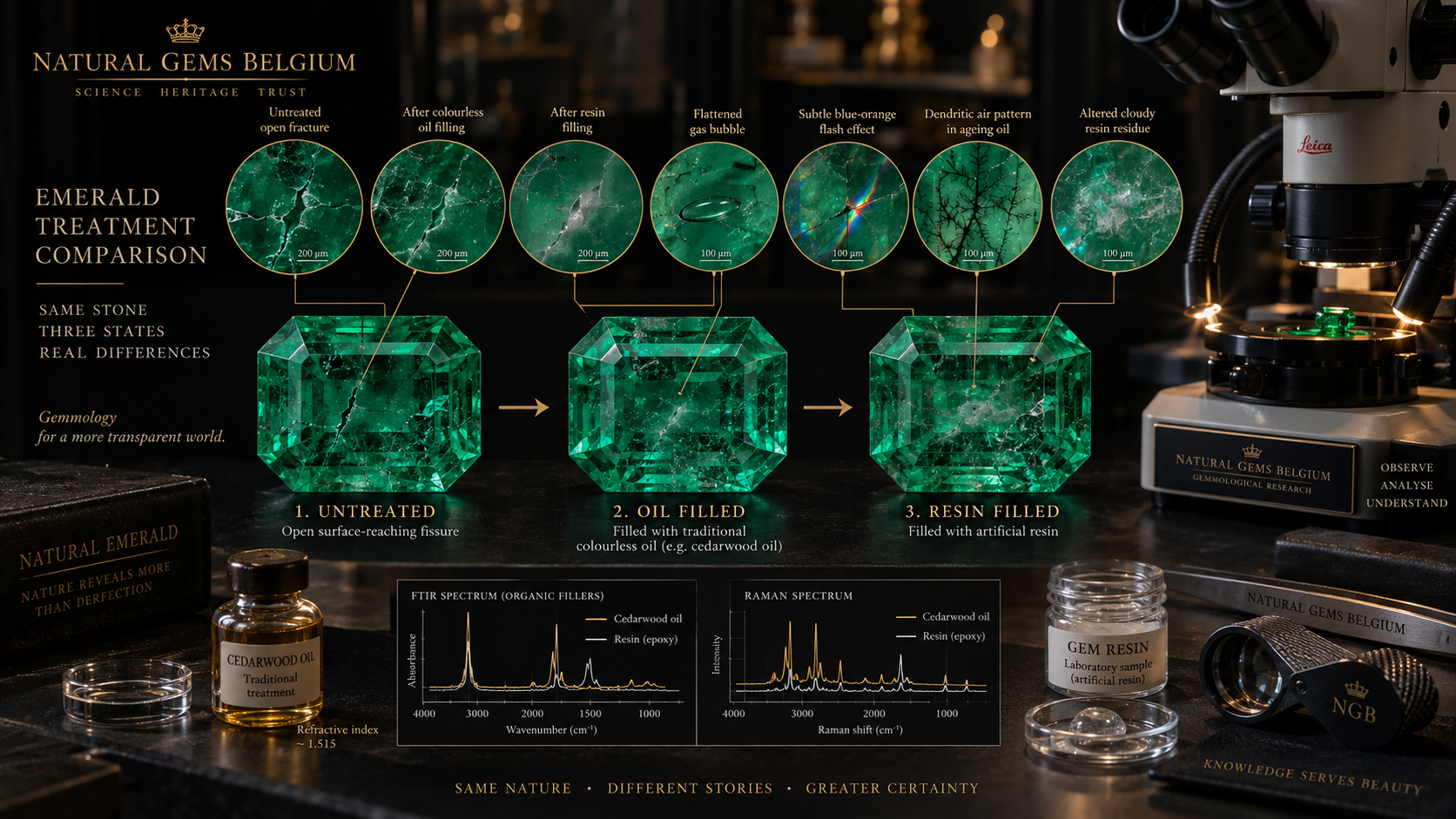
Modern treatments can also involve:
- waxes;
- natural resins;
- artificial resins;
- polymeric materials;
- mixtures of several substances.
Therefore describing every clarity-enhanced emerald simply as:
“oiled”
can be scientifically incomplete.
Understanding emerald treatment requires several separate questions:
Is filler present?
How much filler is present?
What kind of substance is it?
How stable is it?
How strongly does it affect appearance?
What does it mean for care, disclosure and value?
This guide examines those questions one by one.
Table of Contents
1. Why Emeralds Commonly Contain Fissures
Emerald is the green to bluish-green variety of beryl.
Its idealised formula is:
Be₃Al₂Si₆O₁₈
Natural emerald generally forms under complex geological conditions involving fluids, chemical reactions and deformation.
During and after growth, crystals can develop fractures because of:
- tectonic stress;
- differential pressure;
- changes in temperature;
- internal growth stress;
- later geological deformation.
As a result, many fashioned emeralds contain surface-reaching fissures.
2. A Fissure Is Not the Same as an Inclusion Crystal
Gemstone terminology matters.
A fissure is a break within the gemstone.
A mineral inclusion is a separate material trapped inside the host.
An emerald may contain both.
Clarity enhancement is principally concerned with:
surface-reaching fissures
because a filling substance must have access from the surface to enter the crack.
A completely enclosed internal inclusion cannot simply be filled from outside.
3. Why Open Fissures Look So Obvious
The visibility of a fissure is strongly influenced by refractive index.
Emerald has a refractive index around:
1.57–1.59
depending on composition.
Air has a refractive index close to:
1.00.
The large optical difference between emerald and air causes strong reflection at the fissure boundary.
That is why an otherwise transparent emerald can contain a fracture that appears bright and conspicuous.
4. Filler Reduces Optical Contrast
Now replace the air inside the fissure with a transparent substance whose refractive index is closer to emerald.
The optical contrast decreases.
Less light is reflected from the fracture boundary.
The fissure becomes:
- less white;
- less reflective;
- less visible.
This can create a significant improvement in apparent clarity.
The treatment therefore works through:
optical matching.
5. The Crack Has Not Necessarily Disappeared
This is perhaps the most important conceptual point.
Fissure filling does not necessarily repair the emerald structurally.
The fracture may remain physically present.
The filler simply reduces its visibility.
Therefore:
clarity enhancement ≠ geological healing.
The gemstone can look much clearer without becoming structurally identical to an emerald that never contained the fracture.
6. Traditional Oil Treatment
Oil is the best-known traditional emerald treatment.
Historical accounts document the practice of introducing oil into emerald fissures for many generations.
The principle is straightforward:
- The emerald is cleaned.
- Surface-reaching fissures are exposed.
- Oil is encouraged into the openings.
- Air within the fissures is displaced.
- The filled fissure becomes less visible.
Pressure or vacuum may be used to assist penetration.
7. Cedarwood Oil
One of the most famous traditional filler substances is:
cedarwood oil.
Its long association with emerald has led many buyers to assume that:
all emerald oil = cedarwood oil.
That is incorrect.
Several oils and other transparent substances can be used.
A laboratory cannot safely identify a filler merely because oiling is traditional.
8. Not All Oils Are the Same
Gemological research has examined a wide range of fillers.
GIA classified studied emerald filling substances into groups that included:
- essential oils;
- other oils;
- waxes;
- epoxy prepolymers;
- other prepolymers;
- polymers.
Therefore:
“oil-filled emerald”
and
“clarity-enhanced emerald”
are not automatically equivalent descriptions.
The second category is broader.
9. Natural Resins
Transparent natural resinous substances have also been used in fissures.
An example is:
Canada balsam.
Natural resins differ chemically from simple oils.
Their ageing behaviour can also differ.
A filler should therefore be considered an actual material inside the gemstone—not merely an abstract treatment label.
10. Artificial Resins
Modern emerald treatment can employ artificial resins.
These may include:
- epoxy-related materials;
- prepolymers;
- UV-curing systems;
- other polymer formulations.
Some can harden after entering the fissure.
This can make them more persistent than traditional liquid oil.
The trade may therefore view oil and hardened resin differently.
11. Why Resins Became Attractive
A traditional oil can migrate or deteriorate.
A polymerised resin can offer:
- greater persistence;
- stronger retention;
- effective refractive-index matching.
From a purely technical perspective, this can create a more stable visual improvement.
From a commercial perspective, however, buyers may prefer traditional oil to artificial resin.
Technical effectiveness and market preference are not the same thing.
12. Filler Stability Matters
A clarity filler exists inside an open fracture.
It may therefore interact with:
- air;
- heat;
- cleaning chemicals;
- solvents;
- light;
- time.
Different materials behave differently.
Some can:
- evaporate;
- oxidise;
- polymerise;
- discolour;
- shrink;
- become cloudy.
The visual appearance of an enhanced emerald can therefore change.
13. Oils Can Age
Oil-filled fissures may become more visible as filler changes or escapes.
Over time, air can enter previously filled portions of the fracture.
This can create characteristic patterns.
SSEF has documented:
dendritic air structures
developing inside oil-filled fissures as air progressively penetrates.
Under magnification, such patterns can help reveal treatment.
14. Resins Can Age Too
Artificial resin should not automatically be considered permanently invisible.
SSEF has documented aged artificial fillers becoming:
- whitish;
- brownish;
- opaque;
- visually altered.
Changes can make a fissure more conspicuous again.
The assumption that:
synthetic resin = permanent treatment
is therefore too simplistic.
15. Mixed Fillers Complicate Identification
An emerald may not contain only one filler.
It can be:
- treated originally with resin;
- later cleaned;
- refilled with oil;
- incompletely cleaned;
- treated more than once.
Residues of earlier filler may remain.
GIA therefore cautions that identifying one material in a fissure does not necessarily prove that no other filler is present.
Treatment history can be layered.
16. Clarity Enhancement Can Be Reversible
Some fillers can be removed.
A heavily treated emerald may be cleaned with appropriate solvents or chemicals.
Once the filler is removed, previously hidden fissures can become much more visible.
The same stone can therefore appear dramatically different:
filled → apparently clearer
versus
cleaned → visibly fractured.
This difference demonstrates just how strong the optical effect of filling can be.
17. Cleaning Does Not Remove the Fracture
Removing filler does not restore an emerald to an originally flawless state.
The fissure remains.
In fact, once the optical masking material is removed, the crack may become dramatically more visible.
Therefore:
“no filler present”
does not automatically mean:
high natural clarity.
An untreated fissured emerald can look significantly more included than the same stone after filling.
18. Aggressive Cleaning Can Introduce Risk
Removing hardened resin may require strong chemical processes.
SSEF has documented emeralds that chipped after aggressive filler removal.
Existing fractures remain structural weaknesses.
Cleaning cannot make them disappear.
Mechanical or chemical treatment may even increase vulnerability.
This becomes particularly important when high-value emeralds are repeatedly cleaned and re-treated for market preferences.
19. Why Some Emeralds Are Cleaned and Re-oiled
The high-end market often places a premium on emeralds containing:
- no filler;
- only small amounts of traditional oil.
An emerald originally filled with artificial resin may therefore be:
- chemically cleaned;
- submitted to a laboratory;
- later refilled with oil.
This can change the treatment description while leaving the same underlying fissure system.
Treatment status can therefore change during a gemstone’s commercial life.
20. A Laboratory Report Describes a Moment in Time
This has an important consequence.
A gem laboratory examines the gemstone as it exists:
at the time of testing.
Suppose an emerald is cleaned.
The report records:
no indications of clarity modification
at that moment.
If someone later fills the fissures with oil or resin, the physical gemstone has changed.
The old report no longer accurately describes the current treatment condition.
21. The 2026 SSEF Trade Alert
In June 2026, the Swiss Gemmological Institute SSEF issued a trade alert after encountering exactly this problem.
Emeralds were reportedly:
- cleaned;
- tested;
- issued reports showing little or no filler;
- later refilled;
- offered with the earlier report.
The report itself had not become scientifically incorrect.
The gemstone had been modified after testing.
This episode demonstrates why treatment disclosure requires current documentation.
22. Re-testing Can Be Important
For significant transactions involving highly fissured emeralds, particularly when:
- the report is old;
- the stone looks unusually clear;
- clarity modification is commercially important;
re-testing may be appropriate.
This is especially relevant because introducing filler into existing surface-reaching fissures can sometimes be performed relatively quickly.
A report should never be treated as physically binding the gemstone to one future state.
23. Detecting Filler with a Microscope
Gemological microscopy is usually the first major tool used to detect emerald filling.
A gemmologist searches surface-reaching fissures for features such as:
- flash effects;
- bubbles;
- flow structures;
- incomplete filling;
- dendritic patterns;
- residue.
Different illumination methods can reveal different evidence.
24. Darkfield Illumination
Darkfield can reveal the overall fracture network.
Filled and unfilled regions may behave differently.
Under darkfield:
- cracks can appear bright;
- residues may scatter light;
- bubbles may stand out.
But darkfield alone may not reveal the best evidence.
Directional lighting is often more informative.
25. Fibre-Optic Illumination
A fibre-optic light source can be moved around the emerald while the fissure is observed under magnification.
This can reveal:
- flash effects;
- filler boundaries;
- reflective interfaces;
- gas bubbles.
Some treatment features become visible only through a narrow lighting angle.
Therefore the stone and light should both be moved slowly.
26. Flash Effects
Certain fillers can produce coloured flashes along fissures.
Depending on filler properties and viewing conditions, these may appear:
- blue;
- orange;
- violet;
- yellow.
The effect results from the optical interaction between different materials at the fracture boundary.
Flash effects can provide important evidence.
27. Flash Does Not Automatically Mean Artificial Resin
This is an important caution.
GIA research showed that fillers with refractive indices of approximately 1.54 or higher can produce flash effects regardless of whether they are classified as oil, wax or artificial resin.
Therefore:
flash effect = evidence of filler
does not necessarily equal:
flash effect = synthetic resin.
The actual filler may require spectroscopy.
28. Gas Bubbles
Flattened gas bubbles can appear inside filled fissures.
They may be:
- rounded;
- elongated;
- flattened against the fracture plane.
These bubbles reveal incomplete filling or trapped air.
They can become particularly obvious with directional lighting.
29. Flow Structures
Some filling materials can show internal flow-related structures.
These may appear as:
- swirls;
- streaks;
- irregular lines.
They are especially useful when combined with other evidence.
Like most microscopic features, they should not be interpreted in isolation.
30. Dendritic Air Patterns
As oil leaves or air re-enters a previously filled fissure, the boundary can form branching patterns.
These can resemble:
- trees;
- fern-like structures;
- dendrites.
SSEF has documented such patterns as practical microscopic evidence of oil-filled fissures undergoing change.
The pattern illustrates treatment ageing in real time.
31. Spectroscopy Identifies What the Eye Cannot
Microscopy may establish that:
something occupies the fissure.
It may not establish exactly what that substance is.
Laboratories can therefore use spectroscopic methods, particularly:
- FTIR;
- Raman spectroscopy.
Organic materials contain molecular bonds that produce characteristic spectral features.
These provide chemical evidence about the filler.
32. FTIR
Fourier-transform infrared spectroscopy detects molecular absorption in infrared wavelengths.
Organic fillers can display absorption associated with bonds such as:
- C-H;
- C-O;
- other molecular groups.
Different oils and resins may produce different spectral patterns.
FTIR is therefore particularly useful in investigating organic clarity-enhancement substances.
33. Raman Spectroscopy
Raman spectroscopy provides another molecular fingerprint.
A laser interacts with the material.
A tiny portion of light changes energy according to molecular vibrations.
The resulting spectrum can help identify:
- minerals;
- glass;
- organic fillers;
- treatment residues.
Confocal Raman systems can sometimes target material inside a specific fissure.
34. GIA’s Filler Research
A major GIA study examined:
39 different filling substances.
They included natural-type and artificial materials.
Spectroscopy separated the samples into several major spectral groups.
Most commonly used artificial resins could be distinguished from cedarwood oil.
However, overlap and mixtures mean identification is not always trivial.
This research is one reason filler terminology has become more precise.
35. Current GIA Filler Reporting
Beginning in December 2024, GIA reintroduced optional identification of emerald filling material on laboratory reports.
When identifiable filler is detected, it can be reported as:
Filler Type A
May include:
- oil;
- wax;
- natural resin.
Filler Type B
Artificial resin.
The report may also state that the clarity-enhancing material cannot currently be identified.
This deliberately avoids pretending that every formulation can be named exactly.
36. Why GIA Uses Broad Types
Filler chemistry can be complicated.
Materials can be:
- proprietary;
- mixed;
- aged;
- altered;
- partially removed.
A broad scientifically defensible category can therefore be more accurate than confidently naming a specific commercial product without sufficient evidence.
Good gemology favours a supported category over an unsupported precise label.
37. SSEF Uses a Different Reporting Approach
SSEF reports the detected filler substance more directly where possible, such as:
- oil;
- artificial resin;
- wax.
It also quantifies the amount of filler at the time of testing.
Different laboratories can use different reporting terminology while studying essentially the same treatment phenomenon.
Always read the definitions used by the issuing laboratory.
38. How Much Filler Is Present?
Knowing that an emerald is clarity enhanced is only part of the story.
The extent of enhancement can vary from:
- almost negligible;
- minor;
- moderate;
- extensive.
A tiny filled fissure near the girdle is not equivalent to a network of major fissures crossing the stone.
Treatment amount matters.
39. GIA’s Enhancement Classification
GIA classifies detected emerald clarity enhancement as:
Minor
Moderate
or
Significant
Historically these have also been associated with:
- F1;
- F2;
- F3.
The classification refers to the effect of the treatment.
It is not an overall emerald clarity grade.
40. Minor Enhancement
Minor enhancement indicates that treatment has only a limited effect on face-up appearance.
Filled fissures may be:
- relatively few;
- relatively small;
- less visually important.
This category is often commercially preferred among treated emeralds.
But it does not automatically imply exceptional overall quality.
41. Moderate Enhancement
Moderate enhancement represents a greater treatment contribution.
Several or larger filled fissures may contribute meaningfully to face-up appearance.
Again, this describes:
treatment extent
not:
overall quality.
A vividly coloured moderate-enhancement emerald can still be visually attractive.
42. Significant Enhancement
Significant enhancement means treatment has an obvious effect on appearance.
The stone may contain an extensive network of filled fissures.
Without filler, the apparent clarity could be substantially lower.
Such a stone should not be marketed as though its transparency were entirely natural.
Disclosure allows the buyer to understand what contributes to the visual result.
43. F1, F2 and F3 Are Not Clarity Grades
This misconception is common.
F1 ≠ “high-clarity emerald.”
It means relatively minor clarity enhancement.
A minor-enhancement emerald can still contain visible natural inclusions.
Likewise, F3 does not describe its colour quality.
The system answers one question:
How strongly does fissure filling modify the stone’s apparent clarity?
44. Filler Type and Filler Amount Are Different Questions
Consider two emeralds:
Emerald A
Minor artificial resin.
Emerald B
Moderate oil.
Which is “less treated”?
There is no single answer unless you define what you mean.
One has:
- less filler;
- but artificial resin.
The other has:
- more filler;
- but traditional oil.
Filler composition and filler quantity are separate treatment dimensions.
45. The Market May Treat Them Differently
Some buyers prefer:
traditional oil
over:
artificial resin.
That preference can reflect:
- tradition;
- removability;
- perception of permanence;
- market convention.
But gemmological disclosure should describe the physical evidence rather than enforce one aesthetic or commercial preference.
Value is ultimately determined by the market.
46. No Filler Does Not Automatically Mean “Better Emerald”
An emerald with no detectable clarity enhancement may still be:
- heavily fissured;
- cloudy;
- dark;
- poorly cut.
Another emerald with minor oil may possess:
- exceptional colour;
- excellent transparency;
- attractive cut.
Treatment status affects rarity and value.
It does not replace overall quality evaluation.
47. Enhancement Does Not Make Emerald Synthetic
A naturally formed emerald remains:
natural emerald
after oil or resin filling.
It is simply:
natural emerald with clarity enhancement.
Synthetic emerald is fundamentally different because the crystal itself was grown artificially.
Natural-versus-synthetic and treatment status are separate classifications.
48. Why Emerald Clarity Enhancement Is So Common
Emerald formation naturally produces fractured material.
Fine colour can occur in stones whose clarity would otherwise appear commercially unattractive.
Fissure filling allows more natural emerald material to enter jewellery use.
The prevalence of enhancement is therefore closely connected to emerald geology.
It is not evidence that emerald itself is an artificial product.
49. Permanence Is Relative
No filler should casually be assumed to remain visually unchanged forever.
Its behaviour depends on:
- chemistry;
- fissure dimensions;
- environment;
- wear;
- cleaning;
- heat.
Some artificial resins may be more persistent than oils.
That does not make them indestructible.
Likewise, oil may be removable but can sometimes remain stable for long periods.
50. Heat and Emerald Filler
Heat is a concern for both:
- fractured emerald;
- filling material.
A jeweller’s torch can:
- affect filler;
- expand existing fissures;
- cause damage.
Jewellery repair should therefore be performed with full knowledge that emerald is present.
This is especially important for filled stones.
51. Ultrasonic Cleaning
Ultrasonic cleaners use high-frequency vibration.
Those vibrations can interact badly with:
- surface-reaching fissures;
- fillers.
GIA advises against ultrasonic cleaning for gemstones with filled surface-reaching breaks.
Emerald is a classic example.
52. Steam Cleaning
Steam introduces:
- heat;
- pressure;
- rapid temperature change.
This can affect fissures and filling substances.
Routine steam cleaning is therefore not recommended for emerald.
A gemstone’s visual durability depends on more than Mohs hardness.
53. Safe General Cleaning
For ordinary emerald care, a conservative method is:
lukewarm water + mild soap + soft cleaning
followed by careful rinsing and drying.
Avoid prolonged soaking if filler condition is uncertain.
Avoid aggressive chemical cleaners.
High-value jewellery should be examined periodically by a professional for:
- loose settings;
- open fissures;
- treatment changes.
54. Why Mohs Hardness Is Misleading Here
Emerald has a Mohs hardness of approximately:
7.5–8.
That sounds highly durable.
But hardness measures:
scratch resistance.
It does not measure:
- toughness;
- fracture vulnerability;
- filler stability.
A fissured emerald can therefore require more cautious handling than its hardness number suggests.
55. Jewellery Repair Requires Disclosure Too
Treatment disclosure matters not only to the customer.
It matters to the jeweller.
If a setter or repairer assumes an emerald is untreated, heat or cleaning procedures might unintentionally:
- remove filler;
- damage resin;
- open fractures;
- change appearance.
Providing treatment information is therefore part of protecting the gemstone.
56. Can an Emerald Be Refilled?
Yes.
If filler has:
- dried;
- migrated;
- deteriorated;
- been removed,
the stone can sometimes be clarity enhanced again.
This may improve appearance.
But the new treatment state should be disclosed.
An old laboratory report may no longer represent the gemstone accurately.
57. Treatment History Can Be Impossible to Reconstruct Completely
Suppose an emerald was:
- resin filled;
- cleaned;
- oil filled;
- partially cleaned;
- tested.
A laboratory examines the material present now.
It may identify:
- oil;
- resin residue;
- both;
- uncertain organic material.
Reconstructing every earlier treatment event may be impossible.
Gemological reports primarily describe the evidence present during examination.
58. Filler Identification Is Not Always Possible
A treatment substance can be difficult to classify if it is:
- present only in tiny amounts;
- heavily aged;
- chemically altered;
- mixed with another filler.
A scientifically responsible report may therefore state that filler is present while declining to identify its precise nature.
Uncertainty is not a laboratory failure.
It is proper scientific reporting.
59. Treatment Versus Natural Healing
Emerald can contain natural partially healed fissures.
These formed during geological history.
Their internal cavities can resemble fingerprint-like structures.
Artificial fissure filling occurs much later, after mining.
The distinction is therefore:
natural geological healing
versus
post-mining filling of surface-reaching breaks.
Microscopy can help separate the two.
60. Do Not Confuse Emerald Treatment with Ruby Flux Healing
The distinction becomes especially useful when comparing emerald with ruby.
In ordinary emerald oil/resin filling:
foreign substance occupies a pre-existing fissure and reduces optical contrast.
In flux-healed ruby:
high-temperature treatment can promote actual recrystallisation of corundum across part of the fracture.
Both can improve apparent clarity.
Their mechanisms are fundamentally different.
61. Clarity Enhancement and Geographic Origin
Filler does not determine country of origin.
An emerald can be:
Colombia + minor oil
Zambia + moderate resin
Afghanistan + no detectable filler
and many other combinations.
Geographic origin must be established separately through evidence such as:
- inclusions;
- spectroscopy;
- trace-element chemistry;
- laboratory reference collections.
62. Clarity Enhancement Can Complicate Origin Work
Extensive filling can hide or obscure some internal features.
Cleaning can change how fractures appear.
This may reduce the quality of microscopic evidence available for origin determination.
Modern laboratories therefore integrate microscopy with instrumental data.
63. Treatment and Price
Emerald value depends on multiple factors:
- colour;
- transparency;
- size;
- cut;
- geographic origin where relevant;
- enhancement degree;
- filler type;
- overall visual appeal.
All else being equal, emeralds with less clarity modification often receive stronger market preference.
But there is no universal mathematical discount.
Every stone must be evaluated individually.
64. Colour Can Still Dominate Value
An emerald with minor oil and exceptional vivid green may be substantially more desirable than a colourless-looking or weakly saturated stone with no filler.
This illustrates an important gemmological-commercial distinction:
rarity of treatment state
and
beauty
are independent dimensions.
The final market price reflects their interaction.
65. Why Full Disclosure Helps Rather Than Hurts
Treatment disclosure sometimes worries sellers.
But hiding enhancement creates a much greater problem.
Emerald buyers increasingly understand that clarity modification is common.
Transparent disclosure allows them to evaluate:
- how much;
- what kind;
- whether laboratory documentation exists;
- what care is required.
Clear information transforms treatment from a hidden risk into a documented property.
66. Current Laboratory Terminology Matters
Laboratory nomenclature evolves.
A report issued years ago may use terminology different from a current report.
For example, GIA’s current optional filler-identification system distinguishes Type A and Type B materials, while SSEF may specifically name oil, artificial resin or wax where identifiable.
Always interpret a report according to the issuing laboratory’s own definitions.
67. Never Rewrite Laboratory Language Casually
If a report states:
Minor clarity enhancement — Filler Type B
do not casually rewrite it as:
lightly oiled.
Type B indicates artificial resin under GIA’s current system.
Likewise, if a report identifies:
moderate oil
do not upgrade the description to:
minor treatment
because it sounds commercially nicer.
Specimen-specific laboratory wording should be preserved.
68. Questions a Buyer Should Ask
When evaluating an emerald, ask:
Is the stone natural?
Establish natural versus laboratory-grown origin first.
Is clarity enhancement detected?
Do not assume “natural emerald” means untreated.
What is the degree?
Minor, moderate or significant can affect commercial interpretation.
Is the filler type known?
Oil, resin or another substance may matter to the buyer.
How recent is the laboratory report?
Filler can potentially be removed or introduced after testing.
What care does the stone require?
Treatment status influences safe cleaning and repair.
69. Questions a Seller Should Be Able to Answer
A responsible seller should distinguish:
identity
origin
treatment
quality
These are separate questions.
A statement such as:
“Natural Colombian emerald”
does not tell the customer:
- whether fissures are filled;
- how much filler is present;
- what filler was used.
Complete disclosure requires more.
70. Product Descriptions Should Be Specimen-Specific
Avoid generic statements such as:
“Emeralds are traditionally oiled.”
when documenting an individual stone.
That may be true historically.
It does not tell us what happened to that emerald.
If treatment is known, use the specimen’s documented information.
If treatment is unknown, do not invent one from general trade practice.
71. Common Misconceptions
Myth 1 — “All emeralds are oiled.”
Incorrect.
Many are clarity enhanced, but individual stones can have no detectable filler, oil, resin, wax or another material.
Myth 2 — “Oiling heals the crack.”
Incorrect.
It mainly reduces optical visibility.
Myth 3 — “All emerald filler is cedarwood oil.”
Incorrect.
Many oils, natural substances and artificial resins have been used.
Myth 4 — “A flash effect proves artificial resin.”
Incorrect.
Several high-refractive-index fillers can produce flash effects.
Myth 5 — “Artificial resin is permanent forever.”
Incorrect.
Resins can age, alter and sometimes be removed.
Myth 6 — “No filler means no fissures.”
Incorrect.
An emerald can be heavily fissured and contain no filler.
Myth 7 — “Minor enhancement means high clarity.”
Incorrect.
It describes treatment extent, not overall clarity.
Myth 8 — “F3 means poor colour.”
Incorrect.
Enhancement degree does not grade colour.
Myth 9 — “A natural emerald cannot be treated.”
Incorrect.
Natural origin and treatment history are separate classifications.
Myth 10 — “An old laboratory report always describes the emerald today.”
Incorrect.
The stone may have been cleaned, refilled or otherwise altered after testing.
72. Evidence Classification
| Statement | Classification |
|---|---|
| Surface-reaching emerald fissures can be made less visible with transparent fillers | Established treatment principle |
| Oils have traditionally been used as emerald fillers | Established historical practice |
| Artificial resins can also fill emerald fissures | Established modern treatment practice |
| Filling principally reduces optical contrast rather than eliminating the fracture | Established optical principle |
| Filler can age or change over time | Established laboratory observation |
| Filled fissures may show flash effects and gas bubbles | Established microscopic evidence |
| Flash effects uniquely identify artificial resin | Incorrect |
| FTIR and Raman can help identify organic fillers | Established analytical practice |
| GIA classifies enhancement as minor, moderate or significant | Established laboratory practice |
| F1/F2/F3 are overall emerald clarity grades | Incorrect |
| Filler type and filler quantity are separate characteristics | Established treatment principle |
| A gemstone can be cleaned and refilled after laboratory testing | Established trade/laboratory observation |
| A laboratory report describes treatment status at the time of examination | Established reporting principle |
| Natural emerald automatically means untreated emerald | Incorrect |
| No detectable filler automatically means superior visual quality | Incorrect |
| Clarity enhancement determines geographic origin | Incorrect |
73. A Practical Gemmological Examination Workflow
A structured emerald-treatment examination can proceed as follows.
Step 1 — Confirm Identity
Establish that the stone is emerald/beryl and determine natural versus synthetic origin.
Step 2 — Examine the Surface
Locate:
- surface-reaching fissures;
- cavities;
- chips.
Step 3 — Darkfield Microscopy
Map the internal fracture network.
Step 4 — Fibre-Optic Illumination
Search for:
- flash effects;
- filler boundaries;
- bubbles;
- dendritic structures.
Step 5 — Rotate the Stone
Treatment evidence can appear only from particular angles.
Step 6 — Estimate Enhancement Extent
Determine how strongly filled fissures contribute to face-up appearance.
Step 7 — Spectroscopic Investigation
Use FTIR or Raman where filler identification is required.
Step 8 — Compare Laboratory Terminology
Report the treatment according to the definitions used by the laboratory.
Step 9 — Consider Care
Treatment information should inform cleaning, setting and repair recommendations.
Step 10 — Report Conservatively
State only what the evidence demonstrates.
Conclusion
Emerald clarity enhancement is easy to understand at a basic level.
A fissure contains air.
Air creates strong optical contrast against emerald.
Replace that air with a transparent material whose optical properties are closer to beryl and the fracture becomes less visible.
The emerald looks clearer.
But beneath that simple effect lies a surprisingly complex treatment history.
The filler might be:
- traditional oil;
- wax;
- natural resin;
- artificial resin;
- polymer;
- a mixture of materials.
It may be present in:
- minor;
- moderate;
- significant
amounts.
It may remain stable.
It may age.
It may become cloudy.
It may migrate.
It may be removed.
The emerald may then be filled again.
That means clarity enhancement is not merely a historical event.
It can be a changing physical condition.
This is why a laboratory report describes what was observed when the gemstone was examined.
An emerald tested without filler can later be refilled.
An emerald once containing artificial resin can be cleaned and re-treated with oil.
Treatment status can change while the gemstone itself remains the same natural crystal.
Modern gemmology therefore separates several questions:
Is the emerald natural or synthetic?
Are surface-reaching fissures filled?
How much clarity modification is present?
What type of material occupies those fissures?
How stable is that material?
Does the documentation still describe the gemstone in its current condition?
Microscopy provides the first evidence.
Flash effects, bubbles, flow structures and dendritic patterns can reveal the presence and behaviour of filler.
FTIR and Raman spectroscopy can investigate what the substance actually is.
Laboratory classification then places the treatment into a defined context.
The most important lesson for buyers and sellers is therefore not:
“Avoid treated emerald.”
It is:
Understand exactly what treatment is present and disclose it accurately.
A beautiful natural emerald with minor traditional oil can remain a beautiful natural emerald.
A resin-filled stone can also be attractive.
But the buyer deserves to know which is which.
In gemstone commerce, treatment does not destroy transparency.
Failure to disclose it does.
References & Further Reading
Johnson, M. L., Elen, S. & Muhlmeister, S. — “On the Identification of Various Emerald Filling Substances.” Gems & Gemology, Summer 1999, Gemological Institute of America.
Foundational analytical study examining 39 emerald filling substances, including essential oils, other oils, waxes, epoxy prepolymers and polymers. Particularly important for understanding flash effects and the use of Raman and infrared spectroscopy in filler identification.
https://www.gia.edu/gems-gemology/summer-1999-identification-emerald-filling-johnson
McClure, S. F., Moses, T. M., Tannous, M. & Koivula, J. I. — “Classifying Emerald Clarity Enhancement at the GIA Gem Trade Laboratory.” Gems & Gemology, Winter 1999.
Foundational GIA study developing the minor, moderate and significant clarity-enhancement classification after systematic examination of more than 500 filled emeralds.
https://www.gia.edu/doc/WN99.pdf
Gemological Institute of America — “Emerald Quality Factors.”
Current consumer and professional reference explaining GIA’s minor, moderate and significant clarity-enhancement classifications and emphasizing that they describe treatment rather than an overall emerald clarity grade.
https://www.gia.edu/emerald-quality-factor
Gemological Institute of America — “On a Laboratory Report for a Treated Emerald, What Does F1, F2 and F3 Mean?”
Concise definition of F1 = minor, F2 = moderate and F3 = significant clarity enhancement and their relationship to face-up appearance.
https://my.gia.edu/FAQ/gia-faq-analysis-grading-treated-emerald-f1-f2-f3
Gemological Institute of America — “GIA Enhances its Emerald Reports.” December 11, 2024.
Current reference for GIA’s optional emerald filler-identification service. GIA reports Filler Type A as material that may include oil, wax and/or natural resin, Type B as artificial resin, or states that the clarity-enhancing material cannot currently be identified.
https://www.gia.edu/gia-news-press/gia-enhances-emerald-reports
Gemological Institute of America — “Raman Spectroscopy and X-Ray Diffraction: Phase Identification of Gem Minerals and Other Species.” Gems & Gemology, Winter 2024.
Modern review explaining how Raman spectroscopy can identify foreign treatment substances, including organic fillers in emerald through characteristic molecular vibrations.
https://www.gia.edu/gems-gemology/winter-2024-raman-spectroscopy-and-xrd
Gemological Institute of America — “Tips on Caring for Jewelry.”
Practical care reference explaining why filled gemstones require special caution with heat, solvents, steam and ultrasonic cleaners.
https://www.gia.edu/gia-news-research-tips-caring-jewelry
Swiss Gemmological Institute SSEF — “Emerald.”
Current SSEF laboratory reference explaining its treatment-disclosure system, including identification of oil, wax, natural resin and artificial resin and quantification as minor, moderate or significant at the time of testing.
https://www.ssef.ch/reports/emerald/
Swiss Gemmological Institute SSEF — “Emeralds and the Saga of Cleaning and Filling Fissures.”
Important discussion of emerald cleaning, filler removal, re-oiling and the principle that treatment statements on laboratory reports describe the gemstone’s condition at the time of testing.
https://www.ssef.ch/emeralds-and-the-saga-of-cleaning-and-filling-fissures/
Swiss Gemmological Institute SSEF — “Bachelor Thesis on Fissure Filling Substances in Emeralds.” Facette 29, 2024.
Recent research overview examining ageing, alteration, polymerisation and mixtures of emerald filling materials using FTIR and Raman spectroscopy.
https://www.ssef.ch/bachelor-thesis-on-fissure-filling-substances-in-emeralds/
Swiss Gemmological Institute SSEF — “Fraudulent Filling of Fissures in Emeralds After They Have Been Laboratory Tested.” Trade Alert, June 15, 2026.
Highly relevant current trade alert documenting cases in which emeralds were cleaned and laboratory tested, then subsequently refilled while being offered with earlier reports. The alert explains why current treatment state and report date matter.
https://www.ssef.ch/fraudulent-filling-of-fissures-in-emeralds-after-they-have-been-laboratory-tested/
Swiss Gemmological Institute SSEF — “Chipping of Emeralds.”
Practical reference documenting the structural risks associated with highly fissured emeralds and aggressive chemical/mechanical cleaning used to remove artificial filler.
https://www.ssef.ch/fr/chipping-of-emeralds/
CIBJO — The World Jewellery Confederation, Gemstone Guides: Emerald.
International jewellery-trade guidance covering emerald quality factors, modifications and treatment disclosure.
https://cibjo.org/the-gemstone-guides/
CIBJO — The Blue Books.
International standards resource covering coloured-stone nomenclature, treatments, disclosure and laboratory terminology.
https://cibjo.org/the-blue-books/