

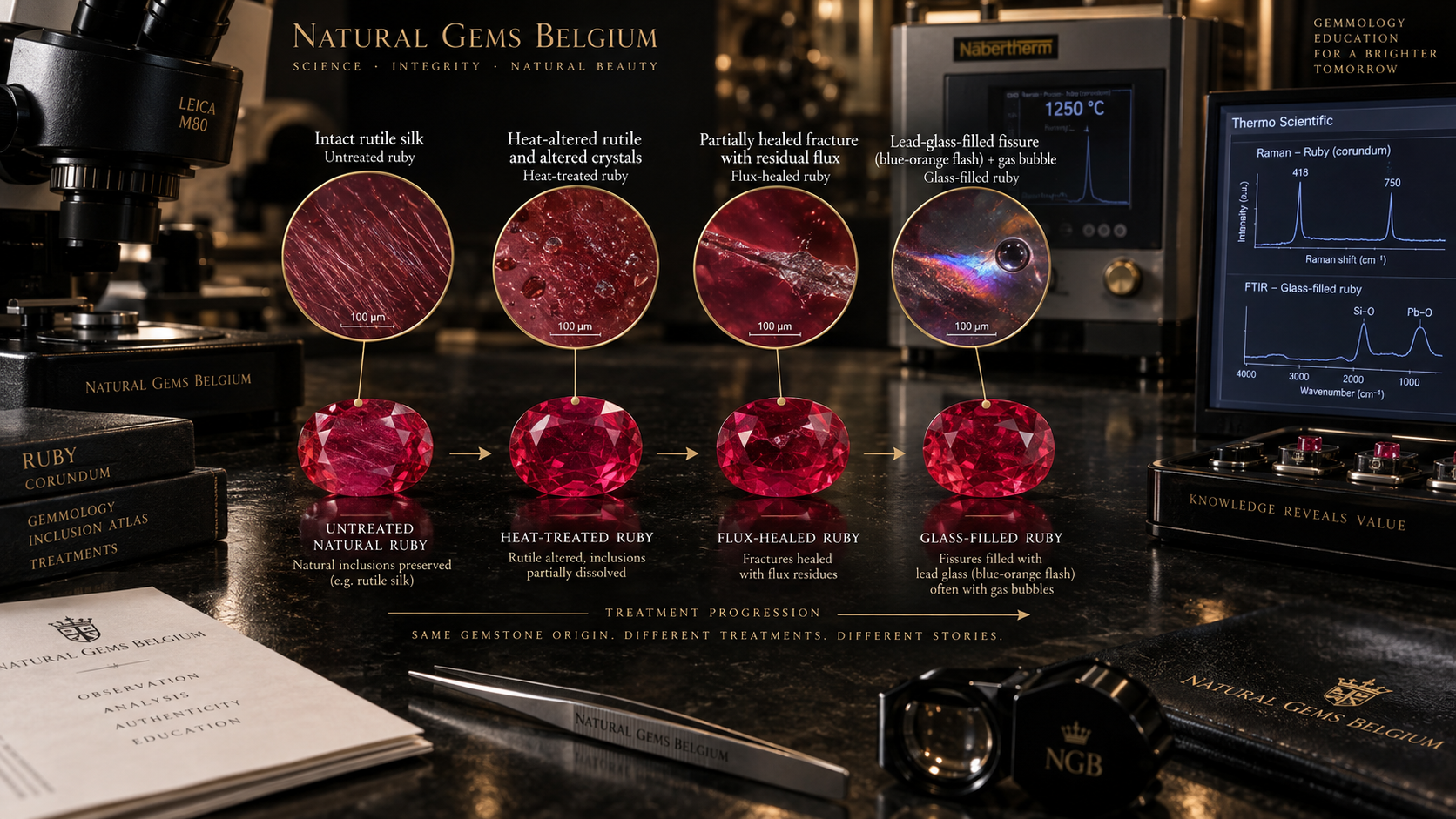
Why “Treated Ruby” Does Not Describe One Single Process
Ruby treatments are frequently reduced to one simple word:
heated.
That can be seriously misleading.
Two rubies may both have experienced a furnace yet have very different ruby heat treatment histories.
One may have been heated primarily to improve colour.
Another may have been heated at high temperature in the presence of a flux that entered its fractures and helped them partially heal.
A third may contain substantial quantities of foreign glass deliberately introduced into open fissures to improve transparency.
There are also diffusion treatments capable of introducing colour-causing elements into corundum at very high temperatures.
All of these involve human intervention.
But they are not gemmologically equivalent.
They differ in:
- mechanism;
- amount of foreign material;
- detectability;
- durability implications;
- rarity;
- commercial positioning;
- disclosure significance.
Understanding those differences is essential when buying, selling or studying ruby.
This guide separates the principal ruby treatment categories and explains what happens physically inside the gemstone, what evidence gemmologists look for and why a simple description such as “treated ruby” may not provide enough information.
Table of Contents
1. Begin with Natural Ruby
Ruby is the red variety of corundum.
Its ideal chemical composition is:
Al₂O₃
Pure corundum would be colourless.
Ruby’s red colour arises principally because small quantities of chromium substitute for aluminium in the crystal structure.
Natural ruby can also contain:
- iron;
- titanium;
- vanadium;
- magnesium;
- other trace elements.
Its internal features may include:
- rutile silk;
- mineral crystals;
- healed fissures;
- open fractures;
- twinning;
- colour zoning;
- cavities.
Some of these features can reduce transparency or produce undesirable colour components.
Treatment attempts to modify them.
2. Why Ruby Is Treated
Natural ruby rough does not emerge from the ground optimised for jewellery.
A stone may contain:
- unwanted blue or purple colour;
- dense rutile silk;
- fractures;
- cloudy areas;
- low transparency.
Heating can sometimes improve these characteristics enough to transform material that would otherwise have limited commercial appeal.
Treatment can therefore increase the usable supply of ruby.
The important issue is not simply whether treatment exists.
It is:
what treatment was performed and what did it change?
3. Heat Treatment Has a Long History
Heating ruby and sapphire is not a modern invention.
Historical records indicate that humans have used heat to modify corundum for many centuries.
Modern furnace technology, however, allows much greater control over:
- temperature;
- heating duration;
- atmosphere;
- oxygen availability;
- reducing conditions;
- fluxes;
- chemical additives.
Temperatures used in modern corundum treatment can range from relatively modest levels to well above:
1,500°C
depending on the intended result.
Some diffusion processes require temperatures approaching the melting temperature of corundum.
4. Conventional Heating
The simplest conceptual treatment category is:
heat only.
The ruby is heated under controlled conditions without intentionally filling its fractures with a foreign glass.
The objectives may include:
- improving colour;
- removing unwanted colour components;
- reducing silk;
- improving transparency;
- modifying inclusions.
Although we call this “simple heating,” the physics and chemistry inside the gemstone can be complex.
5. Heat Does Not Paint a Ruby
A furnace does not apply a red pigment.
Instead, heat changes systems already present in the gemstone.
It can influence:
- oxidation states;
- defect structures;
- trace-element interactions;
- microscopic inclusions;
- exsolved rutile;
- internal stress.
The resulting optical absorption changes.
Colour can therefore become:
- stronger;
- lighter;
- more uniform;
- less purple;
- less blue.
The precise result depends entirely on the starting material.
6. Ruby Can Contain Unwanted Blue
Some natural ruby—particularly historically important material from Mong Hsu, Myanmar—can contain dark or blue core regions.
These colour components can involve iron and titanium interactions.
Suitable heating can reduce or remove much of this unwanted coloration.
The stone may become a more commercially attractive:
red.
This treatment helped bring large quantities of previously unattractive ruby material into the jewellery market.
7. Heating Can Alter Rutile Silk
Natural ruby may contain fine rutile needles:
TiO₂
commonly called:
silk.
At sufficiently high temperatures, rutile can begin dissolving back into the corundum structure.
GIA research places major rutile dissolution approximately around:
1,200–1,350°C
although actual behaviour depends on the material and treatment conditions.
This alteration is one of the classic microscopic clues to high-temperature heat treatment.
8. Before Heating: Intact Silk
Unheated natural ruby may show:
- fine straight needles;
- organised intersecting networks;
- dense clouds;
- crisp rutile particles.
The needles can follow crystallographic directions in corundum.
Their geometry records part of the gemstone’s natural cooling history.
9. After High-Temperature Heating
Heat-altered rutile may appear:
- partially dissolved;
- broken;
- dotted;
- interrupted;
- reduced.
Other inclusions can also show heat-related changes.
The microscopic scene may therefore reveal that the gemstone has experienced temperatures far beyond anything expected during normal jewellery wear.
10. Heat Can Improve Transparency
Dense microscopic particles scatter light.
When heating dissolves or modifies those particles, less light may be scattered.
The ruby can consequently appear:
- clearer;
- more transparent;
- brighter.
This is important because treatment can improve apparent clarity even when no fracture filler has been introduced.
That mechanism is fundamentally different from glass filling.
11. High Heat Can Damage Included Crystals
Ruby frequently contains mineral crystals trapped during natural growth.
Possible inclusions include:
- calcite;
- mica;
- spinel;
- zircon;
- apatite;
- amphibole.
When ruby is heated, these minerals do not necessarily react in the same way as corundum.
Some may:
- expand differently;
- recrystallise;
- melt;
- change phase;
- develop surrounding fractures.
The inclusion can therefore act as a record of heating.
12. Discoid Fractures
A mineral inclusion can respond differently to heat than the surrounding corundum.
Differential expansion can create stress.
The result may be a circular or disc-like fracture around the crystal.
These heat-related features are commonly known as:
discoid fractures
or heat-induced tension fractures.
They can provide strong microscopic evidence of treatment when interpreted correctly.
13. Heated Zircon Inclusions
Zircon is a well-known natural inclusion in corundum.
Heat can modify zircon and its surrounding structures.
Possible evidence may include:
- altered crystal surfaces;
- expanded tension fractures;
- changes in internal structure.
But not every zircon inclusion reacts identically.
Its size, position and previous geological history all matter.
14. The Traditional Heat-Detection Problem
For many years, gemmologists relied heavily on obvious high-temperature indicators such as:
- dissolved rutile;
- melted inclusions;
- strongly altered crystals;
- recrystallised surfaces.
These remain valuable.
But modern treatment increasingly challenges this approach.
Why?
Because not every ruby needs extreme temperatures to improve.
15. Low-Temperature Ruby Heating
Low-temperature heating has become an important laboratory challenge.
In experimental research on ruby from Mogok, GIA heated specimens across a range from:
600°C to 1,500°C.
Below the temperatures required to strongly dissolve rutile, traditional silk-based heat indicators could remain largely unchanged.
A ruby can therefore look surprisingly natural under the microscope despite having been intentionally heated.
16. The “Canary in the Ruby Mine”
GIA researchers examined which natural inclusions react before rutile does.
They found that some:
- calcite;
- mica;
- spinel;
- zircon
inclusions could show alterations at approximately:
600–1,100°C.
These inclusions can act as earlier indicators of heat exposure.
The analogy used by the researchers was a canary in the ruby mine:
a sensitive feature that reacts before the better-known rutile indicator does.
17. But Some Inclusions Do Not React
This limitation is crucial.
Not every calcite crystal changes visibly.
Not every spinel crystal changes.
Not every zircon reacts.
Reaction depends on variables such as:
- mineral species;
- size;
- position;
- distance from the surface;
- heating conditions.
Therefore:
The absence of visibly heat-altered inclusions does not prove that a ruby is unheated.
That is one of the most important conclusions in modern ruby treatment detection.
18. Raman Spectroscopy Can Help
When a mineral inclusion remains visually ambiguous, laboratory analysis can provide additional evidence.
Micro-Raman spectroscopy can identify tiny internal minerals and detect structural changes associated with heating.
GIA’s low-temperature experiments found Raman investigation of inclusions such as:
- spinel;
- calcite
useful as complementary evidence.
Microscopy and spectroscopy therefore work together.
19. FTIR Can Add Another Line of Evidence
Fourier-transform infrared spectroscopy:
FTIR
is widely used in modern corundum analysis.
Infrared absorption can reveal features associated with:
- hydroxyl;
- inclusions;
- defect structures;
- treatment.
Not every ruby provides diagnostic FTIR evidence.
But when appropriate features are present, infrared spectroscopy can strengthen the treatment interpretation.
20. Why Laboratory Reports Say “No Evidence of Heat”
A reputable laboratory generally does not claim:
“This ruby has definitely never experienced any heat whatsoever during its entire history.”
Instead, reports commonly use terminology such as:
No indications of heating
or
No evidence of heat treatment.
That wording reflects scientific limits.
The laboratory is reporting the evidence observed with available methods.
21. Unheated Ruby Can Command a Premium
Fine natural ruby with laboratory evidence indicating no heat treatment is relatively rare.
For that reason, high-quality unheated stones can command significant premiums over comparable heated ruby.
GIA advises that consumers generally assume ruby may have been heated unless a respected independent laboratory report indicates otherwise.
This is a market observation, not a judgement that heating makes a ruby undesirable.
Fine heated ruby can still be beautiful and valuable.
22. Ordinary Heated Ruby Is Still Natural Ruby
This distinction deserves emphasis.
A naturally formed ruby does not become synthetic because it is heated.
It remains:
natural corundum.
Its treatment history is simply:
heated.
Natural/synthetic status and treated/untreated status are separate classifications.
23. Then Comes a More Complex Process: Flux-Assisted Heating
Some natural ruby contains significant open fractures.
High-temperature heating can be performed in the presence of a:
flux.
Flux is a material that becomes molten at treatment temperatures and facilitates chemical reactions.
Examples historically include borate-related materials such as borax.
The flux can enter open fissures in the ruby.
What happens next makes this process fundamentally interesting.
24. What Is Flux Healing?
During high-temperature treatment, molten flux penetrates an existing fracture.
Under appropriate conditions, some corundum can dissolve into the flux.
As treatment continues, corundum may recrystallise across portions of the fissure.
The fracture therefore becomes:
partially healed.
After cooling, some solidified flux residue can remain trapped within the reconstructed fissure.
This is not simply the same as pouring glass into a crack.
25. Partial Recrystallisation Is the Key
In flux-assisted healing, actual corundum can regrow across parts of the fracture.
The process therefore produces a combination of:
- newly recrystallised corundum;
- remaining voids;
- residual flux.
GIA describes the treatment as partial healing or recrystallisation of naturally occurring fractures.
That distinguishes it from straightforward fracture filling.
26. Why Flux Healing Improves Clarity
A large open fracture reflects and scatters light strongly.
If parts of the fissure become physically healed, its optical visibility decreases.
The ruby may appear:
- clearer;
- more transparent;
- less fractured.
The improvement comes partly from structural healing rather than simply masking the fracture with a refractive-index-matched foreign material.
27. Mong Hsu Ruby and Flux Healing
Mong Hsu ruby from Myanmar played an important historical role in flux-assisted treatment.
Much of the material emerged from the mine with:
- blue cores;
- dense clouds;
- significant fractures.
High-temperature treatment could improve the colour.
Flux-assisted healing could simultaneously reduce the visual impact of fissures.
The treatment helped convert otherwise difficult rough into commercially viable ruby.
28. Flux Residues Remain Important
Flux healing does not necessarily eliminate the fracture completely.
Residue may remain trapped within the partially healed fissure.
Under magnification, the resulting patterns can resemble:
- fingerprints;
- networks;
- glassy patches;
- irregular residue.
These features are important in treatment identification.
29. Flux-Healed Fissures Can Resemble Synthetic Features
There is an interesting complication.
Flux is also used in some methods of growing synthetic ruby.
Flux residues in a naturally formed but flux-healed ruby can therefore resemble inclusions found in:
flux-grown synthetic ruby.
The surrounding evidence must establish whether the host gemstone itself formed naturally.
One microscopic feature cannot answer every classification question.
30. Synthetic Corundum Overgrowth
Very high-temperature heating can sometimes cause partial dissolution of corundum followed by redeposition.
Small synthetic corundum crystals can grow:
- on the stone’s surface;
- within cavities;
- around damaged areas.
This is known as:
synthetic overgrowth.
It is a treatment-related feature on a natural ruby, not evidence that the entire gemstone is synthetic.
31. Why Flux Healing Is Not Glass Filling
Both treatments can make fractures less visible.
But the processes are different.
Flux Healing
The fissure can partially recrystallise with actual corundum.
Some flux residue remains.
Glass Filling
A foreign glass is intentionally introduced into open fractures and remains there as the primary clarity-enhancing material.
This distinction is central to understanding treated ruby.
32. Glass-Filled Ruby
Glass filling represents a fundamentally different enhancement strategy.
Low-quality ruby or corundum may contain an extensive network of open fractures.
These fissures scatter light so strongly that the material can appear:
- opaque;
- translucent;
- unattractive.
If they are filled with a suitable transparent glass, their optical visibility can be dramatically reduced.
The stone suddenly appears much clearer.
33. Why Filling a Fracture Works
An open fracture contains:
air
with a refractive index of approximately 1.00.
Corundum has a refractive index around:
1.76–1.77.
This large optical difference makes the fracture strongly visible.
A glass with a refractive index closer to ruby reduces the optical contrast between:
- host corundum;
- filled fissure.
The fracture becomes less obvious.
34. Lead-Rich Glass
Beginning in the early 2000s, substantial quantities of ruby treated with:
high-lead-content glass
entered the market.
Lead-rich glasses can have refractive indices much closer to corundum than ordinary silica glass.
This makes them very effective at disguising fractures.
The treatment can transform extremely low-clarity ruby into material that appears surprisingly transparent.
35. This Treatment Can Be Extensive
In some glass-filled ruby, the foreign material occupies relatively small fissures.
In other stones, glass may occur extensively throughout a network of:
- fractures;
- cavities;
- voids.
At the extreme, the finished object can behave more like a:
ruby–glass composite
than a minimally enhanced ruby.
The amount of filler therefore matters.
36. The Famous Flash Effect
One of the most useful microscopic indicators of lead-glass filling is the:
flash effect.
When the ruby is rotated under suitable illumination, filled fissures may flash colours such as:
- blue;
- violet;
- orange;
- yellow.
The exact appearance depends on:
- viewing angle;
- lighting;
- filler composition.
These colours arise from optical behaviour at the boundary between ruby and filling material.
37. Gas Bubbles
The glass filler may contain:
- round bubbles;
- flattened bubbles;
- irregular gas cavities.
Gas bubbles trapped inside a filled fracture provide another important clue.
They demonstrate that foreign material occupies the fissure rather than the fracture being simply a natural healed structure.
38. Flow Structures
Glass-filled areas can also contain:
- flow lines;
- swirls;
- textures
related to the molten filler.
Together with flash effects and bubbles, these features can make many examples identifiable under standard gemmological microscopy.
39. Filled Cavities
Foreign glass can occupy more than thin fissures.
It can also fill:
- pits;
- cavities;
- missing surface areas.
In some stones, a significant portion of apparent shape or surface continuity may therefore depend on filler.
This has implications for:
- durability;
- recutting;
- repolishing;
- jewellery repair.
40. Reflected Light Is Useful
A gemmological microscope should not examine glass-filled ruby only in darkfield.
Reflected illumination can help reveal:
- filled cavities;
- surface-reaching fissures;
- differences in surface structure.
Directional fibre-optic illumination can make flash effects particularly obvious.
Multiple lighting modes should always be used.
41. Glass-Filled Ruby Requires Different Care
The ruby host remains corundum with Mohs hardness 9.
The filler is not corundum.
The assembled treated material therefore does not have the same practical behaviour as homogeneous natural ruby.
Some glass fillers can be vulnerable to:
- acids;
- chemicals;
- aggressive cleaning;
- heat exposure.
Jewellers must know that the gemstone is filled before performing certain repair operations.
42. Ultrasonic and Steam Cleaning
Because filler composition varies, conservative care is advisable for heavily filled ruby.
Avoid assuming that a cleaning procedure suitable for untreated corundum is automatically safe for the filler.
The safest approach is to follow treatment-specific professional guidance.
Particularly heavily filled stones should not be handled as though their entire structure were natural corundum.
43. Recutting Can Expose More Filler
Imagine polishing through a glass-filled fissure.
The cutter may:
- remove filler;
- open a fracture;
- expose cavities;
- change the stone’s appearance.
A heavily filled ruby may therefore react very differently to recutting from a conventionally heated ruby.
This is another reason treatment identification matters beyond value.
44. Flux Healing and Glass Filling: Side by Side
| Feature | Flux-Assisted Healing | Glass Filling |
|---|---|---|
| Existing fracture | Yes | Yes |
| High heat generally involved | Yes | Usually heat involved in treatment process |
| Molten foreign substance enters fissure | Flux | Glass |
| Corundum can partially recrystallise | Yes | Not the main mechanism |
| Foreign material remains | Residual flux | Glass filler |
| Main clarity mechanism | Partial healing + residue | Optical fracture filling |
| Possible microscope evidence | Flux residue, partially healed fingerprint | Flash effect, bubbles, filled fissures/cavities |
| Durability considerations | Treatment-specific | Often more significant because of extensive foreign glass |
The two processes may superficially produce a similar visual improvement.
Their mechanisms are not the same.
45. What About “Flux-Filled Ruby”?
Terminology can become confusing in the trade.
Terms such as:
- flux healed;
- flux assisted;
- residue in fissures;
- fracture healed
may be used differently by different sellers or laboratories.
For educational purposes, the safest scientific description is to explain what actually occurred:
high-temperature treatment in the presence of a flux, with partial healing/recrystallisation of fractures and residual flux remaining.
Avoid allowing one vague trade term to conceal the mechanism.
46. Glass Filling and Conventional Heating Are Not Equivalent Commercially
The market generally distinguishes between:
conventionally heated natural ruby
and
glass-filled ruby.
GIA consumer guidance notes that diffused or glass-filled rubies generally command lower values than otherwise comparable conventionally heated ruby.
This should not be misunderstood as a universal price formula.
Value still depends on:
- quality;
- size;
- transparency;
- treatment extent;
- market.
But treatment category is commercially significant.
47. Heat Treatment Can Be Accepted Without Being Invisible
A treatment does not need to be undetectable to be commercially established.
Conventional heat treatment has long been accepted in the ruby market when properly disclosed.
Disclosure remains essential because buyers may value:
- unheated;
- heated;
- flux-healed;
- glass-filled
material differently.
Transparency about treatment supports informed purchasing.
48. Diffusion Treatment
Ruby and sapphire can also undergo:
lattice diffusion.
At very high temperatures, colouring or colour-modifying elements can be introduced from outside the gemstone.
These elements migrate into the corundum lattice.
Diffusion treatment is therefore different from ordinary heating because external chemical components deliberately modify the gemstone.
49. Beryllium Diffusion
Beryllium diffusion became a major gemmological issue in the early 2000s.
Treatment at temperatures above approximately:
1,800°C
can introduce beryllium into corundum.
The process can significantly modify colour.
Although particularly famous in orange, yellow and pink sapphire, research demonstrated that ruby colours can also be affected.
50. Why Diffusion Can Require Advanced Analysis
Beryllium is a very light element.
Standard visual examination may not always identify it reliably.
Some treated stones show colour zoning or other clues.
But definitive detection can sometimes require highly sensitive chemical analysis such as:
mass spectrometry.
This is another reason gemmology cannot depend on microscopy alone.
51. Surface Diffusion Is Another Concept
Some diffusion treatments produce colour concentrated near the gemstone surface.
If the stone is:
- repolished;
- chipped;
- recut,
the appearance may change.
Not all diffusion processes penetrate to the same depth.
Therefore the exact treatment mechanism must be understood before making durability statements.
52. Dyeing
Ruby-quality corundum can also occasionally be enhanced with:
dye.
Colourant may enter:
- fractures;
- pores;
- cavities.
Under magnification, concentrations can sometimes be visible.
Dye generally represents a very different and less stable enhancement than chromium colour naturally contained within the corundum lattice.
53. Why One Word Is Not Enough
Consider four product descriptions:
Natural ruby — heated
Natural ruby — heated, flux residues in healed fissures
Natural ruby — glass-filled fractures
Natural ruby — diffusion treated
Every one describes natural corundum.
But the post-mining history is substantially different.
For a buyer, those differences can affect:
- rarity;
- price;
- durability;
- care;
- laboratory reporting.
That is why precise treatment disclosure matters.
54. How Gemmologists Investigate Heating
The examination begins with microscopy.
Possible evidence includes:
- altered rutile;
- damaged crystals;
- discoid fractures;
- recrystallisation;
- synthetic overgrowth;
- changed residues.
But microscopic observations are interpreted within context.
One inclusion rarely decides the entire treatment status.
55. Darkfield Microscopy
Darkfield can reveal:
- altered crystals;
- residues;
- fracture networks;
- silk.
Bright inclusions stand out against the dark background.
It is often the starting illumination technique.
But it should not be the only one.
56. Fibre-Optic Illumination
Directional fibre-optic lighting is particularly useful for:
- glass-filled fissures;
- flash effects;
- reflective residues;
- heat-altered inclusions.
Moving the light around the gemstone can transform an almost invisible fracture into an obvious treatment feature.
57. Reflected Light
Reflected illumination helps examine:
- surface-reaching fissures;
- filled cavities;
- synthetic overgrowth;
- polish differences.
Treatment evidence is often strongest when internal and surface observations are combined.
58. UV Fluorescence Imaging
Heat can modify the distribution and visibility of luminescent features in ruby.
Specialised ultraviolet imaging can provide supporting treatment evidence.
GIA’s controlled heating experiments documented fluorescence changes at high temperatures.
At lower temperatures, however, those changes were not always diagnostic.
This again demonstrates why one test is insufficient.
59. Spectroscopy
Modern ruby treatment analysis may use:
- UV-Vis-NIR;
- FTIR;
- Raman;
- photoluminescence.
Each technique investigates different physical phenomena.
The strongest laboratory conclusion comes from:
converging evidence.
60. Why Low-Temperature Treatment Is Especially Difficult
High-temperature heating can dramatically alter inclusions.
Low-temperature treatment may not.
This creates a difficult analytical situation:
the treatment can be commercially significant while leaving very limited evidence.
The correct response is not to lower the evidentiary standard.
It is to use more sensitive methods and accept that some cases may remain difficult.
61. “Untreated-Looking” Is Not a Scientific Classification
A ruby can contain:
- crisp silk;
- intact-looking crystals;
- natural fingerprints.
That may support natural geological origin.
It does not automatically establish:
no heat.
Low-temperature treatment can preserve many natural-looking features.
This distinction should be taught explicitly whenever ruby inclusions are discussed.
62. Treatment and Geographic Origin Are Separate Questions
A ruby can be:
natural + heated + Myanmar origin
or:
natural + unheated + Mozambique origin
or:
natural + glass filled + Mozambique origin
depending on the evidence.
Treatment status does not automatically determine origin.
Origin does not automatically determine treatment.
Each conclusion requires its own evidence.
63. Treatment and Quality Are Separate Too
Heating does not automatically create a high-quality ruby.
A heated stone may still have:
- poor colour;
- low transparency;
- weak cut;
- unattractive inclusions.
Likewise, a fine heated ruby can be visually exceptional.
A treatment report describes history.
It does not substitute for quality evaluation.
64. Unheated Does Not Automatically Mean Better Looking
An unheated ruby may be:
- dark;
- heavily included;
- poorly cut.
A heated ruby may be:
- vivid;
- transparent;
- beautifully faceted.
The unheated stone may be rarer in treatment status.
The heated stone may be visually superior.
Commercial evaluation must keep:
rarity
and
beauty
separate.
65. A Practical Treatment Hierarchy
Although individual value always depends on the gemstone, the treatment categories can be understood conceptually as follows.
No Evidence of Heat
Natural ruby showing no detectable treatment evidence.
Potential rarity premium, particularly in fine quality.
Conventional Heat
Natural ruby heated to improve colour or clarity without substantial foreign filler.
Widely encountered and commercially accepted when disclosed.
Heat With Flux-Assisted Healing
Natural ruby heated in the presence of flux, with partially healed fissures and residual foreign material.
Requires more detailed disclosure.
Glass-Filled Ruby
Natural ruby/corundum whose open fissures and possibly cavities contain foreign glass.
Can involve substantial clarity enhancement and additional durability considerations.
Diffusion-Treated Ruby
Natural corundum whose colour has been modified through externally introduced elements at high temperature.
Distinct treatment requiring disclosure.
This is an educational framework rather than a universal monetary ranking.
66. CIBJO and Treatment Disclosure
International jewellery-industry nomenclature recognises the importance of describing gemstone treatments accurately.
CIBJO’s coloured-stone guidance distinguishes treatments such as:
- heat;
- fissure filling;
- dyeing;
- diffusion.
Its retailer guidance specifically notes that high-lead-content glass can fill surface-reaching fissures, pits or cracks in ruby/corundum and can substantially increase transparency.
These standards exist because treatment information is material to the buyer.
67. Questions a Ruby Buyer Should Ask
When purchasing ruby, ask:
Is the ruby natural or laboratory-grown?
Treatment cannot be discussed properly until origin of growth is established.
Has it been heated?
If no heat is claimed for a valuable stone, independent laboratory documentation is appropriate.
Are there residues in healed fractures?
This may indicate flux-assisted treatment.
Is foreign glass present?
This can substantially affect commercial classification and care.
Has diffusion been detected?
This is different from conventional heating.
Is treatment documented by an independent laboratory?
For higher-value ruby, laboratory evidence can be extremely important.
68. What a Seller Should Avoid Saying
Avoid vague statements such as:
“Natural ruby, lightly treated.”
What does “lightly” mean?
It might refer to:
- temperature;
- amount of filler;
- visual effect;
- seller opinion.
Likewise:
“Heat treated only”
should not be used where significant flux residue, filling or diffusion has also occurred.
Precision creates trust.
69. Ruby Care Should Follow Treatment Status
Unheated or Conventionally Heated Ruby
Corundum is generally durable, although fractures still require caution.
Flux-Healed Ruby
Care should consider residual material and fracture structure.
Glass-Filled Ruby
More conservative handling is advisable because foreign filler may respond differently to heat and chemicals.
Before jewellery repair, always inform the jeweller of known treatment.
This is particularly important for soldering and other high-temperature operations.
70. Treatment Can Be Invisible to the Naked Eye
A shopper usually cannot determine treatment by ordinary visual examination.
Two rubies may look almost identical face-up while having completely different treatment histories.
This is why treatment identification is a gemmological rather than purely aesthetic question.
Beauty can be judged by eye.
Treatment history often cannot.
71. Common Misconceptions
Myth 1 — “All heated ruby is basically the same.”
Incorrect.
Conventional heating, flux-assisted healing, diffusion and glass filling are different processes.
Myth 2 — “Heated means synthetic.”
Incorrect.
A heated natural ruby remains natural corundum.
Myth 3 — “Flux healing and glass filling are the same.”
Incorrect.
Flux treatment can promote partial recrystallisation of corundum; glass filling mainly leaves foreign glass occupying the fracture.
Myth 4 — “If rutile silk looks intact, the ruby is unheated.”
Incorrect.
Low-temperature heating may leave rutile largely unchanged.
Myth 5 — “No visible heat damage means no heat.”
Incorrect.
Absence of microscopic evidence does not establish absence of treatment.
Myth 6 — “Glass-filled ruby has the same durability as untreated ruby because ruby is hardness 9.”
Incorrect.
The filler is not corundum and introduces different care considerations.
Myth 7 — “Unheated always means better looking.”
Incorrect.
Treatment status and visual quality are different factors.
Myth 8 — “Heated ruby has no value.”
Incorrect.
Fine conventionally heated ruby can be valuable and beautiful.
Myth 9 — “All treated ruby must be inexpensive.”
Incorrect.
Value depends on treatment type, quality, size, rarity and market.
Myth 10 — “A seller can determine every ruby treatment with a loupe.”
Incorrect.
Some cases require sophisticated laboratory analysis.
72. Evidence Classification
| Statement | Classification |
|---|---|
| Ruby can be heated to improve colour and transparency | Established treatment fact |
| High-temperature heat can partially dissolve rutile silk | Established experimental and gemmological evidence |
| Low-temperature heating can leave subtler evidence | Established experimental finding |
| Some calcite, mica, spinel and zircon inclusions react below the rutile-dissolution range | Established experimental finding |
| Absence of visible inclusion damage proves unheated status | Incorrect |
| Flux-assisted heat treatment can partially heal natural fissures through corundum recrystallisation | Established treatment mechanism |
| Residual flux can remain inside partially healed fissures | Established microscopic evidence |
| Lead-rich glass can dramatically reduce the visibility of fractures | Established treatment fact |
| Gas bubbles and flash effects can indicate glass filling | Established gemmological observations |
| Glass filling can introduce additional durability considerations | Established practical concern |
| Beryllium diffusion can modify corundum colour | Established treatment fact |
| Diffusion treatment is identical to ordinary heat treatment | Incorrect |
| Heated natural ruby remains natural ruby | Established nomenclature principle |
| Treatment status automatically determines geographic origin | Incorrect |
| “Unheated” automatically means superior visual quality | Incorrect |
73. A Gemmological Examination Workflow
A professional treatment investigation can follow a structured sequence.
Step 1 — Establish Identity
Confirm that the material is ruby/corundum.
Step 2 — Establish Natural or Synthetic Growth
Treatment interpretation comes after growth origin.
Step 3 — Examine the Surface
Look for:
- fractures;
- cavities;
- filler;
- coating;
- overgrowth.
Step 4 — Darkfield Microscopy
Search for:
- rutile;
- crystals;
- altered inclusions;
- fracture networks.
Step 5 — Fibre-Optic Illumination
Look for:
- flash effects;
- flux residue;
- filler;
- reflective fractures.
Step 6 — Reflected Light
Examine:
- filled openings;
- cavities;
- surface deposits;
- synthetic overgrowth.
Step 7 — Spectroscopy
Use appropriate methods when microscopic evidence requires confirmation.
Step 8 — Chemical Analysis
Consider advanced analysis when diffusion or unusual treatment is suspected.
Step 9 — Conclude Conservatively
Report only what the evidence supports.
That final step is as important as every instrument preceding it.
Conclusion
Ruby treatment is not one process.
That is the central lesson.
A ruby can be heated without substantial foreign material being introduced.
Heat can modify:
- colour;
- rutile;
- mineral inclusions;
- transparency.
At high temperatures, those changes may be dramatic and relatively straightforward to recognise.
At lower temperatures, the evidence can be far subtler.
Intact rutile does not automatically mean unheated.
Natural-looking inclusions do not automatically mean unheated.
Modern treatment detection therefore requires increasingly careful microscopy and, in difficult cases, Raman, FTIR and other analytical methods.
Flux-assisted treatment moves the story further.
Molten flux can enter natural fractures during high-temperature heating.
Corundum can partially dissolve and recrystallise across those fissures.
The fracture becomes partly healed while residual flux remains.
Glass filling is different again.
Foreign glass occupies open fractures and cavities and reduces their optical visibility.
The improvement can be dramatic, but the filler changes the practical and commercial nature of the treated material.
Diffusion treatment represents yet another category, introducing colour-modifying elements into corundum under extreme temperature conditions.
So when a ruby is described simply as:
“treated”
the next question should be:
How?
Was it conventionally heated?
Were fissures flux healed?
Does it contain foreign glass?
Was its colour modified by diffusion?
Those distinctions matter because gemstone value is inseparable from gemstone history.
A beautiful ruby can remain beautiful after treatment.
But beauty does not erase the need for accurate disclosure.
Modern gemmology therefore has two responsibilities:
discover what happened to the gemstone
and
describe that history clearly.
That is how treatment knowledge becomes consumer trust.
References & Further Reading
Hughes, E. B. & Vertriest, W. — “A Canary in the Ruby Mine: Low-Temperature Heat Treatment Experiments on Burmese Ruby.” Gems & Gemology, Winter 2022, Gemological Institute of America.
One of the most important modern experimental studies of ruby heat-treatment detection. Mogok rubies were heated between 600°C and 1500°C, documenting how calcite, mica, spinel, zircon, rutile, fluorescence and spectroscopic features respond across different temperature ranges.
https://www.gia.edu/gems-gemology/winter-2022-burmese-ruby
McClure, S. F., Smith, C. P., Wang, W. & Hall, M. — “Identification and Durability of Lead Glass–Filled Rubies.” Gems & Gemology, Spring 2006, Gemological Institute of America.
Foundational study of high-lead-content glass filling in ruby, including its dramatic effect on fracture visibility, microscopic identification features, filler behaviour and practical durability concerns.
https://www.gia.edu/gems-gemology/spring-2006-identification-lead-glass-filled-rubies-mcclure
Nassau, K. — “Heat Treating Ruby and Sapphire: Technical Aspects.” Gems & Gemology, Fall 1981, Gemological Institute of America.
Classic technical overview showing that corundum heating can improve, remove or modify colour, alter silk and asterism and change internal imperfections through several distinct physical processes.
https://www.gia.edu/gems-gemology/fall-1981-asterism-ruby-sapphire-nassau
Gemological Institute of America — “FAPFH/GFF Treated Ruby from Mozambique.”
Educational treatment comparison explaining flux-assisted partially healed fissures and glass-filled fissures in Mozambique ruby, useful for understanding why the two treatments should not be treated as equivalent.
https://www.gia.edu/doc/Flux_heated_and_glass_filled_rubies_from_Mozambique_edu.pdf
Gemological Institute of America — “Laboratory Growth of Gem Materials and the Attempt to Replicate Nature.” Gems & Gemology, Summer 2024.
Modern scientific discussion of flux processes, including a clear explanation and diagram showing how molten flux enters ruby fractures, dissolves corundum and allows partial recrystallisation while leaving flux residue behind.
https://www.gia.edu/gems-gemology/summer-2024-colored-stones-unearthed0
Renfro, N. D. et al. — “Chart: Inclusions in Natural, Synthetic, and Treated Ruby.” Gems & Gemology, Winter 2017, Gemological Institute of America.
Extensive photomicrographic reference showing natural, synthetic and treatment-related ruby features and illustrating why microscopic interpretation should rely on patterns of evidence rather than one inclusion.
https://www.gia.edu/gems-gemology/winter-2017-inclusions-natural-synthetic-ruby
Koivula, J. I. — “Useful Visual Clue Indicating Corundum Heat Treatment.” Gems & Gemology, Fall 2013, Gemological Institute of America.
Practical microscopic study describing heat-induced transformation of limonitic residues to hematite as an additional visual indicator of heating in corundum.
https://www.gia.edu/gems-gemology/fa13-koivula-corundum-heat-treatment
Emmett, J. L. et al. — “Beryllium Diffusion of Ruby and Sapphire.” Gems & Gemology, Summer 2003, Gemological Institute of America.
Major scientific reference on beryllium diffusion in corundum at temperatures above approximately 1800°C and the analytical challenges involved in identifying this chemically modified material.
https://www.gia.edu/gems-gemology/summer-2003-beryllium-diffusion-ruby-sapphire-emmett
Atikarnsakul, U. — “Evil Eye in a Flux-Healed Mong Hsu Ruby.” Gems & Gemology, Spring 2025, Gemological Institute of America.
Recent microscopic example of residual flux in a heat-treated Mong Hsu ruby. It also provides useful context on heating Mong Hsu material to remove blue cores and silk while flux assists healing of its extensive fractures.
https://www.gia.edu/gems-gemology/spring-2025-microworld-evil-eye-in-ruby
Jia, X. & Sit, M. M. — “Bismuth Glass-Filled Burmese Star Ruby.” Gems & Gemology, Spring 2020, Gemological Institute of America.
Demonstrates that glass filling is not limited to one glass composition and documents blue flash effects and gas bubbles in filled surface-reaching fractures and cavities.
https://www.gia.edu/gems-gemology/spring-2020-labnotes-bismuth-glass-filled-burmese-star-ruby
Gemological Institute of America — “Ruby Buyer’s Guide.”
Consumer-oriented guidance distinguishing heated ruby from unheated, diffused and glass-filled ruby and explaining the commercial relevance of independent laboratory treatment reports.
https://www.gia.edu/ruby/buyers-guide
CIBJO — The World Jewellery Confederation, Retailer’s Reference Guide: Gemstones.
International trade guidance covering coloured-stone treatment disclosure. Its ruby section discusses heat, oils/dyes and high-lead-content glass filling in surface-reaching fissures and cavities, including relevant special-care considerations.
https://cibjo.org/rrg/wp-content/uploads/2021/10/CIBJO%20RRG%20%28Full%20Guide%29.pdf
CIBJO — The Blue Books.
Current international industry resource for coloured-gemstone nomenclature and disclosure standards. CIBJO describes the Blue Books as living standards reviewed regularly and intended to provide common terminology throughout the jewellery supply chain.
https://cibjo.org/the-blue-books/
