The working day has ended.
The computer is still open.
A telephone rests beside a notebook, its screen occasionally illuminating with new notifications.
There may be unfinished tasks, messages awaiting replies or responsibilities that will continue tomorrow.
Yet the evening has already begun.
On a small table near the window lies a Smoky Quartz stone.
Within contemporary crystal spirituality, Smoky Quartz is frequently associated with grounding, protection, stability and the release of unwanted influences.
Some practitioners believe it absorbs negative energy, protects against harmful vibrations or supports emotional balance.
Others place it near a doorway, carry it as a pocket stone or hold it during meditation.
These are spiritual beliefs rather than scientifically established effects.
There is no reliable evidence that Smoky Quartz absorbs negative emotions, shields people from supernatural forces or improves sleep through gemstone energy.
Nevertheless, symbolic objects can become personally meaningful.
A gemstone may represent an intention.
A familiar location may mark a transition.
And a deliberate action may help distinguish one part of the day from another.
This article introduces an original contemporary practice:
The Smoky Quartz Evening Boundary Ritual: A Smoky Quartz Evening Ritual.
It combines one Smoky Quartz stone with a short, practical routine for ending daily activities and preparing for personal time.
This practice is an essential part of the smoky quartz evening ritual.
The ritual does not promise better sleep.
It is not a treatment for stress or insomnia.
And it does not reproduce a documented ancient Smoky Quartz ceremony.
Instead, it explores a simple question:
How can we recognise that a responsibility may remain important without allowing it to occupy every moment of our evening?
Table of Contents
Smoky Quartz in Contemporary Crystal Spirituality
Smoky Quartz is commonly associated in modern crystal traditions with protection, grounding and energetic stability.
Some practitioners describe it as a stone that absorbs or transforms negative energy.
Others believe it creates a protective barrier against unwanted emotional or spiritual influences.
It may be placed near entrances, carried during difficult situations or incorporated into crystal arrangements intended to symbolise safety.
These interpretations vary between practitioners and spiritual communities.
They should not automatically be presented as universal ancient teachings.
The modern use of Smoky Quartz as a protective crystal is part of contemporary metaphysical practice.
It is not evidence of a scientifically measurable protective field.
For the Evening Boundary Ritual, Smoky Quartz represents a chosen intention:
Engaging in a smoky quartz evening ritual helps to create space for personal reflection and tranquility.
The day may contain unfinished responsibilities, but I can still establish a reasonable boundary around my personal time.
The stone does not create that boundary through supernatural energy.
The participant establishes it through practical choices.
The Human Tradition of Protective Objects
Throughout history, people have used physical objects to express religious beliefs, hopes for safety and ideas about protection.
Amulets are especially important examples.
The Metropolitan Museum of Art documents ancient Egyptian amulets associated with protection, regeneration and religious symbolism.
Such objects could be worn, placed with the deceased or incorporated into particular ritual contexts.
Their meanings depended on the beliefs and practices of the societies that produced them.
These historical traditions demonstrate that people have long attributed symbolic and spiritual significance to material objects.
However, historical belief does not establish supernatural effectiveness.
Nor does the existence of ancient amulets prove that modern Smoky Quartz protection rituals originated in ancient Egypt.
The Evening Boundary Ritual is a contemporary symbolic exercise.
It is not a reconstruction of an ancient religious ceremony.
What Does Protection Mean in a Modern Crystal Ritual?
Protection can refer to very different ideas.
Within spiritual traditions, it may involve prayers, blessings, sacred objects or beliefs about unseen influences.
Within everyday life, protection may concern physical safety, personal boundaries, privacy or the responsible management of obligations.
These meanings should not be confused.
A gemstone cannot replace locks, secure digital accounts, appropriate medical care or practical safety measures.
Nor can it guarantee protection from interpersonal conflict.
For the Smoky Quartz Evening Boundary Ritual, protection is interpreted symbolically.
The stone represents the decision to protect a reasonable period of personal time from unnecessary interruptions.
This is not supernatural protection.
It is a practical boundary expressed through a personally meaningful object.
Why the End of the Working Day Can Feel Unfinished
Many responsibilities do not disappear at a fixed hour.
A person may finish work while still thinking about a problem.
They may remember an unanswered message.
Or they may anticipate the following day’s obligations.
Digital technology can make these transitions more complicated.
Messages, notifications and online platforms may remain accessible long after formal working hours have ended.
However, not everyone has the same schedule.
Some people work evenings.
Others have caring responsibilities or irregular shifts.
And some need to remain reachable for legitimate reasons.
The Evening Boundary Ritual does not prescribe a universal time for switching off.
Instead, it invites participants to identify a realistic transition within their own circumstances.
Psychological Detachment and Recovery
Occupational psychology has examined the importance of recovery experiences outside working hours.
One concept is psychological detachment from work.
This generally concerns mentally disengaging from work-related demands during nonworking time.
A 2007 study by Sabine Sonnentag and Charlotte Fritz introduced the Recovery Experience Questionnaire.
The researchers examined several dimensions of recovery, including psychological detachment, relaxation, mastery experiences and control during leisure time.
These concepts provide a useful framework for understanding why personal time may involve more than simply stopping physical work.
A person may leave the workplace while continuing to think intensely about work-related responsibilities.
However, recovery experiences vary between individuals and circumstances.
The research does not suggest that everyone can or should disengage completely at a particular hour.
And it does not investigate Smoky Quartz.
The gemstone has no demonstrated ability to produce psychological detachment through supernatural energy.
Digital Disconnection Is Not the Same as Avoidance
Turning off a notification can be a reasonable boundary.
But avoiding an urgent responsibility may create additional problems.
The Evening Boundary Ritual therefore distinguishes between unnecessary interruptions and genuinely important communication.
A person may choose to silence promotional notifications while remaining reachable by family members.
They may close work applications while keeping emergency communication available.
Or they may establish a specific time for checking messages.
The appropriate boundary depends on individual circumstances.
The ritual does not encourage ignoring emergencies, professional obligations or necessary caregiving responsibilities.
Its purpose is to make boundaries more deliberate.
The Symbolism of the Threshold
A threshold separates one space from another.
A doorway marks the transition between rooms.
A gate distinguishes a garden from the street.
And a familiar object can symbolically mark the transition between activities.
The Evening Boundary Ritual uses this idea.
Smoky Quartz is placed at a chosen location in the home.
It may rest beside a closed notebook, on a shelf near a workspace or on a small table used for evening reflection.
The location represents a transition.
It does not create a supernatural barrier.
The meaning is chosen by the participant.
Introducing the Smoky Quartz Evening Boundary Ritual
The following exercise is an original contemporary symbolic practice.
It is not an ancient Smoky Quartz ceremony.
It is not a clinically validated treatment.
And it does not require belief in supernatural crystal energy.
The ritual takes approximately ten to fifteen minutes.
You will need one Smoky Quartz pocket stone, palm stone or small stable specimen.
A notebook and pen are optional.
Choose a safe, comfortable location.
The ritual can be completed after work, after household responsibilities or at another suitable transition in the day.
Its three central themes are:
Acknowledge. Set Aside. Return to Personal Time.
Stage One – Identifying the Transition
Begin by choosing a realistic moment when one set of responsibilities is ending.
This may be after closing a computer.
After completing household tasks.
Or after finishing a period of study.
The time does not need to be evening if your schedule differs.
Place the Smoky Quartz on a stable surface.
Consider one question:
Which part of my day is ending now?
The answer should be practical.
You are not required to declare that every responsibility has disappeared.
You are simply recognising a transition.
Stage Two – Acknowledging What Remains Unfinished
Some tasks may still require attention.
Open a notebook if you wish.
Write down one or two responsibilities that remain unfinished.
For example:
A message to answer tomorrow.
A document to review.
An appointment to arrange.
Or a household task that can reasonably wait.
Do not attempt to solve every problem during this stage.
The purpose is to identify what remains outstanding.
If a task genuinely requires immediate action, address it appropriately.
The ritual should never become an excuse to neglect urgent responsibilities.
Stage Three – Choosing What Can Wait
Look at the unfinished tasks.
Consider which ones can reasonably be postponed.
For each appropriate task, identify a next step.
For example:
Tomorrow morning, I will review the document.
Or:
After breakfast, I will answer the message.
This creates a practical distinction between remembering a responsibility and continuing to work on it.
The Smoky Quartz does not remove the task.
It symbolises the decision to set aside something that does not require immediate attention.
Stage Four – The Boundary Gesture
Place the Smoky Quartz beside the closed notebook.
Close any applications that are no longer needed.
If appropriate, silence nonessential notifications.
Then move the stone a short distance toward the part of the table associated with personal time.
This small gesture represents the transition.
It does not activate a protective field.
It does not absorb negative energy.
And it does not guarantee relaxation.
Its purpose is symbolic.
The action marks a boundary that the participant has chosen.
Stage Five – Returning Attention to the Present
Choose one ordinary activity that belongs to your personal time.
Perhaps you want to read.
Prepare a meal.
Spend time with someone.
Listen to a favourite recording.
Or sit quietly for a few minutes.
The activity does not need to be productive.
It does not need to have a spiritual purpose.
And it does not need to produce a measurable wellbeing benefit.
The objective is simply to recognise that personal time can contain activities other than unfinished responsibilities.
Stage Six – The Optional Reflection
If you wish, consider three questions:
What did I complete today?
What can reasonably wait?
What would I like to give my attention to now?
There is no requirement to answer in writing.
Nor must every answer be positive.
Some days are difficult.
Some responsibilities remain demanding.
And some evenings provide little opportunity for rest.
The exercise should remain flexible and realistic.
Stage Seven – Closing the Ritual
Return the Smoky Quartz to its usual place.
Leave the notebook closed unless a necessary task requires attention.
If you wish, end with a simple personal statement:
I can recognise my responsibilities without giving every unfinished task the whole evening.
The statement is not a magical affirmation.
It does not activate the gemstone.
The ritual is complete.
Smoky Quartz as a Pocket Stone for Personal Boundaries
Some contemporary crystal practitioners carry Smoky Quartz as a protective talisman.
They may believe it shields them from negative influences or supports energetic grounding.
These are spiritual interpretations rather than scientifically established effects.
A small Smoky Quartz pocket stone may also serve as a reminder to consider personal boundaries.
Before accepting an additional nonurgent commitment, someone might ask:
Do I have the time and capacity for this responsibility?
The stone does not determine the answer.
Nor does it provide supernatural protection against excessive demands.
Its role is symbolic.
The decision depends on the person’s circumstances.
Smoky Quartz Near a Doorway
In some modern crystal practices, Smoky Quartz is placed near entrances or windows.
Practitioners may believe it protects a home from unwanted energy.
There is no reliable evidence that gemstones create supernatural barriers around buildings.
However, a stone near a doorway can be used as a personal symbol of transition.
For example, someone returning home might notice the stone and remember to change out of work clothing, put away unnecessary equipment or begin an ordinary household routine.
The gemstone does not alter the environment through invisible energy.
Its meaning comes from the chosen association.
Smoky Quartz and the Root Chakra
Within contemporary seven-chakra spirituality, Smoky Quartz is frequently associated with the root chakra.
Modern practitioners often connect this chakra with stability, safety, grounding and a sense of security.
Some believe Smoky Quartz strengthens or balances the energetic qualities of this centre.
These correspondences vary between spiritual communities.
Historical South Asian chakra traditions developed within diverse religious and philosophical contexts.
Modern gemstone-to-chakra charts should not automatically be presented as ancient or universal teachings.
There is no reliable biomedical evidence that Smoky Quartz balances an anatomical root-chakra energy centre.
For the Evening Boundary Ritual, chakra symbolism is optional.
The gemstone may simply represent a practical intention to establish a reasonable boundary.
A Smoky Quartz Centre Stone for an Evening Reflection Grid
Contemporary crystal-grid practices sometimes place Smoky Quartz at the centre of arrangements intended to represent protection or grounding.
Practitioners may believe surrounding stones amplify its energetic influence.
These claims have not been scientifically demonstrated.
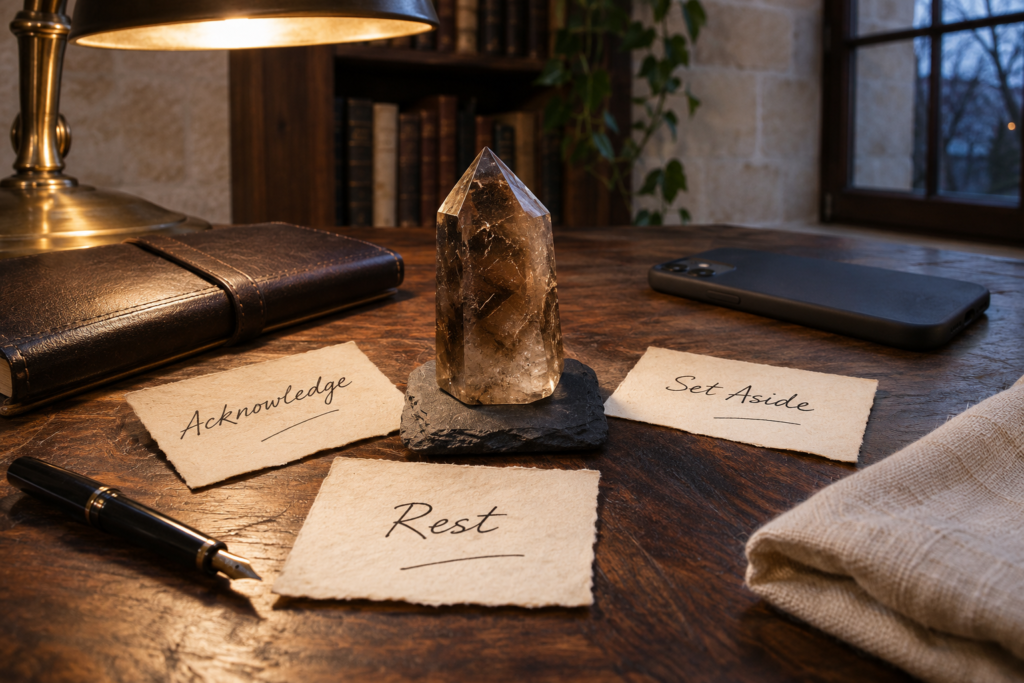
A simplified symbolic arrangement can be created using one Smoky Quartz stone and three paper cards.
Write one word on each card:
Acknowledge
Set Aside
Rest
Place the Smoky Quartz in the centre.
Arrange the cards around it.
The arrangement represents the stages of the ritual.
It does not generate a measurable protective field.
No additional gemstones are necessary.
Evening Routines and Sleep Health
The US Centers for Disease Control and Prevention provides educational guidance on healthy sleep habits.
Its recommendations include maintaining consistent sleep schedules where possible, creating a suitable sleeping environment and reducing certain activities that may interfere with sleep.
These are general health recommendations.
They should be adapted to individual circumstances.
The Evening Boundary Ritual may be incorporated into a personal routine, but it has not been tested as a sleep intervention.
There is no reliable evidence that Smoky Quartz improves sleep quality through crystal energy.
People experiencing persistent sleep difficulties should seek appropriate healthcare guidance rather than relying on gemstones.
Why Rest Should Not Become Another Obligation
Wellbeing practices can sometimes become demanding.
A person may feel pressured to meditate perfectly.
Maintain an elaborate evening routine.
Or complete a series of rituals before allowing themselves to relax.
The Smoky Quartz Evening Boundary Ritual is deliberately simple.
It does not require a fixed sequence every night.
It does not require candles, incense or additional gemstones.
And it does not demand that the participant feel calm immediately.
Some evenings may be too busy for a formal ritual.
On other days, closing a notebook and putting away a telephone may be sufficient.
The practice should support personal choice rather than create another responsibility.
When Boundaries Are Difficult to Establish
Not everyone has equal control over their schedule.
Some people work multiple jobs.
Others provide care for children, relatives or dependants.
Some workplaces require availability outside conventional hours.
And certain responsibilities cannot simply be postponed.
The ritual should not imply that people experiencing these circumstances have failed to establish appropriate boundaries.
Practical constraints matter.
A symbolic exercise cannot change employment conditions, caregiving demands or financial obligations.
Where possible, realistic boundaries may involve communication, planning or seeking support.
The gemstone cannot substitute for these measures.
A Five-Minute Evening Variation
For a shorter practice, place the Smoky Quartz beside a closed notebook.
Identify one unfinished task.
Decide whether it requires attention now or can reasonably wait.
If it can wait, record the next appropriate step.
Then put away the notebook.
Choose one activity for your personal time.
The exercise may take only a few minutes.
It does not need to be repeated every evening.
And repetition does not increase the gemstone’s supernatural power.
Its meaning lies in the chosen transition.
An Alternative Without a Gemstone
The same exercise can be completed without Smoky Quartz.
A small wooden object.
A familiar notebook.
A ceramic token.
Or simply closing a laptop may serve as the symbolic gesture.
The practical principles remain unchanged.
Acknowledge.
Set Aside.
Return to Personal Time.
This matters because the reflective exercise does not depend on a scientifically established gemstone effect.
Smoky Quartz is included because of its contemporary spiritual association with protection and grounding.
It is not a necessary therapeutic instrument.
Responsible Use of Smoky Quartz
A symbolic ritual does not require a large gemstone collection.
One stone is sufficient.
A specimen already owned is entirely appropriate.
There is no need to purchase additional crystals to strengthen the intention.
If placing Smoky Quartz near a doorway or workspace, ensure that it cannot fall or create a hazard.
Keep small stones away from young children who might put them in their mouths.
The ritual should remain simple, safe and appropriate to the home.
Its focus is the boundary itself, not the accumulation of spiritual objects.
What Scientific Research Does Not Establish
Occupational psychology has examined recovery experiences and psychological detachment from work.
Sleep-health research has investigated routines and environmental conditions associated with sleep.
Historical museums document the cultural significance of protective amulets.
However, these sources address different questions.
They do not establish that Smoky Quartz absorbs negative energy.
They do not demonstrate that the gemstone improves sleep.
They do not prove that it creates supernatural protection.
And they do not validate the Evening Boundary Ritual as a clinical intervention.
The exercise is an original contemporary symbolic practice.
Its meaning depends on the participant’s interpretation.
Final Reflection: The Boundary Between Responsibility and Rest
Smoky Quartz cannot eliminate unfinished tasks.
It cannot guarantee relaxation.
It cannot create a scientifically demonstrated protective energy field.
And it cannot replace practical decisions about time, work and personal responsibilities.
Yet within contemporary crystal spirituality, its association with grounding and protection offers a meaningful symbolic starting point.
The Evening Boundary Ritual explores a different understanding of protection.
Not protection from invisible forces.
But the deliberate recognition that personal time has value.
Some responsibilities must be addressed immediately.
Others can reasonably wait.
And some evenings will remain demanding despite our best intentions.
The ritual does not require perfect circumstances.
It does not demand complete disconnection.
And it does not turn rest into another obligation.
It simply invites a moment of choice.
The Smoky Quartz represents the boundary.
The practical action establishes it.
And the meaning belongs to the participant.
Rest does not require every responsibility to disappear.
Sometimes, it begins with recognising which responsibilities can wait until tomorrow.
References & Further Reading
The following sources provide historical, psychological and health-education context for protective objects, psychological detachment from work, recovery experiences, sleep habits and personal boundaries.
All references lead to informative, non-commercial resources from museums, peer-reviewed academic publications or government health institutions.
None establishes supernatural protection, grounding or sleep-enhancing properties of Smoky Quartz.
1. The Metropolitan Museum of Art – Djed Pillar Amulet
Institution: The Metropolitan Museum of Art, New York
Type: Museum collection and religious-history education
This museum record provides historical context for ancient Egyptian amulets and their believed protective or regenerative significance.
It illustrates how physical objects could acquire spiritual meaning within particular religious traditions.
The source does not document modern Smoky Quartz protection rituals.
Direct source:
https://www.metmuseum.org/art/collection/search/574168
2. Sonnentag & Fritz – The Recovery Experience Questionnaire: Development and Validation of a Measure for Assessing Recuperation and Unwinding From Work
Authors: Sabine Sonnentag and Charlotte Fritz
Publication: Journal of Occupational Health Psychology
Volume: 12, Issue 3
Pages: 204–221
Published: 2007
DOI: 10.1037/1076-8998.12.3.204
Type: Peer-reviewed occupational psychology research
This study developed and validated a measure of recovery experiences outside working hours.
It examined psychological detachment, relaxation, mastery experiences and control during leisure time.
The research provides context for understanding the distinction between ending work and mentally disengaging from work-related demands.
It does not investigate gemstones.
DOI:
https://doi.org/10.1037/1076-8998.12.3.204
3. Wendsche & Lohmann-Haislah – A Meta-Analysis on Antecedents and Outcomes of Detachment From Work
Authors: Johannes Wendsche and Andrea Lohmann-Haislah
Publication: Frontiers in Psychology
Published: 2017
DOI: 10.3389/fpsyg.2017.02072
Type: Peer-reviewed meta-analysis
This review examined factors associated with psychological detachment from work and its relationships with recovery-related outcomes.
It provides broader research context for the importance of nonworking time and recovery.
The findings do not establish supernatural gemstone effects.
Full open-access article:
https://www.frontiersin.org/journals/psychology/articles/10.3389/fpsyg.2017.02072/full
4. Centers for Disease Control and Prevention – About Sleep
Institution: US Centers for Disease Control and Prevention
Type: Government health education
This resource explains the importance of sleep and provides general recommendations for healthy sleep habits.
It supports the article’s distinction between optional symbolic evening rituals and evidence-based sleep-health guidance.
Direct source:
https://www.cdc.gov/sleep/about/index.html
5. National Center for Complementary and Integrative Health – Meditation and Mindfulness: Effectiveness and Safety
Institution: US National Institutes of Health
Type: Government evidence-based health education
This resource reviews research into meditation and mindfulness, including potential benefits, methodological limitations and possible adverse experiences.
It provides context for distinguishing optional reflective exercises from established clinical interventions.
Direct source:
https://www.nccih.nih.gov/health/meditation-and-mindfulness-effectiveness-and-safety
Educational and Scientific Clarification
Smoky Quartz’s associations with grounding, protection, emotional stability, the absorption of negative energy and the root chakra belong to contemporary crystal spirituality.
These interpretations are not scientifically established therapeutic or supernatural properties.
There is no reliable evidence that Smoky Quartz absorbs negative energy, creates protective fields, improves sleep through crystal vibrations, regulates emotions or balances anatomical chakra centres.
The Evening Boundary Ritual described in this article is an original contemporary symbolic exercise.
It is not a historically documented ancient ceremony.
It is not a clinically validated psychological or sleep intervention.
And it is not a substitute for professional healthcare, counselling or evidence-based treatment.
Research into psychological detachment, recovery and sleep habits does not establish additional benefits from Smoky Quartz.
Participation should remain voluntary, flexible and appropriate to individual circumstances.
Gemstones and symbolic rituals should never replace appropriate medical treatment, psychological support or professional assistance.