


A doorway stands open between two rooms.
One room is familiar.
The other is not yet fully arranged.
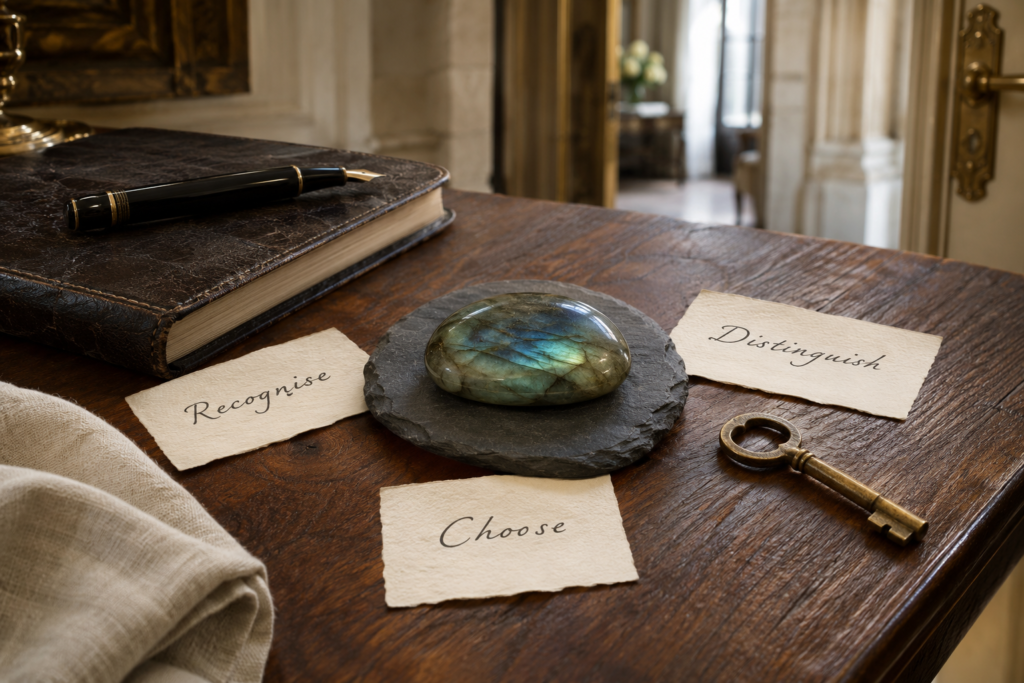
A small Labradorite palm stone rests on a narrow wooden table beside the doorway.
The scene is ordinary, yet it offers a powerful image.
A threshold separates what is known from what comes next.
Human life contains many such transitions.
Beginning a new job.
Moving to another home.
Starting a course of study.
Changing a familiar routine.
Or entering a period in which the future is not entirely clear.
Within contemporary crystal spirituality, Labradorite is frequently associated with intuition, transformation, protection and personal change.
Some practitioners believe it strengthens inner awareness, supports spiritual development or protects the energetic field during periods of uncertainty.
Others carry it as a pocket stone, hold it during meditation or place it near a doorway as a symbol of transition.
These are spiritual interpretations rather than scientifically established effects.
There is no reliable evidence that Labradorite predicts future events, strengthens supernatural intuition, protects an invisible energy field or produces psychological transformation through gemstone vibrations.
Nevertheless, a gemstone can serve as a meaningful personal symbol.
And a deliberate ritual can provide an opportunity to reflect on a transition.
This article introduces an original contemporary exercise:
The Labradorite Threshold of Change Ritual, a labradorite ritual for change designed to help individuals navigate transitions in their lives.
It combines one Labradorite stone with three questions about uncertainty, personal choice and the next manageable action.
The ritual does not promise clarity about the future.
It does not reproduce an ancient Labradorite ceremony.
And it does not suggest that every change is desirable.
Instead, it explores one important distinction:
We cannot always know what comes next, but we can sometimes choose how to approach the next step.
Table of Contents
Labradorite in Contemporary Crystal Spirituality
Labradorite is widely associated in modern crystal traditions with transformation, intuition, spiritual awareness and protection.
Some practitioners describe it as a stone for periods of personal change.
Others believe it strengthens intuitive perception, encourages self-discovery or shields the wearer from unwanted energetic influences.
It may be carried during significant transitions or placed near a workspace associated with a new beginning.
These interpretations vary between practitioners and spiritual communities.
They should not automatically be presented as universal ancient teachings.
The modern metaphysical meanings of Labradorite should also be distinguished from historical cultural traditions involving stones and sacred objects.
A contemporary gemstone ritual does not become an ancient practice simply because it uses a natural material.
For the Threshold of Change Ritual, Labradorite represents one intention:
To approach uncertainty with curiosity while recognising the limits of personal control.
The stone does not provide supernatural knowledge.
Its role is symbolic.
The Meaning of Thresholds in Human Culture
A threshold is more than a physical boundary.
It marks the passage between spaces.
A doorway separates inside from outside.
A gate distinguishes one area from another.
And a ceremonial entrance may indicate movement into a different social or religious setting.
Anthropologists have studied how transitions are represented through rituals.
One influential concept is the rite of passage.
Arnold van Gennep described transitions involving separation, an intermediate phase and incorporation into a new status.
Later, Victor Turner developed the concept of liminality to explore the ambiguous condition of being between established positions or identities.
These ideas have influenced the study of ritual, religion and social change.
However, they do not establish that every personal transition follows the same pattern.
Nor do they demonstrate supernatural properties of Labradorite.
The Threshold of Change Ritual uses the doorway as a contemporary symbol.
It is not a reconstruction of a particular historical rite of passage.
Why Uncertainty Can Feel Uncomfortable
Uncertainty is part of many decisions.
A person may know what they want to attempt without knowing whether it will succeed.
They may have enough information to begin but not enough to predict every outcome.
Or they may face circumstances that cannot be controlled completely.
Uncertainty can produce different responses.
Some people experience curiosity.
Others feel hesitation.
And many experience a mixture of both.
The ritual does not assume that uncertainty is always beneficial.
Some situations require additional information, professional advice or practical safeguards.
The purpose is not to replace careful decision-making with spiritual confidence.
It is to distinguish between what is known, what remains uncertain and what action may be appropriate.
Intuition: Spiritual Belief and Ordinary Judgement
Within contemporary crystal spirituality, Labradorite is often associated with intuition.
Some practitioners believe it strengthens psychic perception or reveals hidden truths.
These claims have not been scientifically established.
In everyday language, intuition may refer to a judgement or impression that arises without a person consciously working through every step.
Such impressions can sometimes reflect prior experience or learned patterns.
They can also be mistaken.
An intuitive feeling is not proof that a prediction is correct.
Nor should it replace evidence when important decisions are involved.
For the Threshold of Change Ritual, intuition is treated as one possible source of personal reflection.
It is not presented as supernatural knowledge.
Psychological Flexibility and Life Transitions
Psychological research has examined how people respond to changing circumstances.
One relevant concept is psychological flexibility.
In the context of Acceptance and Commitment Therapy, psychological flexibility involves responding to experiences in ways that remain connected with personally chosen values and appropriate action.
This does not mean accepting every situation without question.
Nor does it require suppressing difficult emotions.
A person may recognise uncertainty while still seeking information, establishing boundaries or taking practical steps.
The Labradorite ritual is not a form of psychotherapy.
It has not been clinically validated.
However, the distinction between uncertainty and chosen action provides a useful educational framework for the exercise.
Introducing the Labradorite Threshold of Change Ritual
The following practice is an original contemporary symbolic exercise.
It is not an ancient Labradorite ceremony.
It is not a clinically validated psychological intervention.
And it does not require belief in supernatural crystal energy.
The ritual takes approximately fifteen to twenty minutes.
You will need one Labradorite pocket stone, palm stone or cabochon.
A notebook and pen are optional.
Choose a safe, comfortable place where you can reflect without unnecessary interruptions.
A doorway may be used as a visual symbol, but standing in a doorway is not required.
The ritual has three central themes:
Recognise. Distinguish. Choose.
Stage One – Naming the Transition
Begin by identifying one change or decision currently present in your life.
It may be modest.
A new routine.
A personal project.
A different responsibility.
Or a practical adjustment to your daily schedule.
Avoid choosing a highly distressing subject if you do not feel comfortable exploring it alone.
The ritual does not require disclosure of private information.
Write one sentence describing the transition.
For example:
I am preparing to begin a new course of study.
Or:
I am considering a change to my daily routine.
The sentence should describe the situation without predicting the outcome.
Stage Two – Placing the Labradorite
Place the Labradorite on a stable surface.
If you are using a doorway as a symbol, position the stone on a nearby table rather than on the floor or in the walking path.
The gemstone does not need to face a particular direction.
It does not require moonlight, water, incense or energetic activation.
Its purpose is to represent the transition.
Consider one question:
What is familiar about my current situation?
You may identify a routine, responsibility, skill or source of support.
There is no requirement to feel grateful for every aspect of the present.
Simply recognise what is already known.
Stage Three – Identifying What Remains Uncertain
Write a second heading:
What I Do Not Yet Know
List one or two uncertainties connected with the transition.
For example:
How long will the adjustment take?
What information is still missing?
Which practical difficulties might arise?
Avoid trying to answer every question immediately.
The purpose is to identify uncertainty rather than eliminate it.
Some questions may be answered through research.
Others may require experience.
And some outcomes may remain unpredictable.
The gemstone does not reveal the answers.
Stage Four – Distinguishing Influence From Control
Consider which parts of the situation you can influence.
Perhaps you can prepare.
Ask questions.
Develop a skill.
Or choose when to begin.
Other factors may depend on circumstances beyond your control.
These might include another person’s decision, external conditions or unexpected events.
Write two short headings:
What I Can Influence
What I Cannot Fully Control
Place one or two examples beneath each heading.
This distinction is not always simple.
Some situations involve partial influence rather than complete control.
The exercise is intended to encourage realistic reflection.
Stage Five – Choosing One Manageable Action
Now identify one practical step that may help you approach the transition.
The action should be specific.
For example:
Read the course information.
Arrange a conversation.
Prepare a necessary document.
Or practise a relevant skill.
Avoid vague statements such as “be more confident” or “trust the universe.”
These may express feelings or beliefs, but they do not identify a concrete action.
The ritual focuses on something that can actually be done.
Stage Six – The Threshold Gesture
Place the Labradorite beside your written notes.
Look at the chosen action.
Then move the stone a short distance from one side of the table to the other.
This movement symbolises crossing a threshold.
It does not activate supernatural energy.
It does not predict success.
And it does not remove uncertainty.
The gesture simply marks the decision to consider a next step.
If the action requires further information, that may itself be the appropriate first step.
Stage Seven – Allowing Uncertainty to Remain
After choosing an action, consider whether any questions remain unanswered.
They probably do.
The ritual does not require complete certainty.
Nor does it encourage taking unnecessary risks.
Some decisions should be delayed until sufficient information is available.
Others may be approached gradually.
The important distinction is between acknowledging uncertainty and assuming that uncertainty makes every action impossible.
The appropriate response depends on the situation.
Stage Eight – Closing the Ritual
Return the Labradorite to its usual place.
Read your chosen action once more.
If appropriate, decide when you will complete it.
For example:
Tomorrow afternoon, I will review the available information.
Or:
This weekend, I will prepare the first part of the project.
The plan does not guarantee success.
It simply makes the next step more concrete.
The ritual is complete.
Labradorite as a Pocket Stone During Personal Transitions
Some contemporary crystal practitioners carry Labradorite when beginning new activities or entering unfamiliar situations.
They may believe it strengthens intuition or provides energetic protection.
These are spiritual interpretations rather than scientifically established effects.
A Labradorite pocket stone can also serve as a personal reminder to consider practical choices.
Before an unfamiliar appointment or activity, someone might notice the stone and ask:
What information do I need, and what can I prepare?
The stone does not provide the answer.
It represents the intention to approach the situation thoughtfully.
A Labradorite Palm Stone for Reflective Meditation
A larger Labradorite palm stone may be used during a short seated reflection.
Place it in your hand or on a nearby table.
Choose one question connected with a manageable transition.
For example:
What am I assuming about the outcome?
Consider whether the assumption is supported by evidence.
If the answer is uncertain, acknowledge that uncertainty.
There is no requirement to visualise supernatural energy.
Nor must the stone touch the body.
The exercise can be completed in a few minutes.
Its purpose is reflection rather than prediction.
Labradorite and the Third-Eye Chakra
Within contemporary seven-chakra spirituality, Labradorite is often associated with the third-eye chakra.
Modern practitioners commonly connect this chakra with intuition, insight, imagination and spiritual awareness.
Some believe Labradorite strengthens or balances the energetic qualities of this centre.
These correspondences vary between spiritual communities.
Historical South Asian chakra traditions developed within diverse religious and philosophical contexts.
Modern gemstone-to-chakra charts should not automatically be presented as ancient or universal teachings.
There is no reliable biomedical evidence that Labradorite balances an anatomical third-eye chakra or improves psychic perception.
For the Threshold of Change Ritual, chakra symbolism is optional.
The gemstone may simply represent thoughtful reflection.
A Labradorite Centre Stone for a Transition Grid
Contemporary crystal-grid practices sometimes place Labradorite at the centre of arrangements intended to represent transformation or spiritual protection.
Practitioners may believe surrounding stones amplify its energetic influence.
These claims have not been scientifically demonstrated.
A simple symbolic arrangement can be created using one Labradorite stone and three small paper cards.
Write one word on each card:
Recognise
Distinguish
Choose
Place the Labradorite in the centre.
Arrange the cards around it.
The arrangement represents the stages of the ritual.
It does not generate a measurable energetic field.
No additional gemstones are necessary.
Why New Beginnings Do Not Always Feel Positive
Personal transitions are often described as exciting opportunities.
But not every change is welcome.
A new responsibility may create uncertainty.
A move may involve loss as well as possibility.
And a change in circumstances may be necessary rather than desired.
The Labradorite ritual does not require enthusiasm.
It does not suggest that every transition is part of a spiritual plan.
And it does not demand that difficult experiences be interpreted as opportunities for growth.
A person may feel disappointed, uncertain or reluctant.
These responses do not mean the ritual has failed.
The exercise simply provides a structure for considering the situation.
The Difference Between Reflection and Decision-Making
A reflective ritual may help someone organise their thoughts.
But it cannot replace appropriate decision-making processes.
Important financial decisions may require professional advice.
Medical questions require qualified healthcare guidance.
Legal matters may require legal expertise.
And interpersonal difficulties may require communication, boundaries or support.
Labradorite does not provide reliable answers to these questions through supernatural intuition.
The ritual should remain a personal reflective exercise.
It should not be used to justify risky or poorly informed decisions.
A Five-Minute Threshold Practice
For a shorter version, place the Labradorite beside a notebook.
Write three sentences:
What is changing?
What remains uncertain?
What is one appropriate next step?
Move the stone slightly to one side.
Then close the notebook.
The exercise can be completed in a few minutes.
It does not need to be repeated daily.
And repetition does not increase the gemstone’s supernatural power.
Its meaning lies in the act of reflection.
An Alternative Without a Gemstone
The same exercise can be completed without Labradorite.
A small wooden token.
A familiar pen.
A folded piece of paper.
Or a simple mark in a notebook may serve as the symbolic threshold.
The practical process remains unchanged.
Recognise.
Distinguish.
Choose.
This matters because the exercise does not depend on a scientifically established gemstone effect.
Labradorite is included because of its contemporary spiritual association with intuition and transformation.
It is not a necessary therapeutic instrument.
Responsible Use of Labradorite in Personal Rituals
A symbolic ritual does not require a large gemstone collection.
One stone is sufficient.
A specimen already owned is entirely appropriate.
There is no need to purchase additional crystals to strengthen the intention.
If placing Labradorite near a doorway, ensure that it cannot fall or obstruct movement.
Avoid placing stones on stairs or in walking paths.
The ritual should remain simple, safe and voluntary.
Its focus is reflection rather than the accumulation of spiritual objects.
What Scientific Research Does Not Establish
Anthropological scholarship has examined rites of passage and the symbolism of transitions.
Psychological research has investigated uncertainty, coping and psychological flexibility.
However, these fields address different questions.
They do not establish that Labradorite predicts future events.
They do not demonstrate that the gemstone strengthens psychic intuition.
They do not prove that it creates supernatural protection.
And they do not validate the Threshold of Change Ritual as a clinical intervention.
The exercise is an original contemporary symbolic practice.
Its meaning depends on the participant’s interpretation.
Final Reflection: Crossing the Threshold Without Knowing Everything
Labradorite cannot guarantee successful transitions through scientifically demonstrated crystal energy.
It cannot reveal the future.
It cannot eliminate uncertainty.
And it cannot replace practical preparation or informed decisions.
Yet within contemporary crystal spirituality, its association with intuition and transformation offers a meaningful symbolic starting point.
The Threshold of Change Ritual explores a different understanding of new beginnings.
Not certainty about what will happen.
Not supernatural knowledge.
And not the assumption that every change must be welcomed.
Instead, it invites a person to recognise the present, identify uncertainty and consider one appropriate action.
Some transitions require patience.
Others require information.
And some require practical support.
The ritual does not determine which response is correct.
It simply provides a moment of reflection.
The Labradorite represents the threshold.
The chosen action represents the next step.
And the meaning belongs to the participant.
We do not always need to know the entire path before considering the next step.
But we do need to recognise when the next step requires more information, preparation or support.
References & Further Reading
The following sources provide anthropological, psychological and educational context for rites of passage, liminality, uncertainty and psychological flexibility.
All references lead to informative, non-commercial resources from academic publishers, peer-reviewed publications, universities or established educational institutions.
None establishes supernatural intuition, protection or chakra-balancing properties of Labradorite.
1. Encyclopaedia Britannica – Rite of Passage
Institution: Encyclopaedia Britannica
Type: Encyclopedic anthropology and religious-studies reference
This resource explains the concept of rites of passage and their significance in social and religious transitions.
It provides historical and anthropological context for understanding thresholds and changes in social status.
The source does not document modern Labradorite rituals.
Direct source:
https://www.britannica.com/topic/rite-of-passage
2. Encyclopaedia Britannica – Victor Turner
Institution: Encyclopaedia Britannica
Type: Encyclopedic anthropological biography
This resource introduces the work of anthropologist Victor Turner, including his contributions to the study of ritual and liminality.
It provides context for understanding the symbolism of transitional states.
Direct source:
https://www.britannica.com/biography/Victor-Turner
3. Kashdan & Rottenberg – Psychological Flexibility as a Fundamental Aspect of Health
Authors: Todd B. Kashdan and Jonathan Rottenberg
Publication: Clinical Psychology Review
Volume: 30, Issue 7
Pages: 865–878
Published: 2010
DOI: 10.1016/j.cpr.2010.03.001
Type: Peer-reviewed psychological review
This paper examines psychological flexibility and its relevance to adaptive functioning.
It provides broader research context for responding to changing circumstances without relying on supernatural explanations.
The paper does not investigate gemstones.
DOI:
https://doi.org/10.1016/j.cpr.2010.03.001
4. National Center for Complementary and Integrative Health – Meditation and Mindfulness: Effectiveness and Safety
Institution: US National Institutes of Health
Type: Government evidence-based health education
This resource reviews research into meditation and mindfulness, including potential benefits, methodological limitations and possible adverse experiences.
It provides context for distinguishing optional reflective exercises from established clinical interventions.
Direct source:
https://www.nccih.nih.gov/health/meditation-and-mindfulness-effectiveness-and-safety
5. American Psychological Association – Stress
Institution: American Psychological Association
Type: Professional psychological education
The APA’s educational resources discuss stress, coping and psychological responses to demanding circumstances.
They provide general context for understanding why uncertainty and life transitions may be challenging.
Direct source:
https://www.apa.org/topics/stress
Educational and Scientific Clarification
Labradorite’s associations with intuition, transformation, spiritual protection, personal change and the third-eye chakra belong to contemporary crystal spirituality.
These interpretations are not scientifically established therapeutic or supernatural properties.
There is no reliable evidence that Labradorite predicts future events, strengthens psychic abilities, creates protective energy fields, improves psychological flexibility through gemstone vibrations or balances anatomical chakra centres.
The Threshold of Change Ritual described in this article is an original contemporary symbolic exercise.
It is not a historically documented ancient ceremony.
It is not a clinically validated psychological intervention.
And it is not a substitute for professional healthcare, counselling or evidence-based treatment.
Research into rites of passage, uncertainty and psychological flexibility does not establish additional benefits from Labradorite.
Participation should remain voluntary, flexible and appropriate to individual circumstances.
Gemstones and symbolic rituals should never replace appropriate medical treatment, psychological support or professional assistance.
Related Products
-

18K Yellow Gold Rope Chain Bracelet · Adjustable 15 · 18 cm · Luxury NGB Jewelry
$251.21 -
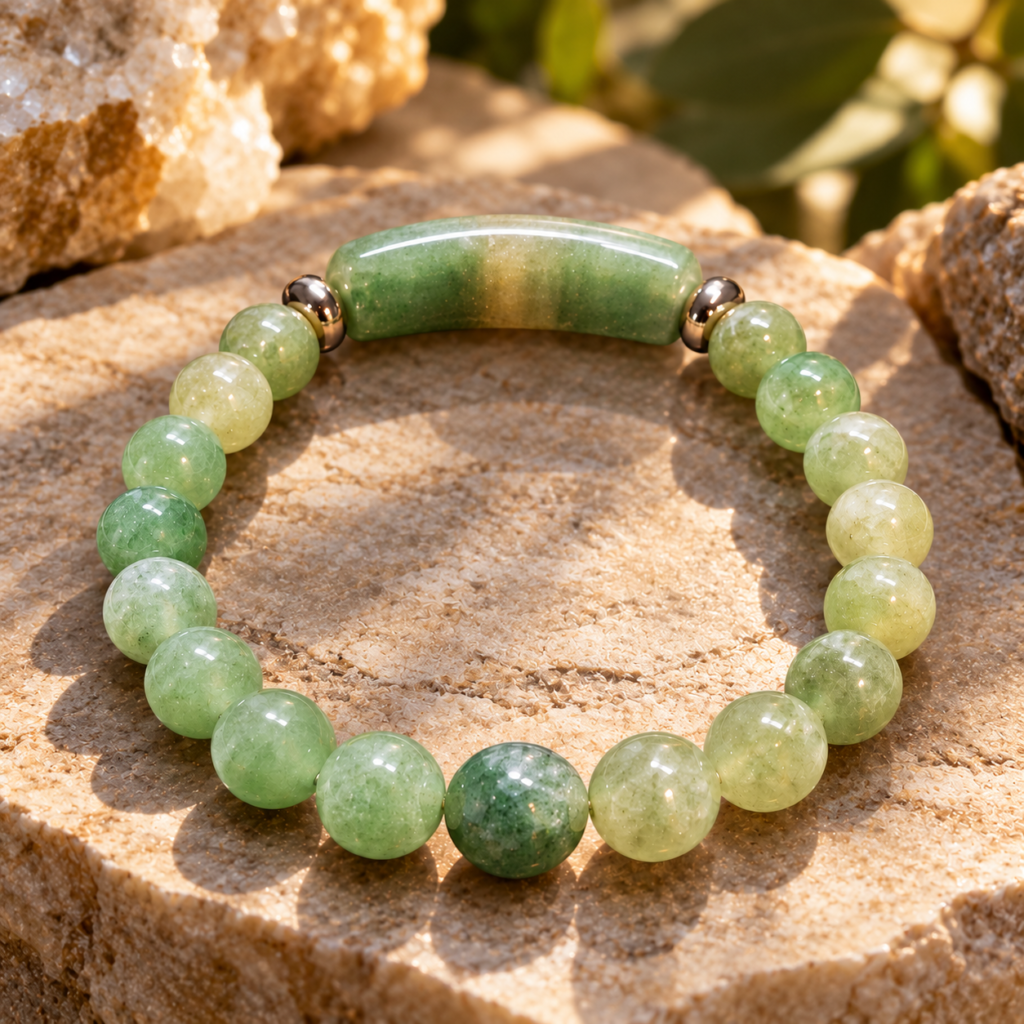
Aventurine Bead Bracelet with Bridge · 8 mm · 19 cm · Unisex · Untreated · Good Polish
$39.10 -
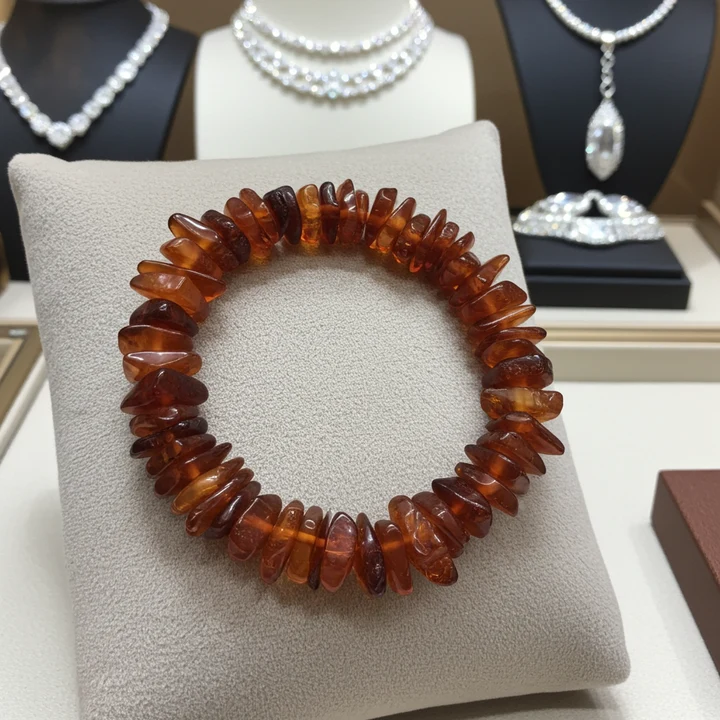
Baltic Amber Chip Bracelet 10 mm · Natural Dark Honey Amber Bead Bracelet
$32.67 -
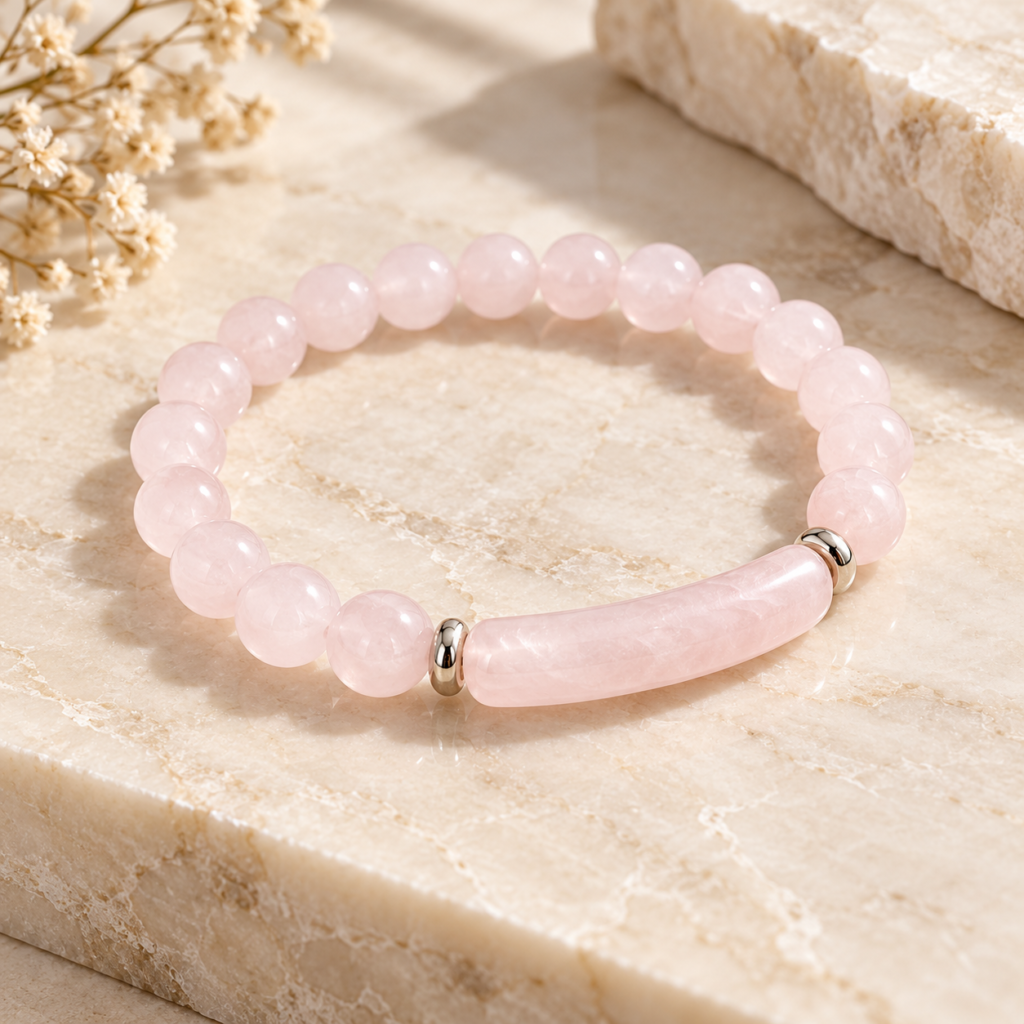
Bead Bracelet with bridge · Rose Quartz · 8mm · pink charm bracelet
$36.86