Table of Contents
The Mysterious Curved Gemstones of Ancient Japan
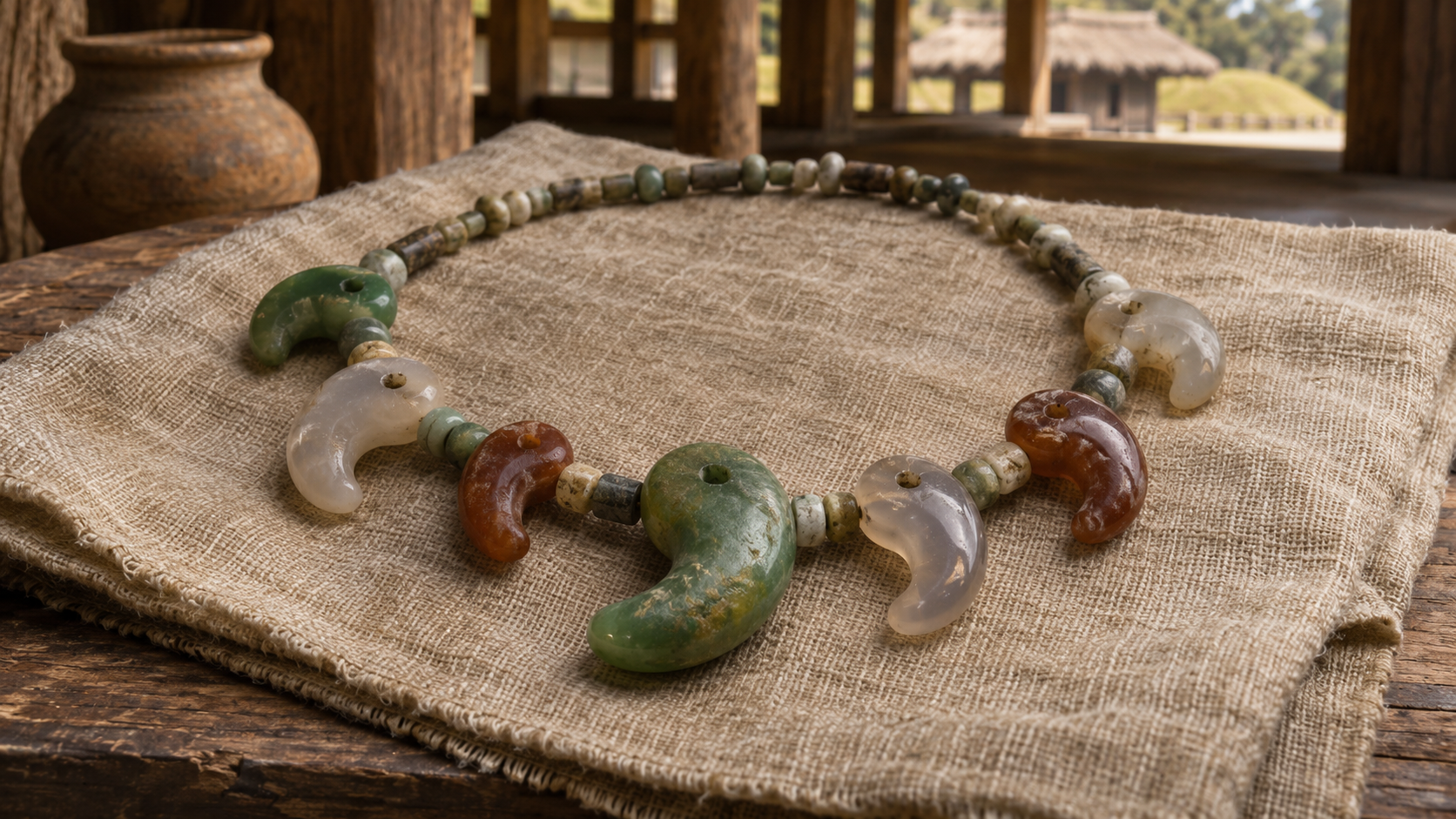
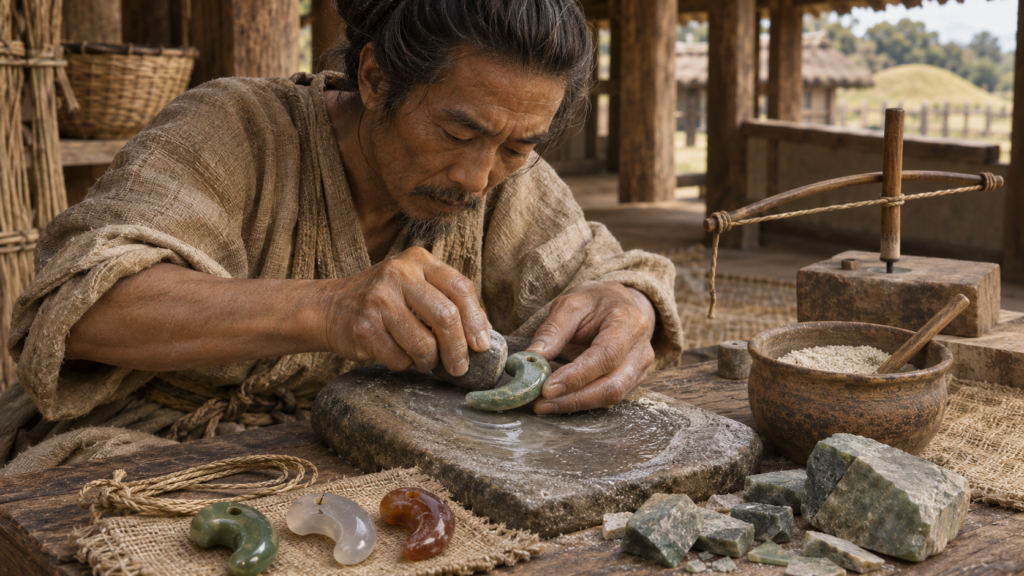
Among the most distinctive ornaments of ancient East Asia is a small, curved bead known in Japanese as a magatama.
Its form is immediately recognisable.
One end is broad and rounded.
The other tapers into a narrower point.
A perforation near the thicker end allows the ornament to be suspended from a cord or incorporated into a necklace.
Some magatama were carved from green jadeite. Others were fashioned from agate, jasper, quartz, soapstone or glass.
Their materials varied, but their characteristic curved form remained remarkably persistent.
Archaeologists have recovered these ornaments from ancient Japanese sites, including graves associated with the Yayoi and Kofun periods.
They appear in contexts connected with personal adornment, social status and ceremonial activity.
Centuries later, a curved jewel became part of the traditional narrative surrounding Japan’s imperial regalia.
The jewel known as Yasakani no Magatama is associated with the sacred treasures of the Japanese imperial institution.
Yet important questions remain.
Why were these beads curved?
What did their shape originally represent?
Were they worn as ornaments, religious objects or symbols of political authority?
And how did an ancient bead form become connected with Japanese sacred kingship?
The history of magatama demonstrates how natural materials can acquire cultural significance through craftsmanship, ritual practice and inherited tradition.
It also illustrates why archaeology, mythology and modern spiritual interpretations must be distinguished carefully.
What Is a Magatama?
A magatama is a curved ornamental bead associated particularly with ancient Japan.
The term refers primarily to its shape and cultural identity, rather than to a particular gemstone species.
This distinction is essential.
A magatama is not automatically jade.
Nor is every curved green bead a magatama of ancient Japanese origin.
The Metropolitan Museum of Art preserves numerous examples classified as Japanese Kofun-period jewellery.
Its collections include beads made from chalcedony, green jasper, agate, jadeite and steatite.
These objects demonstrate that the magatama tradition involved several different materials.
The form could be reproduced in stones with very different mineralogical properties.
Its cultural significance therefore cannot be explained by the chemistry of one gemstone alone.
The Origins of Magatama in Prehistoric Japan
Curved beads appeared in Japan long before the emergence of the historically documented imperial state.
The Metropolitan Museum’s scholarly publication The Guennol Collection, Volume 2 discusses examples associated with the later Jōmon period.
The Jōmon period encompasses a long span of Japanese prehistory, extending into the first millennium BCE.
Its communities produced sophisticated pottery, stone ornaments and other crafted objects.
Early magatama-like forms appear within this wider tradition of ornamental production.
However, the precise developmental sequence remains a subject of archaeological study.
The earliest surviving curved beads were not necessarily identical in function or meaning to those produced centuries later.
A shape can survive across generations while its cultural significance changes.
This is particularly important when interpreting objects whose original owners left no written explanation.
The Yayoi Period: Ornaments and Changing Societies
During the Yayoi period, approximately the first millennium BCE through the third century CE, Japanese communities underwent major economic and social changes.
Wet-rice agriculture expanded.
Metalworking became increasingly important.
Settlement patterns and social relationships changed.
Ornaments continued to play a role in personal and ceremonial life.
The Metropolitan Museum’s educational research on Korean art identifies related curved beads in Japanese upper-class graves from the Yayoi period.
Their presence in burial contexts suggests that these ornaments could possess significance beyond ordinary decoration.
They may have communicated identity, rank or social affiliation.
However, the archaeological evidence does not establish a universal religious meaning for every bead.
A magatama discovered in a grave is evidence of deliberate deposition.
Its precise intended function requires interpretation of the surrounding archaeological context.
The Kofun Period: When Curved Beads Became Symbols of Authority
The Kofun period, conventionally dated from approximately the third to the seventh century CE, takes its name from monumental burial mounds.
These tombs are associated with the development of increasingly powerful regional elites and the emergence of the Yamato political order.
Some kofun contained weapons, mirrors, ornaments and other prestige objects.
Magatama appeared among these burial assemblages.
The Metropolitan Museum’s publication The Arts of Japan notes that curved beads discovered in Kofun-period graves seem to have symbolised rank or ritual power within the Yamato state.
This interpretation is especially important.
It connects magatama with social and ceremonial authority.
But it does not establish that every bead was considered a magical talisman.
The objects belonged to a world in which political leadership, ceremonial display and religious practices could overlap.
Their meaning depended upon their use within that society.
The Metropolitan Museum’s Seventh-Century Necklace
One of the clearest surviving examples is a necklace preserved by the Metropolitan Museum of Art.
Catalogued as Necklace with Claw-Shaped Beads (Magatama), the object is attributed to Japan’s Kofun period and dated to approximately the seventh century.
Its materials are chalcedony and green jasper.
The necklace measures approximately 29.2 centimetres in length.
This object is particularly valuable because it demonstrates that magatama were not exclusively carved from jadeite.
The beads’ shape and arrangement were central to their identity.
Their mineralogical composition was variable.
The surviving necklace also provides a tangible connection with ancient Japanese adornment.
Its beads could be worn together as a coordinated ornament.
The object should not automatically be interpreted as a modern-style chakra necklace or healing bracelet.
Its archaeological and historical identity belongs to a different cultural framework.
Why Were Magatama Curved?
The distinctive shape has attracted numerous interpretations.
Some researchers and commentators have suggested that it resembles an animal tooth or claw.
Others have proposed associations with embryos, crescents or other natural forms.
Such comparisons are visually understandable.
However, resemblance is not proof of original meaning.
The surviving archaeological evidence does not establish one universally accepted explanation for the earliest magatama shape.
The Metropolitan Museum catalogues certain curved ornaments as tiger claw jewels, reflecting a descriptive interpretation of their form.
This terminology does not demonstrate that all magatama were intended to represent tiger claws.
Nor does it establish that the original makers attributed identical meanings to every curved bead.
The most responsible conclusion is that magatama developed a recognisable ornamental form whose symbolism probably changed across time and context.
A Shape That Could Outlive Its Original Meaning
The persistence of the magatama form is one of its most fascinating characteristics.
A particular shape can become culturally recognisable even when its earliest significance is no longer remembered.
Later generations may inherit the form.
They may reproduce it in new materials.
They may associate it with new religious or political meanings.
This process is familiar throughout the history of material culture.
Objects can retain traditional forms while their social functions evolve.
For magatama, the archaeological record documents long-term continuity.
But continuity of shape does not necessarily establish continuity of belief.
A bead made during the late Jōmon period should not automatically be assigned the same meaning as a jewel described in eighth-century Japanese mythology.
The chronological distinction is essential.
Magatama and Ancient Japanese Burial Traditions
Burial objects provide some of the strongest evidence for the historical importance of magatama.
The presence of curved beads in elite graves demonstrates that they were considered appropriate possessions for inclusion in funerary assemblages.
Such objects could communicate social identity.
They might indicate status.
They could form part of ceremonial clothing or personal ornaments.
Some may have possessed religious significance.
However, burial archaeology does not always reveal the beliefs behind deposition.
An ornament placed beside the deceased may have been valued because it belonged to that person.
It might have represented a family or political relationship.
It could have participated in funerary ritual.
These explanations are not mutually exclusive.
What cannot be established from the presence of a gemstone alone is that its owner believed it possessed scientifically measurable supernatural energy.
Magatama, Haniwa and the Representation of Ritual Authority
Haniwa are terracotta figures and objects associated with Japanese Kofun-period burial mounds.
They include representations of people, animals, houses and other subjects.
Some human haniwa depict jewellery and elaborate clothing.
The Metropolitan Museum’s publication The Arts of Japan discusses magatama in relation to such representations.
Curved beads appear as ornaments associated with both male and female figures.
A figure interpreted as a ritual specialist or shaman is also discussed in connection with magatama adornment.
These representations are important because they provide evidence beyond the surviving beads themselves.
They show how ornaments could be incorporated into the visual presentation of people.
Nevertheless, identifying the exact religious role of every represented figure remains an interpretive challenge.
The jewellery may communicate ceremonial importance without revealing the complete beliefs of its wearer.
The Relationship Between Jewellery and Sacred Authority
In many historical societies, personal ornaments helped distinguish people with particular social or ceremonial roles.
The significance of such objects could arise from several factors.
Their materials might be difficult to obtain.
Their craftsmanship might require specialist knowledge.
Their appearance could be recognisable within a particular community.
Their ownership might be restricted by rank or custom.
Magatama may have participated in these forms of distinction during the Kofun period.
The Metropolitan Museum’s interpretation of their connection with rank and ritual power supports this possibility.
However, the word power must be understood carefully.
Political power, ritual authority and supernatural force are not interchangeable concepts.
An ornament can signify authority without possessing a measurable energetic property.
Magatama Beyond Japan: Connections with the Korean Peninsula
Curved beads were not restricted to the Japanese archipelago.
Related ornaments are documented in ancient Korean contexts.
The Metropolitan Museum’s research on Korean art discusses curved beads known as kogok.
These appear in burial assemblages and were sometimes made from nephrite.
The museum’s research also identifies comparable forms in Japanese Yayoi and Kofun graves.
Such similarities are relevant to the history of cultural contact across East Asia.
However, the precise origins and transmission of curved-bead traditions remain complex.
It would be misleading to claim that every Korean and Japanese example had the same religious meaning.
Similar forms can circulate between communities while acquiring different associations.
The evidence demonstrates cultural relationships and shared ornamental traditions, not a single uniform spiritual doctrine.
The Gemmology of Magatama Materials
Magatama could be made from several distinct materials.
Their mineralogical properties differ substantially.
Jadeite
Jadeite is a sodium-aluminium silicate mineral belonging to the pyroxene group.
Its chemical formula is NaAlSi₂O₆.
It can occur in green, white, lavender and other colours.
Jadeite is valued for its toughness, texture and appearance.
Agate and Chalcedony
Agate is a variety of chalcedony, a microcrystalline form of silica.
Its principal chemical composition is SiO₂.
Agate often displays banding, although not every chalcedony ornament is visibly banded.
It is relatively hard and suitable for polishing.
Jasper
Jasper is an opaque silica-rich ornamental material.
Its colour and pattern depend on mineral inclusions and other constituents.
Green jasper appears in surviving magatama necklaces.
Steatite
Steatite, commonly called soapstone, is a relatively soft rock composed largely of talc.
It can be carved more easily than jadeite or chalcedony.
Glass
Some ancient curved beads were produced from glass rather than natural stone.
Glass is an amorphous material.
Its inclusion in the magatama tradition demonstrates that the object’s shape could remain culturally significant even when the material changed completely.
These distinctions matter because magatama is an archaeological and cultural category, not a mineral species.
Why Material Identification Matters
An ancient green bead cannot be identified reliably as jadeite from colour alone.
Green jasper, serpentine-rich rock, glass and other materials may appear similar.
Scientific examination can investigate chemical composition, crystal structure and optical properties.
Methods may include microscopy, Raman spectroscopy and other appropriate non-destructive techniques.
Such analyses can help distinguish materials.
They may also provide information about geological provenance.
However, mineral identification does not automatically reveal cultural meaning.
A laboratory can determine that a bead is made from chalcedony.
It cannot establish, through chemistry alone, what prayer or belief its owner associated with the object.
The scientific and historical questions must be investigated together.
The Emergence of Japan’s Imperial Regalia
One of the most enduring associations of magatama is its connection with the Japanese imperial regalia.
Traditional accounts identify three sacred treasures.
They are a mirror, a sword and a jewel.
The jewel is known as Yasakani no Magatama.
Within Japanese imperial tradition, these objects are associated with the legitimacy and sacred ancestry of the imperial institution.
However, their history must be approached with care.
The imperial regalia belong to a continuing religious and political tradition.
Their significance is not equivalent to the archaeological function of every ancient magatama.
Nor can the history of the regalia be reconstructed solely from surviving prehistoric beads.
The connection between curved ornaments and imperial mythology is an important historical development, but it involves different categories of evidence.
The Kojiki and Nihon Shoki
Two important early Japanese textual sources are the Kojiki, compiled in 712 CE, and the Nihon Shoki, completed in 720 CE.
These works preserve narratives concerning deities, origins, rulers and the sacred ancestry of the imperial line.
They are indispensable for studying early Japanese religious and political traditions.
However, they were compiled centuries after many of the archaeological magatama discussed in this article were produced.
They also contain mythological narratives.
Their accounts should therefore not be treated as direct eyewitness descriptions of prehistoric bead-making or burial ceremonies.
The texts reveal how sacred objects were understood within the political and religious world of early eighth-century Japan.
They do not establish that all earlier magatama had identical meanings.
The Jewel and the Sun Goddess Amaterasu
Within Japanese mythology, the sun goddess Amaterasu occupies a central position.
The sacred treasures associated with imperial tradition are connected with narratives involving the heavenly deities and the establishment of legitimate rule.
The jewel forms part of this symbolic world.
Its significance derives from the mythological narrative and the authority attached to the imperial institution.
The curved form recalls the archaeological tradition of magatama.
However, the relationship between the legendary jewel and the earliest prehistoric beads cannot be reduced to one continuous, fully documented religious system.
The mythology provides evidence of later sacred interpretation.
The archaeological record provides evidence of earlier material use.
Both are important, but they answer different questions.
Yasakani no Magatama: What Can Be Established?
The Yasakani no Magatama is traditionally identified as one of Japan’s three imperial regalia.
Its religious and ceremonial significance is part of the Japanese imperial tradition.
However, the regalia are not ordinary museum objects available for unrestricted scientific examination.
Detailed claims about the jewel’s precise mineral composition, age or manufacturing technique should therefore be treated cautiously.
It is not scientifically established through public gemmological testing that the regalia jewel is made from one particular gemstone species.
Nor should modern illustrations be mistaken for direct documentary photographs of the object.
Its importance lies principally in its inherited ceremonial and mythological identity.
The archaeological history of magatama helps explain the broader cultural background of the curved-jewel form.
It does not provide a complete material history of the imperial treasure itself.
Were Magatama Protective Amulets?
The possibility that some magatama functioned as protective or talismanic objects has attracted scholarly attention.
The Metropolitan Museum’s discussion of ancient Japanese ornaments suggests that certain carved stone objects may have served as talismans.
It also identifies magatama with rank and ritual power in Kofun-period contexts.
These interpretations are relevant.
However, they do not establish that every magatama was a protective amulet.
Some may have been personal ornaments.
Others may have signified status.
Certain examples may have participated in ceremonial or religious activities.
The function of an individual bead depends on its archaeological context.
A modern statement that all magatama repel negative energy would go beyond the available evidence.
Magatama and Shinto: Avoiding a Historical Anachronism
Modern discussions frequently describe magatama as Shinto sacred jewels.
This association reflects their place in Japanese religious traditions and imperial mythology.
However, the history of Shinto is complex.
The religious practices of prehistoric Japan cannot simply be equated with the institutional and textual traditions of later periods.
The term Shinto itself has a history.
Religious practices, local deity traditions, court ceremonies and Buddhist influences developed through changing historical circumstances.
It would therefore be inaccurate to assume that a magatama buried centuries before the Kojiki was produced necessarily carried the same religious meaning as the jewel of later imperial tradition.
The more accurate approach is to distinguish prehistoric ritual evidence from later Shinto interpretations.
Did Magatama Represent the Soul?
One popular interpretation associates the curved shape with life, embryos or spiritual essence.
Such interpretations appear in modern discussions of magatama symbolism.
However, the archaeological evidence does not establish that the original form universally represented the human soul.
The shape’s resemblance to a developing embryo is an interpretation.
It is not proof of the intentions of prehistoric artisans.
Similarly, comparisons with animal teeth or claws may be suggestive without being definitive.
The original meanings may have varied by period and region.
Some may no longer be recoverable.
A historically responsible article should acknowledge these uncertainties rather than present attractive theories as established facts.
Modern Spiritual Interpretations
Contemporary spiritual practitioners sometimes associate magatama with protection, harmony, good fortune or a connection to Japanese sacred traditions.
These interpretations may hold personal meaning.
However, they should not automatically be attributed to every ancient Japanese community.
A modern jadeite magatama pendant may be worn as a symbolic reminder of balance or cultural heritage.
That choice is different from proving that the gemstone emits protective energy.
There is no reliable scientific evidence that the curved shape of a magatama generates a supernatural field.
Nor is there established scientific evidence that wearing one prevents misfortune, balances chakras or treats medical conditions.
Its cultural and spiritual significance can be appreciated without making unsupported physical claims.
The Importance of Context in Sacred Gemstone History
A gemstone’s meaning is not determined solely by its chemical composition.
An agate bead may be used as ordinary jewellery in one society.
A similarly shaped bead may become part of a ceremonial object in another.
A jadeite ornament may express wealth, rank or devotion depending on its historical context.
Magatama provide a particularly clear example.
Their form persisted across different materials and centuries.
Their use included adornment and burial deposition.
Their later cultural associations extended into imperial mythology.
The same basic shape could therefore participate in different systems of meaning.
Understanding those systems requires archaeology, historical texts and the study of religious traditions.
It cannot be accomplished through a universal gemstone-energy chart.
How to Appreciate Magatama Responsibly Today
Modern magatama-inspired jewellery can be appreciated for its distinctive design and historical associations.
Collectors should distinguish contemporary reproductions from archaeological artefacts.
Ancient beads require appropriate provenance documentation.
Claims of exceptional age or ritual origin should not be accepted without evidence.
The material should also be identified accurately.
A green pendant advertised as jadeite may actually be another stone.
A glass reproduction should not be described as a natural gemstone.
For historically significant objects, professional examination and responsible collecting practices are essential.
The cultural meaning of magatama deserves respect.
Their scientific identity deserves accuracy.
And their archaeological heritage should not be reduced to unsupported commercial claims about mystical powers.
What the Evidence Actually Establishes
The archaeological and museum evidence supports several conclusions.
Magatama are distinctive curved beads associated with ancient Japan.
Examples occur in prehistoric and early historic contexts.
They were produced from several materials, including jadeite, agate, chalcedony, jasper, steatite and glass.
Curved beads appear in Japanese Yayoi and Kofun burial contexts.
The Metropolitan Museum preserves Kofun-period necklaces and individual curved beads.
Some magatama appear to have been associated with rank or ritual authority.
Related curved ornaments also occur on the Korean Peninsula.
The jewel of Japan’s imperial regalia belongs to a later documented religious and political tradition.
The Kojiki and Nihon Shoki preserve important mythological narratives concerning sacred objects and imperial ancestry.
However, the precise original meaning of the earliest magatama remains uncertain.
The specific mineral composition of the imperial jewel has not been established through publicly available gemmological analysis.
And no reliable scientific evidence demonstrates supernatural healing or protective properties in magatama beads.
Conclusion: A Sacred Shape Across Centuries
The history of Japanese magatama is remarkable because it connects several different worlds.
It begins with prehistoric craftsmanship.
It continues through the ornaments of Yayoi communities.
It becomes particularly visible in the elite burial traditions of the Kofun period.
It intersects with wider East Asian material culture.
And it eventually enters the sacred narratives surrounding Japanese imperial authority.
The materials changed.
The historical settings changed.
The social functions changed.
Yet the curved form remained recognisable.
Magatama demonstrate that the spiritual and cultural significance of an ornament can develop through human tradition rather than through scientifically demonstrable supernatural properties of the material itself.
Their mineralogy explains what they are made from.
Archaeology reveals where and how they were used.
Historical texts document later sacred interpretations.
Religious traditions preserve their continuing symbolic importance.
For Natural Gems Belgium, magatama offer an important example of why gemstone education should combine scientific accuracy with cultural sensitivity.
A curved bead may be made from jadeite, agate or jasper.
But its significance cannot be understood from the mineral name alone.
It belongs to a history of craftsmanship, status, burial practice, mythology and religious identity.
Its enduring importance lies not in an invisible energy field, but in the extraordinary meanings that people have attached to a simple and recognisable form over many centuries.
References & Further Reading
1. Metropolitan Museum of Art – Necklace with Claw-Shaped Beads (Magatama)
https://www.metmuseum.org/art/collection/search/44837
Source description: Official collection record for a seventh-century Japanese Kofun-period necklace made from chalcedony and green jasper. Provides direct archaeological material evidence of magatama jewellery.
2. Metropolitan Museum of Art – The Arts of Japan
Source description: Scholarly museum publication discussing Japanese art and archaeology, including magatama in Kofun-period burials, their apparent association with rank or ritual authority and their representation on haniwa figures.
3. Metropolitan Museum of Art – The Guennol Collection, Volume 2
https://resources.metmuseum.org/resources/metpublications/pdf/The_Guennol_Collection_Vol_2.pdf
Source description: Museum research publication containing a detailed discussion of an agate magatama bead, its form, historical distribution, possible prehistoric origins and related examples in Japan and Korea.
4. Metropolitan Museum of Art – Tiger Claw Jewel
https://www.metmuseum.org/art/collection/search/60550
Source description: Official collection record for a Kofun-period Japanese curved ornament within a group catalogued as made from jasper, agate, jadeite and steatite. Demonstrates material diversity within the curved-bead tradition.
5. Metropolitan Museum of Art – Tiger Claw Jewel, Agate or Soapstone
https://www.metmuseum.org/art/collection/search/60526
Source description: Official record for a Japanese Kofun-period curved ornament dated to the seventh century or earlier. Useful for comparing forms and the uncertainty sometimes involved in identifying historical materials.
6. Metropolitan Museum of Art – String of Beads, Kofun Period
https://www.metmuseum.org/art/collection/search/60595
Source description: Official museum catalogue for an ancient Japanese stone bead assemblage dated to the seventh century or earlier. Provides comparative evidence of personal ornaments in the Kofun period.
7. Metropolitan Museum of Art – Agate Bead, Kofun Period
https://www.metmuseum.org/art/collection/search/60601
Source description: Official collection record for a Japanese agate bead dated to the seventh century or earlier, documenting the use of agate in early Japanese jewellery.
8. Metropolitan Museum of Art – The Arts of Korea: A Resource for Educators
https://www.metmuseum.org/-/media/files/learn/for-educators/publications-for-educators/korea.pdf
Source description: Museum educational publication examining Korean archaeology and art, including curved beads known as kogok and their relationship to comparable ornaments from Japanese Yayoi and Kofun graves.
9. Smithsonian National Museum of Asian Art – Beads (Glass, Bronze, Jade, etc.)
https://asia.si.edu/explore-art-culture/collections/search/edanmdm%3Afsg_FSC-G-8
Source description: Official Smithsonian collection record for a group of ornaments attributed broadly to Korea or Japan. Provides comparative evidence of stone, glass and metal materials in ancient East Asian adornment. The attribution and dating are broad and should not be treated as evidence for one specific archaeological context.
Historical, Religious and Scientific Distinctions
Scientifically established: Magatama is a cultural and archaeological ornament category, not a single gemstone species.
Scientifically established: Magatama were made from different materials with distinct chemical, structural and physical properties.
Archaeologically documented: Curved beads occur in ancient Japanese contexts, including Yayoi and Kofun burials.
Historically interpreted: Some Kofun-period magatama appear to have signified rank or ritual authority.
Archaeologically documented: Related curved beads also occur in ancient Korean contexts.
Historical uncertainty: The original meaning of the magatama shape has not been established universally.
Religious tradition: The Yasakani no Magatama is associated with Japan’s imperial regalia and sacred imperial mythology.
Historical distinction: The mythological accounts preserved in the eighth-century Kojiki and Nihon Shoki should not automatically be projected onto prehistoric archaeological objects.
Modern metaphysical belief: Contemporary spiritual interpretations sometimes associate magatama with protection, harmony, good fortune or personal balance.
Scientific limitation: There is no established scientific evidence that magatama generate supernatural protective energy, balance chakras or cure medical conditions.
Japanese magatama demonstrate how the significance of a gemstone ornament can evolve across historical periods.
Their materials belong to gemmology.
Their archaeological contexts belong to the study of ancient societies.
Their imperial associations belong to Japanese religious and political tradition.
Their modern spiritual interpretations remain matters of personal belief rather than scientifically established physical properties.