Not every meaningful journey requires travelling somewhere.
Sometimes, a journey takes place while sitting quietly at a table.
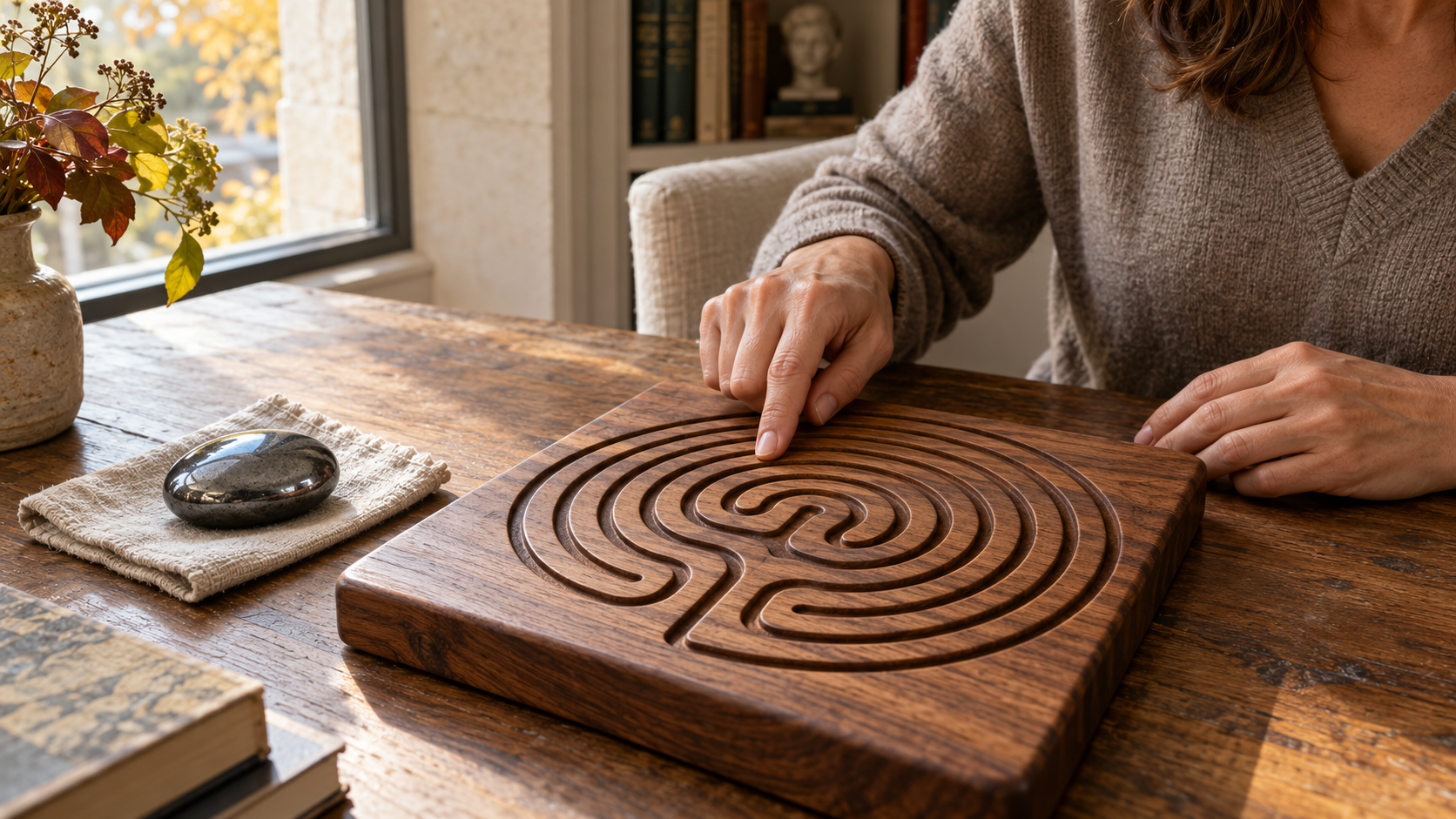
A finger follows a winding path.
The route turns unexpectedly.
It approaches the centre, moves away, and eventually returns.
There are no decisions about which direction to take.
No intersections.
No dead ends.
Only one continuous pathway.
For centuries, labyrinths have appeared in religious architecture, cultural symbolism and contemplative traditions.
Today, smaller versions can be traced with a finger, providing an accessible form of quiet reflection.
Within contemporary crystal spirituality, Hematite is frequently associated with grounding, stability, protection and a sense of connection with the physical world.
Some practitioners believe that Hematite absorbs negative energy, encourages emotional balance or strengthens their connection with the Earth.
These are spiritual interpretations rather than scientifically established gemstone properties.
There is no reliable evidence that Hematite emits a protective energy field, removes psychological distress or produces therapeutic effects through supernatural mechanisms.
Nevertheless, a gemstone can serve as a meaningful personal symbol.
And a labyrinth can provide a structured focus for contemplation.
Combining these two elements creates an interesting contemporary practice.
The Hematite Finger Labyrinth Ritual.
A quiet exercise in which the gemstone represents stability while the labyrinth provides a pathway for attention.
The purpose is not to activate an ancient energetic system.
Nor is it to reproduce a historical religious ceremony.
Instead, the ritual invites us to explore a simple idea:
Sometimes, finding our centre begins by paying attention to the path we are already following.
Table of Contents
Why Hematite?
Hematite occupies a distinctive place in contemporary crystal spirituality.
Its dark metallic appearance has contributed to modern associations with strength, stability and protection.
Many crystal practitioners describe Hematite as a grounding stone.
Some connect it with the root chakra.
Others carry it as a pocket stone or use it during meditation.
Within these belief systems, grounding is sometimes understood as strengthening a person’s connection with the Earth’s energy.
Such claims are not scientifically established.
For the present ritual, grounding has a simpler meaning.
It refers to deliberately directing attention toward immediate experience.
The sensation of a fingertip touching a surface.
The movement of the hand.
The position of the body.
And the awareness of being present in a particular moment.
The Hematite does not create these experiences.
It serves as a symbolic reminder to notice them.
Its dark appearance and substantial visual presence make it an appropriate object for someone who personally associates these qualities with steadiness.
The symbolism is contemporary and individual.
It should not be confused with a historically universal meaning of the gemstone.
The Labyrinth: A Symbol of the Journey
Labyrinths have appeared in different historical and cultural contexts.
Their meanings have varied considerably.
Some were connected with mythology.
Others appeared in religious buildings.
In modern settings, labyrinths are also used for contemplation, education and personal reflection.
One of the most famous surviving examples is found in Chartres Cathedral in France.
The cathedral’s labyrinth is incorporated into the stone pavement of the nave.
Its construction belongs to the early thirteenth century.
The labyrinth consists of a continuous pathway that winds through a series of circuits before reaching the centre.
Unlike a maze, it does not require the participant to choose between competing routes.
There is one way inward.
The same pathway can then be followed outward.
This distinction is central to the contemplative experience.
A maze asks us to solve a problem.
A labyrinth invites us to follow a path.
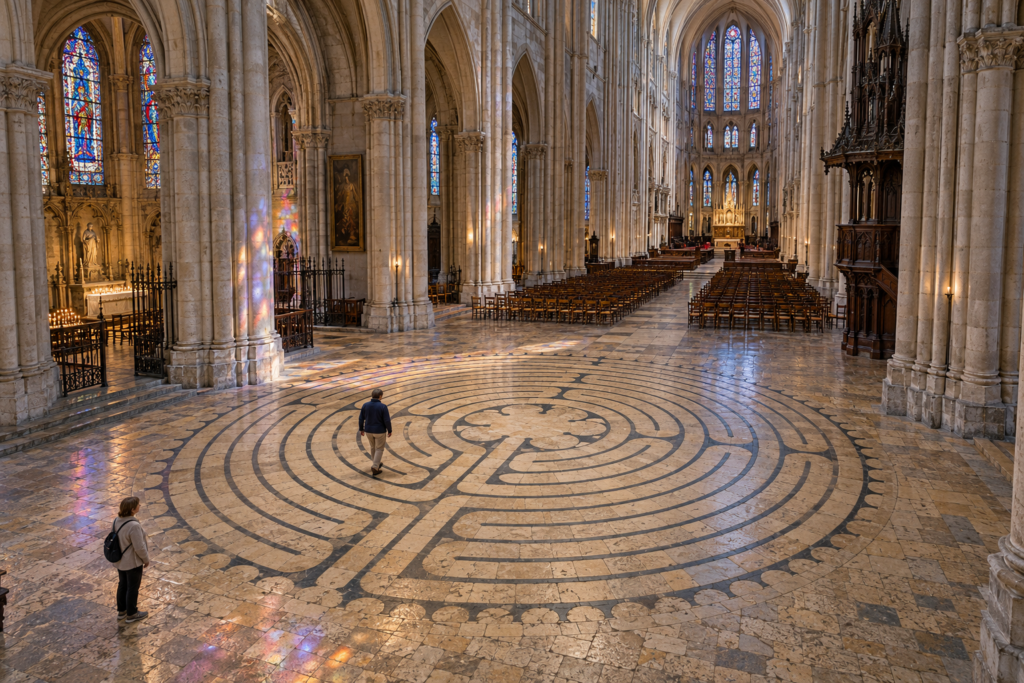
Chartres Cathedral and the Medieval Labyrinth
Chartres Cathedral is one of the most important monuments of medieval European religious architecture.
It is recognised as a UNESCO World Heritage Site.
The cathedral’s labyrinth is particularly significant because it survives within its original architectural setting.
According to the cathedral’s official historical information, the labyrinth was commissioned around the beginning of the thirteenth century.
Its diameter is approximately 12.89 metres.
The complete pathway extends approximately 261.5 metres.
The labyrinth belongs to the Christian religious environment in which the cathedral was constructed.
Its historical symbolism cannot be separated from that context.
The cathedral’s own interpretation emphasises the labyrinth as a path of pilgrimage and contemplation.
It describes the journey as an opportunity for spiritual reflection.
The cathedral also discusses historical connections with Easter liturgy and the religious symbolism of movement toward the centre.
These interpretations concern Christian faith and religious practice.
They do not establish that labyrinths possess supernatural energy.
Nor do they suggest that medieval pilgrims used Hematite as part of the cathedral’s labyrinth tradition.
The gemstone ritual presented in this article is a modern adaptation.
Its historical inspiration is acknowledged without claiming an ancient connection that has not been documented.
The Labyrinth Is Not a Maze
The difference between a labyrinth and a maze may appear small.
But it changes the entire experience.
A maze usually contains choices.
Several possible routes.
Intersections.
And sometimes dead ends.
The participant must decide which direction to follow.
A traditional unicursal labyrinth is different.
It contains one continuous path.
The route may turn repeatedly.
It may approach the centre before moving away again.
But the participant does not need to solve a puzzle.
The pathway is already established.
For contemplative purposes, this removes the need to make navigational decisions.
Attention can instead be directed toward the experience of following the path.
The movement becomes the focus.
This is one reason labyrinths have attracted interest in modern meditation and wellbeing settings.
From Cathedral Floors to Finger Labyrinths
A full-sized labyrinth requires considerable space.
But the same basic principle can be represented on a much smaller surface.
A finger labyrinth is a miniature labyrinth designed to be traced by hand.
The pattern may be printed on paper.
Engraved into wood.
Or incorporated into another suitable material.
Instead of walking along the path, the participant follows it with a fingertip.
The exercise can be performed while sitting.
It does not require travelling to a religious building.
Nor does it require a particular level of physical mobility.
This accessibility has contributed to the use of finger labyrinths in contemporary healthcare and educational environments.
Cambridge University Hospitals NHS Foundation Trust provides an educational guide to finger labyrinths.
The guide was developed for patients who had been provided with a finger labyrinth through Addenbrooke’s pain service.
It describes the practice as a possible aid to relaxation and offers instructions for tracing the pathway.
The guidance encourages participants to find a comfortable position, notice physical sensations and follow the path at their own pace.
The hospital’s educational material does not involve gemstones.
Our Hematite ritual adds a separate symbolic element.
Finger Labyrinths in Contemporary Healthcare
The use of finger labyrinths is not limited to religious contemplation.
Modern healthcare institutions have explored their application as optional reflective activities.
Michigan Medicine, part of the University of Michigan’s academic medical system, published an educational resource titled Pathway to Peace in August 2026.
The article describes finger labyrinth activities offered through patient and family support services.
It explains how participants can trace a labyrinth while attending to breathing and physical sensations.
The resource also provides a sample labyrinth pattern.
The activity is presented as a way to explore mindfulness and personal wellbeing.
It is important to interpret this correctly.
The existence of a hospital programme does not mean that every finger labyrinth practice has been clinically proven to treat a medical condition.
Nor does it establish that adding a gemstone produces additional benefits.
The healthcare examples demonstrate that finger labyrinths are being used as accessible contemplative tools.
The evidence for their effectiveness must be considered separately.
What Does Research Say About Labyrinth Practices?
Research into labyrinth-based interventions has expanded in recent years.
A scoping review published in the Therapeutic Recreation Journal in May 2026 examined 25 research articles published between 2000 and 2025.
The review investigated studies involving labyrinth practices and outcomes across several domains of wellbeing.
The authors identified encouraging findings.
However, they also emphasised that the evidence base remains limited.
The studies differed in design, population and methodology.
Further research is necessary before strong conclusions can be drawn about specific therapeutic applications.
The review primarily concerns labyrinth-based activities.
It does not demonstrate that Hematite improves the effects of meditation.
Nor does it establish that a gemstone-labyrinth combination has measurable therapeutic properties.
For our ritual, the research provides context for the contemplative activity.
The gemstone remains a symbolic addition.
The Spiritual Symbolism of Returning to the Centre
A labyrinth provides a powerful visual metaphor.
The centre represents a destination.
The pathway represents movement.
The repeated turns suggest that progress does not always follow a straight line.
In contemporary contemplative practice, the journey toward the centre may symbolise reflection.
The pause at the centre may represent stillness.
And the outward journey may represent a return to everyday life.
These meanings are interpretative.
They are not universal historical definitions.
Different religious communities and individual practitioners may understand labyrinth symbolism differently.
For the Hematite Finger Labyrinth Ritual, the centre represents a moment of deliberate attention.
Not a supernatural energy point.
Not a chakra.
And not a location where the gemstone becomes activated.
It is simply a place to pause.
The Hematite symbolises steadiness throughout the experience.
Preparing Your Hematite Finger Labyrinth Ritual
The practice requires very little equipment.
Choose one small Hematite stone.
A polished palm stone is suitable.
A smooth tumbled stone can also be used.
Select a stone that is comfortable to handle and free from sharp edges.
You will also need a finger labyrinth.
This may be a printed design or a wooden board with a continuous engraved pathway.
A simple unicursal pattern is sufficient.
There is no need to reproduce the elaborate eleven-circuit design of Chartres Cathedral.
A smaller labyrinth may be easier to follow.
Place the labyrinth on a stable surface.
Position the Hematite beside it.
Do not place the stone directly on the pathway where it might obstruct your finger.
Choose a comfortable chair.
Allow your arms and shoulders to rest naturally.
The exercise can take approximately five to ten minutes.
This is a practical suggestion, not a scientifically established therapeutic duration.
There is no requirement to complete the practice within a particular time.
The Hematite Finger Labyrinth Ritual
The following exercise is an original contemporary practice.
It combines the symbolic interpretation of Hematite with the general contemplative structure of a finger labyrinth.
It is not a historical reconstruction of a medieval Christian ceremony.
Nor is it a clinically validated gemstone intervention.
The practice has three main stages:
Entering.
Pausing.
Returning.
Each stage provides a different opportunity for reflection.
Stage One — Entering the Labyrinth
Begin by placing your Hematite beside the labyrinth.
Observe the stone briefly.
Notice its dark appearance and polished surface.
If you associate Hematite with grounding, allow it to represent the intention to become more attentive to the present moment.
You do not need to imagine energy entering your body.
Simply acknowledge the symbolism.
Now place one fingertip at the entrance to the labyrinth.
Pause.
Notice the contact between your skin and the surface.
If the labyrinth is engraved into wood, you may feel the edge of the pathway.
If it is printed on paper, notice the smoothness of the page.
Begin tracing the path slowly.
There is no need to move at a predetermined speed.
Follow the route as it turns.
If your attention wanders, gently return it to the movement of your finger.
You do not need to eliminate thoughts.
You do not need to force yourself to feel peaceful.
The purpose is to notice what is happening.
Following the Winding Path
As your finger moves inward, the route may approach the centre and then turn away.
This is part of the labyrinth’s design.
You may find yourself expecting the path to reach the centre more quickly.
Perhaps you feel impatient.
Perhaps the movement seems repetitive.
Perhaps you enjoy the simplicity.
There is no correct emotional response.
The exercise invites you to recognise your experience without immediately attempting to change it.
For some people, the winding pathway may become a metaphor for uncertainty.
Life rarely follows a perfectly predictable sequence.
Circumstances change.
Plans require adjustment.
And situations sometimes develop differently from what we expected.
These reflections are personal.
The labyrinth does not predict future events.
It simply provides a structure through which someone may choose to contemplate them.
Stage Two — Pausing at the Centre
Eventually, your finger reaches the centre.
Stop moving.
Allow your fingertip to rest there.
Take a moment to notice your surroundings.
The chair beneath you.
The position of your hand.
The sounds in the room.
The ordinary rhythm of your breathing.
There is no need to hold your breath or follow a demanding breathing pattern.
Allow breathing to remain comfortable.
The centre represents a pause.
It does not need to represent a solution.
You may ask yourself:
What am I noticing right now?
Perhaps you are aware of a particular thought.
Perhaps you feel physically comfortable.
Perhaps you are distracted.
Or perhaps nothing especially interesting occurs.
All of these experiences are acceptable.
The purpose is not to produce an extraordinary state of consciousness.
It is to practise a moment of deliberate attention.
The Hematite Centre Stone
Some contemporary crystal practitioners place a gemstone at the centre of a meditation arrangement.
Within modern spiritual belief systems, the centre stone may be understood as concentrating intention or directing energy.
These claims are not scientifically established.
For the finger labyrinth exercise, it is better to keep the Hematite beside the board.
This preserves the continuous pathway.
The stone remains visible without interfering with the movement.
At the centre of the labyrinth, you may briefly direct your attention toward the Hematite.
Consider what it represents to you.
Stability.
Patience.
Physical presence.
Or the intention to approach the remainder of your day more thoughtfully.
These meanings are symbolic.
The stone does not generate them.
The individual chooses them.
Stage Three — Returning Along the Path
When you are ready, begin tracing the pathway outward.
Follow the same route in reverse.
There is no need to hurry.
Notice the movement of your finger.
The changes in direction.
The sensation of contact.
And the gradual return toward the entrance.
The outward journey can represent a return to ordinary responsibilities.
In some religious labyrinth traditions, the return journey has specific spiritual meanings.
For this contemporary practice, the interpretation is deliberately simple.
You have taken time to pause.
Now you return to everyday activity.
You do not need to carry a special revelation.
You do not need to feel transformed.
The exercise is complete when your finger reaches the entrance.
Closing the Ritual
Lift your finger from the labyrinth.
Rest your hand comfortably.
Look briefly at the Hematite.
Consider whether there is anything you wish to remember from the experience.
Perhaps you noticed impatience.
Perhaps you appreciated the quiet movement.
Perhaps the exercise reminded you that not every moment requires an immediate decision.
You may choose one short reflection:
I can return my attention to the present.
Or:
I do not need to solve everything during this moment.
These statements are optional.
They are not magical formulas.
They do not guarantee psychological benefits.
When you are ready, return the Hematite to its usual place.
The ritual is finished.
Why the Outward Journey Matters
Many contemporary discussions of meditation concentrate on reaching a particular state.
Calm.
Clarity.
Peace.
Or emotional balance.
But the return to ordinary activity is equally important.
A contemplative exercise takes place within a larger day.
Responsibilities remain.
Conversations continue.
And practical decisions still need to be made.
The outward journey symbolises this return.
The purpose is not to escape everyday life permanently.
It is to create a brief opportunity for reflection before continuing.
The labyrinth provides a useful visual representation.
The same path that leads inward also leads outward.
For some practitioners, this may symbolise continuity between contemplation and daily experience.
That interpretation is personal rather than scientifically established.
Hematite and Contemporary Grounding Beliefs
Within modern crystal spirituality, Hematite is frequently described as a grounding gemstone.
Some practitioners believe it strengthens their connection with the Earth.
Others associate it with protection against negative energy.
These interpretations are part of contemporary metaphysical belief systems.
They should not be presented as verified physical effects.
There is no reliable scientific evidence that holding Hematite removes negative energy from the body or produces a protective energetic barrier.
In the finger labyrinth ritual, grounding is understood as an attentional practice.
The person notices the physical environment.
The contact between finger and surface.
The position of the body.
And the movement of the hand.
These ordinary experiences provide the practical focus.
The Hematite represents the intention to pay attention.
The Root Chakra Connection
Contemporary seven-chakra systems commonly associate Hematite with the root chakra.
The root chakra is often called Muladhara in modern interpretations of South Asian chakra traditions.
It is frequently associated with stability, security and a sense of connection with the physical world.
However, chakra traditions have complex religious histories.
Different historical systems do not always use the same number of chakras or assign them identical meanings.
Modern gemstone-chakra correspondences should not automatically be described as ancient teachings.
The association between Hematite and the root chakra is best understood as part of contemporary crystal spirituality.
It does not establish that the gemstone influences an anatomically recognised energy centre.
The finger labyrinth ritual does not require chakra beliefs.
Someone may find the symbolism meaningful.
Another person may prefer a secular interpretation based on tactile attention.
Both can participate in the same practical exercise.
Why Finger Labyrinths Can Be Accessible
One advantage of a finger labyrinth is that it does not require walking.
This can make the practice more accessible to individuals who experience mobility limitations.
A person may trace the pathway while seated.
The board can be placed on a table.
It can also be positioned on a stable lap tray.
Some participants may prefer a raised wooden pathway.
Others may find a printed design easier to use.
The exercise should be adapted to individual comfort.
Someone experiencing hand pain may choose a different finger or use a visual tracing method instead.
There is no requirement to continue if the movement causes discomfort.
The Hematite itself is optional.
If holding or handling the stone is uncomfortable, simply leave it beside the labyrinth.
The contemplative activity does not depend on physical contact with the gemstone.
A Labyrinth for People Who Find Meditation Difficult
Traditional seated meditation can feel unfamiliar.
Some people find it difficult to remain still without a specific activity.
Others become distracted when asked to concentrate on breathing.
A finger labyrinth offers a different form of attention.
There is something to do.
A visible pathway to follow.
A small physical movement.
And a recognisable beginning and ending.
The exercise does not require an empty mind.
Thoughts may continue.
Attention may wander.
The participant simply returns to the pathway.
This makes the practice an interesting alternative for people who prefer a structured contemplative activity.
However, individual responses vary.
A finger labyrinth is not guaranteed to be relaxing.
Some people may find the repetitive movement frustrating.
Others may prefer walking, reading or another quiet activity.
The practice should remain optional.
What the 2026 Research Review Tells Us
The 2026 scoping review in the Therapeutic Recreation Journal provides a useful overview of labyrinth-based interventions.
It identified 25 research articles examining labyrinth activities.
The studies included different populations and approaches.
Some investigated walking labyrinths.
Others explored contemplative or therapeutic applications.
The review reported encouraging findings across several areas of wellbeing.
However, the authors acknowledged important limitations in the available evidence.
A scoping review maps existing research.
It does not necessarily establish that an intervention is clinically effective.
The included studies also differed considerably.
For this reason, findings should not be generalised to every labyrinth practice.
The evidence is especially insufficient to support claims about a specific Hematite finger labyrinth ritual.
Our exercise combines an established contemplative format with contemporary gemstone symbolism.
The combined ritual has not been independently evaluated in controlled research.
The Difference Between Symbolic Grounding and Medical Treatment
The word grounding can refer to several different concepts.
In contemporary crystal spirituality, it may describe a supposed energetic connection with the Earth.
In ordinary contemplative language, it may refer to directing attention toward immediate sensory experience.
In psychological settings, grounding techniques can involve structured exercises intended to help someone orient themselves to the present.
These meanings should not be treated as interchangeable.
The Hematite ritual is a personal contemplative exercise.
It is not a clinical grounding protocol.
It has not been validated as a treatment for anxiety, trauma or other mental health conditions.
The US National Center for Complementary and Integrative Health explains that meditation and mindfulness practices have been studied for various health-related outcomes.
Some interventions show potential benefits.
However, the evidence varies, and negative experiences have also been reported.
The Hematite finger labyrinth should therefore be presented as an optional reflective activity rather than medical treatment.
A Five-Minute Version for Everyday Use
The complete ritual can be simplified.
Place the finger labyrinth on a table.
Set the Hematite beside it.
Begin tracing the pathway inward.
Follow the route without rushing.
Pause briefly at the centre.
Then trace the pathway outward.
When finished, put the materials away.
There is no need for additional ceremonial elements.
The exercise can be performed during a quiet break.
Before reading.
After completing a demanding task.
Or whenever a person wishes to spend a few minutes in deliberate reflection.
Five minutes is simply a convenient timeframe.
It is not a scientifically established dose of meditation.
The practice should fit naturally into the individual’s circumstances.
Using a Hematite Palm Stone
A polished Hematite palm stone may also be used separately from the labyrinth.
Some people prefer holding a familiar object during quiet reflection.
The stone can serve as a tactile reminder.
Sit comfortably.
Rest the stone in your open palm.
Notice its shape.
Its surface.
And the sensation of holding it.
You may then place it beside the labyrinth and begin tracing.
There is no need to maintain contact with the stone throughout the exercise.
The purpose is not to transfer energy between the gemstone and the labyrinth.
It is to create a simple symbolic transition into the contemplative activity.
Why the Stone Should Not Control the Ritual
Contemporary crystal practices sometimes include detailed instructions about which gemstones must be used and where they should be placed.
For the Hematite Finger Labyrinth Ritual, such complexity is unnecessary.
The gemstone is not required to complete the pathway.
It does not determine how long the exercise should last.
It does not need to be energetically activated.
And it does not require special cleansing before use.
The stone is a personal symbol.
If you forget it, the labyrinth remains usable.
If you prefer another meaningful object, the contemplative practice can continue.
The intention should remain more important than the accessory.
A Labyrinth Without Religious Requirements
The labyrinth of Chartres Cathedral belongs to a Christian religious setting.
Its historical meaning should be respected.
However, modern finger labyrinths are used in a variety of contexts.
Some people incorporate prayer.
Others use them for meditation.
Still others approach them as quiet reflective activities without religious beliefs.
The Hematite ritual presented here is a contemporary secular-compatible adaptation.
It does not claim to reproduce Christian liturgy.
It does not require religious participation.
And it does not suggest that the cathedral’s historical labyrinth was designed for gemstone meditation.
Readers interested in the religious tradition can explore the cathedral’s own explanations.
Those interested in personal reflection may use a simple finger labyrinth without adopting the religious interpretations.
Acknowledging these differences allows historical traditions and contemporary practices to be discussed respectfully.
The Meaning of a Winding Path
A labyrinth can offer a useful metaphor for human experience.
Progress does not always appear direct.
Sometimes we move toward an objective.
Sometimes circumstances require a change in direction.
Sometimes the route feels longer than expected.
The labyrinth’s winding design can remind us of these experiences.
However, it does not provide answers about the future.
It cannot predict relationships.
It cannot determine whether a decision is correct.
And it cannot resolve practical problems through supernatural means.
Its value as a symbol comes from the interpretation chosen by the participant.
For some people, the winding path may represent patience.
For others, it may symbolise acceptance of uncertainty.
Another person may simply appreciate the geometric movement.
No single interpretation is required.
When the Ritual Does Not Feel Peaceful
Contemplative practices are often presented as universally calming.
But individual experiences differ.
Some people may become impatient while tracing the labyrinth.
Others may find that quiet attention makes uncomfortable thoughts more noticeable.
The exercise should not require anyone to continue through distress.
If the activity becomes unpleasant, stop.
Return your attention to the room.
Move your hands comfortably.
And choose another activity if appropriate.
There is no spiritual obligation to complete the pathway.
The gemstone does not need to be cleansed because the exercise was uncomfortable.
Nor does an unpleasant experience indicate negative energy.
It simply means that this particular practice may not be suitable at that moment.
Creating a Personal Reflection Space
A finger labyrinth does not require an elaborate altar.
A small table is sufficient.
Choose a stable surface.
Place the labyrinth where it can be reached comfortably.
Keep the Hematite beside it.
You may also include a notebook if you enjoy recording reflections.
However, additional objects are optional.
Avoid creating unnecessary distractions.
The visual simplicity of the arrangement can help keep attention on the activity.
A wooden labyrinth and one dark Hematite stone provide a restrained, meaningful composition.
The contrast between the winding pathway and the still gemstone reinforces the symbolic theme.
Movement and stability.
Journey and pause.
Attention and return.
These are personal interpretations rather than measurable energetic relationships.
A Weekly Finger Labyrinth Reflection
Readers who enjoy the exercise may choose to repeat it once a week.
Each session can remain simple.
Trace the path inward.
Pause at the centre.
Return outward.
Afterward, consider one question:
What did I notice during this experience?
There is no need to compare every session.
Some may feel comfortable.
Others may be distracting.
The purpose is not to achieve progressively deeper meditation.
Nor is it to measure the supposed energy of the Hematite.
The practice provides an opportunity for regular reflection.
If it remains meaningful, continue.
If it does not, there is no obligation to repeat it.
The Labyrinth as an Object of Contemplative Art
Labyrinths are also visually fascinating.
Their pathways combine repetition with unexpected turns.
The pattern may appear complex even though it contains only one route.
This creates an interesting contrast.
The design looks difficult.
But following it requires no navigational problem-solving.
The participant can concentrate on movement rather than choosing directions.
A wooden finger labyrinth can therefore function as both an artistic object and a contemplative tool.
Its significance does not depend on supernatural claims.
It can be appreciated for its design.
Its historical associations.
And the experience of following its pathway.
The Hematite adds another visual element.
Its dark metallic appearance contrasts with the warmth of natural wood.
Together, the objects create a simple arrangement that may hold personal symbolic meaning.
A Different Understanding of Protection
Hematite is frequently associated with protection in contemporary crystal spirituality.
Some practitioners believe it creates an energetic shield against negative influences.
Such claims are not supported by reliable scientific evidence.
For this ritual, protection can be interpreted symbolically.
It may represent the intention to respect personal limits.
To create a short period without unnecessary interruptions.
Or to choose a comfortable environment for reflection.
These are ordinary actions.
They do not require supernatural explanations.
The stone represents the value of stability.
The participant decides how to express that value.
What Does It Mean to Return to the Present?
The present moment is sometimes discussed as though it were a special spiritual destination.
But present-moment attention can be understood more simply.
It involves noticing what is happening now.
The contact of a finger with wood.
The movement of the hand.
The sounds in the room.
The position of the body.
These experiences are ordinary.
They do not require an altered state of consciousness.
The finger labyrinth provides a structure for observing them.
The Hematite provides a symbolic reminder.
Neither guarantees calm or emotional transformation.
The exercise is simply an opportunity to direct attention deliberately.
The Deeper Meaning of the Hematite Finger Labyrinth
At first glance, the arrangement is uncomplicated.
One small gemstone.
One winding pathway.
One person tracing the route.
Yet the symbolism can be meaningful.
The Hematite represents steadiness.
The labyrinth represents movement.
The centre represents a pause.
And the outward path represents returning to ordinary life.
These meanings are contemporary interpretations.
They are not scientifically demonstrated energetic properties.
Nor are they presented as universal religious teachings.
The historical labyrinth tradition provides cultural depth.
Modern healthcare resources provide examples of practical contemplative use.
The gemstone adds a personal symbolic dimension.
Together, they form a simple exercise in attention.
The Journey Is the Practice
It is tempting to imagine that every spiritual exercise must produce a result.
An answer.
A revelation.
A feeling of peace.
Or a dramatic personal change.
But the Hematite Finger Labyrinth Ritual makes no such promise.
The purpose is not to reach a supernatural destination.
It is to experience the pathway.
To notice movement.
To pause.
And to return.
The stone remains beside the labyrinth.
Quiet.
Unchanged.
It does not direct the finger.
It does not determine the experience.
It simply represents a chosen intention.
Perhaps the most meaningful lesson is found in the difference between the stone and the pathway.
The Hematite symbolises stability.
The labyrinth symbolises movement.
And human experience often contains both.
There are moments when we need to act.
Moments when we need to wait.
And moments when we benefit from directing attention toward what is immediately present.
The labyrinth offers a simple way to explore that relationship.
The stone reminds us to remain attentive.
The pathway invites us to continue.
And the centre gives us permission to pause.
Not because an invisible energy has changed.
But because we have deliberately chosen to spend a few moments noticing the experience of being here.
Sometimes, that is enough.
References & Further Reading
1. Chartres Cathedral – The Labyrinth
Institution: Rectorate of Chartres Cathedral, France
Type: Official religious, historical and architectural resource
The cathedral’s official educational page explains the historical significance of its medieval labyrinth.
It discusses the labyrinth’s Christian religious context, its relationship with pilgrimage, and its interpretation as a pathway for contemplation.
The resource also provides historical information about the construction and symbolism of the labyrinth.
This is the principal historical reference for the article.
https://www.cathedrale-chartres.org/en/cathedrale/monument/the-labyrinth
2. UNESCO World Heritage Centre – Chartres Cathedral
Institution: UNESCO
World Heritage inscription: 1979
Type: International cultural heritage documentation
UNESCO’s official description establishes the architectural, historical and cultural importance of Chartres Cathedral.
The resource discusses the cathedral’s medieval construction, religious significance and outstanding preservation.
It provides authoritative context for understanding the environment in which the famous labyrinth was created.
https://whc.unesco.org/en/list/81
3. Cambridge University Hospitals NHS Foundation Trust – Guide to Using the Finger Labyrinth
Institution: Cambridge University Hospitals NHS Foundation Trust
Department: Addenbrooke’s Pain Service
Type: Institutional patient education
An accessible educational guide describing the use of finger labyrinths in a hospital setting.
The resource explains how to prepare for the activity, trace the pathway, pause at the centre and return along the same route.
It also discusses the use of finger labyrinths as an optional relaxation activity.
The guide does not involve gemstones or claim that crystal energy produces therapeutic effects.
https://www.cuh.nhs.uk/patient-information/guide-to-using-the-finger-labyrinth
4. University of Michigan Health – Pathway to Peace
Institution: Michigan Medicine, University of Michigan
Published: August 14, 2026
Type: University hospital educational resource
An educational article explaining how finger labyrinths are used within patient and family support activities.
The resource discusses finger tracing, attention to breathing and the use of labyrinths as contemplative tools.
It also provides a downloadable labyrinth pattern and practical instructions.
This source supports the accessible, seated finger labyrinth component of the ritual.
https://www.uofmhealth.org/thrive/pathway-peace
5. Walking the Path to Well-Being: A Scoping Review of Labyrinth Walking Outcomes
Author: Karen Carnicello Wenzel
Publication: Therapeutic Recreation Journal
Published: May 4, 2026
Type: Peer-reviewed scoping review
DOI: 10.18666/TRJ-2026-V60-I2-13268
A research review examining 25 articles published between 2000 and 2025 concerning labyrinth-based interventions.
The review discusses findings across psychological, physical, cognitive and spiritual dimensions of wellbeing.
Although encouraging outcomes were reported, the author emphasises that the evidence base remains limited.
The review does not investigate Hematite or gemstone-related therapeutic effects.
https://www.js.sagamorepub.com/index.php/trj/article/view/13268
6. National Center for Complementary and Integrative Health – Meditation and Mindfulness: Effectiveness and Safety
Institution: US National Institutes of Health
Type: Evidence-based medical and wellness education
An authoritative overview of meditation and mindfulness research.
The resource discusses potential benefits, methodological limitations and possible adverse experiences.
It provides scientific context for the article’s distinction between optional contemplative practices and established medical treatment.
https://www.nccih.nih.gov/health/meditation-and-mindfulness-effectiveness-and-safety
7. Baylor University – Labyrinth Walk
Institution: Diana R. Garland School of Social Work, Baylor University
Type: University educational resource
An educational introduction to labyrinth walking and finger labyrinth practices.
The resource describes their use in contemplation, prayer, meditation and reflection.
It also provides guidance and additional educational materials concerning finger labyrinths.
The university’s resource illustrates how labyrinth practices continue to be explored in contemporary educational and contemplative settings.
https://socialwork.web.baylor.edu/labyrinth-walk
Educational and Scientific Clarification
The associations between Hematite, grounding, stability, protection and the root chakra are contemporary spiritual interpretations. They are not scientifically established energetic or therapeutic properties.
The Hematite Finger Labyrinth Ritual presented in this article is an original contemporary contemplative exercise.
It is not a reconstruction of medieval Christian religious practice, and there is no historical evidence that Hematite formed part of the labyrinth tradition at Chartres Cathedral.
Research into labyrinth walking, finger labyrinths, meditation and mindfulness does not demonstrate that Hematite provides additional psychological, physiological or supernatural benefits.
The practice should not be presented as a treatment for anxiety, trauma, depression, chronic pain or other medical conditions.
Gemstones and spiritual rituals should not replace professional healthcare, psychological treatment or appropriate support.
Participation should remain voluntary, comfortable and adapted to individual circumstances.