There is something remarkable about the natural world.
A forest does not need to explain itself.
A tree does not require our attention.
The changing seasons continue whether we notice them or not.
Yet when we deliberately pay attention to our surroundings, an ordinary landscape can become unexpectedly meaningful.
The movement of leaves.
The appearance of moss on an old stone wall.
The changing colours of a familiar tree.
The quiet activity of insects among fallen branches.
These details are easy to overlook during a busy day.
Within contemporary crystal spirituality, Moss Agate is frequently associated with nature, renewal, stability and personal growth.
Its distinctive appearance has inspired symbolic connections with forests, vegetation and the cycles of the natural environment.
Some crystal practitioners believe Moss Agate strengthens their connection with the Earth or encourages emotional balance.
These are spiritual interpretations rather than scientifically established properties.
There is no reliable evidence that Moss Agate transmits a special energy capable of improving wellbeing, influencing plants or creating a supernatural connection with nature.
Nevertheless, a small stone can become a meaningful personal symbol.
It can remind us to slow down.
To notice.
To appreciate.
And to recognise that our relationship with nature involves more than simply spending time outdoors.
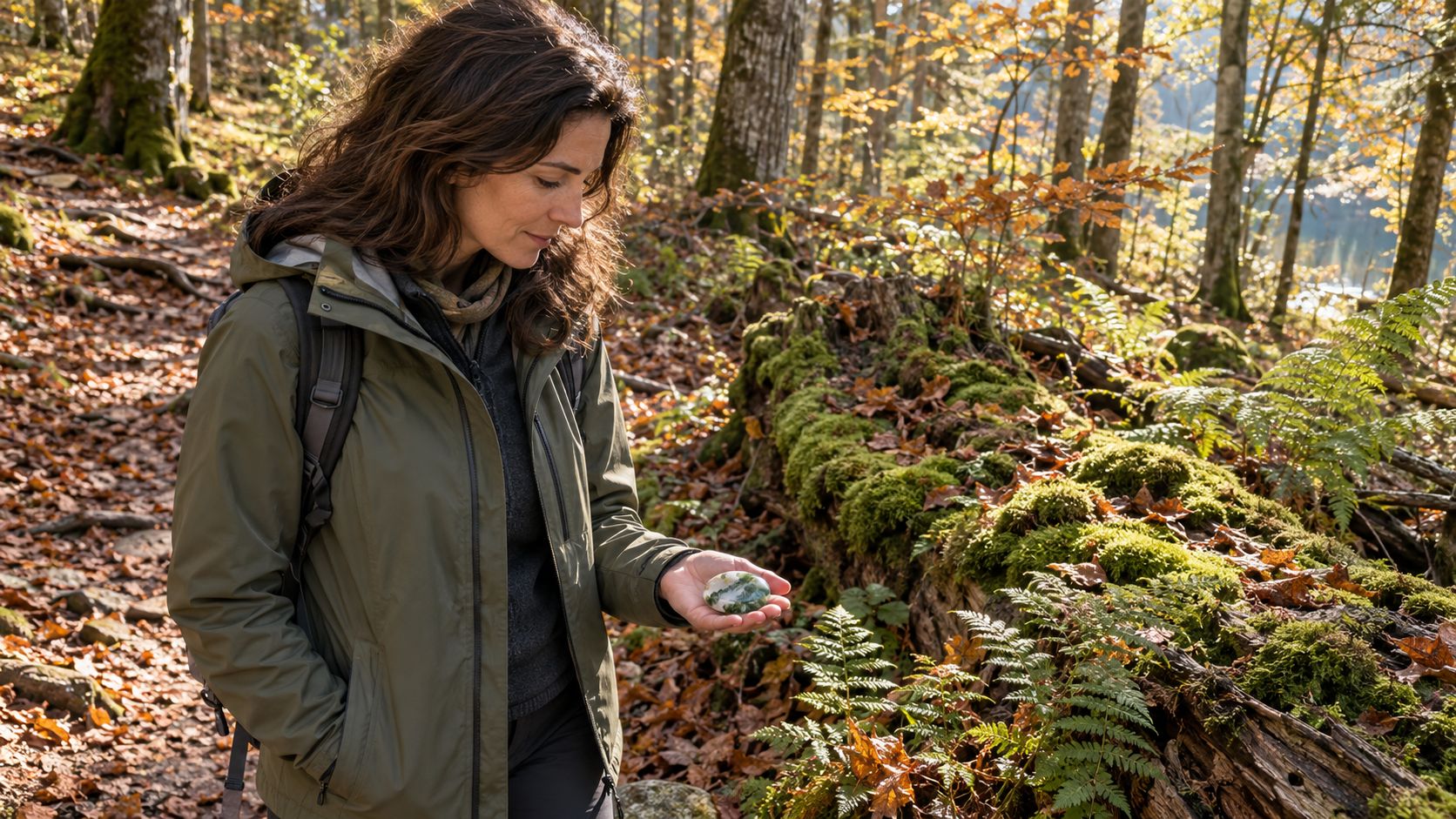
The Moss Agate nature walk ritual explores this idea through five practical approaches to connecting with the natural world.
Its foundation combines contemporary gemstone symbolism with research into nature connectedness.
The result is a simple contemplative practice that can be adapted to forests, gardens, urban parks and even small green spaces close to home.
Table of Contents
Why Moss Agate?
Many gemstones acquire symbolic meanings through their appearance.
A blue stone may remind someone of the sea.
A golden stone may suggest sunlight.
A dark stone may become associated with stillness or protection.
Moss Agate offers a particularly evocative visual connection with the natural landscape.
Its green, branching and moss-like patterns can resemble miniature forests, delicate vegetation or fragments of a woodland scene.
These visual associations have contributed to its popularity within contemporary nature-oriented crystal practices.
Modern spiritual interpretations commonly connect Moss Agate with renewal, abundance, patience and the cycles of growth.
Some practitioners also associate it with grounding and a sense of belonging to the natural world.
These meanings are not universally established historical traditions.
Nor are they scientifically demonstrated energetic effects.
For the ritual described here, Moss Agate represents a personal intention:
To become more attentive to the natural environment and our place within it.
The stone is not the source of the experience.
The experience comes from our interaction with the world around us.

Nature Connectedness: More Than Spending Time Outdoors
Spending time outside and feeling connected with nature are related experiences.
But they are not identical.
Someone may walk through a park every morning without paying much attention to the surroundings.
Another person may spend five minutes observing a tree outside their window and experience a meaningful sense of appreciation.
Researchers use the term nature connectedness to describe aspects of the relationship people experience with the natural world.
It involves more than recognising different species or knowing facts about the environment.
Nature connectedness can include emotional attachment, appreciation, personal meaning and a sense of belonging within the wider natural world.
Research conducted at the University of Derby has explored how people develop this relationship.
In 2017, researchers Ryan Lumber, Miles Richardson and David Sheffield published a study in the peer-reviewed journal PLOS ONE.
Their work identified five pathways associated with developing nature connectedness:
- Contact through the senses.
- Emotional engagement.
- Appreciation of natural beauty.
- Personal meaning.
- Compassion and care for nature.
The research included two surveys involving 321 participants and a walking intervention involving 72 participants.
The findings suggested that activities involving these pathways could strengthen people’s reported connection with nature.
Importantly, this research did not involve gemstones.
It does not establish that Moss Agate improves nature connectedness.
However, the five pathways provide an interesting educational framework for a contemporary symbolic crystal ritual.
The Spiritual Meaning of Walking With Nature
Walking has appeared in many contemplative and religious traditions.
Different communities have developed their own practices involving pilgrimage, reflection, meditation and movement through meaningful landscapes.
These traditions have distinct histories and should not be treated as interchangeable.
The Moss Agate nature walk described here is not presented as a reconstruction of an ancient ceremony.
It is an original contemporary practice.
Its spiritual dimension comes from the intention brought to the experience.
Rather than walking only to reach a destination, the participant chooses to become more aware of the environment.
The stone acts as a personal reminder of that intention.
For someone who follows contemporary crystal spirituality, this may feel like a symbolic connection with the Earth.
For someone who prefers a secular interpretation, it may simply be a mindful walk with a meaningful object.
Both approaches can use the same practical exercise without requiring claims about supernatural energy.
Preparing Your Moss Agate Nature Walk
The ritual requires very little preparation.
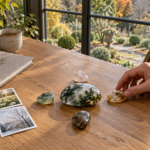
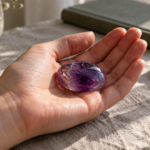
Choose one small Moss Agate stone.
A polished palm stone is particularly convenient.
A smooth cabochon or small tumbled stone can also be suitable.
The stone should be comfortable to carry and free from sharp edges.
Place it inside a small fabric pouch or secure pocket.
Choose a suitable location.
A woodland path.
A public garden.
A quiet park.
A tree-lined street.
Or a familiar green space near your home.
You do not need to travel to a remote forest.
The purpose is to develop attention toward the natural world, not to reach an impressive destination.
Choose a route appropriate for your mobility, the weather and local conditions.
The walk can last approximately 15–20 minutes, although a shorter experience is perfectly acceptable.
There is no scientifically established duration required for a gemstone ritual.
The suggested timeframe is simply a practical starting point.
The Five Pathways of the Moss Agate Nature Walk
The following ritual adapts the University of Derby’s five pathways to nature connectedness into a contemporary personal exercise.
The gemstone symbolism is an original addition.
It was not part of the university’s research intervention.
Each stage encourages a different way of experiencing the natural environment.
There is no need to complete the stages perfectly.
They are invitations to notice, appreciate and reflect.
Pathway One – Contact: Experience Nature Through the Senses
Begin your walk at a comfortable pace.
Hold the Moss Agate briefly.
Look at its green patterns.
Then return your attention to the environment.
For the first few minutes, concentrate on direct sensory experience.
Notice the light.
The temperature of the air.
The sounds around you.
The movement of leaves.
The texture of the path beneath your shoes.
Perhaps you hear birdsong.
Perhaps the wind moves through the branches of a nearby tree.
Perhaps sunlight creates changing patterns across the ground.
You do not need to identify every sound or plant.
The purpose is not to test your knowledge.
It is to experience your surroundings more attentively.
University of Derby research identifies sensory contact as one of the pathways associated with nature connectedness.
For this stage, the Moss Agate serves as a reminder to move from abstract thoughts toward direct observation.
After a few moments, return the stone to your pocket.
Allow the natural environment to become the focus.
Reflection question: What am I noticing now that I would normally overlook?
Pathway Two – Beauty: Notice Something Ordinary
Continue walking.
Look for one natural detail that attracts your attention.
It does not need to be spectacular.
Perhaps it is a single leaf.
A patch of moss.
The shape of a tree branch.
A small flower growing beside a path.
Or the way light falls across an old stone wall.
Spend a short moment appreciating it.
Notice its colour.
Its shape.
Its relationship with the surrounding environment.
You do not need to photograph it.
You do not need to collect it.
And you do not need to explain why it appeals to you.
The University of Derby’s nature connectedness research highlights appreciation of natural beauty as an important dimension of people’s relationship with nature.
This includes ordinary experiences that may be overlooked during everyday activities.
The Moss Agate provides a useful symbolic contrast.
Its patterns may resemble a tiny natural landscape.
But the living environment around you is infinitely more complex.
The stone reminds you to look beyond the object itself.
Reflection question: What small detail in nature do I find beautiful today?
Pathway Three – Emotion: Recognise Your Response
Nature does not produce the same emotional experience for everyone.
A forest may feel peaceful to one person.
Another may find it unfamiliar or uncomfortable.
A storm may inspire awe.
A quiet garden may evoke nostalgia.
A particular landscape may remind someone of childhood.
The third pathway involves recognising your emotional response without forcing a particular feeling.
Pause somewhere safe.
Consider how the surroundings affect you.
Do you feel curious?
Interested?
Comfortable?
Restless?
Indifferent?
Perhaps you feel several things at once.
There is no required answer.
The purpose is awareness rather than emotional correction.
Some contemporary crystal practitioners describe Moss Agate as a stone of emotional balance.
That interpretation is not scientifically established.
In this exercise, emotional awareness comes from recognising your own experience.
The stone simply represents the intention to pay attention.
Reflection question: What feelings arise when I spend time in this environment?
Pathway Four – Meaning: Explore Personal Symbolism
Human beings frequently use the natural world as a source of metaphor.
A changing season may represent transition.
A growing tree may suggest patience.
A river may symbolise movement.
A forest path may evoke uncertainty or discovery.
These meanings are interpretations.
They do not imply that nature is sending supernatural messages.
The University of Derby’s research identifies personal meaning as another pathway toward nature connectedness.
For this stage, choose one natural feature.
Perhaps an old tree.
A fallen leaf.
A young plant.
Or a quiet section of the landscape.
Consider whether it reminds you of something in your own life.
For example, a tree that has survived many winters might symbolise persistence.
A new shoot emerging from the ground might represent a beginning.
A changing autumn landscape might remind you that circumstances evolve.
These associations are personal.
They do not need to be universal.
They are also not predictions about future events.
The Moss Agate can serve as a small symbolic companion to this process.
Its patterns may suggest growth and natural complexity.
But the meaning belongs to the person reflecting.
Reflection question: Does anything I have noticed today represent an idea that matters to me?
Pathway Five – Compassion: Care for the Natural World
The final pathway introduces an important change in perspective.
Nature connectedness is not only about what the environment provides for us.
It can also concern how we treat the environment.
The University of Derby’s research identifies compassion and care for nature as meaningful aspects of nature connection.
This can involve concern for wildlife.
Respect for habitats.
Or a willingness to make choices that reduce unnecessary environmental damage.
During the final part of your walk, consider one practical action.
Perhaps you can remain on designated paths.
Avoid disturbing wildlife.
Dispose of litter responsibly.
Respect protected plants.
Or support the conservation of a local green space.
There is no requirement to perform a dramatic gesture.
Small, consistent actions can express a meaningful commitment.
The US National Park Service promotes the principle of leaving natural objects where they are found.
Rocks, plants, fallen branches and other materials may contribute to habitats or the character of a landscape.
For our ritual, this principle has particular significance.
You have brought your own Moss Agate.
There is no need to remove anything from the environment.
The stone becomes a reminder to appreciate nature without unnecessarily disturbing it.
Reflection question: What can I do to show greater care for this place?
Closing the Nature Walk Ritual
At the end of the walk, choose a safe place to pause.
Take the Moss Agate from your pocket.
Hold it briefly.
Consider the five experiences.
What did you notice?
What did you find beautiful?
What emotions arose?
What personal meaning did you discover?
And what action could express greater care for nature?
You do not need to answer every question.
Choose one observation that feels meaningful.
Then return the stone to its pouch.
The ritual is complete.
No special energetic cleansing is necessary.
No ceremonial words are required.
The purpose is not to activate the gemstone.
It is to recognise the experience you have just had.
Why the Five Pathways Matter
One of the interesting findings from the University of Derby’s research is that nature connectedness involves more than simply accumulating knowledge.
Learning to identify plants and animals can be valuable.
Scientific knowledge contributes enormously to environmental understanding and conservation.
But the researchers found that emotional engagement, personal meaning, sensory contact, beauty and compassion were particularly relevant to the relationship participants experienced with nature.
This suggests an important distinction.
We can know many facts about an environment without necessarily feeling connected to it.
Conversely, we can appreciate a natural place without knowing the names of every species.
The two approaches are not mutually exclusive.
Knowledge can enrich appreciation.
And appreciation can encourage curiosity.
For the Moss Agate ritual, this means there is no requirement to become an expert in botany or ecology.
The practice begins with attention.
Nature, Wellbeing and Scientific Evidence
The relationship between natural environments and human wellbeing has received substantial scientific attention.
The World Health Organization has examined the potential health benefits of urban green spaces.
Its 2016 report Urban Green Spaces and Health discusses several pathways through which green environments may support public health.
These include opportunities for physical activity, psychological relaxation, social interaction and reduced exposure to certain environmental stressors.
However, the relationship between green space and health is complex.
Accessibility, environmental quality, individual circumstances and other factors can influence outcomes.
It would be misleading to claim that every nature walk produces the same psychological or physical benefits.
It would also be incorrect to attribute the potential benefits of green spaces to the gemstone carried during the walk.
The scientific evidence concerns environmental exposure, activity and related human experiences.
It does not demonstrate that Moss Agate produces additional therapeutic effects.
The stone’s role remains symbolic.
Moss Agate as a Pocket Stone
Not everyone wishes to perform a structured ritual.
A small Moss Agate can also be carried as an everyday pocket stone.
Its purpose may be as simple as reminding you to notice nature.
For example, during a lunch break, you might step outside for a few minutes.
Touch the stone briefly through its pouch.
Then look for one natural detail.
A tree.
A cloud formation.
A bird.
Or the changing light on a building.
The practice does not require a long walk.
Nor does it require a special location.
The important element is the deliberate shift in attention.
The stone becomes a familiar reminder of that intention.
If you forget to carry it, the practice remains possible.
A meaningful contemplative habit should not depend entirely on possessing a particular object.
A Nature Ritual for Urban Environments
Nature connectedness is not limited to remote landscapes.
Many people live in cities.
Some have limited access to forests or large parks.
Others face mobility, transport or time constraints.
These circumstances should not exclude anyone from nature-oriented contemplative practices.
A small public garden may provide opportunities for observation.
A tree-lined street may reveal seasonal changes.
A balcony with plants may become a familiar place for quiet attention.
Even a window overlooking a courtyard can provide an opportunity to notice weather, light and vegetation.
The University of Derby’s research has been applied to activities intended to strengthen nature connectedness in urban settings.
The underlying principle is that meaningful engagement does not always require extensive travel.
For the Moss Agate ritual, choose the environment that is realistically available to you.
The practice should adapt to your circumstances.
Not the other way around.
The Moss Agate Window Ritual
For readers unable to walk outdoors, the five pathways can be adapted into a seated exercise.
Place the Moss Agate on a small table beside a window.
Choose a view containing some natural element.
A tree.
A garden.
A patch of sky.
Or a group of plants.
Begin with sensory observation.
Notice the light and movement.
Then identify something you find visually interesting.
Consider your emotional response.
Reflect on any personal meaning.
Finally, think of one practical way to care for the natural environment.
This adaptation is an original contemplative exercise.
It has not been independently validated as a therapeutic intervention.
Nevertheless, it offers an accessible way to explore the same symbolic intentions.
The stone remains a reminder.
The attention remains yours.
Moss Agate and the Symbolism of Growth
Contemporary crystal spirituality often associates Moss Agate with growth.
Sometimes this is described in energetic terms.
Practitioners may believe that the stone encourages new beginnings, prosperity or personal development.
These claims are not scientifically established.
However, growth can be explored as a metaphor.
Plants develop according to environmental conditions.
Some grow quickly.
Others require many years.
Certain species remain dormant during unfavourable seasons.
Others adapt to changing circumstances.
These natural processes can inspire personal reflection.
Someone beginning a new project might associate a young plant with patience.
Another person may see an old tree as a symbol of persistence.
The important distinction is that the natural object does not determine the person’s future.
It provides an image through which the person chooses to reflect.
Moss Agate can serve a similar symbolic function.
Seasonal Nature Walks
One way to deepen the practice is to revisit the same location during different seasons.
A familiar path changes throughout the year.
Spring may bring new leaves.
Summer may reveal dense vegetation.
Autumn introduces changing colours and fallen foliage.
Winter exposes branches and structures that were previously hidden.
Observing these changes can encourage greater familiarity with a place.
You may begin noticing details that were previously overlooked.
A particular tree becomes recognisable.
A patch of woodland develops its own seasonal character.
A garden reveals patterns that become apparent only through repeated visits.
The Moss Agate can accompany these walks as a consistent symbolic object.
Its appearance remains familiar while the surrounding environment changes.
For contemporary practitioners, this contrast may represent continuity within natural cycles.
This is a personal interpretation, not an energetic property.
A Four-Season Moss Agate Practice
Consider choosing one accessible natural location.
Visit it once during each season.
Carry the same Moss Agate.
During every visit, observe three things.
First, what has changed?
Second, what has remained familiar?
Third, what do you appreciate about the place today?
There is no need to collect leaves, stones or other natural materials.
A photograph or brief written observation can be sufficient.
Over time, the practice may encourage a more detailed awareness of the environment.
It may also reveal how your own responses change.
A place that initially seemed ordinary may become increasingly meaningful through familiarity.
The purpose is not to measure the gemstone’s influence.
It is to develop a continuing relationship with a real place.
The Difference Between Nature Symbolism and Nature Worship
Nature-oriented spiritual practices exist in many different religious and cultural contexts.
Some traditions regard particular landscapes as sacred.
Others incorporate seasonal ceremonies, religious offerings or relationships with specific natural features.
These practices have their own histories and meanings.
A contemporary Moss Agate nature walk should not automatically be described as an ancient Earth ceremony.
Nor should it claim to represent Indigenous spiritual traditions or particular religious practices.
The exercise presented here is a modern personal ritual.
It uses symbolic gemstone interpretation alongside research-informed nature engagement.
Participants may understand the experience spiritually or secularly.
Neither interpretation requires inventing a historical lineage.
Respectful engagement with nature can exist without appropriating the ceremonies of another culture.
Can Moss Agate Influence Plants?
Some contemporary crystal-healing traditions suggest that Moss Agate can stimulate plant growth or improve the energy of a garden.
Such claims are not supported by reliable scientific evidence.
There is no established basis for concluding that placing Moss Agate beside a plant improves its growth through spiritual energy.
Plants require appropriate environmental conditions.
These include suitable light, water, nutrients and other species-specific needs.
A gemstone does not replace these requirements.
However, someone may choose to place Moss Agate near a houseplant as a decorative symbol of their intention to care for it.
The meaningful action is the care provided.
Observing the plant.
Checking its needs.
And maintaining suitable growing conditions.
The stone does not perform those tasks.
Mindfulness and the Natural Environment
The Moss Agate nature walk also shares certain features with mindfulness practices.
Mindfulness commonly involves directing attention toward present experiences without immediately judging them.
During the walk, participants are invited to notice sounds, colours, movement and emotional responses.
This resembles aspects of informal mindfulness.
The US National Center for Complementary and Integrative Health provides evidence-based information about meditation and mindfulness.
Research suggests that some mindfulness-based interventions may support aspects of psychological wellbeing.
However, results depend on the practice, population and circumstances.
Some individuals also report negative experiences during meditation.
The Moss Agate nature walk is not equivalent to a clinically studied mindfulness intervention.
Nor has its effectiveness been established through controlled research.
Its value should therefore be understood as a personal contemplative practice rather than a medical treatment.
Respecting Wildlife During Spiritual Practices
A nature-oriented ritual should not disturb the environment it seeks to appreciate.
Avoid approaching wild animals unnecessarily.
Do not interfere with nests.
Do not remove protected plants.
And do not alter natural features to create a more visually attractive ritual setting.
The US National Park Service recommends leaving natural objects in place and respecting wildlife.
These principles are particularly relevant to contemporary crystal practices.
Some spiritual arrangements involve collecting stones, branches, flowers or other natural materials.
But removing these objects may affect habitats or violate local regulations.
For the Moss Agate walk, bringing your own stone avoids the need to collect anything.
If you wish to photograph a natural object, do so without disturbing it.
The most meaningful expression of nature appreciation may be leaving the environment as you found it.
Why a Single Stone Is Enough
Contemporary crystal spirituality sometimes involves elaborate arrangements.
Multiple gemstones.
Crystal grids.
Decorative altars.
Or carefully organised collections.
These can hold personal symbolic meaning.
But they are not necessary for the Moss Agate nature walk.
One small stone is sufficient.
The simplicity is deliberate.
The purpose is to direct attention outward.
Toward trees.
Plants.
Wildlife.
Weather.
And the wider environment.
An elaborate arrangement could distract from that objective.
The gemstone should support the experience rather than dominate it.
For this particular ritual, less is often more.
When Nature Does Not Feel Peaceful
Nature is sometimes presented as universally calming.
But not everyone experiences it that way.
A dense forest may feel uncomfortable.
Unfamiliar wildlife may cause anxiety.
Uneven paths can create accessibility challenges.
Weather conditions may be unpleasant or unsafe.
The Moss Agate ritual should never require someone to ignore these concerns.
Choose environments that feel reasonably comfortable and appropriate.
Remain aware of your surroundings.
Follow local guidance.
And avoid isolated or hazardous locations when conditions are unsuitable.
There is no spiritual benefit in forcing yourself into an unsafe situation.
If an outdoor environment causes distress, choose another setting or discontinue the exercise.
Personal wellbeing and practical safety take priority over completing a ritual.
The Meaning of Returning
One of the most interesting aspects of a repeated nature practice is familiarity.
A place may initially appear unremarkable.
But repeated visits can reveal details.
You begin recognising particular trees.
Noticing changes in light.
Observing seasonal patterns.
And becoming aware of small differences from one visit to another.
This developing familiarity can create personal meaning.
The location becomes more than a point on a map.
It becomes somewhere you have paid attention.
Some contemporary spiritual practitioners may describe this as developing a stronger energetic relationship with the Earth.
That remains a metaphysical interpretation.
A more grounded explanation is that repeated attention can influence how personally significant a place feels.
The Moss Agate becomes a symbolic companion to that process.
A Seven-Day Moss Agate Nature Challenge
Readers who enjoy the ritual may wish to explore a short seven-day variation.
Each day, choose one small opportunity to engage with nature.
On the first day, notice a natural sound.
On the second, appreciate a colour or shape.
On the third, observe a change in the weather.
On the fourth, identify a natural detail you had previously overlooked.
On the fifth, consider what a familiar place means to you.
On the sixth, perform one appropriate action that supports environmental care.
On the seventh, revisit your favourite observation from the week.
The Moss Agate may accompany these activities.
But it is not required for every session.
This challenge is an original personal exercise.
It should not be confused with a scientifically validated seven-day treatment programme.
Its purpose is to encourage variety in how nature is experienced.
From Personal Appreciation to Environmental Responsibility
A meaningful relationship with nature involves more than personal enjoyment.
It also raises questions about responsibility.
How do our actions affect the places we visit?
What happens when natural objects are removed?
How can we reduce unnecessary disturbance?
And what can we do to support the environments we appreciate?
The University of Derby’s research links nature connectedness with attitudes and behaviours concerning environmental protection.
However, relationships between attitudes and actual behaviour are complex.
Feeling connected to nature does not guarantee that someone will always act sustainably.
For the Moss Agate ritual, environmental care is therefore included as a deliberate practical step.
It encourages the participant to move beyond appreciation.
Toward responsibility.
The stone symbolises that intention.
The meaningful contribution comes from the action itself.
A Different Understanding of Grounding
Within contemporary crystal spirituality, Moss Agate is sometimes described as a grounding stone.
Practitioners may believe that it strengthens their connection with the Earth’s energy.
Such claims are not scientifically established.
The word grounding can also have ordinary, non-metaphysical meanings.
For example, someone may use the term to describe becoming more aware of their immediate surroundings.
Noticing physical sensations.
Or directing attention away from distracting thoughts.
The Moss Agate nature walk can incorporate this everyday interpretation.
Feel the ground beneath your shoes.
Notice the temperature of the air.
Observe the environment.
Recognise where you are.
These experiences do not require supernatural explanations.
They involve ordinary sensory attention.
The gemstone provides a symbolic reminder rather than an independent physiological effect.
The Stone and the Living Landscape
There is an interesting contrast between a polished Moss Agate and the environment it symbolises.
The stone is small.
Portable.
And familiar.
The landscape is changing.
Complex.
And filled with living relationships.
A gemstone may remind someone of a forest.
But it cannot replace the experience of being among trees.
It may resemble vegetation.
But it does not substitute for caring for plants.
It may symbolise connection with nature.
But that connection develops through actual engagement.
This distinction gives the ritual its central meaning.
The stone invites attention.
Nature provides the experience.
And the person chooses how to respond.
A Practice That Can Grow With You
The Moss Agate nature walk does not need to remain unchanged.
Some people may enjoy a quiet woodland route.
Others may prefer a botanical garden.
Some may concentrate on birdsong.
Others may be drawn to seasonal colours or the movement of clouds.
The ritual can adapt to personal interests.
It can also change over time.
A short walk may become a regular practice.
A familiar park may become a place of reflection.
An interest in natural beauty may develop into environmental volunteering or further study.
None of these developments is guaranteed.
And none should be attributed to supernatural effects from the gemstone.
They are possibilities arising from deliberate engagement with the natural world.
The Deeper Meaning of Moss Agate
Within contemporary crystal spirituality, Moss Agate is often associated with growth, renewal and a harmonious relationship with nature.
These meanings are symbolic beliefs rather than established energetic properties.
But symbolism can still provide a meaningful starting point for personal practice.
The five pathways offer a way to translate an abstract intention into ordinary actions.
Notice the environment.
Appreciate beauty.
Recognise emotion.
Explore meaning.
And express care.
The gemstone does not need to change anything around you.
Its purpose is to remind you that attention is a choice.
And that the natural world contains far more than we usually notice.
Learning to See Nature Again
A familiar path can become almost invisible through repetition.
We walk it without looking.
Pass trees without noticing their shape.
Hear birds without recognising their presence.
And move through changing seasons while concentrating on the next task.
The Moss Agate nature walk offers a different approach.
Not a dramatic spiritual transformation.
Not a promise of energetic healing.
But a modest invitation to pay attention.
A small stone becomes a reminder.
A familiar landscape becomes an opportunity.
And ordinary observations begin to acquire personal meaning.
The practice does not require a distant forest.
It does not require rare gemstones.
And it does not require belief in supernatural forces.
It begins with something much simpler.
A willingness to notice the natural world.
To appreciate its beauty.
To recognise our relationship with it.
And to treat it with care.
Perhaps that is the most meaningful interpretation of Moss Agate’s contemporary symbolism.
Not that the stone connects us to nature through invisible energy.
But that it can remind us to develop a connection through our own attention and actions.
The stone may resemble a tiny forest.
But the real forest is waiting to be experienced.
And sometimes, reconnecting with nature begins with nothing more extraordinary than looking carefully at what has been around us all along.
References & Further Reading
1. Lumber, Richardson & Sheffield (2017) – Beyond Knowing Nature: Contact, Emotion, Compassion, Meaning, and Beauty Are Pathways to Nature Connection
Publication: PLOS ONE, Volume 12, Issue 5
Published: May 9, 2017
Type: Peer-reviewed scientific research
A foundational study examining the different ways people develop a stronger relationship with nature.
The researchers conducted two surveys involving 321 participants and a walking intervention involving 72 participants.
Their findings identified contact, emotion, compassion, meaning and beauty as pathways associated with nature connectedness.
This is the principal scientific reference supporting the five-part structure of the Moss Agate nature walk.
The study did not investigate gemstones or crystal spirituality.
Read the complete open-access research article
2. University of Derby – Five Ways to Be Closer to Nature
Institution: University of Derby
Author: Professor Miles Richardson
Published: May 18, 2017
Type: University research communication
An educational explanation of the five pathways to nature connectedness.
Professor Richardson discusses how sensory contact, appreciation of beauty, personal meaning, emotional engagement and compassion can contribute to a more meaningful relationship with the natural environment.
The article also explains the university’s research methodology and findings.
Read the University of Derby educational article
3. University of Derby – Pathways to a Closer Connection With Nature
Institution: University of Derby
Author: Professor Miles Richardson
Published: December 6, 2018
Type: Academic educational resource
An expanded discussion of nature connectedness and its practical applications.
The resource explains how appreciation of natural beauty, sensory experiences, emotional responses, meaning and environmental compassion can encourage a deeper relationship with nature.
It also discusses why factual knowledge alone is not necessarily sufficient to develop nature connectedness.
Explore the university’s nature connectedness guidance
4. World Health Organization – Urban Green Spaces and Health
Institution: World Health Organization, Regional Office for Europe
Published: October 1, 2016
Type: Scientific and public-health evidence review
An authoritative report examining the relationship between urban green spaces and human health.
The publication discusses psychological relaxation, opportunities for physical activity, social interaction and the reduction of certain environmental stressors.
It provides scientific context for the potential wellbeing value of spending time in green environments.
The report does not investigate gemstone rituals or establish therapeutic effects from crystals.
Read the WHO report on urban green spaces and health
5. US National Park Service – Leave What You Find
Institution: US National Park Service
Resource: Leave No Trace Principle Four
Type: Environmental education and conservation guidance
An educational resource explaining why natural objects should generally remain in their original environments.
The guidance discusses the ecological importance of rocks, plants, fallen branches and other natural materials.
It also provides practical recommendations for appreciating natural objects without removing or disturbing them.
This resource supports the environmental responsibility component of the Moss Agate ritual.
Read the National Park Service conservation guidance
6. National Center for Complementary and Integrative Health – Eight Things to Know About Meditation and Mindfulness
Institution: US National Institutes of Health
Type: Evidence-based medical and wellness education
An authoritative overview of scientific research concerning meditation and mindfulness.
The resource discusses potential benefits, limitations and possible adverse experiences associated with contemplative practices.
It provides context for the mindful-attention elements of the Moss Agate nature walk.
The research does not demonstrate additional effects from gemstones.
Read the NIH mindfulness research overview
The associations between Moss Agate, nature, renewal, grounding, emotional balance and personal growth are contemporary spiritual and symbolic interpretations. They are not scientifically established energetic or therapeutic properties.
The Moss Agate nature walk ritual described in this article is an original contemporary contemplative exercise. It is not presented as an ancient religious ceremony or an authentic Indigenous spiritual practice.
Research concerning nature connectedness, mindfulness and green environments does not establish that Moss Agate produces additional psychological, physiological or medical benefits.
The University of Derby’s five pathways provide an educational framework for the exercise, but the specific gemstone ritual has not been scientifically tested.
Gemstones and spiritual practices should not replace professional healthcare, psychological treatment or appropriate environmental safety precautions. Participants should choose accessible, safe environments and respect local conservation regulations.