

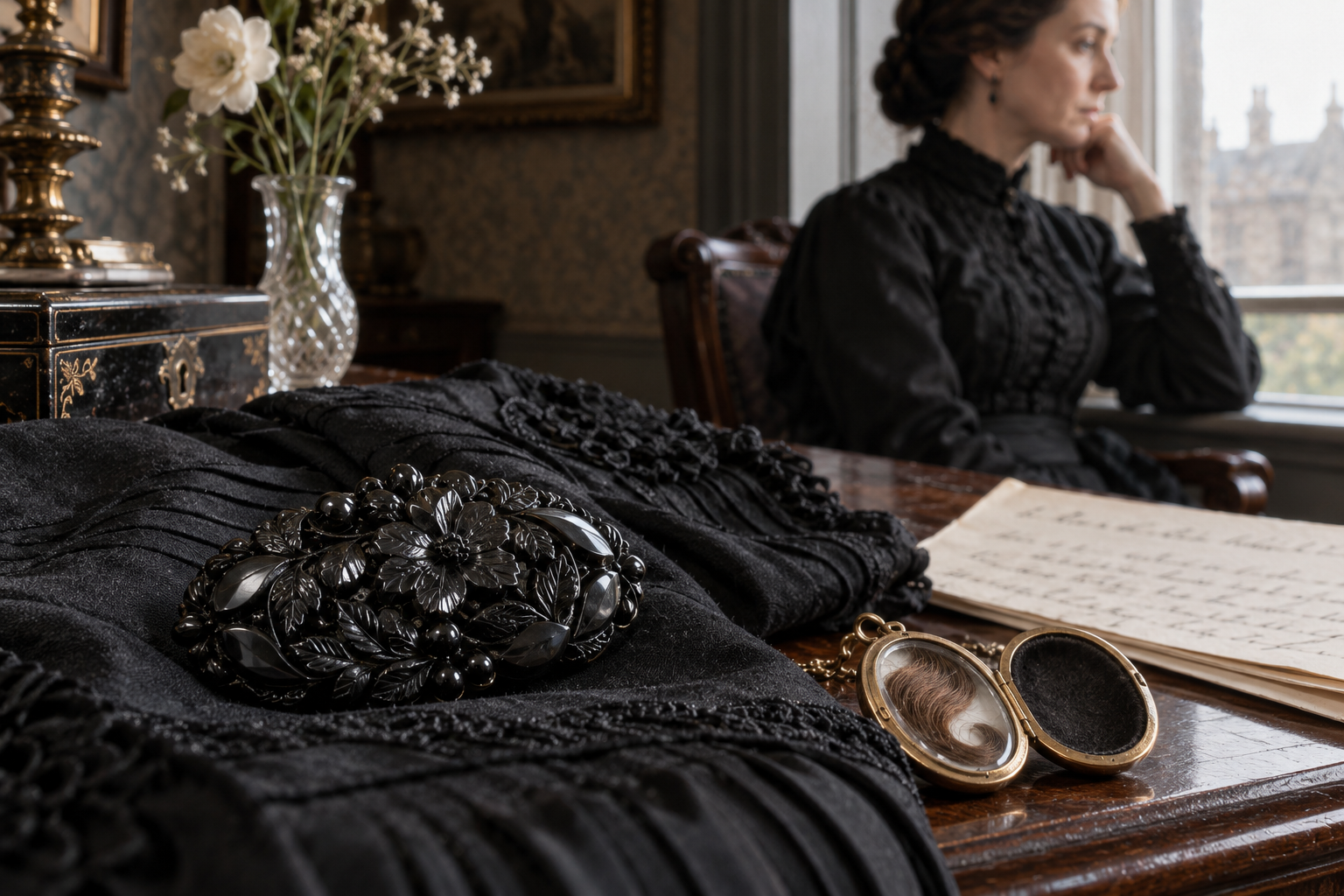
In nineteenth-century Britain, grief had a colour. Among the materials associated with this elaborate culture of mourning, Whitby jet Victorian mourning jewellery became closely linked to the public expression of loss.
Black.
Whitby jet Victorian mourning jewellery is a testament to the emotional connections and cultural practices of the time.
It appeared in clothing, veils, gloves, ribbons and jewellery. It communicated bereavement before a word was spoken.
Among the materials associated with this elaborate culture of mourning, one gemstone acquired extraordinary importance.
Whitby jet.
Deep black, remarkably lightweight and capable of taking a beautiful polish, jet became closely associated with the public expression of loss.
It adorned necklaces and earrings.
It was carved into flowers and crosses.
It surrounded miniature portraits.
It appeared alongside carefully preserved locks of human hair.
And it became particularly fashionable during the prolonged mourning of Queen Victoria following the death of her husband, Prince Albert, in 1861.
Yet the historical meaning of jet was considerably more complex than its colour.
For many Victorian wearers, mourning jewellery belonged to a world of Christian belief, social obligation, personal remembrance and continuing emotional attachment to the dead.
A black gemstone could communicate loss without being considered a supernatural healing crystal.
A brooch could preserve a person’s memory without claiming to possess an invisible energy field.
And a simple pendant could become precious because of the individual it commemorated.
The history of Whitby jet therefore offers an unusually revealing example of how gemstones acquire spiritual and emotional meaning.
It also challenges a familiar assumption in modern crystal culture:
A gemstone does not need to possess supernatural powers to become profoundly meaningful.
Table of Contents
A Black Gemstone Born from an Ancient Forest
Before jet became associated with Victorian mourning, it had already experienced an extraordinary geological history.
Whitby jet formed from ancient wood preserved within sedimentary environments during the Early Jurassic.
The jet-bearing rocks of the Yorkshire coast date to approximately 183 million years ago.
At that time, the geography and environment of what is now northern England were dramatically different from those of today.
Ancient vegetation supplied woody material that entered sedimentary environments.
Under particular conditions of burial, preservation and chemical alteration, some of that material eventually became jet.
Whitby Museum describes the material as fossilised driftwood that underwent a process involving organic compounds derived from its surrounding sediments.
The exact geological processes remain subjects of scientific investigation.
This is important because jet is sometimes described rather casually as either fossilised wood or coal.
Neither expression fully communicates its unusual nature.
Is Jet a Mineral?
Strictly speaking, jet is not a conventional mineral species.
Most minerals possess a characteristic chemical composition and an ordered crystalline structure.
Jet is different.
It is an organic gem material derived from ancient plant matter.
Its composition is complex and predominantly carbonaceous.
Unlike quartz, sapphire or garnet, jet does not possess a single defining crystal structure.
Nevertheless, it has long been valued as a gemstone because it can be cut, carved, polished and worn as jewellery.
This distinction is familiar within gemmology.
Not every material used as a gemstone is a mineral.
Amber, pearl and certain other organic materials also occupy important places within the gem trade.
Jet belongs to this broader category of natural gem materials.
Why Whitby Jet Became So Desirable
Several physical characteristics made Whitby jet particularly suitable for jewellery.
First, its colour.
Good-quality jet possesses a deep, relatively uniform black appearance.
Second, its lustre.
When carefully polished, jet can develop an exceptionally smooth, reflective surface.
Third, its weight.
Jet is considerably lighter than many mineral gemstones.
This made it particularly suitable for large necklaces, elaborate earrings and decorative ornaments.
Finally, it is relatively easy to carve compared with hard crystalline gemstones.
Skilled craftspeople could produce detailed floral patterns, geometric ornaments and elaborate sculptural designs.
These properties made jet both practical and visually compelling.
But they do not explain why it became associated with death.
That association emerged from history.
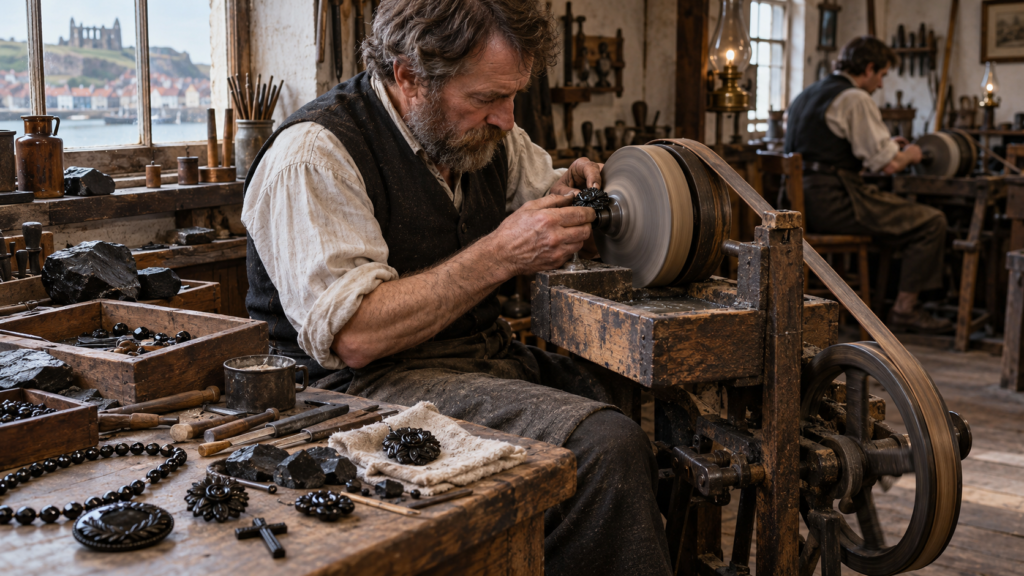
Whitby Before the Victorian Mourning Craze
Whitby is a coastal town in North Yorkshire, England.
Its surrounding cliffs contain sedimentary rocks that preserve an internationally important Jurassic fossil record.
Jet occurs within these geological formations.
People used jet long before the nineteenth century.
Whitby Museum documents evidence for jet working extending back thousands of years, including prehistoric jewellery.
However, prehistoric use should not automatically be interpreted through later Victorian beliefs.
A Bronze Age jet ornament and a nineteenth-century mourning brooch may contain similar material.
Their cultural meanings are not necessarily identical.
The Victorian mourning industry was a historically specific development.
Mourning Before Queen Victoria
The association between black clothing and mourning did not begin with Queen Victoria.
European societies had developed various mourning conventions over centuries.
The details differed according to period, region, religious tradition, social class and circumstance.
By the nineteenth century, British mourning customs had become increasingly elaborate.
Clothing could communicate the relationship between the bereaved person and the deceased.
A widow might be expected to observe a more prolonged period of mourning than someone grieving a distant relative.
Different stages of mourning could also influence the materials and colours considered appropriate.
Jewellery participated in this system.
It was not simply decoration.
It could communicate a person’s social and emotional circumstances.
The Death That Changed British Jewellery
On 14 December 1861, Prince Albert, the husband of Queen Victoria, died.
Victoria’s response became one of the most influential examples of public mourning in nineteenth-century Europe.
She continued wearing mourning dress for the remainder of her life.
Her example contributed to the popularity of black clothing and jewellery among sections of British society.
Whitby jet became particularly fashionable.
The Victoria and Albert Museum explains that the different stages of mourning could even be expressed through the finish of jet jewellery.
A subdued, matte surface could be appropriate during an earlier stage of bereavement.
A brighter, polished surface could become acceptable later.
The gemstone’s appearance therefore participated in a social language of grief.
When a Gemstone Communicated Mourning
Imagine a woman entering a drawing room in Victorian Britain.
Her clothing is black.
Her jewellery is restrained.
A carved jet brooch is pinned to her dress.
Those familiar with contemporary mourning conventions might recognise that her appearance communicated bereavement.
The jewellery could indicate something about her social situation without requiring an explanation.
This is an important form of symbolism.
The stone itself did not need to contain an invisible supernatural force.
Its meaning depended upon a shared cultural understanding.
Black jet became part of a recognisable visual language.
Mourning Was Not a Universal Victorian Experience
It is important not to describe all Victorian people as following one identical mourning code.
Expectations differed according to wealth, gender, occupation, region and social position.
Elaborate mourning wardrobes were expensive.
Not every family could afford specialised clothing and jewellery.
Women, particularly within middle-class and upper-class social environments, often faced more extensive expectations than men.
Some people followed mourning conventions closely.
Others adapted them to their circumstances.
The popular image of Victorian mourning represents a powerful cultural tendency, not an identical experience shared by every person in nineteenth-century Britain.
The Rise of the Whitby Jet Industry
Demand for jet helped transform Whitby’s economy.
According to Whitby Museum, the industry reached an extraordinary scale during the nineteenth century.
Between approximately 1860 and 1880, the town had more than 200 jet factories employing around 1,500 people.
Mining and material supply extended beyond the town itself.
Workshops produced jewellery for customers across Britain and international markets.
The development of railway connections also helped Whitby become a popular destination.
Visitors could purchase jet jewellery as souvenirs.
The material therefore acquired several overlapping identities.
It was a natural gemstone.
A regional speciality.
A fashionable accessory.
A symbol of mourning.
And an important source of employment.
A Gemstone That Was Once Alive
Jet possesses a particularly striking geological characteristic.
It originated from wood.
Unlike a gemstone crystallised directly from a mineral-forming process, jet began as part of a living organism.
Over geological time, that organic material was transformed and preserved.
It is tempting to connect this history with the Victorian association between jet and death.
The material itself had once been alive.
It survived in a transformed state.
It became jewellery worn by people remembering the dead.
This is a compelling modern interpretation.
However, we should distinguish it from documented historical belief.
The fact that jet originated from ancient wood does not prove that Victorian mourners selected it because they consciously understood the material as a metaphor for life after death.
Its black colour, appearance, established jewellery use and social associations provide more direct explanations for its popularity.
The geological parallel remains thought-provoking, but it should not be presented as a universally documented Victorian belief.
Black as a Symbol of Loss
Colour symbolism is culturally dependent.
Black does not represent mourning in every society.
Different cultures have used white, other colours or combinations of colours in funerary traditions.
In nineteenth-century Britain, however, black had become firmly established within mourning dress.
Jet’s intense black colour made it especially appropriate.
The material allowed jewellery to remain visually impressive while conforming to the conventions of bereavement.
A highly polished jet necklace could be beautiful without introducing the bright colours associated with ordinary fashionable gemstones.
The result was a distinctive aesthetic.
Restrained in colour.
Often elaborate in craftsmanship.
Emotionally significant.
And socially recognisable.
The Difference Between Matte and Polished Jet
One of the most interesting details documented by the Victoria and Albert Museum concerns surface finish.
Jet could be polished to a brilliant lustre.
But it could also be left comparatively matte.
These finishes could correspond to different mourning conventions.
A subdued surface was more appropriate during periods when conspicuous ornamentation was discouraged.
A more reflective finish could become acceptable during later stages.
The material remained the same.
Its surface treatment changed.
And that change affected its social meaning.
This demonstrates something fundamental about gemstone symbolism.
Meaning does not always come from mineral identity alone.
The same material can communicate different messages depending on how it is worked and worn.
Jewellery as a Public Expression of Private Grief
Grief is deeply personal.
Victorian mourning customs made parts of that experience publicly visible.
A mourning brooch could communicate that someone had died.
A black necklace could indicate participation in mourning.
A memorial inscription could identify the deceased.
These objects occupied an unusual position between private emotion and public behaviour.
They could express genuine affection.
They could also reflect social expectations.
The two were not mutually exclusive.
A person might wear mourning jewellery because it was expected and because it offered a meaningful connection with someone they loved.
A Remarkable Mourning Brooch from 1852
The Metropolitan Museum of Art preserves an American mourning brooch dating to approximately 1850.
It is an especially powerful example of how jet participated in remembrance.
The brooch contains human hair arranged beneath a transparent crystal covering.
Gold and pearls surround the central composition.
A border of faceted jet completes the design.
On the reverse is an inscription commemorating Charles T. Evans, who died at sea on 20 September 1852, aged 39.
This object is historically important because its purpose is not merely inferred from its colour.
The inscription directly connects the jewellery with a named deceased individual.
The jet contributes to the mourning aesthetic.
The hair provides a physical keepsake.
The inscription preserves identity and the circumstances of loss.
Together, these elements create a memorial object.
Human Hair as a Material of Remembrance
Victorian memorial jewellery sometimes incorporated carefully preserved human hair.
Hair possesses several characteristics that made it suitable for such objects.
It can survive long after being separated from the body.
It can be woven.
Braided.
Arranged into decorative patterns.
Placed beneath glass or crystal.
The Metropolitan Museum explains that hair jewellery could commemorate either living or deceased loved ones.
This distinction is important.
Not every nineteenth-century piece containing hair was necessarily mourning jewellery.
Hair could also represent affection, friendship or romantic attachment.
Context determines meaning.
The Physical Presence of an Absent Person
A memorial locket containing human hair creates an extraordinary relationship between absence and presence.
The person has died.
Yet something physically associated with them remains.
The jewellery makes that connection portable.
It can be worn close to the body.
Opened privately.
Held.
Preserved.
Eventually inherited.
The object does not reverse death.
It preserves a tangible connection with someone who is no longer present.
This is a powerful form of remembrance.
The Jet Locket at the British Museum
The British Museum preserves a nineteenth-century jet locket dating approximately 1860–1880.
Its design is particularly revealing.
The locket is carved with decorative leaf forms.
A hinged compartment contains carefully arranged human hair beneath glass.
Gold wire forms part of the construction.
Some areas of the jet are polished.
Others remain matte.
This combination brings several Victorian traditions together.
Gemstone carving.
Mourning aesthetics.
Personal keepsakes.
The preservation of hair.
And the use of jewellery as a container for memory.
The locket is not simply a black ornament.
It is an object designed to hold something personally significant.
Is Mourning Jewellery a Religious Object?
Not necessarily.
Victorian mourning jewellery occupied a space where personal emotion, social convention and religious belief could overlap.
Nineteenth-century Britain contained diverse religious commitments, including different Christian traditions and people whose beliefs were less conventionally religious.
Some mourning jewellery incorporated explicitly Christian imagery.
Other pieces contained portraits, initials, dates or personal keepsakes without obvious religious symbols.
A cross could express Christian faith.
A lock of hair could preserve a personal connection.
A black brooch could communicate social mourning.
These meanings could coexist within the same object.
But they should not automatically be treated as identical.
Christian Hope and the Meaning of Death
Christian beliefs concerning death, resurrection and eternal life were influential within Victorian British society.
For many believers, mourning existed alongside hope for reunion beyond death.
Jewellery could reflect this religious environment.
Crosses, flowers and inscriptions could evoke faith, affection and remembrance.
Yet the meaning of an individual piece must be established through its design and historical context.
A black gemstone does not automatically become a Christian symbol merely because it was worn by a Christian.
Religious interpretation requires evidence.
The Cross in Victorian Mourning Jewellery
The British Museum preserves a boxed jewellery set dating approximately 1865–1870.
It includes a necklace, earrings, bracelet and brooch.
The pieces are designed around Maltese-cross forms.
The set was retailed by C. Packer, a major London supplier of mourning clothing and accessories.
Interestingly, the material is not natural jet.
It is a glass imitation historically marketed as French jet.
This object illustrates how religiously recognisable forms, fashionable black materials and the commercial mourning industry could intersect.
The cross motif belongs to a broader Christian visual tradition.
Its use in mourning jewellery demonstrates how that visual vocabulary could enter nineteenth-century personal adornment.
Flowers and the Language of Mourning
Victorian jewellery also made extensive use of floral imagery.
Flowers could carry associations with affection, remembrance and the passage of life.
The British Museum documents a particularly interesting example involving the lily of the valley.
In nineteenth-century symbolic interpretations, the flower could communicate ideas of returning happiness and reunion with loved ones after death.
The museum notes that lily-of-the-valley designs appeared in jet as well as ivory.
This is a more historically specific interpretation than claiming that every black gemstone represented one fixed spiritual property.
The meaning depended on the combination of material, design and contemporary symbolic conventions.
Jewellery and the Language of Flowers
Nineteenth-century Britain developed a strong interest in assigning meanings to flowers.
Books and popular publications circulated symbolic interpretations of different plants.
These meanings were not always consistent.
A flower might have several associations.
Its significance could vary between publications.
Nevertheless, floral imagery became an important component of sentimental jewellery.
A carved flower could communicate affection.
Remembrance.
Hope.
Or an idealised emotional message.
When carved into jet, the flower also participated in the visual conventions of mourning.
The Black Gemstone and the Hope of Reunion
A Victorian memorial object might therefore express several ideas simultaneously.
The black material acknowledges loss.
The floral decoration evokes remembrance.
A cross introduces Christian symbolism.
An inscription preserves a name.
A lock of hair maintains a tangible personal connection.
Together, these elements can communicate grief and hope without requiring the gemstone itself to possess supernatural properties.
The spiritual meaning emerges from the complete object.
A Material That Could Be Touched
Jet also possesses distinctive tactile qualities.
It is lightweight.
It does not feel like a heavy crystalline gemstone.
It is a relatively poor conductor of heat.
Consequently, it can feel comparatively warm to the touch.
These physical characteristics helped distinguish genuine jet from certain imitations.
They also made it comfortable for larger jewellery pieces.
A necklace containing many jet beads could appear substantial without becoming excessively heavy.
For a person wearing mourning jewellery throughout the day, such practical qualities mattered.
When Gemmology Meets Emotional History
A gemmologist can describe jet through its physical properties.
Its organic origin.
Carbonaceous composition.
Low density.
Relative softness.
Characteristic lustre.
And behaviour under examination.
But those properties cannot explain why a particular brooch was treasured.
The memorial inscription on the Charles T. Evans brooch supplies information that gemmological testing cannot.
The object becomes historically meaningful because of the human life it commemorates.
This illustrates an important distinction.
Material identification explains what an object is made from.
Historical interpretation explains what people did with it and why it mattered.
Both forms of knowledge are necessary.
The Problem of Imitation Jet
As demand increased, manufacturers developed cheaper alternatives to natural Whitby jet.
Some imitations were made from glass.
Others used vulcanised rubber.
Pressed horn.
Bog oak.
Or other dark materials.
The term French jet commonly referred to black glass rather than natural jet.
The British Museum’s mourning jewellery set from the late 1860s is an excellent example.
Its dark appearance resembles jet, but the museum identifies the material as glass.
This matters for both historical interpretation and modern gemstone identification.
Not every black Victorian mourning ornament is genuine jet.
Did Imitation Jewellery Have Less Emotional Value?
From a gemmological perspective, natural jet and black glass are different materials.
From a historical perspective, the distinction may be more complicated.
A less expensive glass brooch could still have been worn in sincere mourning.
A modest locket could preserve the hair of a deeply loved person.
A commercially inexpensive object could become emotionally irreplaceable.
The market value of a material does not necessarily determine the personal significance of the object.
This is particularly important when studying remembrance jewellery.
The Economic Reality Behind Mourning Fashion
The Victorian mourning industry was also a commercial phenomenon.
Businesses manufactured clothing, accessories and jewellery for a market shaped by social expectations.
Whitby became an important production centre.
Manufacturers benefited from demand.
Imitation materials made fashionable styles accessible at different prices.
Retailers promoted specialised mourning goods.
This commercial dimension should not be ignored.
Victorian mourning was not exclusively a spiritual practice.
It was also a system of consumption.
That does not make every expression of grief insincere.
It demonstrates that personal emotion and commercial markets can become closely connected.
When Mourning Became Fashion
Jet’s popularity eventually extended beyond strictly funerary contexts.
Its colour and lustre made it attractive as fashionable jewellery.
It could be carved into elaborate decorative forms.
Large ornaments became possible because of its low weight.
Some pieces were purchased as souvenirs rather than memorials.
The same material could therefore serve different purposes.
A jet necklace might express bereavement.
Another might be worn because it was fashionable.
A third might commemorate a visit to Whitby.
Identical materials do not guarantee identical meanings.
The Decline of the Jet Industry
The jet industry eventually declined.
Changing fashions contributed.
So did competition from alternative materials.
Whitby Museum documents the arrival of imported jet, including material from Spain, and the problems associated with some less stable supplies.
Manufactured substitutes also became increasingly sophisticated.
By the end of the nineteenth century, the extraordinary popularity of Victorian jet jewellery was fading.
Yet the surviving objects retained their historical importance.
Today they provide evidence of craftsmanship, fashion, commerce and mourning customs.
Is Jet a Protective Stone?
Modern crystal literature sometimes describes jet as a stone of protection.
It may be associated with grounding, absorbing negativity or shielding the wearer from unwanted spiritual influences.
Such interpretations belong to contemporary metaphysical traditions.
They should not automatically be presented as the beliefs of Victorian mourners.
A nineteenth-century woman wearing a jet brooch might have understood it primarily as an expression of bereavement.
Another person might have valued its religious design.
Someone else might simply have followed contemporary fashion.
We cannot infer belief in crystal energy from the presence of jet alone.
Jet and Modern Spirituality
Contemporary crystal practitioners sometimes assign jet properties such as emotional protection, grounding and support during grief.
The association with grief is understandable in light of the material’s historical relationship with mourning.
But historical association and scientifically demonstrated therapeutic action are different things.
There is no established scientific evidence that jet absorbs negative spiritual energy or possesses a measurable field that protects someone from grief, illness or supernatural harm.
A person may nevertheless find personal meaning in holding or wearing an object associated with remembrance.
The emotional significance of an object does not require a supernatural explanation.
Can a Gemstone Help Someone Remember?
Objects can function as reminders.
A photograph recalls a person.
A letter preserves someone’s words.
A wedding ring can represent a relationship.
A piece of jewellery can evoke memories of the person who wore or gave it.
Jet mourning jewellery demonstrates that this relationship between objects and memory has a long history.
However, it is important not to turn that observation into a medical claim.
A meaningful keepsake is not a scientifically established treatment for grief.
Bereavement is complex and deeply individual.
Symbolic objects may be personally valuable, but they should not replace appropriate professional support when someone needs it.
Is Jet Connected to the Root Chakra?
Modern crystal-healing literature sometimes associates black gemstones with the Root Chakra.
This association should not be projected onto Victorian mourning culture.
Chakra traditions originated within South Asian religious contexts and underwent substantial reinterpretation in modern Western spirituality.
Victorian British mourning jewellery developed within a different cultural and religious environment.
The two systems should not be presented as one continuous historical tradition.
A black jet brooch from 1870 is not evidence that Victorian mourners practised chakra healing.
Does Jet Absorb Negative Energy?
Jet has measurable physical properties.
Its composition, density, surface characteristics and electrical behaviour can be studied scientifically.
Like some other materials, jet can develop static electrical effects through friction.
But this physical phenomenon should not be confused with claims about absorbing grief, fear or supernatural negativity.
Electrostatic behaviour is measurable.
Metaphysical claims about emotional or spiritual energy require independent evidence.
The existence of one does not establish the other.
An Interesting Geological and Cultural Paradox
Jet began as organic material.
It was preserved through extraordinary geological processes.
Millions of years later, humans transformed it into jewellery.
Some of that jewellery was used to remember people whose lives had ended.
The contrast is striking.
An ancient material became a modern instrument of remembrance.
The stone survived geological time.
The jewellery preserved personal memory.
This connection offers a compelling editorial interpretation.
But it should remain an interpretation rather than an invented historical doctrine.
The Spiritual Meaning of Remembrance
Not all spiritual significance depends on supernatural forces.
For some people, remembering the dead is connected with religious belief.
For others, remembrance is primarily emotional or familial.
A memorial object can participate in either context.
A Victorian Christian might interpret a cross-shaped mourning brooch through beliefs about death and resurrection.
A different wearer might treasure a locket because it contained a loved one’s hair.
Both relationships could be profound.
Neither requires us to claim that jet itself possesses a scientifically measurable spiritual power.
A Historically Inspired Reflection with Jet
Someone interested in gemstone symbolism can draw inspiration from Victorian mourning jewellery without attempting to recreate nineteenth-century mourning conventions.
Consider a piece of natural jet.
Observe its black colour.
Its smooth surface.
Its light weight.
Its unusual geological origin.
Then consider the objects through which people preserve memory.
A photograph.
A handwritten note.
A family heirloom.
A piece of jewellery.
Ask:
Why do certain objects become connected with particular people?
What makes an ordinary possession emotionally irreplaceable?
How does memory change the meaning of a material object?
These questions offer a contemplative approach to gemstone symbolism.
They do not require claims about invisible energy or supernatural protection.
Caring for Historic Jet Jewellery
Jet’s relative softness means it requires appropriate handling.
It can be scratched by harder gemstones and abrasive materials.
Antique jewellery may also contain fragile settings, adhesives, human hair, glass or delicate metal components.
These materials can require different conservation approaches.
For historically significant pieces, professional conservation guidance is preferable to aggressive cleaning.
Whitby Museum provides information about jet identification and care.
The museum also warns against destructive identification techniques such as the hot-needle test.
Such tests can permanently damage jewellery and may create safety hazards when applied to certain imitation materials.
Responsible gemmology begins with preserving the object.
Why Authenticity Matters
The historical popularity of jet created an extensive imitation industry.
Collectors should therefore distinguish between:
natural Whitby jet;
jet from other geological sources;
black glass;
vulcanised rubber;
bog oak;
and other historical substitutes.
An antique black necklace should not automatically be identified as Whitby jet based on appearance alone.
Similarly, a piece made from imitation material should not automatically be dismissed as historically unimportant.
A Victorian glass mourning brooch may possess considerable cultural significance even when it has little gemmological value.
Material authenticity and historical significance are related but separate questions.
What Can We Say with Confidence?
The historical evidence supports several important conclusions.
Whitby jet is an organic gem material derived from ancient wood preserved within Jurassic sedimentary environments.
It possesses physical characteristics that made it particularly suitable for jewellery, including deep black colour, low weight and the ability to take a fine polish.
Jet was used long before the Victorian period.
During the nineteenth century, Whitby developed into a major centre of jet manufacture.
Queen Victoria’s prolonged mourning following Prince Albert’s death in 1861 helped popularise jet jewellery.
Victorian mourning conventions could distinguish between matte and polished jet.
Jet appeared in necklaces, brooches, lockets, earrings and other ornaments.
Some mourning jewellery incorporated Christian symbols.
Other pieces preserved hair, names, dates and personal memorial inscriptions.
The Metropolitan Museum and British Museum preserve examples directly connecting jet with remembrance.
Imitation materials, including black glass marketed as French jet, became important components of the mourning jewellery industry.
These facts demonstrate jet’s substantial historical role in the expression of bereavement.
They do not establish that jet possesses scientifically measurable powers to absorb negative energy, treat grief or provide supernatural protection.
Conclusion: When a Black Stone Became a Language of Love
Whitby jet is an extraordinary material.
Its geological history stretches back approximately 183 million years.
Its use as an ornamental stone extends across thousands of years.
Yet one particular chapter of its history made it internationally famous.
Victorian mourning.
During the nineteenth century, jet became closely associated with bereavement, remembrance and the public expression of grief.
Its black colour communicated loss.
Its polish reflected changing conventions of mourning.
Its softness allowed elaborate carving.
Its light weight made substantial jewellery practical.
And its presence in memorial lockets and brooches connected it with deeply personal histories.
The Charles T. Evans mourning brooch demonstrates this particularly clearly.
Its jet border contributes to the visual language of mourning.
Its preserved hair creates a physical connection with the deceased.
Its inscription records a name and a death.
The gemstone becomes part of a carefully constructed object of remembrance.
Modern crystal spirituality may interpret jet through grounding, protection or the absorption of negative energy.
Those contemporary beliefs should be distinguished from documented Victorian practices.
The historical evidence offers something more specific and arguably more profound.
Jet became meaningful because people used it to express love in the presence of loss.
At Natural Gems Belgium, this history illustrates why gemstone symbolism deserves serious cultural and historical study.
A gemstone’s physical properties can be measured.
Its geological origin can be investigated.
Its authenticity can be tested.
But the emotional meaning of a memorial object emerges through human experience.
Whitby jet reminds us that gemstones do not need supernatural powers to carry extraordinary significance.
Sometimes their greatest value lies in what they help us remember.
References & Further Reading
The following references prioritise museums, gemmological institutions and historical collections. They document the geological properties of jet, Victorian mourning customs, surviving jewellery and the distinction between natural jet and imitation materials.
1. Whitby Museum — Whitby Jet and Jet Jewellery
https://whitbymuseum.org.uk/collection/jet-and-jet-jewellery
Source description: Extensive museum resource covering the geological formation of Whitby jet, its prehistoric use, the development of the Victorian jet industry, mining, carving techniques, historical literature and imitation materials. Particularly valuable for understanding the relationship between jet’s physical properties and its nineteenth-century popularity.
2. Victoria and Albert Museum — An A–Z of Gemstones
https://www.vam.ac.uk/articles/an-a-z-of-gemstones
Source description: Museum article containing a dedicated section on Whitby jet. The V&A documents a nineteenth-century jet necklace and brooch and explains how different surface finishes could communicate different stages of Victorian mourning. This is especially useful for understanding the relationship between gemstone appearance and social convention.
3. University of Oxford, Pitt Rivers Museum — Jet Necklace and Black Silk Tie
Source description: Museum educational resource examining Victorian mourning as a social practice, including black clothing, jewellery, Queen Victoria’s influence and the development of the Whitby jet industry. It also discusses imitation jet and the commercial expansion of mourning accessories.
4. The Metropolitan Museum of Art — American Memorial Brooch, circa 1850
https://www.metmuseum.org/art/collection/search/16806
Source description: Particularly important primary material evidence. The brooch combines jet, pearls, gold, crystal and human hair. Its reverse carries a memorial inscription commemorating Charles T. Evans, who died at sea on 20 September 1852. The museum explains the use of human hair in sentimental and mourning jewellery.
5. British Museum — Carved Jet Mourning Locket, 1860–1880
https://www.britishmuseum.org/collection/object/H_2018-8042-87
Source description: Collection record for a Victorian jet locket decorated with leaf forms and containing human hair beneath glass. The combination of polished and matte jet surfaces, gold wire and a personal keepsake illustrates the sophistication of nineteenth-century remembrance jewellery.
6. British Museum — French Jet Mourning Jewellery Set, 1865–1870
https://www.britishmuseum.org/collection/object/H_1994-0706-1-5
Source description: Boxed jewellery set comprising a necklace, earrings, bracelet and brooch decorated with Maltese-cross forms. The material is glass rather than natural jet. The museum identifies the retailer as C. Packer, a major London supplier of mourning clothing and accessories. Useful for understanding Christian imagery, commercial mourning fashion and historical gemstone imitations.
7. British Museum — Lily-of-the-Valley Brooch and Victorian Floral Symbolism
https://www.britishmuseum.org/collection/object/H_1978-1002-668
Source description: Collection record for a carved ivory brooch with lily-of-the-valley decoration. The museum discusses the flower’s nineteenth-century symbolic associations, including returning happiness and reunion with loved ones after death, and notes that similar floral designs appeared in jet mourning jewellery.
8. The Metropolitan Museum of Art — Mourning Ring, 1848
https://www.metmuseum.org/art/collection/search/5261
Source description: Museum record for a mourning ring made from gold, jet, glass and human hair. This object provides additional evidence for the combination of jet with personal memorial materials during the nineteenth century.
9. The Metropolitan Museum of Art — Mourning Ring, 1770–1830
https://www.metmuseum.org/art/collection/search/5262
Source description: Earlier mourning ring incorporating gold, jet, glass and human hair. Its dating demonstrates that jet appeared in memorial jewellery before Prince Albert’s death in 1861, an important chronological qualification when discussing Queen Victoria’s influence.
10. Gemological Institute of America — Historical Reading List: Mourning Jewelry and Whitby Jet
https://www.gia.edu/whitby-jet-reading-list
Source description: Gemmological and historical reference resource examining Whitby jet’s origins, extraction, jewellery production and nineteenth-century popularity. It discusses the 1851 Great Exhibition, the influence of Victorian mourning and the decline of the jet industry toward the end of the century.
11. ASU FIDM Museum — Black Beauty
https://asufidmmuseum.asu.edu/learn/articles/black-beauty
Source description: Fashion museum article examining jet as a decorative material in nineteenth-century clothing and mourning dress. It discusses the distinction between natural jet and French jet, Victorian fashion, Queen Victoria’s influence and the use of jet embellishments on garments.
12. Whitby Museum — Jet Workers from Past & Present
https://whitbymuseum.org.uk/jet-ooh-ooh-ooh
Source description: Museum research article published in June 2026 examining Whitby’s historic jet industry and its craftspeople. It discusses the material’s fossil origin, historical production and the continuing importance of jet working as a regional heritage craft.
Historical Belief, Religious Symbolism and Modern Crystal Claims
The documented historical evidence establishes that jet became closely associated with mourning in nineteenth-century Britain.
Its significance developed through several overlapping cultural systems.
Social convention: Black jewellery communicated bereavement and conformity with contemporary mourning expectations.
Personal remembrance: Lockets, rings and brooches could preserve names, dates, portraits and human hair associated with loved ones.
Religious symbolism: Crosses and certain floral motifs could connect mourning jewellery with Christian ideas of death, remembrance and reunion.
Material characteristics: Jet’s black colour, light weight, polishability and workability made it particularly suitable for mourning ornaments.
Commercial history: The expansion of the Whitby jet industry demonstrates how social rituals could create substantial demand for particular natural materials.
Modern metaphysical interpretation: Contemporary crystal traditions sometimes associate jet with grounding, emotional protection and the absorption of negative energy.
These categories should not be confused.
The historical popularity of jet does not demonstrate that Victorian mourners universally believed in crystal healing.
Likewise, there is no established scientific evidence that jet emits a field capable of absorbing grief, repelling negative spiritual forces or treating emotional distress.
A person’s attachment to a memorial object may nevertheless be deeply meaningful.
The historically responsible distinction is therefore between:
the measurable properties of the natural material;
the documented customs of Victorian mourning;
the personal and religious symbolism of memorial jewellery;
and contemporary metaphysical beliefs about gemstones.
Whitby jet provides an especially powerful example of why these distinctions matter.
Its cultural significance is firmly documented.
Its emotional associations are historically understandable.
And its role in remembrance jewellery demonstrates that the symbolic value of a gemstone can be extraordinary without requiring scientifically unsupported claims about supernatural energy.
Related Products
-
18K Yellow Gold Rope Chain Bracelet · Adjustable 15 · 18 cm · Luxury NGB Jewelry
$251.21 -
Aventurine Bead Bracelet with Bridge · 8 mm · 19 cm · Unisex · Untreated · Good Polish
$39.10 -
Baltic Amber Chip Bracelet 10 mm · Natural Dark Honey Amber Bead Bracelet
$32.67 -
Bead Bracelet with bridge · Rose Quartz · 8mm · pink charm bracelet
$36.86