

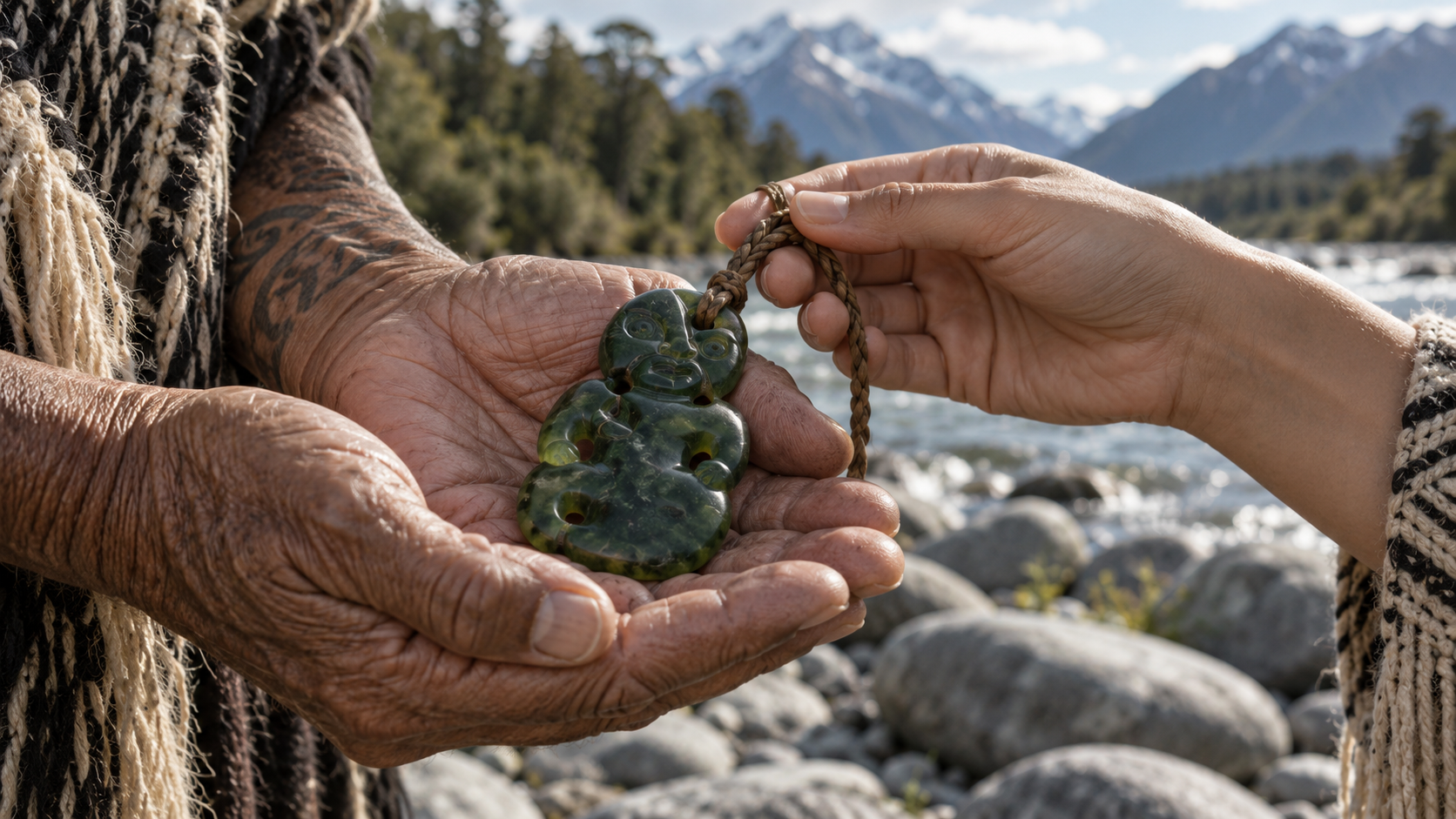
A polished green pendant hangs against the chest.
Its surface is smooth from generations of handling.
The stone is cool when first touched but gradually takes on the warmth of the body.
Its suspension hole bears traces of wear.
Perhaps a parent once wore it.
Before that, a grandparent.
Perhaps its personal name is remembered.
Perhaps stories are attached to it.
Perhaps the stone itself came from a river on the western side of Aotearoa New Zealand’s South Island.
To describe such an object merely as a jade pendant would identify its material.
But it would not explain the object.
Within Māori culture, pounamu can exist within relationships connecting people, ancestors, land, status, memory and identity.
Objects made from it can become taonga—treasured possessions whose significance may extend far beyond economic value.
This makes pounamu particularly important for anyone interested in the spiritual and cultural history of gemstones.
It also provides an important warning.
Modern crystal culture often asks:
“What is the spiritual meaning of greenstone?”
Māori traditions suggest that this question is too simple.
The meaning may not reside solely inside the mineral.
It can emerge through the relationship between:
stone,
place,
carver,
wearer,
whānau,
ancestors,
and history.
Pounamu therefore offers something far richer than a universal list of gemstone properties.
It offers a different way of thinking about how natural materials become culturally powerful.
Table of Contents
What Is Pounamu?
Pounamu is a Māori term associated with several valued hard green stones found principally in the South Island of Aotearoa New Zealand.
Much pounamu is nephrite, one of the two mineral materials traditionally grouped under the gemmological term jade.
The other major jade material is jadeite.
Nephrite is not a single crystal in the ordinary sense.
It consists of an extremely tough interlocking aggregate of amphibole minerals, principally within the tremolite-actinolite series.
This fibrous interlocking structure gives nephrite an extraordinary resistance to breaking.
That toughness—not merely hardness—is one of its most important physical characteristics.
It helps explain why pounamu became suitable for both ornament and functional objects.
Not All Pounamu Is Nephrite
An important gemmological qualification is necessary.
The cultural category pounamu does not correspond perfectly with one modern mineralogical category.
Materials traditionally recognised as pounamu include nephrite but can also include other stones.
Tangiwai, for example, is associated with bowenite, a variety of serpentinite material rather than nephrite.
This distinction illustrates an important principle in ethnogemmology.
Scientific mineral classification and Indigenous cultural classification do not always divide the natural world in the same way.
Neither should automatically be substituted for the other.
A Stone Connected to Place
Pounamu is intimately associated with the South Island.
One Māori name for the island is:
Te Waipounamu
—often translated in relation to the waters or place of greenstone.
Important deposits occur particularly on the western side of the island.
Rivers transported resistant pieces of stone from geological sources, naturally shaping and weathering them over immense periods.
Finding pounamu therefore connects geology directly with landscape.
The stone is not culturally detached from its place of origin.
Place matters.
Ngāi Tahu and Pounamu
Today, Ngāi Tahu holds a particularly important relationship with pounamu.
Te Rūnanga o Ngāi Tahu describes pounamu as sacred and highly valued and identifies carving the stone as a cornerstone of Ngāi Tahu culture extending back centuries.
Ngāi Tahu are also recognised as kaitiaki—custodians—of pounamu within their takiwā.
This is important for contemporary discussion.
Pounamu is not simply an archaeological material belonging to a vanished civilisation.
It exists within a living Indigenous cultural tradition.
Writing about it therefore requires a different sensitivity from discussing an extinct ancient gemstone practice.
Taonga: More Than “Property”
The Māori word taonga is often translated as “treasure.”
That translation is useful but incomplete.
A taonga can possess value through relationships, ancestry, history and identity.
An inherited pounamu pendant may therefore matter for reasons that cannot be expressed through market price.
The material itself is valuable.
But the object’s biography can make it considerably more significant.
Who carved it?
Who wore it?
Who gifted it?
Who inherited it?
Which events did it accompany?
These questions become part of the object.
When an Object Accumulates History
Imagine two physically similar pieces of pounamu.
One was carved yesterday.
The other has passed through a family for eight generations.
Mineralogically, they might be almost identical.
Culturally, they are not.
The older object has accumulated relationships.
This provides an important alternative to the modern metaphysical idea that a gemstone’s meaning comes primarily from a fixed “energy” inherent in its crystal structure.
In a Māori context, the history of an object can be central to its significance.
The stone has participated in human life.
Mana and Pounamu
Another important Māori concept is mana.
Translating mana simply as “power” is inadequate.
Depending on context, it can involve authority, prestige, status, influence, spiritual potency and inherited standing.
Pounamu objects could become closely associated with mana.
The Metropolitan Museum of Art notes that highly prized pounamu ornaments could serve as markers of wealth and status.
Particularly important objects could also acquire prestige through association with significant people.
Again, the relationship matters.
A stone does not exist culturally in isolation.
Hei Tiki
Among the most internationally recognisable Māori pounamu objects is the hei tiki.
A hei tiki is a pendant representing a human-like figure.
Its form is distinctive.
The head is often tilted.
The eyes can be large.
Arms may rest against the thighs.
The legs are typically flexed.
The pendant is worn around the neck.
Many surviving examples are carved from pounamu.
But what does the figure represent?
The answer is more complicated than many popular explanations suggest.
There Is No Single Proven Meaning of Hei Tiki
Te Papa Tongarewa, the Museum of New Zealand, explicitly notes that the meaning of the Māori hei tiki remains uncertain.
Several interpretations have been proposed.
One connects hei tiki with Hine-te-iwaiwa, an important female ancestral figure associated with childbirth and Māori womanhood.
Another associates the figure with Tiki, sometimes described within Polynesian traditions as a first human.
Another interpretation sees the form as suggestive of an embryo or unborn child.
These interpretations should be presented as theories rather than collapsed into one supposedly certain explanation.
The uncertainty itself is historically important.
Why Uncertainty Matters
Modern spiritual writing frequently dislikes ambiguity.
It wants a concise answer:
Hei tiki means fertility.
Or:
Hei tiki represents ancestors.
Or:
Hei tiki is a protection symbol.
Real cultural history is rarely so tidy.
Different objects can acquire different meanings.
Traditions can change.
Families can possess their own histories.
Scholarly interpretations can disagree.
Living communities can understand inherited objects through relationships that are not recorded in museum catalogues.
Responsible writing preserves complexity rather than eliminating it.
Hei Tiki as Heirloom
One point is much clearer.
Hei tiki could be passed between generations.
The Metropolitan Museum describes its nineteenth-century pounamu hei tiki as an object that would have been worn and kept as an heirloom.
This changes how we should think about the pendant.
It is not simply an ornament depicting a mysterious figure.
Repeated inheritance allows an object to connect generations physically.
The descendant can touch something an ancestor touched.
The same polished surface crosses time.
Stone and Permanence
This is particularly powerful because pounamu is exceptionally durable.
The Metropolitan Museum’s curator Maia Nuku has emphasised that many traditional Māori artistic materials—wood, fibre and feathers, for example—can be relatively fragile.
Pounamu is different.
Its toughness allows it to endure.
An object capable of surviving generation after generation naturally lends itself to becoming an heirloom.
The geological property of toughness therefore acquires cultural consequences.
Here, mineralogy and symbolism genuinely intersect.
But Toughness Is Not “Energy”
This distinction is worth making carefully.
Nephrite’s toughness is scientifically measurable.
Its interlocking mineral structure resists fracture.
That physical durability helps an object survive.
Survival enables inheritance.
Inheritance can strengthen ancestral association.
Ancestral association can increase cultural importance.
This chain is historically and physically plausible.
It is very different from claiming:
“Nephrite emits an ancestral vibration.”
The first interpretation connects material properties with documented human behaviour.
The second proposes an unverified metaphysical mechanism.
The Body Changes the Stone
Pounamu is also intensely tactile.
A pendant touches skin.
It warms.
Its surface becomes polished through handling.
Cord slowly wears the suspension hole.
Tiny marks accumulate.
The object records use.
This creates an unusual intimacy.
The Met describes pounamu’s ability to retain bodily warmth as contributing to the intimate experience of the material.
A well-worn heirloom therefore contains physical traces of relationship even without invoking supernatural energy.
The Hei Tiki at The Met
The Metropolitan Museum preserves a large nineteenth-century pounamu hei tiki approximately 15.5 centimetres high.
Its eyes are inset with pāua shell and wax.
Its head tilts.
Its broad eyes confront the viewer.
On the reverse, wear around the suspension area demonstrates that it was actually carried on a cord.
This is important.
Museum objects can appear static.
But wear reminds us that the pendant once moved with a person.
It belonged to a lived body before it belonged to a display case.
A Named Hei Tiki
Te Papa preserves a pounamu hei tiki known as Te Pirau, or Nga Pirau.
Naming changes our relationship with an object immediately.
It is no longer merely:
“pounamu pendant, catalogue number X.”
A named taonga possesses an individual identity within cultural memory.
Other hei tiki have documented connections to particular Māori leaders and families.
Te Papa, for example, preserves a double-sided hei tiki formerly belonging to the prominent Ngāi Tahu rangatira Matenga Taiaroa, which later passed to his son Hori Kerei Taiaroa.
The genealogy of ownership becomes part of the object.
Whakapapa and Material Memory
The Māori concept of whakapapa concerns genealogy and relationships across generations.
It extends beyond the narrow English idea of a family tree.
Within a worldview organised through relationships, inherited taonga can participate in the maintenance of connection between past and present.
A pounamu heirloom can therefore function as material memory.
The stone remains while generations change.
Its durability makes continuity visible.
Kuru and Kapeu
Not every pounamu ornament is a hei tiki.
Māori created several forms of suspended ornament.
Kuru are elongated pendant or ear ornaments.
Kapeu are another distinctive form, often long and gently curved.
The Metropolitan Museum describes pounamu kuru as objects worn from the pierced ear or around the neck by prominent Māori men and women.
Such ornaments signalled wealth and status.
Their elegant simplicity also highlights the stone itself.
No human figure is required.
Colour, translucency and workmanship can become the focus.
Specialist Pounamu Carvers
Pounamu is difficult to work.
Traditional carving required patience and considerable expertise.
The Metropolitan Museum identifies specialist greenstone carvers as tohunga tārai pounamu.
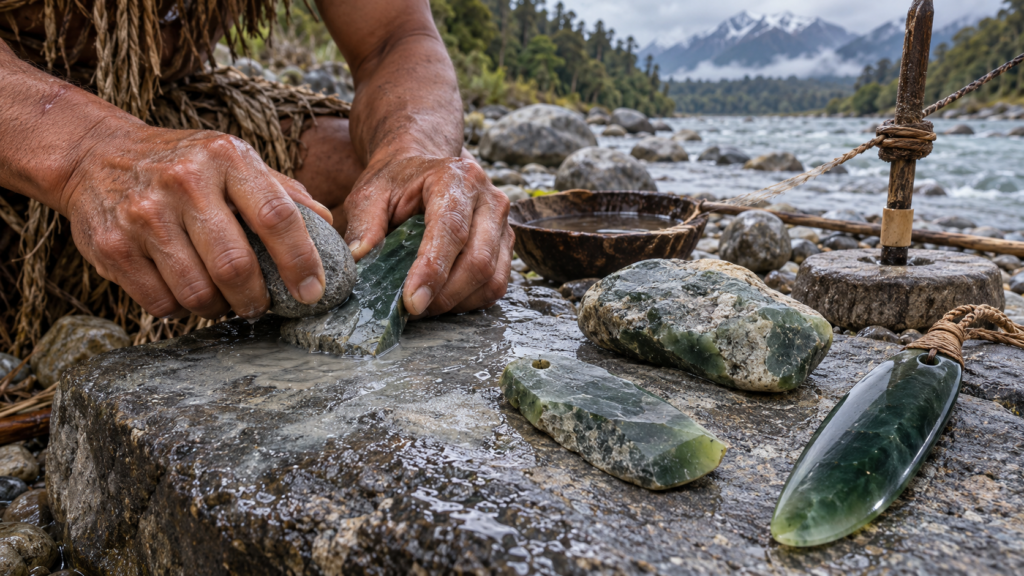
Natural abrasives were used for grinding.
Holes could be created by drilling from opposing sides until the openings met.
This labour matters.
A finished pounamu ornament represents not merely valuable raw material but hours of skilled transformation.
Craftsmanship becomes another layer of meaning.
The Carver Does Not Simply Dominate the Stone
The Met’s discussion of pounamu carving is particularly interesting because it describes specialist carvers as working in relation to the natural qualities of the stone.
This is different from imagining raw material as passive matter awaiting human domination.
Colour.
Shape.
Translucency.
Fractures.
Grain.
These characteristics constrain what the material can become.
Anyone who works natural gemstones understands this principle.
The material participates in the design.
Hei Matau
Another famous pounamu form is the hei matau.
The form resembles a fish hook.
Te Papa explains that hei matau are stylised representations of the fishing hook and connects them with the Polynesian culture hero Māui.
In Māori tradition, Māui is associated with fishing up the North Island, known as Te Ika-a-Māui, the great fish of Māui.
Hei matau therefore participate in stories connecting people, fishing, sea and land.
Tangaroa and the Sea
Te Papa further connects hei matau with the importance of fishing to Māori and relationships with Tangaroa, associated with the sea and its domains.
Again, this provides a historically grounded interpretation very different from the modern internet statement:
“Fish-hook jade attracts abundance.”
Abundance may be a modern symbolic interpretation.
But the traditional cultural context is more specific.
Fishing is not an abstract manifestation metaphor.
It is a fundamental relationship between people and the marine environment.
The Mere Pounamu
Pounamu could also become a weapon.
The mere pounamu is a short, flat hand club made from greenstone.
These were among the most prestigious objects associated with chiefly authority.
The Metropolitan Museum explains that mere pounamu were laboriously ground and polished, created for chiefly elites and passed through families as heirlooms.
When not in combat, such weapons could be carried as visible symbols of martial prestige.
Here, pounamu’s toughness becomes practically important.
But the object also communicates rank.
Weapon and Taonga
A modern viewer may find it difficult to reconcile “sacred treasure” with “weapon.”
But cultural categories do not need to conform to modern expectations.
An important weapon can become an heirloom.
It can carry the memory of a leader.
It can acquire a personal name.
It can be presented ceremonially.
It can become associated with authority and ancestry.
The Met notes that mere pounamu were so prestigious that some historical accounts describe captured chiefs choosing to be killed with a prestigious greenstone weapon rather than an ordinary one.
Whether considering combat or ceremony, these were not simply utilitarian clubs.
Named Objects Have Biographies
Some important Māori objects possess personal names.
This practice reminds us again that material culture can possess social identity.
A named mere pounamu is not interchangeable with another mere.
A named hei tiki is not merely another specimen of nephrite.
Individual history matters.
The Western gem trade often works in the opposite direction.
A stone is classified by:
species,
variety,
weight,
colour,
clarity,
origin,
treatment.
These are important gemmological categories.
But they cannot describe everything an object can become.
A Gemmologist Sees Nephrite
Imagine placing a pounamu pendant in a gemmological laboratory.
A gemmologist might investigate:
refractive behaviour,
specific gravity,
microscopic structure,
mineral composition,
spectral characteristics,
and possibly geographic indicators.
Those tests can answer:
What is the material?
They cannot answer:
Who inherited it?
Which ancestor wore it?
What was it called?
Why was it gifted?
What does it mean to the family today?
Different forms of knowledge answer different questions.
Cultural Meaning Is Not a Gemmological Property
This distinction is fundamental.
Mana cannot be detected using a refractometer.
Whakapapa cannot be observed through a microscope.
Ancestral connection does not appear in Raman spectroscopy.
That does not make these concepts false.
It means they belong to cultural rather than mineralogical knowledge.
Confusing the categories damages both.
Science becomes distorted when asked to verify cultural meaning.
Culture becomes distorted when reduced to chemistry.
Is Pounamu a “Healing Crystal”?
Modern metaphysical shops sometimes market New Zealand greenstone or nephrite as a healing crystal.
Common claims include:
- emotional balance
- prosperity
- heart healing
- protection
- grounding
- longevity
- harmony
- connection with nature
- Heart Chakra activation
These descriptions belong primarily to modern crystal spirituality.
They should not be presented as a summary of Māori pounamu traditions.
There may occasionally be superficial similarities—protection, wellbeing, strength—but similarity does not prove historical continuity.
The Heart Chakra Is Not a Māori Concept
Green gemstones are frequently assigned to the Heart Chakra in contemporary Western crystal practice.
This occurs largely because modern chakra systems commonly associate the colour green with the heart centre.
That system derives through modern reinterpretations of South Asian religious traditions.
It is not a traditional Māori framework.
Therefore:
pounamu is green
does not logically become
pounamu was traditionally a Māori Heart Chakra stone.
That would combine unrelated cultural systems.
Does Pounamu Protect the Wearer?
This question requires nuance.
Pounamu objects can possess profound cultural and spiritual significance.
Particular taonga may be understood within relationships involving mana, ancestry and identity.
Objects can also provide psychological reassurance through family connection and memory.
But there is no established scientific evidence that nephrite produces an invisible protective field capable of preventing accidents, illness or supernatural harm.
Cultural belief and scientific evidence are different categories.
Respecting one does not require misrepresenting the other.
The Problem with the Word “Energy”
The English word energy causes particular confusion in discussions of Indigenous objects.
In physics, energy has specific measurable meanings.
In contemporary spirituality, “energy” can mean atmosphere, spiritual potency, emotional impression, life force or something difficult to define.
Using the word carelessly can therefore make very different ideas appear identical.
It is better to use the culturally relevant terminology where appropriate rather than translating everything into generic “crystal energy.”
Mana Is Not Crystal Energy
Mana should not simply be translated as a gemstone’s “vibration.”
Mana exists within Māori systems of relationship, authority, ancestry and spiritual understanding.
Treating it as another word for crystal energy removes it from its cultural context.
A pounamu taonga may possess or express mana because of its relationships and history.
That is a much richer proposition than saying:
“Jade has high vibrations.”
Pounamu and Gifting
Te Papa notes an important contemporary cultural practice: pounamu is commonly understood as especially appropriate when given as a gift.
Gifting creates relationship.
There is a giver.
A receiver.
An occasion.
An intention.
The object becomes connected with an event.
This can make the same physical stone more meaningful than an anonymous purchase.
The value is relational.
Why Gifting Changes an Object
Consider a pendant purchased randomly.
Now compare it with one given by a parent at a major life transition.
Graduation.
Marriage.
A journey.
A birth.
A farewell.
The mineral has not changed.
Its chemical composition is identical.
But its meaning has changed completely.
This demonstrates why cultural meaning cannot be reduced to mineral structure.
Human relationships transform objects without altering their atoms.
Pounamu and Contemporary Identity
Pounamu continues to have major significance in Aotearoa New Zealand today.
It appears in contemporary Māori art.
It is gifted during important occasions.
It is worn publicly.
It connects modern wearers with heritage.
Ngāi Tahu continues active guardianship of pounamu resources.
The stone therefore belongs simultaneously to:
geology,
traditional culture,
contemporary Indigenous identity,
art,
craft,
and modern New Zealand life.
It is not frozen in the nineteenth century.
A Living Tradition Requires Respect
This point deserves emphasis.
When discussing Ancient Egyptian lapis lazuli or Roman amber, we are often reconstructing practices from archaeological and textual evidence.
Māori pounamu traditions are different.
Māori communities exist.
Carvers work today.
Taonga remain within families.
Cultural authorities speak for their own traditions.
Contemporary institutions such as Te Papa work directly within these living cultural relationships.
Therefore external writers should avoid claiming ownership over interpretations that Māori sources themselves present more carefully.
Not Every Hei Tiki Means the Same Thing
The same caution applies to individual objects.
A museum can describe general cultural patterns.
But a particular hei tiki may possess a family history unavailable to outsiders.
Its significance may derive from a named ancestor.
A historical event.
A gift.
An inheritance.
A particular iwi or hapū context.
Generic spiritual descriptions cannot replace that biography.
What Modern Crystal Practice Can Learn from Pounamu
Pounamu tradition offers a valuable lesson for contemporary gemstone spirituality.
Instead of always asking:
“What energy does this stone have?”
consider asking:
“What relationship do I have with this stone?”
Where did it come from?
Who gave it to me?
What event does it represent?
Who worked it?
What responsibility accompanies owning it?
What will happen to it after I die?
These questions transform a gemstone from a consumable spiritual product into an object with biography.
A Stone Can Become More Valuable Without Becoming More Expensive
Suppose someone gives you a modest natural stone during an important moment.
You keep it for fifty years.
Eventually you give it to a child.
They later give it to their child.
Its commercial price may remain almost unchanged.
Its relational value can become enormous.
Pounamu heirlooms demonstrate this distinction particularly clearly.
Price measures market demand.
It does not measure memory.
A Historically Respectful Reflection with Pounamu
For someone who owns pounamu, particularly outside Māori culture, the most respectful reflection may begin not with assigning supernatural powers but with learning about the material.
Observe the stone.
Its green colour.
Translucency.
Texture.
Weight.
Then investigate provenance.
Was it genuinely sourced from Aotearoa New Zealand?
Who carved it?
Was the carver Māori?
What form does it represent?
Was it gifted?
What cultural explanation accompanied it?
Then ask:
What relationship does this object now represent in my own life?
The objective is not to imitate Māori ritual.
It is to respect the fact that material meaning can arise through relationship.
Provenance Matters
For Natural Gems Belgium, pounamu also illustrates why gemstone provenance can matter beyond commercial origin disclosure.
Origin can have geological importance.
But in culturally significant materials, origin may also carry legal, ethical and Indigenous dimensions.
A stone from Aotearoa New Zealand is not merely a green mineral with geographic coordinates.
Its extraction and distribution can exist within contemporary systems of guardianship.
Responsible sourcing therefore includes cultural awareness.
The Difference Between Appreciation and Appropriation
People outside Māori culture can appreciate pounamu.
Museums around the world preserve historic examples.
Gem collectors study nephrite.
Jewellery buyers admire the material.
But appreciation becomes problematic when culturally specific meanings are stripped away and replaced with invented claims presented as “ancient Māori wisdom.”
Statements such as:
“Māori shamans used greenstone to activate the Heart Chakra”
should immediately raise suspicion.
They combine terminology from unrelated traditions and lack historical credibility.
Respect begins with specificity.
Pounamu Is Not Generic Jade
Another useful distinction concerns terminology.
Calling pounamu simply “jade” can be mineralogically convenient but culturally incomplete.
“Jade” is an international gemmological category.
“Pounamu” carries geographic and Māori cultural meaning.
The terms overlap but are not interchangeable in every context.
Similarly, not every pounamu material is nephrite.
Using precise language preserves both geological and cultural information.
What Can We Say with Confidence?
Several conclusions are strongly supported.
Pounamu is a culturally important Māori stone associated especially with Aotearoa New Zealand’s South Island.
Much pounamu consists of nephrite, although the Māori category also encompasses other valued greenstone materials such as tangiwai.
Pounamu was traditionally worked into tools, weapons and personal ornaments.
Important forms include:
hei tiki,
hei matau,
kuru,
kapeu,
and mere pounamu.
Pounamu objects could indicate status and mana.
They could be worn.
Gifted.
Named.
Inherited.
Passed through families as heirlooms.
Particular objects could become taonga with histories inseparable from the people connected to them.
Ngāi Tahu maintains a living custodial relationship with pounamu.
The precise original meaning of hei tiki is not definitively established, and responsible sources present multiple interpretations rather than one universal explanation.
Modern claims that pounamu inherently activates the Heart Chakra, emits healing vibrations or scientifically protects the wearer should not be presented as traditional Māori knowledge or established physical fact.
Conclusion
Pounamu teaches us something important about gemstones.
A stone can be scientifically identified without being culturally understood.
Gemology can tell us that much pounamu is nephrite.
It can explain its interlocking mineral structure.
Its toughness.
Its colour.
Its translucency.
Its physical durability.
But none of those measurements explains why a pendant may be treasured by a family.
Why a mere may embody chiefly prestige.
Why an inherited hei tiki can connect generations.
Why the place from which the stone came matters.
Or why a gift can transform an object.
Those meanings arise from relationships.
Modern crystal culture often searches for fixed meanings inside minerals:
jade equals prosperity;
green equals heart;
pounamu equals protection.
Māori material culture offers a more sophisticated possibility.
Perhaps the most important meaning of a stone does not always reside inside the stone.
Perhaps meaning can accumulate around it.
Through landscape.
Through craftsmanship.
Through gifting.
Through ancestry.
Through memory.
Through generations of touch.
At Natural Gems Belgium, this distinction allows us to appreciate pounamu without turning Māori cultural concepts into generic crystal-healing language.
Pounamu is geologically remarkable.
Its toughness is real.
Its beauty is real.
Its cultural importance is real.
And the relationships carried by a taonga do not need to be translated into scientifically unsupported “energy” to be profound.
A stone may endure for centuries.
What makes it a treasure is the human history it carries forward.
References & Further Reading
Pounamu, Hei Tiki and Taonga Māori
Museum of New Zealand Te Papa Tongarewa — Hei Tiki, Pounamu, 1600–1850
Te Papa’s collection record for a historic pounamu hei tiki made from the inanga variety of greenstone. The object provides authoritative museum documentation for traditional pounamu lapidary work and the physical form of hei tiki.
https://collections.tepapa.govt.nz/object/56551
Museum of New Zealand Te Papa Tongarewa — Hei Tiki and Theories of Meaning
Detailed Te Papa collection discussion explaining that the original meaning of hei tiki remains uncertain. It presents several interpretations, including associations with Hine-te-iwaiwa, Tiki as a first human and the unborn embryo. Particularly useful because it avoids presenting one speculative explanation as established fact.
https://collections.tepapa.govt.nz/object/57526
Museum of New Zealand Te Papa Tongarewa — Hei Tiki Formerly Belonging to Matenga Taiaroa
An unusual double-sided pounamu hei tiki formerly belonging to prominent Ngāi Tahu rangatira Matenga Taiaroa and later inherited by his son Hori Kerei Taiaroa. The object’s documented ownership illustrates how a pounamu taonga can carry genealogy and family history.
https://collections.tepapa.govt.nz/object/159252
Museum of New Zealand Te Papa Tongarewa — Te Pirau, Named Hei Tiki
Collection record for the pounamu hei tiki known as Te Pirau or Nga Pirau. Its individual name and documented history provide an important example of why culturally significant pounamu objects should not be treated merely as anonymous mineral specimens.
https://collections.tepapa.govt.nz/object/105183
Hei Matau, Māui and the Sea
Museum of New Zealand Te Papa Tongarewa — Hei Matau Pounamu Pendant
Te Papa explains the traditional fish-hook form of hei matau, its association with the Polynesian culture hero Māui and the story of fishing up Te Ika-a-Māui, as well as its relationship to fishing and Tangaroa. The object is carved from the highly valued kahurangi variety of pounamu.
https://collections.tepapa.govt.nz/object/49921
Pounamu as Material and Living Taonga
Museum of New Zealand Te Papa Tongarewa — Pounamu on Rongomaraeroa
Educational resource explaining traditional Māori uses of pounamu for toki, mere and hei tiki; hand-working with sandstone; contemporary Ngāi Tahu management; gifting practice; and the significance of the large pounamu boulder at Te Papa’s marae.
Museum of New Zealand Te Papa Tongarewa — Pounamu from the West Coast
Collection documentation for a natural West Coast pounamu specimen identified as nephrite. Useful for connecting the culturally significant material with its geological occurrence in Aotearoa New Zealand.
https://collections.tepapa.govt.nz/object/420156
Te Rūnanga o Ngāi Tahu — Pounamu as Sacred and Highly Valued Taonga
Ngāi Tahu’s own institutional account describes pounamu as sacred and highly valued and explains that carving this stone has been central to Ngāi Tahu culture for centuries. Particularly important because it represents a contemporary Indigenous source rather than an external interpretation of Māori tradition.
Pounamu Jewellery, Status and Craftsmanship
The Metropolitan Museum of Art — Kuru, Pounamu Ear Ornament or Pendant
The Met documents an eighteenth- to early nineteenth-century nephrite pounamu ornament worn from the ear or around the neck by prominent Māori men and women. The museum identifies ownership of such ornaments with wealth and status and describes traditional drilling and polishing techniques.
https://www.metmuseum.org/art/collection/search/321290
The Metropolitan Museum of Art — Kapeu Pounamu Ear Ornament
Detailed curatorial discussion of a traditional pounamu kapeu, including specialist carvers, natural abrasives, varieties of greenstone and the importance of pounamu as a marker of status and mana. The page also discusses Ngāi Tahu custodianship.
https://www.metmuseum.org/art/collection/search/321287
Hei Tiki, Permanence and Heirloom
The Metropolitan Museum of Art — Māori Greenstone Hei Tiki
Collection page for a nineteenth-century nephrite pounamu hei tiki with pāua-shell eyes. The accompanying curatorial discussion describes the pendant as an heirloom intended to be worn and passed down and considers the special cultural importance of pounamu’s durability.
https://www.metmuseum.org/art/collection/search/43721
The Metropolitan Museum of Art — Immaterial: Jade
An extended museum discussion with Oceania curator Maia Nuku exploring the material and cultural dimensions of pounamu, the hei tiki held by The Met, the tactile qualities of nephrite and the challenge museums face when caring for objects whose importance extends beyond physical conservation.
https://www.metmuseum.org/zh/perspectives/immaterial-jade
Mere Pounamu and Chiefly Prestige
The Metropolitan Museum of Art — Mere Pounamu
The Met’s collection documentation explains that highly prized greenstone hand clubs were laboriously ground and polished for chiefly elites, passed through families as heirlooms and carried as symbols of martial prowess. It also records traditions concerning the exceptional prestige and supernatural potency attributed to important mere pounamu.
https://www.metmuseum.org/art/collection/search/313647
Cultural Meaning Versus Modern Crystal Claims
The documentary, museum and Indigenous sources support a culturally specific interpretation of pounamu.
We can responsibly document:
pounamu as an important Māori taonga material;
its strong geographic relationship with Te Waipounamu, the South Island of Aotearoa New Zealand;
Ngāi Tahu custodianship and continuing cultural relationships with the stone;
its use for tools, weapons and personal ornaments;
hei tiki passed between generations as heirlooms;
hei matau associated with fishing, Māui and Tangaroa;
pounamu ornaments functioning as markers of wealth, status and mana;
mere pounamu associated with chiefly authority and inherited prestige;
and individual taonga accumulating meaning through named histories, ownership and whakapapa.
These traditions should not be converted automatically into modern crystal-healing terminology.
There is no established scientific evidence that nephrite emits a field that heals illness, activates the Heart Chakra, attracts prosperity or physically protects its wearer from external danger.
Likewise, culturally specific Māori concepts such as mana, taonga and whakapapa should not simply be translated as synonyms for “crystal energy.”
The strongest interpretation distinguishes:
the measurable mineralogical properties of pounamu
from
Māori cultural classification and traditional use
from
the accumulated histories and relationships of individual taonga
from
contemporary metaphysical claims about jade and greenstone.
Pounamu demonstrates why that distinction matters.
Its spiritual and cultural significance becomes more compelling—not less—when we allow Māori traditions to speak within their own historical and cultural framework rather than forcing them into a generic modern crystal-healing system.
Related Products
-
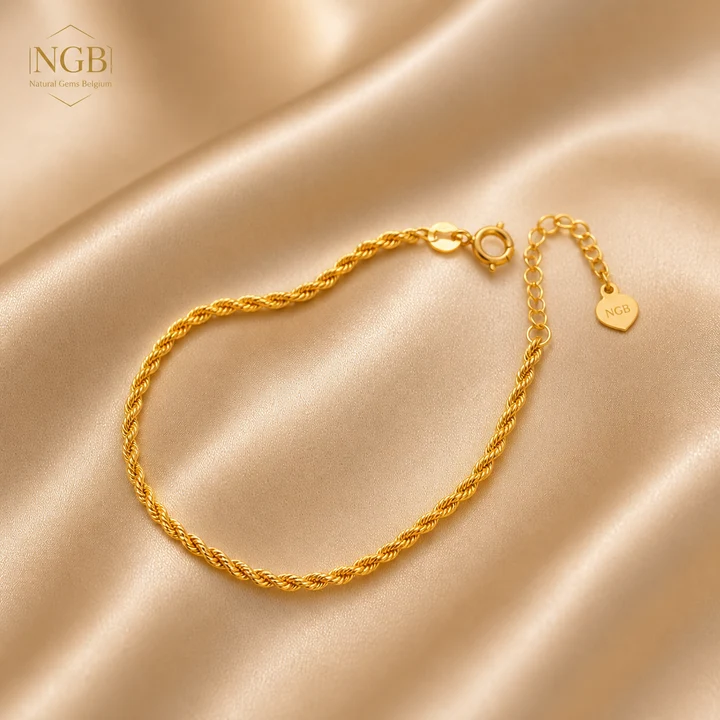
18K Yellow Gold Rope Chain Bracelet · Adjustable 15 · 18 cm · Luxury NGB Jewelry
$251.21 -
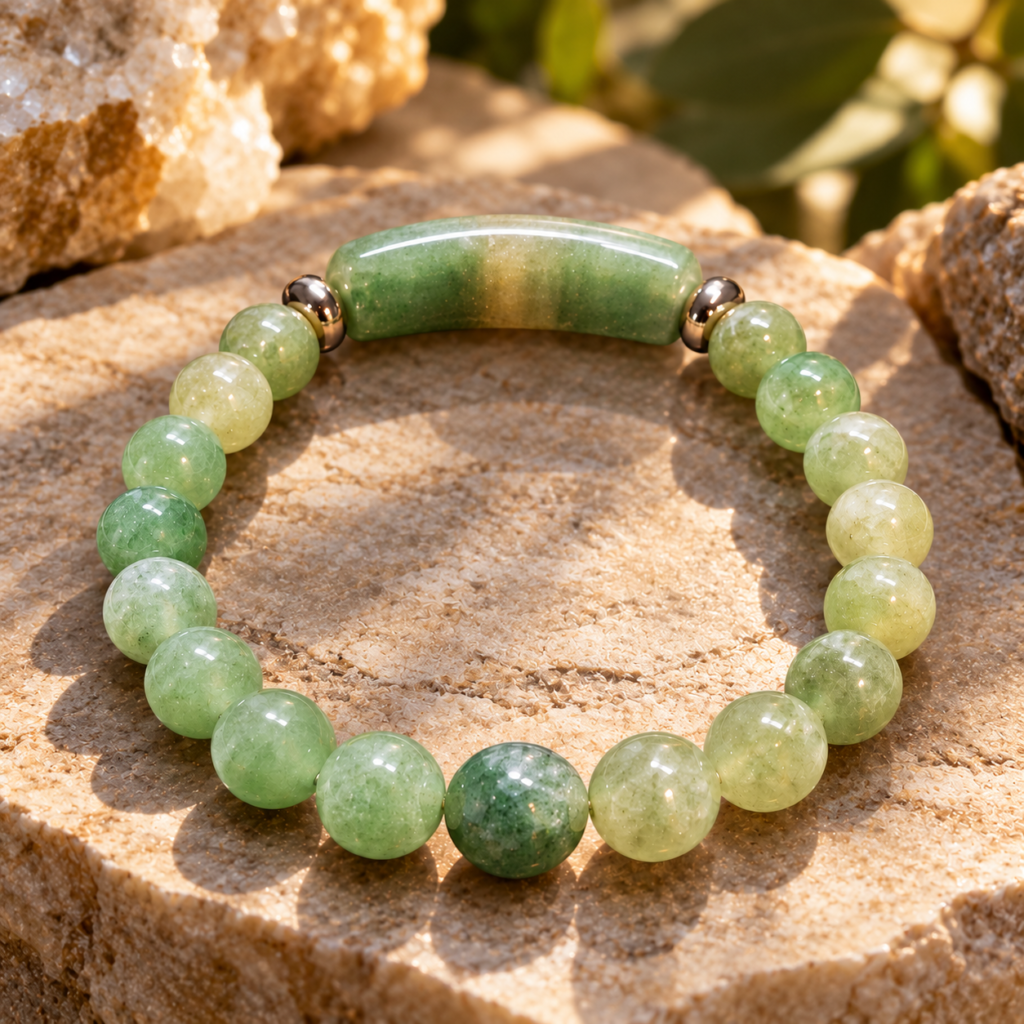
Aventurine Bead Bracelet with Bridge · 8 mm · 19 cm · Unisex · Untreated · Good Polish
$39.10 -
Baltic Amber Chip Bracelet 10 mm · Natural Dark Honey Amber Bead Bracelet
$32.67 -
Bead Bracelet with bridge · Rose Quartz · 8mm · pink charm bracelet
$36.86