
A Practical Guide to Reading the Optical Behaviour of Gemstones
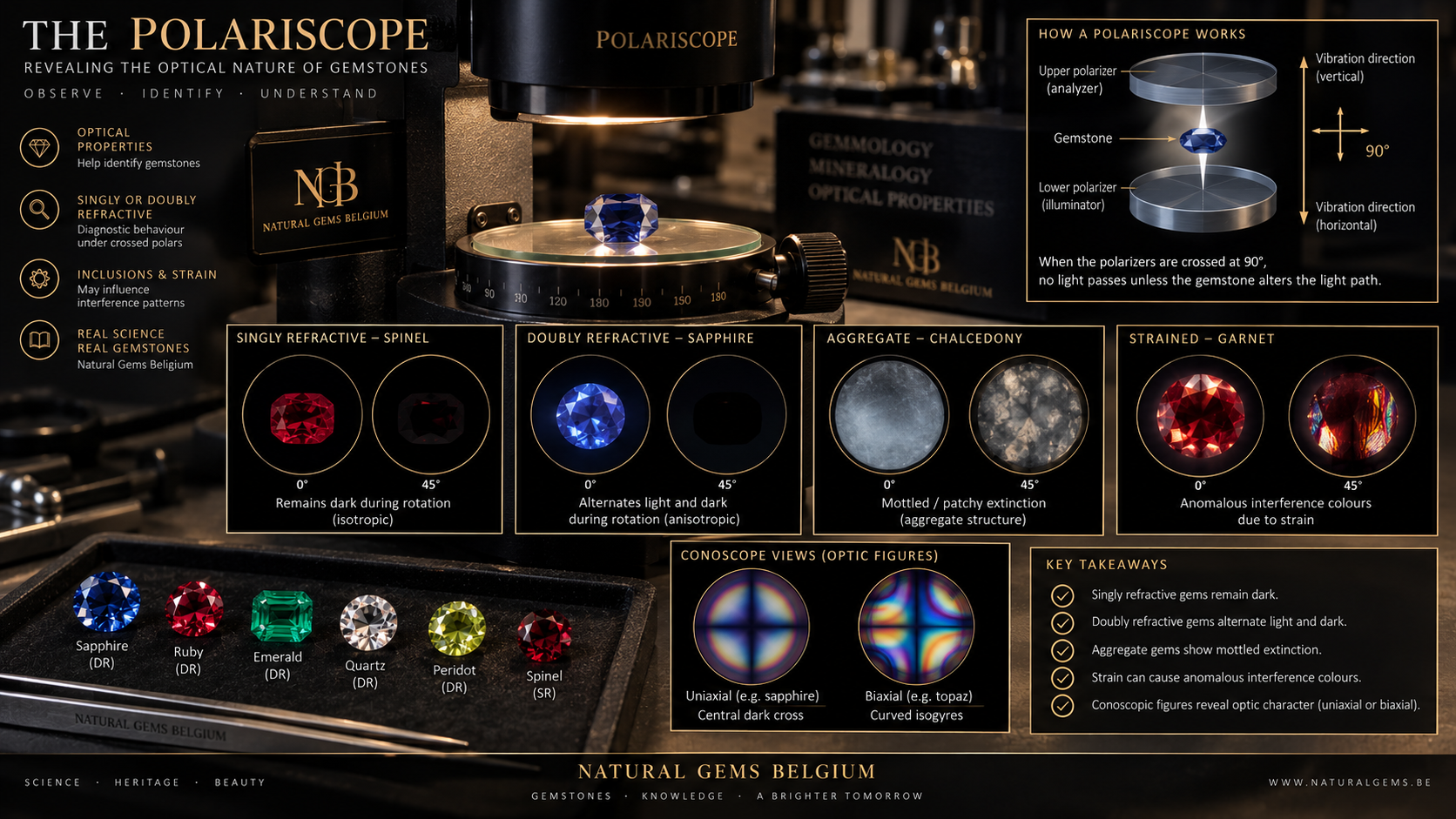
Place a gemstone between two crossed polarizing filters.
Rotate it slowly.
One stone remains dark.
Another alternates between dark and bright.
A third never becomes uniformly dark but instead shows a patchwork of light and shadow.
A fourth should theoretically remain dark but suddenly reveals coloured bands caused by internal strain.
These reactions are not arbitrary.
They arise from the way the gemstone’s crystal structure interacts with polarized light.
The instrument used to observe them is the:
polariscope.
Unlike a refractometer, a polariscope does not normally provide a numerical refractive-index value.
Instead, it answers a different group of questions.
Does the gemstone behave as a:
- singly refractive material;
- doubly refractive material;
- crystalline aggregate?
Does an apparently singly refractive stone contain internal strain?
Can a doubly refractive stone be classified further as:
- uniaxial;
- biaxial?
Can its optic-axis orientation be located?
Used correctly, the polariscope provides remarkably useful structural information with a comparatively simple instrument.
But its reactions must be interpreted cautiously.
Strained glass can imitate double refraction.
Garnets and diamonds can show anomalous optical effects despite belonging to the cubic crystal system.
An unfortunate viewing direction through a doubly refractive stone can make it appear singly refractive.
Very small, opaque or strongly included stones can produce ambiguous reactions.
The polariscope is therefore not a gemstone-name machine.
Like the refractometer, microscope and loupe, it contributes one part of a larger identification process.
The professional approach is:
observe → rotate → classify the reaction → compare → confirm with other evidence.
Table of Contents
1. What Is Polarized Light?
Ordinary visible light can be described as electromagnetic waves.
In normal unpolarized light, the electric-field component vibrates in many directions perpendicular to the direction in which the light travels.
A polarizing filter selectively allows light vibrating primarily in one plane to pass.
The resulting light is:
plane polarized.
This controlled vibration direction is the foundation of the polariscope.
2. Two Polarizing Filters
A conventional polariscope contains two polarizing filters.
The lower filter is commonly called the:
polarizer.
The upper filter is the:
analyzer.
The gemstone is placed between them.
When the vibration directions of the two filters are parallel, light can pass relatively easily.
When they are oriented at 90 degrees to one another, they are:
crossed.
Under crossed polars, the viewing field becomes dark.
3. Why Crossed Polarizers Produce Darkness
The first filter allows one main vibration direction to pass.
The second filter is turned 90 degrees relative to the first.
It therefore blocks that vibration direction.
With no gemstone between them, very little light reaches the observer.
This dark starting condition is critical.
A gemstone placed between the crossed filters may alter the polarization state of the light.
Its resulting reaction reveals information about the gemstone’s optical structure.
4. The Basic Polariscope Setup
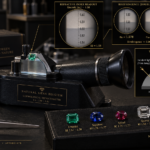
A standard gemmological polariscope normally consists of:
- light source;
- lower polarizing filter;
- transparent rotating stage;
- upper analyzer;
- viewing area.
Useful accessories can include:
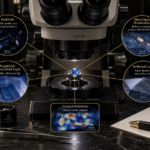
- magnifier;
- conoscope rod;
- interference-figure sphere.
GIA’s current polariscope is designed for determining singly refractive, doubly refractive and aggregate reactions and includes accessories for optic-figure observation.
5. The First Test: Cross the Filters
Before placing a gemstone on the stage:
- Switch on the light.
- Look through the analyzer.
- Rotate one polarizing filter.
- Find the darkest position.
This is the:
crossed position.
The instrument should now provide a dark background.
If the filters are not properly crossed, gemstone reactions become difficult to interpret.
6. Place the Gemstone on the Stage
Place the transparent or sufficiently translucent gemstone between the crossed filters.
The stone may be:
- faceted;
- cabochon;
- crystal fragment;
- suitable rough material.
The specimen must transmit enough light for an observable reaction.
Completely opaque gemstones generally cannot be evaluated using ordinary transmitted-light polariscope methods.
7. Rotate the Gemstone
Now rotate the gemstone through:
360 degrees.
Do not simply glance at it in one position.
The changing reaction during rotation provides the crucial information.
Watch for:
- continuous darkness;
- alternating light and dark;
- patchy or mottled illumination;
- coloured strain patterns.
8. Singly Refractive Materials
An ideal singly refractive gemstone remains:
dark throughout a complete 360° rotation
between crossed polarizers.
This behaviour is generally associated with:
- isotropic crystals;
- certain amorphous materials.
Gemstones belonging to the cubic crystal system are ideally singly refractive.
Examples include:
- spinel;
- garnet;
- diamond.
Glass is also optically isotropic in its ideal unstrained state even though it is not crystalline.
9. What Does Isotropic Mean?
An isotropic material has the same ideal optical behaviour in every direction.
Its refractive index does not depend on crystallographic direction in the way it does in anisotropic crystals.
Plane-polarized light therefore does not normally split into two differently vibrating rays when passing through an ideal isotropic gemstone.
The original polarization direction remains essentially unchanged.
The crossed analyzer then blocks the light.
The stone remains dark.
10. Singly Refractive Does Not Mean Cubic Automatically
This distinction is important.
If a gemstone remains dark, the observation indicates:
singly refractive behaviour under the test conditions.
It does not by itself prove:
cubic crystal system.
Amorphous materials such as glass can also behave singly refractively.
The polariscope classifies optical behaviour.
Additional tests establish identity.
11. Doubly Refractive Materials
Most crystalline gemstones are not cubic.
Their optical properties vary with crystallographic direction.
These materials are:
anisotropic.
When polarized light travels through an anisotropic crystal in most directions, it effectively resolves into two perpendicular vibration components travelling with different optical velocities.
This produces:
double refraction
or:
birefringence.
GIA’s optical research describes uniaxial and biaxial crystals as splitting suitable incident light into two rays with perpendicular vibration directions.
12. What a Doubly Refractive Stone Looks Like
Between crossed polarizers, an anisotropic gemstone commonly alternates:
dark → light → dark → light
as it rotates through 360 degrees.
This occurs because the stone changes the polarization state of the transmitted light differently at different orientations.
At some positions, little light passes the analyzer.
At intermediate positions, more light does.
13. Four Extinction Positions
An ideal anisotropic gemstone often reaches extinction approximately four times during one complete rotation.
These dark positions occur roughly every:
90 degrees.
Between them are illuminated positions.
The sequence can therefore appear approximately as:
dark → bright → dark → bright → dark → bright → dark → bright → dark
through a full 360° rotation.
This repeated behaviour is strong evidence of anisotropy.
14. Extinction
The dark positions are called:
extinction positions.
At extinction, the gemstone’s principal vibration directions are aligned with those of the crossed polarizing filters.
Little transmitted light can pass through the analyzer.
Rotate away from extinction and the gemstone can appear brighter again.
15. Doubly Refractive Gemstones
Many important gemstones are doubly refractive.
Examples include:
- quartz;
- ruby;
- sapphire;
- emerald;
- aquamarine;
- tourmaline;
- peridot;
- topaz;
- chrysoberyl;
- iolite.
But they do not all have the same optical character.
This leads to the next distinction:
uniaxial versus biaxial.
16. Three Broad Optical Crystal Categories
From an optical perspective, crystalline materials can be divided broadly into:
Isotropic
Cubic crystals.
Uniaxial
Tetragonal, trigonal and hexagonal crystals.
Biaxial
Orthorhombic, monoclinic and triclinic crystals.
GIA describes crystalline materials in this optical framework when discussing polarized light and gemstone colour.
17. Uniaxial Gemstones
Uniaxial gemstones have:
one optic-axis direction.
Along this special direction, the stone behaves as though it were singly refractive.
In other directions, it shows double refraction.
Important uniaxial gem materials include:
- quartz;
- corundum;
- beryl;
- tourmaline;
- zircon.
18. Corundum Is Uniaxial
Ruby and sapphire belong to:
corundum
in the trigonal crystal system.
They are optically:
uniaxial.
This agrees with refractometer behaviour: corundum possesses two principal refractive indices.
A polariscope can potentially confirm the uniaxial character through its optic figure.
19. Beryl Is Also Uniaxial
Emerald and aquamarine belong to:
beryl
in the hexagonal crystal system.
They are also uniaxial.
Thus ruby and emerald have completely different:
- chemistry;
- refractive index;
- colour mechanisms;
yet share a broad uniaxial optical classification.
The polariscope alone therefore does not separate every species.
20. Quartz Is Uniaxial
Amethyst, citrine and rock crystal are varieties of:
quartz.
Quartz is trigonal and uniaxial.
Quartz can also display additional optical phenomena related to:
optical activity.
Certain quartz specimens can produce distinctive interference figures such as the well-known bull’s-eye pattern.
21. Biaxial Gemstones
Biaxial gemstones have:
two optic axes.
They belong to:
- orthorhombic;
- monoclinic;
- triclinic
crystal systems.
Examples include:
- peridot;
- topaz;
- chrysoberyl;
- iolite;
- feldspars.
Their optical behaviour is more complex than that of uniaxial gems.
22. Peridot Is Biaxial
Peridot belongs to the orthorhombic crystal system.
It is:
biaxial.
The refractometer also reveals relatively strong birefringence in peridot.
A polariscope provides complementary evidence by confirming its anisotropic behaviour and potentially yielding a biaxial optic figure.
23. Chrysoberyl Is Biaxial
Chrysoberyl—including alexandrite—is orthorhombic and biaxial.
This helps distinguish it optically from some visually similar gems.
For example:
- corundum = uniaxial;
- chrysoberyl = biaxial.
An optic figure can therefore add evidence when RI ranges and other properties are being considered.
24. The Optic Axis
An optic axis is a special direction through an anisotropic crystal along which light does not exhibit the usual double-refraction separation.
A uniaxial crystal has:
one optic-axis direction.
A biaxial crystal has:
two.
These directions arise directly from the internal optical symmetry of the crystal.
25. Why a Doubly Refractive Stone Can Sometimes Stay Dark
This creates one of the major beginner traps.
Suppose you look almost directly down the optic axis of a uniaxial gemstone.
Along that direction, it behaves as though it were singly refractive.
The stone can therefore remain dark or produce an unexpectedly weak reaction.
That does not necessarily mean it is an isotropic stone.
26. Always Change Orientation
If a stone appears singly refractive but the identification remains uncertain:
- tilt it;
- rotate it;
- view through another facet;
- test another direction.
Never base a final optical classification on one orientation when the stone allows other views.
GIA cautions that locating and interpreting optical reactions can require appropriate orientation and sufficient specimen size.
27. The Blink Test
An anisotropic gemstone can often be recognised by an obvious:
light-dark blinking reaction
during rotation.
This is sometimes informally called the:
blink test.
A strong, regular blinking response supports double refraction.
But unusual strain patterns and aggregate materials can complicate the observation.
28. Aggregates
Not every gemstone is one single crystal.
Some gem materials consist of many microscopic crystals or fibres assembled together.
These are:
aggregates.
Examples can include:
- chalcedony;
- jadeite jade;
- nephrite;
- some turquoise-related structures.
Each microscopic component may have a different orientation.
29. Aggregate Reaction
Because numerous tiny crystal grains are oriented differently, an aggregate often does not go completely dark as one uniform object.
Instead, it can show:
- mottled light;
- patchy brightness;
- granular illumination;
- irregular patterns.
This reaction differs from the orderly extinction cycle of a transparent single anisotropic crystal.
GIA specifically lists aggregate as a distinct reaction category obtainable with a polariscope.
30. Why Aggregate Recognition Is Useful
Suppose a translucent green material behaves as an aggregate.
That immediately makes certain transparent single-crystal possibilities less likely.
Combined with:
- refractive index;
- spectrum;
- specific gravity;
- microscopy,
the aggregate reaction can help narrow identification considerably.
Again, the polariscope supplies structural evidence rather than a final name.
31. Anomalous Double Refraction
The clean division:
singly refractive versus doubly refractive
has an important complication.
Some materials that should theoretically be singly refractive can show light between crossed polars because of:
internal strain.
This effect is known as:
anomalous double refraction
often abbreviated:
ADR.
32. What Causes ADR?
Internal stress can distort the optical uniformity of an otherwise isotropic material.
Different areas then interact with polarized light differently.
Instead of remaining uniformly dark, the specimen may show:
- bands;
- crosses;
- patches;
- interference colours.
The material has not necessarily become a genuinely anisotropic crystal.
The effect is caused by strain.
33. Garnet and ADR
Garnets belong to the cubic crystal system and are fundamentally singly refractive.
Yet some garnets can show conspicuous anomalous double refraction.
Historical and modern gemmological practice recognises this as an important source of potential misinterpretation.
A bright garnet under crossed polars should therefore not automatically be called truly doubly refractive.
34. Diamond and Strain
Diamond is cubic and ideally singly refractive.
However, internal strain in diamond can produce striking polariscope patterns.
These can include:
- coloured areas;
- bands;
- cross-like patterns;
- irregular strain fields.
GIA specifically notes that diamond cutters use the polariscope to evaluate strain characteristics in diamond.
35. Why Diamond Strain Matters
Internal strain can have practical consequences.
Strongly strained regions may influence:
- cutting behaviour;
- cleavage risk;
- polishing.
The polariscope therefore has uses extending beyond gemstone identification into:
lapidary planning and material assessment.
36. Strained Glass
Glass provides another classic example.
Ideal unstressed glass is isotropic.
But manufacturing, cooling or mechanical stress can introduce strain.
Between crossed polarizers, strained glass may show:
- bright bands;
- interference colours;
- irregular patterns.
A beginner could mistake this for genuine crystalline double refraction.
37. Synthetic Spinel
Synthetic spinel has historically provided another well-known anomalous reaction.
GIA’s older gemmological literature specifically notes anomalous double refraction in materials including:
- garnet;
- synthetic spinel;
- diamond.
The fundamental cause is strain rather than ordinary anisotropic crystal symmetry.
38. ADR Does Not Mean the Stone Is Doubly Refractive
This distinction must remain precise.
True double refraction results from anisotropic crystal structure.
Anomalous double refraction results from strain in a material that should ideally be isotropic.
Both can allow light to appear between crossed polarizers.
Their physical origins are different.
39. How ADR Often Looks Different
A true anisotropic single crystal often shows a relatively orderly:
bright-dark extinction sequence
during rotation.
ADR may look more like:
- irregular coloured bands;
- patchy strain;
- cross-hatched zones;
- persistent bright areas.
However, visual interpretation is not always simple.
Confirm with additional tests.
40. Pleochroism and the Polariscope
GIA notes that a polariscope can also assist in detecting:
pleochroism
in coloured doubly refractive stones.
Pleochroism occurs when a coloured anisotropic crystal absorbs polarized light differently along different crystallographic directions.
As orientation changes, colour can change.
41. A Dichroscope Is Usually Better for Pleochroism
Although pleochroic behaviour may be noticed with polarized light, the dedicated classical instrument is the:
dichroscope.
A dichroscope separates two differently polarized light components so their colours can be compared simultaneously.
Therefore:
- polariscope = primarily optical character;
- dichroscope = primarily pleochroic colour separation.
The instruments complement one another.
42. Optic Figures
Once a gemstone has been established as doubly refractive, the polariscope can sometimes reveal an:
optic figure
also called an:
interference figure.
These patterns provide additional information about the stone’s optical symmetry.
They can distinguish:
uniaxial
from
biaxial
behaviour.
GIA’s current optic-figure sphere is specifically intended for this purpose.
43. The Conoscope
To see an optic figure, gemmologists commonly use a:
conoscope
with the polariscope.
A simple conoscope can be:
- a glass sphere;
- conoscope rod;
- specialised optical lens.
Gem-A describes its conoscope rod as an accessory used with the polariscope to determine whether a gemstone is uniaxial or biaxial.
44. Why the Conoscope Is Needed
The conoscope allows the observer to examine a cone of light passing through the gemstone rather than only one narrow direction.
Different ray directions interfere.
This produces characteristic:
- dark brushes;
- coloured interference bands;
- crosses;
- curves.
The resulting pattern is the optic figure.
45. Locating an Optic Figure
Finding a good optic figure often requires patience.
A basic method is:
- Cross the polarizers.
- Place the gemstone on the stage.
- Rotate and tilt the stone.
- Search for a position showing minimal ordinary blinking.
- Place the conoscope above the stone.
- Look for an interference pattern.
- Fine-tune stone orientation.
The precise technique depends on stone shape and instrument design.
46. The Stone Must Be Suitable
Not every gemstone yields a clear figure easily.
Problems can include:
- small size;
- strong colour;
- heavy inclusions;
- unsuitable facet orientation;
- poor transparency;
- awkward mounting.
GIA explicitly cautions that the stone must be large enough for the reaction and figure to be interpreted reliably.
47. Uniaxial Optic Figure
A classic uniaxial optic-axis figure can show:
a dark cross
often accompanied by:
concentric interference colours or rings.
The centre of the cross corresponds approximately to the optic-axis direction.
The appearance can vary with:
- thickness;
- birefringence;
- orientation;
- lighting.
48. The Uniaxial Cross
In an ideal centred uniaxial figure, two dark brushes intersect at approximately 90 degrees.
When the specimen is appropriately rotated around the optic-axis direction, the basic cross remains characteristically organised.
Historically this pattern has been one of the simplest methods for demonstrating that a gemstone is uniaxial.
49. Quartz Bull’s-Eye Figure
Quartz can show a distinctive variation known as the:
bull’s-eye optic figure.
Quartz is optically active: it can rotate the plane of polarized light.
This modifies the ordinary uniaxial interference pattern.
GIA has documented classic bull’s-eye figures and related optical-activity effects in quartz and ametrine.
50. Brazil-Law Twinning in Quartz
Quartz may contain:
Brazil-law twinning.
This can distort or modify optical figures.
Such patterns can become useful in studying:
- natural growth;
- synthetic quartz;
- structural sectors.
The polariscope can therefore reveal information beyond simple SR/DR classification in suitable specimens.
51. Biaxial Optic Figures
Biaxial crystals produce different interference figures.
Instead of the stable classic uniaxial cross, the observer may see:
- curved dark brushes;
- separated bands;
- hyperbola-like structures;
- interference colours.
The appearance changes as the stone rotates.
52. Why the Biaxial Figure Moves
In biaxial minerals, the geometry involves:
two optic axes.
The interference pattern therefore changes differently during rotation than a uniaxial optic-axis cross.
Historical GIA descriptions note that biaxial brushes move as the specimen is rotated, whereas the centred uniaxial cross behaves differently.
53. Do Not Expect Textbook-Perfect Figures
Actual faceted gemstones rarely behave like perfect teaching diagrams.
You may see only:
- part of a cross;
- one curved brush;
- edge of an interference ring;
- distorted figure.
Facet reflections and limited viewing windows complicate the image.
The goal is to recognise enough of the pattern to classify the optical character reliably.
54. Uniaxial Positive and Negative
Uniaxial gemstones can be subdivided into:
uniaxial positive
and
uniaxial negative.
This classification depends on the relationship between the extraordinary and ordinary refractive indices.
For example:
quartz = uniaxial positive
while:
corundum = uniaxial negative.
55. Biaxial Positive and Negative
Biaxial gemstones can likewise be:
- biaxial positive;
- biaxial negative.
Determining optic sign requires more advanced interference-figure analysis and usually an accessory such as a compensator.
It is useful information, but it is not the first skill a beginner should master.
First learn to establish reliably:
SR → DR → aggregate → ADR → uniaxial/biaxial.
56. The Polariscope and Refractometer Together
These two instruments complement one another exceptionally well.
Suppose the refractometer gives:
RI around 1.76–1.77
with measurable birefringence.
The polariscope shows:
doubly refractive, uniaxial.
The evidence strongly supports:
corundum.
Neither measurement alone answers every question.
Together they become much stronger.
57. Emerald Example
Suppose a green gemstone gives:
RI approximately 1.58
and is clearly doubly refractive.
An optic figure indicates:
uniaxial.
Those properties are consistent with:
beryl.
Combined with sufficiently saturated green colour, emerald becomes a strong possibility.
But the polariscope cannot determine:
- natural versus synthetic emerald;
- oil versus resin treatment;
- Colombia versus Zambia.
58. Peridot Example
A green gemstone produces:
- RI around 1.65–1.69;
- high birefringence;
- clear double-refraction reaction;
- biaxial optic figure.
Together these strongly support:
peridot / olivine.
The microscope may also show visible facet doubling caused by its relatively strong birefringence.
59. Spinel Example
A red gemstone gives:
- RI around 1.718;
- stable refractometer reading;
- dark reaction through 360° rotation.
This combination strongly supports a singly refractive candidate such as:
spinel.
A ruby should instead behave as:
doubly refractive and uniaxial.
This is one of the classic uses of complementary optical tests.
60. Red Stones Require Care
A dark or strongly coloured gemstone may absorb so much light that the polariscope reaction is difficult to see.
GIA’s polariscope instructions specifically caution against declaring a transparent red stone doubly refractive without checking its pleochroism.
When reactions are ambiguous, use additional evidence rather than forcing an interpretation.
61. Mounted Gemstones
Mounted stones can sometimes be tested if enough transmitted light reaches them.
But settings can:
- block light;
- prevent rotation;
- obscure directions.
A polariscope is usually easier to use on loose stones.
Never damage a mounting merely to obtain an optical reaction.
62. Cabochons
Cabochons can often be tested effectively.
Their curved surfaces may even provide access to multiple optical directions.
Transparent or translucent cabochons can therefore show useful:
- SR/DR reactions;
- aggregate patterns;
- strain.
The quality of the reaction still depends on transparency.
63. Very Small Stones
Small gemstones can make subtle reactions difficult to see.
A magnifier above the analyzer can help.
GIA specifically recommends magnification when testing specimens too small for comfortable unaided interpretation.
64. Strongly Included Stones
Dense inclusions can scatter light.
This may make the stone appear bright even at positions where clean extinction would otherwise be expected.
Interpret the broad behaviour rather than individual bright reflections from inclusions.
Microscopy can help separate inclusion scattering from optical reaction.
65. Facet Reflections
Faceted gems can create bright internal reflections that complicate the polariscope view.
Rock the stone slightly.
Change viewing angle.
Look for the optical behaviour of the gemstone body rather than isolated facet reflections.
Experience greatly improves this distinction.
66. Over-the-Limit Gemstones
Some gemstones above the measurement range of a conventional refractometer can also produce difficult or indefinite polariscope reactions.
GIA advises caution when using the polariscope to confirm SR/DR behaviour in stones that are over the refractometer limit.
Use other identification tools when necessary.
67. The Polariscope and Microscope
The microscope can dramatically improve polarized-light examination.
With polarizer and analyzer filters installed, the microscope can reveal:
- strain;
- twinning;
- interference colours;
- oriented inclusions.
This is especially useful for:
- diamond;
- synthetic materials;
- microscopic growth structures.
The principles are the same as the tabletop polariscope, but viewed under magnification.
68. Crossed Polarizers in Inclusion Study
Polarized light can reveal inclusions almost invisible under ordinary lighting.
A transparent crystal trapped inside another gemstone may show interference colours.
Strain surrounding an inclusion may also become visible.
This is why crossed polarizers were already introduced in the NGB microscope guide.
The polariscope now explains the optical principles behind that observation.
69. The Polariscope and Pleochroism
Colored anisotropic gemstones can absorb different polarized vibration directions differently.
That is why minerals such as:
- tourmaline;
- iolite;
- corundum
can show pleochroism.
The polariscope establishes anisotropic behaviour.
The dichroscope then allows those directional colours to be compared more directly.
70. The Polariscope and Synthetic Detection
Optical character can eliminate possibilities, but it rarely proves natural growth.
Synthetic ruby is still:
- corundum;
- doubly refractive;
- uniaxial.
Synthetic emerald is still:
- beryl;
- doubly refractive;
- uniaxial.
GIA has documented laboratory-grown star ruby and sapphire showing expected uniaxial double-refraction behaviour while microscopy provided the evidence of laboratory growth.
71. Correct Optical Behaviour Does Not Prove Natural Origin
This is a key principle.
If a red stone behaves exactly like corundum in the polariscope, you have evidence that its optical behaviour is consistent with corundum.
You have not proved:
- natural ruby;
- unheated ruby;
- Myanmar origin.
Those are different questions requiring different evidence.
72. The Polariscope and Treatment
Most heat treatment does not change a gemstone’s fundamental crystal system.
Therefore a heated sapphire remains:
doubly refractive and uniaxial.
An oil-filled emerald remains:
beryl and uniaxial.
A polariscope is generally not a direct treatment-identification instrument.
Treatment evidence more commonly comes from:
- microscopy;
- spectroscopy;
- chemical analysis.
73. Strain Can Be Treatment-Related
There are exceptions.
Some treatment or manufacturing processes can create or modify internal strain.
The resulting anomalous optical patterns may therefore provide clues.
However, strain is not usually specific enough to identify a treatment by itself.
Interpret it as evidence requiring context.
74. The Polariscope and Geographic Origin
Geographic origin cannot normally be determined using the polariscope.
A sapphire from Sri Lanka and sapphire from Madagascar both remain corundum.
A Colombian and Zambian emerald both remain beryl.
Their fundamental optical character does not encode a simple country signature.
Origin determination requires other evidence.
75. A Strong Practical Workflow
For an unknown transparent gemstone, a useful classical sequence is:
Step 1 — Visual Examination
Record:
- colour;
- transparency;
- cut;
- obvious phenomena.
Step 2 — Loupe / Microscope
Observe:
- inclusions;
- doubling;
- growth features.
Step 3 — Refractometer
Measure:
- RI;
- birefringence where possible.
Step 4 — Polariscope
Determine:
- singly refractive;
- doubly refractive;
- aggregate;
- ADR.
Step 5 — Optic Figure
If useful, investigate:
- uniaxial;
- biaxial.
Step 6 — Dichroscope
Observe pleochroism.
Step 7 — Spectroscope
Investigate absorption.
Step 8 — Specific Gravity / Other Tests
Use where appropriate.
Step 9 — Compare the Complete Dataset
Identify the gemstone only when the properties converge.
76. The Three Most Important Polariscope Observations
For routine work, first answer:
Does It Stay Dark?
Potentially:
singly refractive.
But check for orientation and strain complications.
Does It Blink Light and Dark?
Potentially:
doubly refractive single crystal.
Does It Stay Irregularly Patchy?
Potentially:
aggregate or anomalous strain reaction.
These three observations provide a practical starting framework.
77. Then Ask Why
Never stop at:
“It got bright.”
Ask:
Was the illumination:
- regular?
- fourfold?
- patchy?
- coloured?
- related to strain?
- caused by aggregate texture?
Interpretation begins after observation.
78. Common Beginner Mistakes
Not Crossing the Polarizers Correctly
The starting field must be dark.
Observing Only One Position
Always rotate the stone through 360°.
Calling Every Bright Reaction Double Refraction
ADR and aggregates can also transmit light.
Forgetting the Optic Axis
A doubly refractive stone can appear singly refractive along a special direction.
Confusing Reflections with Optical Reaction
Facet reflections can be misleading.
Calling ADR True Birefringence
Strain-induced optical behaviour is not the same as structural anisotropy.
Expecting Every Optic Figure to Look Perfect
Real faceted stones often reveal only part of the figure.
Using the Polariscope to Claim Natural Origin
Synthetic gemstones generally retain the same optical class as the natural species.
Using It to Claim Treatment Status
Heating often leaves the fundamental optical character unchanged.
79. Common Interpretation Errors
“It stays dark, so it must be spinel.”
Incorrect.
Several materials can be singly refractive.
“It blinks, so it must be natural.”
Incorrect.
Synthetic anisotropic crystals also blink.
“This garnet lights up, therefore it is doubly refractive.”
Possibly incorrect.
Garnet may show anomalous double refraction caused by strain.
“I see a uniaxial figure, therefore it is sapphire.”
Incorrect.
Quartz, beryl, tourmaline and other minerals can also be uniaxial.
“The polariscope says Colombia.”
Impossible as a normal interpretation.
Geographic origin requires different evidence.
80. Evidence Classification
| Statement | Classification |
|---|---|
| A polariscope uses crossed polarized light to investigate gemstone optical behaviour | Established optical/gemmological principle |
| Ideal isotropic gemstones remain dark throughout rotation | Established optical principle |
| Anisotropic gemstones usually alternate light and dark during rotation | Established optical principle |
| Cubic crystals are optically isotropic under ideal conditions | Established crystallographic principle |
| Tetragonal, trigonal and hexagonal crystals are uniaxial | Established optical crystallography |
| Orthorhombic, monoclinic and triclinic crystals are biaxial | Established optical crystallography |
| Aggregates can show patchy or mottled polariscope reactions | Established gemmological practice |
| Internal strain can produce anomalous double refraction in otherwise isotropic materials | Established optical phenomenon |
| Garnet and diamond can show ADR | Established gemmological observation |
| Optic figures can help distinguish uniaxial from biaxial gemstones | Established gemmological method |
| A uniaxial figure uniquely identifies sapphire | Incorrect |
| Brightness under crossed polars always proves structural double refraction | Incorrect |
| Correct optical character proves natural origin | Incorrect |
| Polariscope reaction normally determines geographic origin | Incorrect |
| Polariscope testing alone generally determines heat treatment | Incorrect |
81. A Repeatable Polariscope Routine
Use the same sequence for every suitable unknown.
1. Check Transparency
Ensure enough light can pass through the specimen.
2. Cross the Filters
Set the field to maximum darkness.
3. Place the Stone
Choose a stable initial orientation.
4. Rotate Through 360°
Watch the whole stone.
5. Classify the Initial Reaction
Ask:
- dark?
- blinking?
- patchy?
- strained?
6. Change Orientation
Tilt or turn the stone where possible.
7. Repeat
Confirm that the reaction is reproducible.
8. Look for ADR
Especially in nominally isotropic candidates.
9. Search for an Optic Figure
Use a conoscope when uniaxial/biaxial classification is useful.
10. Compare with Other Tests
Combine with:
- RI;
- birefringence;
- microscopy;
- pleochroism;
- spectrum.
11. Record Conservatively
Describe the optical behaviour before naming the gemstone.
82. A Useful Recording System
Instead of writing only:
“Polariscope positive.”
record something more useful:
Reaction: DR — four extinction positions observed during rotation; uniaxial optic figure obtained.
Or:
Reaction: SR with irregular strain colours consistent with ADR.
Or:
Reaction: aggregate — persistent mottled illumination, no uniform extinction.
Detailed observations remain useful even if the final gemstone identification changes.
83. Why the Polariscope Remains Important
Modern laboratories possess highly advanced tools including:
- Raman spectroscopy;
- FTIR;
- UV-Vis-NIR;
- photoluminescence;
- X-ray methods;
- mass spectrometry.
Yet GIA still lists the:
- refractometer;
- polariscope;
- dichroscope;
- handheld spectroscope
as foundational standard gemmological tools used in coloured-stone identification.
Why?
Because fundamental optical properties provide fast, non-destructive evidence about a material’s structure before expensive advanced analysis is needed.
84. What the Polariscope Is Excellent At
The polariscope is particularly useful for:
- separating SR and DR behaviour;
- recognising aggregates;
- detecting internal strain;
- distinguishing genuine anisotropy from some isotropic possibilities;
- investigating uniaxial and biaxial character;
- observing optic figures;
- supporting other classical gem tests.
It gives structural information using nothing more exotic than:
light + polarization + rotation.
85. What the Polariscope Cannot Usually Tell You
The polariscope generally cannot answer by itself:
Is this ruby natural or synthetic?
Has this sapphire been heated?
Is this emerald oil filled?
Did this sapphire come from Kashmir?
Is this emerald Colombian?
What trace elements produce the colour?
What exact mineral is this inclusion?
Those questions require other evidence.
Recognising these limitations is part of correct instrument use.
86. The Most Important Habit
The greatest mistake is asking:
“What gemstone does this reaction mean?”
too early.
Instead ask:
“What optical behaviour did I actually observe?”
For example:
Observed: stone remains dark through complete rotation.
Then:
Interpretation: singly refractive behaviour under tested orientations.
Then:
Comparison: consistent with spinel, garnet, glass and other SR possibilities.
Only after combining additional data should the gemstone receive an identification.
Conclusion
The polariscope transforms something invisible—the directional behaviour of light inside a crystal—into something a gemmologist can see.
Between two crossed polarizing filters, different gemstone structures reveal themselves through light and darkness.
An ideal singly refractive stone remains dark.
A doubly refractive stone generally alternates between extinction and illumination as it rotates.
An aggregate can show a mottled patchwork.
An otherwise isotropic gemstone under internal stress may reveal anomalous double-refraction patterns.
Add a conoscope and the investigation can go further.
A uniaxial gemstone may reveal its characteristic optic figure.
A biaxial gemstone produces a different pattern.
Quartz, corundum and beryl can be separated optically from peridot, topaz and chrysoberyl at this structural level.
But the polariscope also teaches one of gemmology’s most important lessons:
simple observations can have complicated causes.
A bright stone between crossed polars is not automatically a truly doubly refractive crystal.
A dark stone is not automatically spinel.
A uniaxial optic figure does not automatically mean sapphire.
Synthetic ruby displays the same fundamental uniaxial optical character as natural ruby.
Synthetic emerald remains uniaxial beryl.
Heat treatment generally does not change sapphire into another optical class.
Geographic origin does not appear as a country name inside an interference figure.
So the professional workflow remains:
observe → rotate → classify → compare → confirm.
The loupe shows external and internal detail.
The microscope reveals inclusions under controlled lighting.
The refractometer measures how strongly the gemstone refracts light.
The polariscope reveals whether that optical behaviour changes with direction.
Together, these instruments begin to turn an unknown coloured stone into a measurable scientific object.
And that is the foundation of practical gemmology:
not guessing from appearance,
but allowing several independent properties to tell the same story.
References & Further Reading
Gemological Institute of America — GIA Polariscope.
Current GIA instrument reference defining the main practical functions of the polariscope: distinguishing singly refractive, doubly refractive and aggregate materials; investigating uniaxial and biaxial character; observing pleochroism and examining diamond strain. GIA Polariscope
Gemological Institute of America — GIA Polariscope User Guide.
Detailed operating reference covering crossed-polarizer testing, limitations, optic-axis location, optic figures, small-stone observation and interpretive precautions. GIA Polariscope User Guide
Gemological Institute of America — Interference Figure Sphere.
Current technical reference for the optic-figure accessory used with a polariscope to help distinguish uniaxial and biaxial doubly refractive gemstones. GIA Interference Figure Sphere
Gem-A — Table Polariscope.
Current professional Gem-A instrument reference describing practical observation of single and double refraction and the detection of strain in diamond, supplied with a conoscope rod. Gem-A Table Polariscope
Gem-A — Conoscope Rod.
Professional reference describing the use of a conoscope with a polariscope to observe interference figures and determine whether a gemstone is uniaxial or biaxial. Gem-A Conoscope Rod
Shen, C., Palke, A., Sun, Z. & Fairchild, M. D. — “How to Calculate Color from Spectra of Uniaxial Gemstones.” Gems & Gemology, Spring 2021.
Modern scientific discussion of polarized light and optical crystallography, including the division of crystals into isometric, uniaxial and biaxial categories and the perpendicular vibration directions produced in anisotropic crystals. GIA — Color and Uniaxial Gemstones
Gemological Institute of America — “Analysis of Gemstones at GIA Laboratories.” Gems & Gemology, Winter 2024.
Current laboratory overview confirming that the refractometer, polariscope, dichroscope and handheld spectroscope remain foundational standard gemological tests before advanced instrumental analysis is applied where necessary. GIA — Analysis of Gemstones at GIA Laboratories
Gemological Institute of America — “Anomalous Double Refraction.” Gems & Gemology.
Classic gemological discussion explaining strain-induced anomalous double refraction and documenting its occurrence in materials such as garnet, synthetic spinel and diamond. GIA historical Gems & Gemology reference
Gemological Institute of America — “The Polariscope.” Gems & Gemology.
Historical but technically useful description of uniaxial and biaxial interference figures, including classic uniaxial crosses and the differing behaviour of biaxial dark brushes during rotation. GIA historical Polariscope reference
Gemological Institute of America — “Large Laboratory-Grown Star Ruby and Sapphire.” Gems & Gemology, Fall 2019.
Useful real-world demonstration that laboratory-grown ruby and sapphire can display the expected doubly refractive, uniaxial optical behaviour of corundum; microscopy was needed to establish laboratory growth. GIA — Laboratory-Grown Star Ruby and Sapphire
Gemological Institute of America — “Ametrine Optical Dishes: Windows into the Effects of Crystal Structure.” Gems & Gemology, Spring 2017.
Advanced visual reference demonstrating uniaxial optic figures, the quartz bull’s-eye figure, optical activity and structural/twinning effects under crossed polarizers. GIA — Ametrine Optical Figures
Gem-A — “The Northern Lights Effect in Diamond.” Gems & Jewellery, 2015.
Practical discussion and imagery of anomalous double refraction and internal strain patterns in diamond observed between crossed polarizers. Gem-A Gems & Jewellery archive