Table of Contents
Introduction: The Paradox of Gemstone Cutting
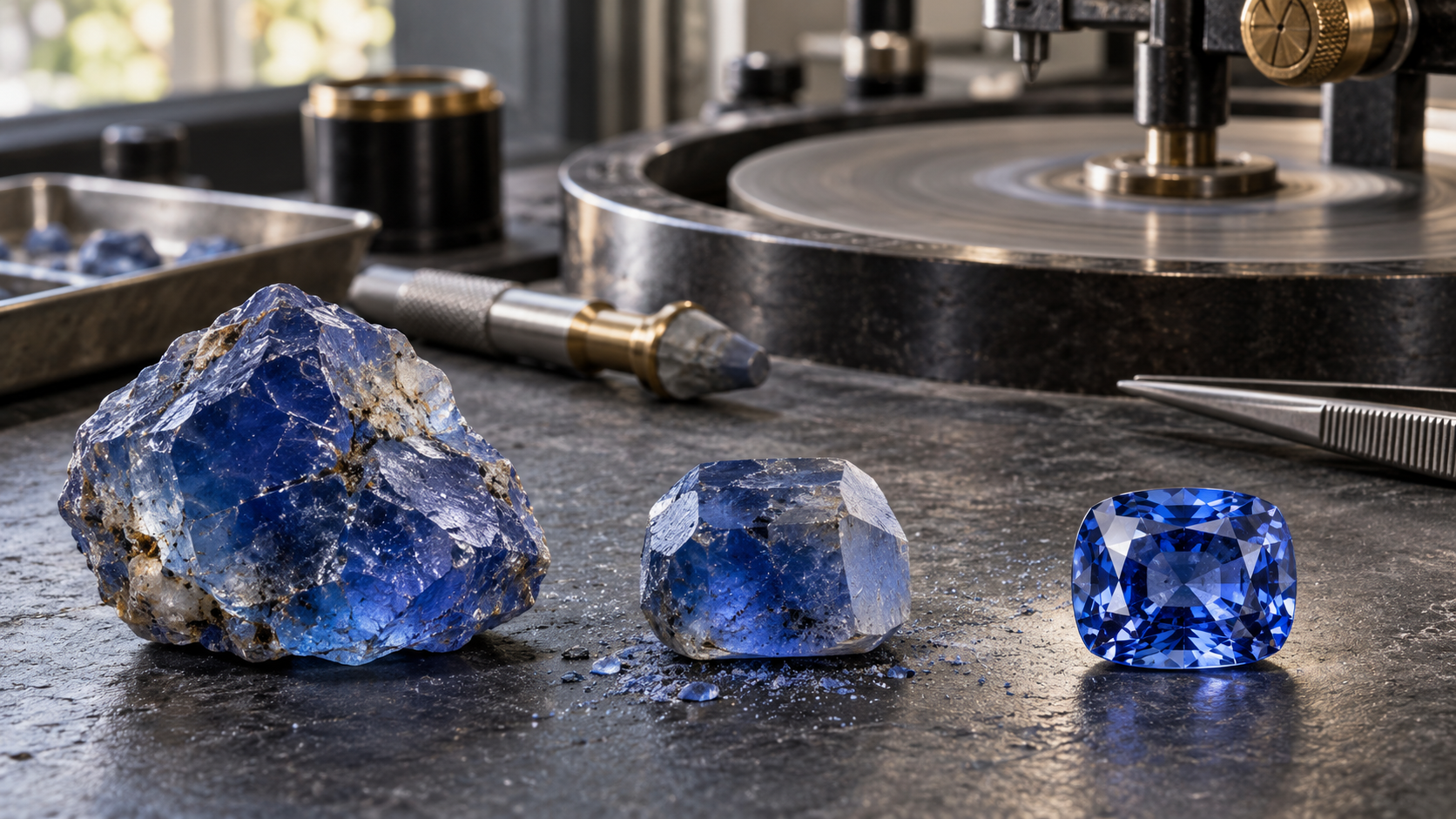
Imagine holding a beautiful natural sapphire crystal weighing 20 carats.
Its colour is attractive. Its transparency is promising. Its crystal structure suggests that a valuable gemstone might be hidden inside.
But there is a problem.
The crystal is irregular.
One side contains a fracture.
The colour is concentrated in certain areas.
And the natural shape does not correspond to the proportions required for an attractive faceted gemstone.
The cutter now faces a difficult decision.
Should the objective be to preserve as much weight as possible?
Or should some of the material be sacrificed to produce a smaller gemstone with better colour, clarity and optical performance?
This is one of the fundamental challenges of gemstone cutting.
The largest possible gemstone is not necessarily the most beautiful—or the most valuable—gemstone that can be produced from a piece of rough.
The transformation from rough mineral to finished gem is therefore not simply a process of grinding away unwanted material.
It is a carefully planned interaction between:
- Mineralogy
- Crystal structure
- Optical physics
- Colour distribution
- Inclusions and fractures
- Cutting geometry
- Craftsmanship
- Commercial judgement
Every decision influences the final result.
And once material has been removed, the process cannot be reversed.
Understanding these decisions reveals why fine gemstone cutting is both a technical discipline and an artistic craft.
1. A Rough Gemstone Is Not a Finished Gemstone Waiting to Be Uncovered
It is tempting to imagine that a perfectly formed faceted gemstone already exists inside a rough crystal.
The cutter simply needs to remove the surrounding material.
In reality, the situation is much more complicated.
Natural gemstones form under geological conditions that rarely produce crystals ideally suited to modern faceting.
A rough crystal may contain:
- Uneven growth surfaces
- Fractures
- Mineral inclusions
- Colour zoning
- Internal stress
- Irregular crystal boundaries
- Damaged or weathered surfaces
Some crystals possess attractive external shapes.
Others occur as broken fragments, pebbles or irregular masses.
Even a beautifully formed natural crystal may contain internal characteristics that make faceting difficult.
The cutter must therefore evaluate the available material and determine which finished shapes are realistically possible.
The objective is not simply to uncover a predetermined gemstone.
The cutter must design a gemstone that can successfully be produced from the material available.
2. The First Decision: Should the Rough Be Cut at All?
Not every attractive gemstone crystal should be faceted.
Some natural crystals possess considerable value as mineral specimens.
An exceptional crystal may display:
- Well-developed natural faces
- Unusual crystal habits
- Rare mineral associations
- Exceptional transparency
- Attractive natural colour zoning
- Important geological characteristics
Cutting such a specimen would permanently destroy its original crystal morphology.
In some circumstances, the intact specimen may be more desirable than the faceted gemstones it could produce.
This creates an important distinction between:
Mineral specimen value
and
Potential faceted-gemstone value.
A collector may value the natural crystal structure.
A lapidary may value the usable transparent material.
A jeweller may value the finished gemstone’s appearance and dimensions.
These are different markets with different priorities.
The first responsible decision is therefore whether faceting is the most appropriate use of the material.
3. Understanding Gemstone Yield
One of the most important concepts in gemstone cutting is:
Cutting Yield
Yield expresses the proportion of the original rough weight retained in the finished gemstone or gemstones.
The basic calculation is:
Yield (%) = Total Finished Gemstone Weight ÷ Original Rough Weight × 100
For example, imagine a 20.00 ct rough sapphire.
After cutting, it produces one finished gemstone weighing 6.40 ct.
The yield is:
6.40 ÷ 20.00 × 100
Yield = 32%.
This means that 68% of the original weight was removed during processing.
That loss may sound enormous.
However, it does not necessarily indicate inefficient cutting.
The removed material may have included:
- Fractured sections
- Unwanted inclusions
- Irregular crystal projections
- Material outside the planned gemstone outline
- Material removed to establish correct facet angles
- Polishing allowance
GIA’s research on coloured-gemstone cutting explains that yield can vary enormously, from only a few percent to unusually high recoveries approaching 50%.
There is no single universal yield percentage appropriate for every gemstone species or piece of rough.
The correct yield depends on the individual material.
4. Why Maximising Weight Can Be a Mistake
Suppose a cutter has two possible plans for the same rough crystal.
Cutting Plan A
Produce a larger gemstone with:
- Higher retained carat weight
- A relatively shallow pavilion
- A visible window
- Weaker central colour
- Uneven optical performance
Cutting Plan B
Produce a smaller gemstone with:
- Lower retained carat weight
- More suitable pavilion proportions
- Reduced windowing
- More consistent colour
- Better face-up brightness
Which plan is better?
The answer depends on the resulting gemstone quality and market value.
A larger gemstone may command a higher total price because of its weight.
However, the smaller gemstone may be more desirable if its improved appearance increases its value per carat sufficiently.
The cutter must therefore consider two different objectives:
Maximum retained weight
and
Maximum finished-gemstone value.
These objectives do not always coincide.
5. A Real Example: The Ruby That Became More Valuable After Losing Weight
A particularly revealing example was documented by GIA in 2016.
The original material was a natural ruby from Tajikistan.
The rough crystal weighed:
45.37 carats.
The largest gemstone initially produced from that rough weighed:
21.17 carats.
However, the finished ruby contained a conspicuous dark inclusion.
After presenting the gemstone to potential buyers, the owner decided to have it recut.
The second cutting reduced its weight to:
17.14 carats.
The ruby had lost:
4.03 carats.
That represents approximately:
19% of its previous finished weight.
Yet the result was commercially significant.
The recutting made the dark inclusion less conspicuous.
It also improved the gemstone’s:
- Colour appearance
- Brightness
- Overall visual appeal
According to the account published by GIA, the owner reported that the recutting increased the gemstone’s overall value by more than 30%.
This was a specific documented commercial outcome, not a universal rule for recutting.
Nevertheless, it illustrates a fundamental principle.
Removing material can sometimes increase the value of what remains.
The cutter’s task is not merely to preserve weight.
It is to optimise the finished gemstone.
6. The Natural Shape Determines the First Possibilities
Before choosing a cutting design, the cutter examines the rough crystal’s morphology.
Different minerals commonly develop different crystal habits.
For example:
- Corundum may form barrel-shaped or prismatic crystals.
- Tourmaline frequently develops elongated prismatic crystals.
- Quartz commonly forms hexagonal prisms with pyramidal terminations.
- Garnets may develop dodecahedral or trapezohedral crystal forms.
- Beryl commonly forms elongated hexagonal prisms.
These natural shapes influence the possible finished outlines.
An elongated tourmaline crystal may lend itself naturally to:
- Rectangular cuts
- Elongated cushions
- Emerald-style cuts
- Long ovals
A more equidimensional piece of garnet rough may offer greater flexibility for:
- Round cuts
- Cushion cuts
- Oval cuts
- Modified brilliant designs
However, natural crystal shape is only one consideration.
Colour, inclusions and optical orientation can require a completely different cutting plan.
7. Crystal Orientation: One of the Most Important Decisions
Many gemstones do not display exactly the same colour when viewed through different crystallographic directions.
This property is known as:
Pleochroism
Pleochroism occurs in optically anisotropic materials when absorption varies with crystallographic direction and polarisation.
The phenomenon is particularly important in gemstones such as:
- Tanzanite
- Tourmaline
- Sapphire
- Ruby
- Alexandrite
- Certain other anisotropic minerals
A cutter must consider how the finished gemstone will appear when viewed through its crown.
This is known as its:
Face-up appearance.
A rough crystal may display an attractive colour from one direction and a less desirable colour from another.
The cutting orientation determines which components contribute most strongly to the finished gemstone’s appearance.
Consequently, preserving the natural crystal’s longest dimension is not always the best strategy.
8. Tanzanite: The Conflict Between Colour and Weight
Tanzanite provides an excellent example of the relationship between cutting orientation and commercial value.
Tanzanite is the blue-to-violet gem variety of zoisite.
It is strongly pleochroic.
Depending on crystal orientation and treatment history, different viewing directions can reveal blue, violet and other colour components.
When cutting tanzanite, the faceter must decide which colour should dominate the finished gemstone.
GIA explains that cutting orientation can significantly affect the face-up colour.
In many cases, orienting the rough to produce a more desirable violetish-blue appearance results in greater weight loss than orienting it to produce a more violet-purple gemstone.
The cutter therefore faces a commercial decision.
Should the finished gemstone be:
Larger, but with a less desirable face-up colour?
Or:
Smaller, but with a more desirable colour?
The answer depends on the particular crystal and the market value of the expected results.
This is one reason why fine tanzanite cutting requires much more than mechanical faceting skill.
It requires understanding how optical properties interact with the crystal’s orientation.
9. Tourmaline: When One Crystal Direction Becomes Almost Black
Tourmaline presents another fascinating cutting challenge.
Many tourmalines are strongly pleochroic.
Some crystals transmit attractive colour when viewed across their length but appear extremely dark when viewed along their longitudinal crystal axis.
Gem cutters sometimes describe this as a:
Closed c-axis.
In such material, the crystal can absorb so much light along one direction that the appearance becomes nearly black.
This can severely restrict cutting options.
For example, an elongated green tourmaline crystal might naturally suggest a long rectangular gemstone.
However, if the cutting arrangement causes the dark axial component to dominate the face-up appearance, the finished gemstone may show unattractive dark ends.
The cutter may need to:
- Change the orientation
- Modify the facet arrangement
- Adjust the pavilion-end angles
- Sacrifice some length
- Accept a smaller finished gemstone
The objective is to minimise the undesirable dark component while preserving attractive colour.
GIA’s research into coloured-gemstone cutting documents these trade-offs in tourmaline.
This illustrates why a gemstone’s natural shape cannot be evaluated independently of its optical properties.
10. Colour Zoning: The Hidden Challenge Inside Sapphire
Some gemstones contain colour that is not distributed uniformly throughout the crystal.
This is called:
Colour Zoning
Colour zoning may appear as:
- Bands
- Angular zones
- Concentrated coloured regions
- Pale and dark areas
- Distinct colour boundaries
Sapphire is particularly well known for complex colour zoning.
In some blue sapphires, the most intense colour occurs within relatively restricted regions.
The rest of the crystal may be much paler.
A cutter who ignores this distribution could remove the strongest colour while preparing the rough.
The finished gemstone might then appear considerably paler than expected.
An experienced cutter instead studies the location and orientation of the coloured zones.
GIA explains that in certain Sri Lankan sapphires, the cutter can position the culet within a concentrated blue zone.
The resulting internal light paths may distribute the visual effect of that zone throughout the face-up appearance.
A relatively small amount of strongly coloured material can therefore influence the perceived colour of the entire gemstone.
This is not colour enhancement by treatment.
It is the deliberate use of the gemstone’s existing natural colour distribution.
11. Why a Deeply Coloured Rough Crystal Can Produce a Dark Gemstone
Colour is influenced not only by trace-element chemistry but also by the distance light travels through the material.
As light passes through a coloured gemstone, certain wavelengths are absorbed.
The longer the optical path, the greater the potential absorption.
A simplified relationship is expressed by the Beer–Lambert law:
T = e^(−αL)
Where:
T represents the transmitted fraction of light.
α represents the absorption coefficient.
L represents the optical path length.
The actual behaviour of a faceted gemstone is more complex because light may undergo multiple internal reflections.
Nevertheless, the principle remains important.
A gemstone with very strong body colour can become excessively dark when cut with substantial depth.
Conversely, pale material may require a greater optical path length to develop attractive saturation.
This means that two pieces of rough from the same mineral species may require very different cutting strategies.
For strongly coloured material, the cutter may favour a smaller or less deep finished gemstone.
For pale material, additional depth may sometimes improve the perceived colour.
The objective is to achieve an attractive balance between colour saturation and brightness.
12. The Pavilion: Where Optical Performance Is Decided
A faceted gemstone generally consists of several principal structural regions.
Crown
The upper portion of the gemstone.
Table
The large upper facet present in many faceting designs.
Girdle
The perimeter separating crown and pavilion.
Pavilion
The lower faceted portion of the gemstone.
Culet
The point or small facet at the bottom of certain cutting designs.
The pavilion plays a particularly important role in controlling how light travels through the gemstone.
Its facets redirect light through refraction and internal reflection.
When the pavilion is appropriately designed for the material and cutting style, it can return substantial light toward the observer.
When the proportions are unsuitable, light may escape through the pavilion or produce undesirable dark patterns.
This is why pavilion geometry is so important.
13. What Is Windowing?
One of the most common cutting problems in coloured gemstones is:
Windowing
A window occurs when light passes through the gemstone in a way that allows the observer to see the background behind it instead of receiving an effective return of light from the pavilion.
The central area may appear:
- Pale
- Transparent
- Washed out
- Less saturated
- Visually inactive
In a strongly windowed gemstone, the observer may even see objects or printed material beneath the stone.
Windowing is frequently associated with pavilion facets that are too shallow for the particular material and design.
However, the full optical behaviour depends on more than overall depth alone.
Facet arrangement, refractive index, orientation and viewing conditions all contribute.
A windowed gemstone may retain more carat weight than a properly recut alternative.
But the resulting reduction in optical performance can significantly affect its visual appeal.
14. Why Refractive Index Matters
The refractive index of a gemstone influences how strongly light changes direction when passing between the gemstone and its surroundings.
It also affects the conditions under which total internal reflection occurs.
For a simplified gemstone-to-air interface, the critical angle is determined by the relationship:
Critical angle = arcsin(1 ÷ n)
where n is the gemstone’s refractive index relative to air.
This relationship helps explain why different gem materials cannot always be cut to identical proportions with identical optical results.
Consider three materials with different refractive indices:
- Quartz
- Beryl
- Garnet
A pavilion design that performs well in garnet may produce more windowing when applied without modification to quartz.
GIA’s research demonstrates this difference using comparable cutting proportions in materials with different refractive indices.
However, the critical angle is not a universal pavilion-angle prescription.
Real faceted gemstones involve multiple surfaces, incident directions and light paths.
The correct cutting design must consider the entire optical system.
15. What Is Extinction?
Windowing is not the only problem that can reduce a gemstone’s apparent brightness.
Another important phenomenon is:
Extinction
In faceted gemstones, extinction refers to areas that appear very dark because the facet arrangement does not return useful illumination toward the observer.
Steep pavilion geometry can contribute to these dark regions.
However, not every dark area within a gemstone represents true extinction.
GIA distinguishes several causes of darkness, including:
- Strong absorption by the gemstone itself
- Windowing
- Extinction
- Reflections of the observer or surrounding objects
This distinction matters.
A gemstone can display attractive dark contrast without being poorly cut.
Indeed, controlled contrast can enhance the impression of colour saturation and create visually interesting patterns.
The problem arises when excessive darkness overwhelms the gemstone.
A well-designed cut therefore seeks a balance between:
Brightness
and
Contrast.
The objective is not necessarily to eliminate every dark reflection.
It is to create an attractive and coherent pattern of light and colour.
16. Why Maximum Brightness Is Not Always the Goal
Diamond cutting frequently emphasises the return of white light, fire and scintillation.
Coloured gemstones require a somewhat different approach.
For many coloured gemstones, the dominant aesthetic factor is:
Colour.
A cutting design that maximises white-light return may reduce the perceived saturation of a pale or moderately coloured gemstone.
Conversely, a design with slightly greater optical path length or controlled contrast may produce a richer face-up colour.
This does not mean that poor light return is desirable.
Rather, the cutter must balance:
- Colour saturation
- Brightness
- Contrast
- Pattern
- Depth
- Weight retention
GIA’s research by Al Gilbertson explains that the relationship between brightness and colour in coloured gemstones is more complex than simply maximising reflected white light.
A successful coloured-gemstone cut should support the gemstone’s natural colour rather than compete with it.
17. Inclusions: Remove, Retain or Work Around?
Natural gemstones frequently contain inclusions.
These may include:
- Mineral crystals
- Fluid inclusions
- Growth structures
- Healed fractures
- Colour-related features
- Other natural internal characteristics
Not every inclusion is undesirable.
Some provide valuable evidence of geological formation.
Others can create optical phenomena or attractive visual textures.
However, certain inclusions interfere with the finished gemstone’s appearance.
A large dark crystal near the centre of a transparent gemstone may be particularly distracting.
A surface-reaching fracture may create durability concerns.
The cutter must determine whether the inclusion should be:
Removed
Repositioned within the final design
or
Accepted as part of the finished gemstone.
Each option has consequences.
Removing an inclusion may require substantial weight loss.
Retaining it may reduce clarity or commercial value.
Attempting to cut too close to a fracture may increase the risk of breakage.
The correct decision depends on the inclusion’s nature, position and effect on the gemstone.
18. Emerald: When Durability Determines the Cutting Design
Emerald illustrates why gemstone cutting cannot be reduced to optical performance alone.
Emerald belongs to the beryl mineral species.
Fine emeralds are prized for their green colour.
However, many natural emeralds contain significant internal fractures and inclusions.
These characteristics can make cutting more challenging.
GIA identifies several important considerations when cutting emerald:
- Fracture distribution
- Relative brittleness
- Colour depth
- Crystal orientation
- Weight retention
The familiar rectangular emerald cut with truncated corners is partly associated with the practical need to protect vulnerable corners.
The design can also provide an attractive presentation of emerald’s colour.
This does not mean every emerald must receive an emerald cut.
Many beautiful emeralds are fashioned as ovals, cushions, rounds and other shapes.
But the material’s structural characteristics remain central to cutting decisions.
A cutter who pursues maximum weight without considering fractures may produce a gemstone vulnerable to damage.
Sometimes removing additional material is necessary to achieve a more durable result.
19. Topaz: Hardness Does Not Eliminate Cleavage Risk
Topaz offers another important example.
Topaz has a Mohs hardness of:
8.
That makes it relatively resistant to scratching.
However, topaz also possesses:
Perfect basal cleavage.
Cleavage is the tendency of a mineral to split along specific crystallographic planes.
This property is fundamentally different from hardness.
A gemstone can be hard yet vulnerable to splitting along a cleavage plane.
For topaz, cutting orientation must account for this structural weakness.
GIA’s research into Texas topaz explains that faceters must avoid placing the table directly along the cleavage plane.
The cutter may need to compromise between:
- The strongest colour direction
- The safest crystallographic orientation
- Weight retention
- Attractive proportions
This illustrates another central principle:
A gemstone’s mechanical properties can be just as important as its optical properties when planning the cut.
20. The Role of Preforming
Once a cutting plan has been selected, the rough must be prepared.
This stage is commonly called:
Preforming
Preforming establishes the approximate shape of the future gemstone.
Depending on the material and cutting plan, the process may involve:
- Sawing
- Grinding
- Removing damaged areas
- Establishing the intended outline
- Preparing surfaces for subsequent faceting
The cutter is not yet producing the final polished facet arrangement.
Instead, the objective is to create a manageable form that supports the chosen design.
Preforming can remove substantial weight.
It is also a critical stage because mistakes may eliminate cutting options that would otherwise have been possible.
A poorly positioned preliminary cut can remove valuable material or leave insufficient depth for the intended pavilion.
For expensive rough, careful planning before preforming is particularly important.
21. From Preform to Faceted Gemstone
After preforming, the cutter begins establishing the final facet geometry.
The exact sequence depends on the cutting system and design.
In precision faceting, the process commonly involves controlled grinding and polishing of facets at selected angles and rotational positions.
The cutting plan must establish:
- Pavilion geometry
- Crown geometry
- Girdle position
- Facet alignment
- Symmetry
- Final outline
- Polishing quality
The cutter must also maintain sufficient material to correct small errors.
A gemstone may lose additional weight during the final stages as facet junctions are aligned and surfaces are polished.
Precision is important because small geometric differences can influence the finished appearance.
However, precision alone does not guarantee a beautiful gemstone.
A perfectly symmetrical design can still be poorly suited to the rough’s colour, refractive index or inclusion distribution.
The best results require both accurate execution and an appropriate original design.
22. Symmetry and Polish
Two important components of cutting craftsmanship are:
Symmetry
Symmetry concerns the arrangement and relationship of the gemstone’s facets and outline.
For designs intended to be symmetrical, the cutter evaluates:
- Outline balance
- Facet alignment
- Table position
- Girdle consistency
- Correspondence between opposing facets
Intentional artistic asymmetry is possible, but it should not be confused with accidental poor workmanship.
Polish
Polish concerns the quality of the finished facet surfaces.
Poor polishing may produce:
- Visible scratches
- Abrasion
- Uneven surface finish
- Reduced apparent brilliance
Good polish allows the designed optical surfaces to function more effectively.
Nevertheless, polishing cannot compensate for fundamentally unsuitable pavilion proportions.
A highly polished windowed gemstone may still display a conspicuous window.
23. Why a Smaller Gemstone Can Appear Larger
Carat weight measures mass.
It does not directly measure the gemstone’s face-up dimensions.
Two gemstones with the same weight may have different:
- Lengths
- Widths
- Depths
- Outlines
A deep gemstone can carry considerable weight below the girdle.
A shallower gemstone may display a larger face-up area.
However, excessively shallow cutting can create windowing.
The cutter must therefore balance apparent size with optical performance.
This creates an interesting possibility.
A lighter gemstone can sometimes have a larger visible face-up area than a heavier gemstone of the same species and similar outline.
But larger face-up dimensions do not automatically mean better cutting.
The optical consequences must also be considered.
24. One Large Gemstone or Several Smaller Ones?
Another important decision concerns how many gemstones should be produced from the rough.
Imagine a crystal containing:
- One relatively clean central section
- A fractured end
- A smaller transparent side region
The cutter might produce one larger gemstone that incorporates some imperfections.
Alternatively, the crystal could be divided into two or more smaller pieces.
The second option may produce gemstones with better clarity and proportions.
But additional sawing and shaping may increase total material loss.
The cutter must compare:
The expected combined value of several smaller gemstones
with
The expected value of one larger gemstone.
There is no universal answer.
The result depends on:
- Gemstone species
- Colour quality
- Inclusion distribution
- Size rarity
- Market demand
- Cutting costs
- Expected finished quality
This is why gemstone yield must be evaluated economically as well as physically.
25. The Difference Between Maximum Yield and Maximum Value
A cutter may develop several alternative plans for the same rough crystal.
For illustration, consider a hypothetical 20 ct piece of transparent gemstone rough.
| Cutting plan | Finished weight | Yield | Expected appearance |
|---|---|---|---|
| A | 9.0 ct | 45% | Larger gemstone, visible window |
| B | 7.0 ct | 35% | Better proportions and brightness |
| C | 5.5 ct | 27.5% | Smaller gemstone, improved clarity and colour |
These figures are illustrative, not measured outcomes from a particular specimen.
The correct decision cannot be determined from yield alone.
The cutter must estimate the market value of each possible result.
If Plan B produces a sufficiently more attractive gemstone, it may offer a better commercial outcome than Plan A.
Plan C may be justified if removing a major inclusion creates a particularly desirable gemstone.
But it is also possible that the larger gemstone remains the most valuable option.
The essential principle is:
Yield is a measure of material recovery, not a direct measure of cutting success.
26. Why Gemstone Species Change the Economics
Different gemstone materials present different cutting challenges.
Quartz
Quartz is relatively abundant in many varieties.
The cutter may have greater freedom to prioritise unusual designs or artistic faceting when the rough is inexpensive.
Sapphire
Fine sapphire rough can be extremely valuable.
The cutter must balance weight retention with colour zoning, orientation and finished optical performance.
Tanzanite
Pleochroism creates important orientation decisions.
The most desirable face-up colour may require sacrificing additional weight.
Tourmaline
Elongated crystal habits, colour zoning and strongly absorbing crystallographic directions can restrict the possible designs.
Emerald
Fractures and relative brittleness can make durability and inclusion management especially important.
Topaz
Perfect basal cleavage requires careful orientation and handling.
These examples demonstrate why there cannot be one universal cutting strategy for all coloured gemstones.
Each mineral presents its own combination of physical, optical and commercial constraints.
27. The Role of Computer-Aided Cutting Design
Modern gemstone cutting can incorporate digital planning and optical simulation.
Specialised software can help cutters explore:
- Facet arrangements
- Pavilion angles
- Crown proportions
- Expected light paths
- Approximate optical performance
- Potential finished dimensions
Such systems are particularly useful when comparing alternative cutting designs.
However, simulations have limitations.
Some modelling approaches simplify the optical behaviour of gemstones.
For example, a program may not fully reproduce:
- Double refraction
- Complex pleochroism
- Internal colour zoning
- Irregular inclusions
- Actual surface conditions
GIA’s research into optimising coloured-gemstone faceting discusses both the usefulness and limitations of computer-based optical models.
Digital planning is therefore best understood as:
A decision-support tool.
It does not eliminate the need for mineralogical knowledge, direct observation or practical experience.
28. The Importance of Experience
Two cutters can examine the same piece of rough and reach different conclusions.
One may favour a larger traditional cut.
Another may identify an opportunity for a smaller precision-cut gemstone.
A third may recommend preserving the material as a mineral specimen.
These differences are not necessarily evidence that one person is incompetent.
Gemstone cutting involves judgement.
The cutter must estimate how the material will behave after irreversible changes.
That requires experience with:
- Different mineral species
- Crystal orientation
- Fracture behaviour
- Colour distribution
- Facet geometry
- Polishing characteristics
- Commercial expectations
The most valuable expertise is often the ability to predict the finished result before significant material has been removed.
29. Why Recutting Is Not Always Advisable
Recutting can improve a gemstone.
But it can also create new problems.
Possible risks include:
- Excessive weight loss
- Loss of desirable colour
- Exposure of previously hidden inclusions
- Damage during cutting
- Loss of historically important cutting characteristics
- Reduced market value
For example, an antique gemstone may possess a cutting style valued for its historical character.
Modernising its proportions could destroy part of that appeal.
Likewise, a gemstone with strong colour zoning may lose its best colour if recut without careful planning.
The decision to recut should therefore be based on the individual stone.
A visible window does not automatically mean recutting is commercially or aesthetically justified.
30. Evaluating Rough for Faceting
For gemstone collectors and buyers, understanding cutting decisions also changes how rough gemstones should be evaluated.
A transparent crystal with attractive colour is not automatically suitable for producing a high-quality faceted gemstone.
Important questions include:
Is the material correctly identified?
The mineral species determines many relevant optical and physical properties.
Is the transparency suitable?
Some rough contains internal features that limit its usefulness for transparent faceted gems.
Where are the inclusions?
Their position may be more important than their number.
Are there significant fractures?
A fracture can reduce usable yield or create durability concerns.
Is the colour uniform?
Strong colour zoning may require specialised orientation.
Is the crystal shape favourable?
Irregular geometry may lead to substantial weight loss.
What cutting orientation is possible?
Pleochroism, cleavage and other crystallographic characteristics may restrict the options.
What is the realistic finished yield?
The original rough weight is not the expected finished weight.
These questions are essential when purchasing material specifically for faceting.
31. Why Rough Gemstone Weight Can Be Misleading
Consider two pieces of rough.
Both weigh:
10 carats.
The first is a compact, relatively clean crystal with favourable proportions.
The second is elongated, fractured and irregular.
Despite their identical weights, they may have very different faceting potential.
The first might produce one attractive finished gemstone.
The second might require extensive material removal or yield several much smaller stones.
Therefore:
Equal rough weight does not imply equal finished-gemstone potential.
The internal quality and usable geometry of the material are often more important than its gross weight.
This is one reason professional rough evaluation must consider more than carat weight and visible colour.
32. Understanding NGB Rough-for-Faceting Evaluation
At Natural Gems Belgium, rough intended for faceting is evaluated through a framework distinct from the grading used for finished faceted gemstones.
The NGB rough-for-faceting framework considers five principal categories:
| Evaluation category | Maximum score |
|---|---|
| Natural Characteristics | 20 |
| Inclusion Profile | 20 |
| Faceting Potential | 20 |
| Usable Yield / Shape Potential | 20 |
| Overall Rough Quality | 20 |
| Total | 100 |
This distinction is important.
A rough gemstone cannot be evaluated as though it already possesses finished facet symmetry, polish or optical performance.
Instead, the evaluation concerns the quality of the natural material and its potential for successful cutting.
The score is an assessment of the rough in its present condition.
It is not a guarantee of the weight, grade or value of any future faceted gemstone.
33. Evaluating the Finished Gemstone Is a Different Process
Once the gemstone has been cut, the relevant evaluation criteria change.
The NGB faceted-gemstone framework considers:
| Evaluation category | Maximum score |
|---|---|
| Colour | 20 |
| Clarity | 20 |
| Cut | 20 |
| Optical Performance | 20 |
| Overall Appeal | 20 |
| Total | 100 |
This approach recognises that the finished gemstone is a different object from the original rough.
Its appearance has been shaped by human decisions.
A promising piece of rough can produce a disappointing finished gemstone if the cutting plan is unsuitable.
Conversely, skilled cutting can significantly improve the visual presentation of material with challenging natural characteristics.
However, cutting cannot create colour or transparency that the material does not possess.
The cutter works within the limits established by geology.
34. The Difference Between Cutting Quality and Optical Performance
Although closely related, cutting quality and optical performance should not be treated as identical concepts.
Cutting quality concerns aspects such as:
- Proportions
- Facet placement
- Symmetry
- Outline
- Polish
- Craftsmanship
Optical performance concerns the resulting visual behaviour, including:
- Light return
- Brightness
- Contrast
- Windowing
- Extinction
- Scintillation
- Interaction with the gemstone’s colour
A gemstone may possess technically accurate facet alignment yet display less desirable optical performance because the selected design is unsuitable for the material.
Conversely, a gemstone with minor symmetry imperfections may still possess attractive colour and lively optical behaviour.
Evaluating both categories provides a more complete understanding of the finished gemstone.
35. A Practical Guide to Examining a Finished Faceted Gemstone
A buyer does not need to be a professional faceter to recognise several important characteristics.
Examine the gemstone face-up
Observe the gemstone in the position in which it would normally be viewed in jewellery.
Look for:
- Attractive colour
- Balanced brightness
- Visible windows
- Excessive darkness
- Distracting inclusions
Tilt the gemstone gently
Observe how the appearance changes as the gemstone moves.
Does the stone display lively reflections?
Do large areas remain consistently dark?
Does the central area become transparent?
Examine the profile
Look at the depth of the gemstone.
A very deep pavilion may retain substantial weight below the girdle.
A very shallow pavilion may contribute to windowing.
However, depth alone does not establish cutting quality.
Examine symmetry and polish
Look for obvious irregularities, misaligned facets and surface defects.
Consider the gemstone species
Different materials require different cutting approaches.
Do not judge every coloured gemstone using diamond-cutting expectations.
Consider the overall impression
Ultimately, the gemstone should be evaluated as a complete visual object.
Colour, clarity, cutting and optical performance interact.
No single measurement tells the whole story.
36. The Cutter’s Responsibility
Gemstone cutting is an irreversible transformation of a natural geological material.
Every cut removes something that cannot be restored.
A responsible cutter therefore attempts to balance several objectives:
Preserve valuable natural material.
Avoid unnecessary damage.
Respect the gemstone’s physical properties.
Optimise the appearance of the finished gem.
Maintain appropriate proportions and durability.
Consider the commercial value of alternative cutting plans.
Sometimes these objectives conflict.
A higher yield may reduce optical quality.
A more attractive colour may require a less efficient orientation.
Removing an inclusion may substantially reduce weight.
Improving brightness may require sacrificing diameter or depth.
The cutter must choose which compromises produce the best overall result.
This is why fine gemstone cutting cannot be reduced to a single numerical target.
37. From Geological Potential to Human Craftsmanship
The relationship between rough and finished gemstones is particularly interesting because it connects two different processes.
The first is geological.
Nature determines:
- Mineral species
- Crystal structure
- Trace-element chemistry
- Colour
- Inclusions
- Natural growth characteristics
The second is human.
The cutter determines:
- Orientation
- Shape
- Proportions
- Facet arrangement
- Symmetry
- Polish
- Final presentation
The finished gemstone represents the interaction between these two processes.
Neither can be understood completely without the other.
An exceptional rough crystal does not guarantee an exceptional finished gemstone.
Likewise, even the most skilled cutter cannot overcome every limitation imposed by the natural material.
Fine gemstone cutting is the art of recognising geological potential and transforming it into optical beauty.
Conclusion: Why Less Can Become More
The journey from rough gemstone to finished gem is much more complex than simply removing unwanted stone.
Every piece of rough presents a different combination of possibilities and limitations.
The cutter must consider:
- Crystal morphology
- Transparency
- Inclusions
- Fractures
- Colour zoning
- Pleochroism
- Cleavage
- Refractive index
- Cutting proportions
- Expected yield
- Commercial value
These factors are interconnected.
A decision that improves one characteristic may reduce another.
Preserving additional weight may create windowing.
Improving colour may require changing orientation.
Removing an inclusion may reduce carat weight.
Protecting the gemstone from cleavage-related damage may restrict the cutting design.
The challenge is to identify the best overall compromise.
The documented Tajik ruby recutting case provides a particularly clear demonstration.
A gemstone weighing 21.17 carats was reduced to 17.14 carats.
Yet its improved appearance reportedly increased its overall value by more than 30%.
The result illustrates a principle that applies throughout the coloured-gemstone industry:
The value of a gemstone is not determined by how much material remains, but by the quality and desirability of the gemstone that has been created.
This does not mean smaller is always better.
Nor does it mean maximum yield is always undesirable.
It means that weight must be considered alongside colour, clarity, durability, cutting quality and optical performance.
For collectors, this knowledge provides a deeper appreciation of the craftsmanship behind a faceted gemstone.
For buyers of rough material, it explains why transparency, inclusions, orientation and usable yield matter as much as the original carat weight.
And for anyone interested in gemmology, it reveals an important truth.
A rough gemstone is a product of geology.
A finished gemstone is the result of geology working together with human understanding.
Nature creates the material.
The cutter reveals its potential.
And sometimes, achieving the most beautiful result means knowing exactly how much to remove.
References & Further Reading
The following references are authoritative educational and scientific resources. They focus on gemmological research, gemstone cutting and mineral properties rather than commercial gemstone product listings.
1. Gilbertson, A. — Colored Gemstone Value Factors
Gemological Institute of America, Research News, 9 August 2018.
Part 1 of a five-part research series examining the principal factors affecting coloured-gemstone value, including colour, clarity, origin, size, shape and cutting quality.
Particularly relevant to the relationship between rough yield and the quality of the finished gemstone.
2. Gilbertson, A. — Colored Stone Darkness & Brightness
Gemological Institute of America, Research News, 9 August 2018.
Part 3 of the coloured-gemstone cutting series.
An important technical reference explaining windowing, extinction, optical path length, refractive index, contrast and the relationship between pavilion geometry and face-up appearance.
https://www.gia.edu/gia-news-research-colored-stone-darkness-and-brightness
3. Gilbertson, A. — Factors in Colored Stones that Interact to Affect Value
Gemological Institute of America, Research News, 9 August 2018.
Part 4 of the series.
Examines how gemstone colour zoning, crystal orientation, pleochroism and cutting decisions interact.
Includes useful examples involving tourmaline and the challenges created by strongly absorbing crystallographic directions.
https://www.gia.edu/gia-news-research-some-factors-that-interact-to-affect-value
4. Gilbertson, A. — Colored Stone Cut Quality: What to Look For
Gemological Institute of America, Research News, 9 August 2018.
Part 5 of the series.
Discusses cutting craftsmanship, proportions, symmetry, polish and the visual consequences of different cutting decisions.
https://www.gia.edu/gia-news-research-colored-stone-cut-quality-what-to-look-for
5. Hsu, T. & Lucas, A. — Afghan Emerald, Tajik Ruby, and Clarity-Enhanced Tourmaline
Gems & Gemology, Spring 2016, Volume 52, Number 1.
Documents the recutting of a Tajik ruby from 21.17 ct to 17.14 ct.
The reported improvement in colour, brightness and inclusion visibility resulted in an estimated value increase exceeding 30%.
An excellent practical example of why maximum weight retention is not always the optimal commercial strategy.
6. Hughes, R. W. — Pleochroism in Faceted Gems: An Introduction
Gems & Gemology, Fall 2014, Volume 50, Number 3.
A scientific discussion of pleochroism in faceted gemstones and the relationship between crystallographic orientation and face-up colour.
Particularly relevant to ruby, sapphire, tourmaline and other strongly pleochroic materials.
https://www.gia.edu/gems-gemology/fall-2014-introduction-pleochroism-faceted-gems
7. Gemological Institute of America — Tanzanite Quality Factors
GIA Gem Encyclopedia.
Explains how pleochroism and cutting orientation influence the face-up colour of tanzanite.
Also discusses the commercial trade-off between preserving carat weight and producing a more desirable blue colour.
https://www.gia.edu/tanzanite-quality-factor
8. Gemological Institute of America — Sapphire Quality Factors
GIA Gem Encyclopedia.
Explains the influence of natural crystal morphology, colour zoning, pleochroism and cutting orientation on finished sapphire quality.
Includes examples of how concentrated colour zones can be positioned to improve the gemstone’s face-up appearance.
https://www.gia.edu/sapphire-quality-factor
9. Gemological Institute of America — Tourmaline Quality Factors
GIA Gem Encyclopedia.
Describes the relationship between elongated tourmaline crystal habits, pleochroism and cutting orientation.
Particularly useful for understanding why some dark tourmalines require cutting designs that minimise the influence of a strongly absorbing crystallographic direction.
https://www.gia.edu/tourmaline-quality-factor
10. Gemological Institute of America — Emerald Quality Factors
GIA Gem Encyclopedia.
Explains the challenges created by emerald’s common fractures, relative brittleness, colour distribution and cutting requirements.
Also discusses the practical advantages of certain cutting styles for protecting vulnerable gemstone corners.
https://www.gia.edu/emerald-quality-factor
11. Gemological Institute of America — Topaz from Mason County, Texas
Gems & Gemology, Winter 2023.
Includes a technical discussion of topaz cutting, basal cleavage, crystal orientation and the relationship between structural durability and colour optimisation.
https://www.gia.edu/gems-gemology/winter-2023-texas-topaz
12. Gemological Institute of America — Optimizing Face-Up Appearance in Colored Gemstone Faceting
Gems & Gemology.
An advanced study of gemstone faceting design, optical modelling, light return and the limitations of computer-based simulations.
Particularly relevant to understanding why refractive index, facet geometry and illumination conditions must be considered together.
https://www.gia.edu/gems-gemology/optimizing-face-up-appearance-in-colored-gemstone-faceting