

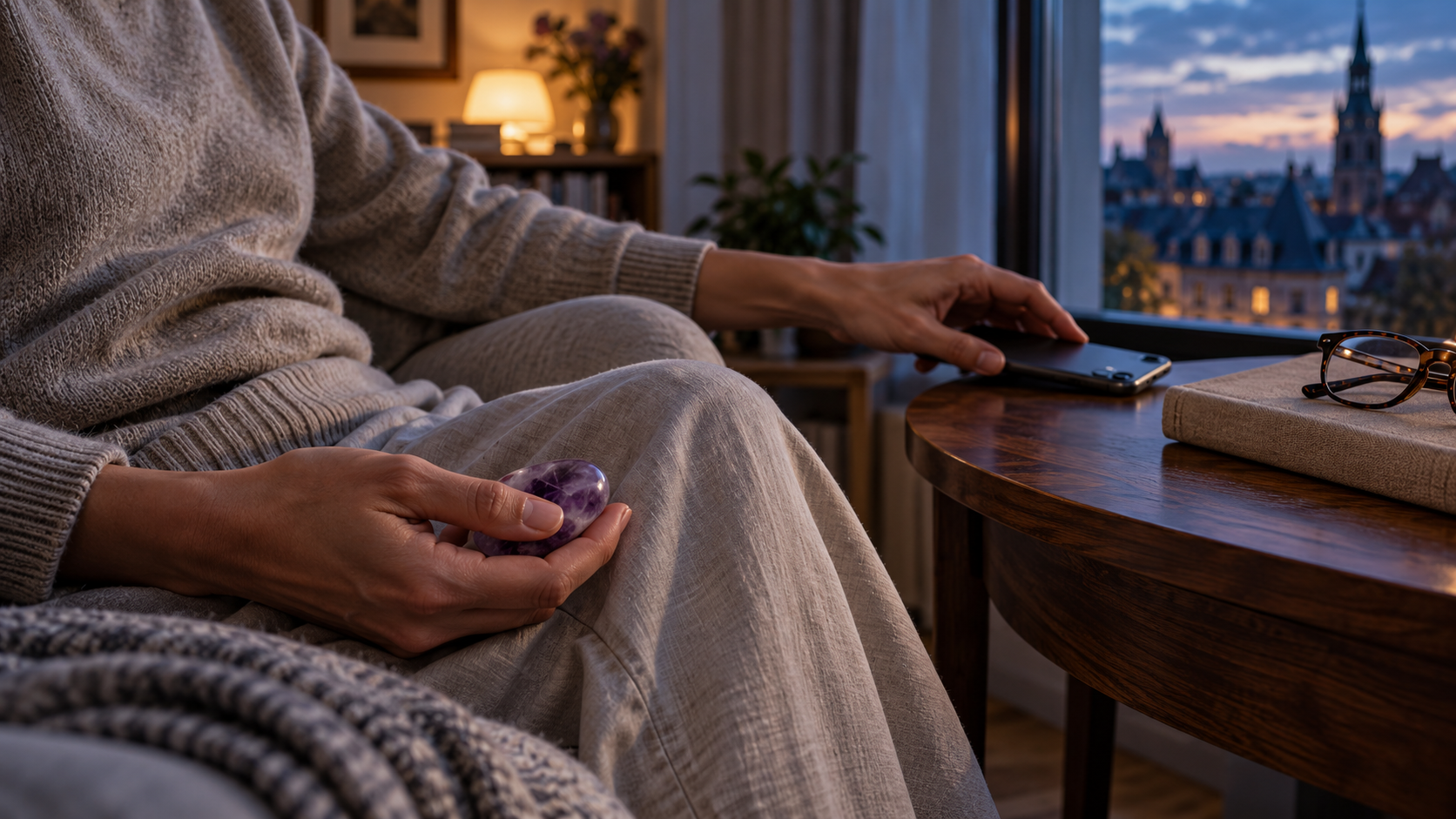
Evening does not always begin when the working day ends.
The computer may be closed. The messages may stop arriving. The front door may be locked.
Yet mentally, the day can continue for hours.
Conversations replay.
Tomorrow’s tasks appear.
Small frustrations return.
Ideas compete for attention precisely when we would prefer the mind to become quieter.
A personal evening ritual can create a deliberate boundary between these two parts of the day.
Within contemporary crystal practice, Amethyst is often chosen for precisely this kind of reflective setting.
Engaging in an Amethyst evening meditation can enhance this reflective practice.
Modern spiritual traditions commonly associate Amethyst with calm, clarity, contemplation and meditation. These interpretations are beliefs and symbolic practices rather than scientifically demonstrated effects of the stone.
Interestingly, however, the modern symbolism does not appear from nowhere.
Amethyst has been connected with ideas of sobriety, restraint and clear-mindedness for centuries. The Burke Museum records the long-standing Greek association between Amethyst and protection from intoxication, while the American Gem Society similarly documents historical beliefs connecting the stone with remaining clear-headed.
The stone therefore offers an interesting bridge between old symbolism and contemporary practice.
Not because Amethyst has been scientifically shown to quiet the mind.
But because an object that has represented clarity for generations can become a meaningful physical focus for a modern contemplative ritual.
This evening practice begins with one small Amethyst pocket stone.
Nothing more is required.
Table of Contents
Why an Evening Ritual?
Human beings naturally use rituals to mark transitions.
We change clothes after work.
We close curtains when daylight disappears.
We prepare a particular drink before sitting down.
We turn off certain lights before going to bed.
Many of these behaviours are so familiar that we barely notice them.
A crystal ritual can work in a similar way.
The objective is not necessarily to create something mystical.
Instead, the stone marks a transition:
the active part of the day is ending.
Mindfulness research offers a useful parallel here.
A major review in the Annual Review of Psychology describes mindfulness interventions as practices designed to cultivate greater attention to and awareness of present-moment experience.
Research has also examined the importance of accepting present-moment experiences rather than immediately trying to alter them. Randomised trials reported in the Journal of Personality and Social Psychology found that acceptance training was an important component of mindfulness interventions affecting emotional experience.
A crystal is not necessary for mindfulness.
But a physical object can become an attention anchor within a personal ritual.
That is the role Amethyst will play here.
Why Amethyst?
Amethyst has one of the richest symbolic histories among commonly used crystals.
Its name derives from the Greek amethystos, meaning approximately “not intoxicated” or “not drunk.”
The historical association was remarkably literal.
Ancient Greek and Roman traditions held that Amethyst could help protect against drunkenness or preserve clear thinking.
The American Gem Society notes historical beliefs that Amethyst could keep a person clear-headed and quick-witted.
The Burke Museum similarly documents the stone’s relationship with Greek stories concerning intoxication.
These were historical beliefs, not medically effective methods for preventing intoxication.
But underneath the literal claim sits a broader symbolic idea:
clarity rather than excess.
That idea adapts remarkably well to an evening meditation.
From Sobriety to Mental Clarity
We normally use sobriety in relation to alcohol.
But the underlying idea is wider.
To be sober can also mean to see something without exaggeration.
Clearly.
Quietly.
Without being swept away by it.
That makes the historical symbolism of Amethyst surprisingly relevant to a modern reflective practice.
At the end of a busy day, the mind often does the opposite.
One unfinished task becomes ten imagined problems.
One awkward conversation becomes an hour of internal debate.
One concern about tomorrow expands into an entire hypothetical future.
An Amethyst meditation can symbolically return to the older idea of clarity:
What actually happened today?
Not:
What might it mean?
Not:
What could happen next?
Just:
What happened?
This becomes the foundation of the ritual.
Choosing an Amethyst Pocket Stone
For this practice, use a small Amethyst that fits comfortably in one hand.
A polished pocket stone works particularly well because it can travel with you during the day and then become part of the evening ritual.
A small natural crystal can work equally well.
The important quality is not size.
It is familiarity.
If you use the same stone repeatedly, the object gradually becomes associated with the ritual itself.
During the day it may simply sit in a pocket, pouch or on a desk.
In the evening, its role changes.
It becomes the object that marks the beginning of reflection.
Creating the Evening Space
Do not build an elaborate altar.
The more complicated a daily ritual becomes, the easier it is to abandon.
Choose one comfortable place.
Perhaps:
- an armchair
- the edge of the bed
- a meditation cushion
- a quiet corner
- a chair beside a window
Reduce obvious distractions.
Place your phone away from your hand.
Dim the room slightly if appropriate.
Sit comfortably.
Then take out the Amethyst.
That action becomes the beginning.
Step One — Observe the Stone
Before closing your eyes, look at the Amethyst.
Do not think about its spiritual meaning yet.
Simply observe it.
Notice the shape.
The changing purple tones.
The places where light enters differently.
Any irregularities.
Turn the stone once in your fingers.
This may seem almost too simple.
That is intentional.
Your attention was previously occupied by the day.
Now it is occupied by one physical object directly in front of you.
You have already begun moving from mental narrative toward observation.
Step Two — Feel Rather Than Interpret
Close your hand around the stone.
Now close your eyes.
Notice what you can physically feel.
Is the Amethyst cool?
Smooth?
Uneven?
Where does it touch your fingers?
How much pressure is required to hold it?
Try not to describe the experience as good or bad.
Simply notice it.
This resembles one fundamental element of mindfulness practice: attending to present experience rather than immediately becoming absorbed in judgement or interpretation.
The Amethyst provides something concrete to notice.
Step Three — Three Facts About Today
Now think about the day.
But impose one unusual rule.
You may recall only facts.
Choose three.
For example:
I completed an important piece of work.
I had a difficult conversation.
I went for a walk after lunch.
Notice what is missing.
No judgement.
Not:
The conversation was a disaster.
Simply:
The conversation happened.
This distinction is central to the exercise.
You are separating the event from the story surrounding the event.
Hold the Amethyst while identifying each fact.
Then pause.
Step Four — Notice the Story
Now choose one of those events.
Ask:
What story did my mind create around this?
Perhaps:
I should have answered differently.
They probably think badly of me.
I will never finish this project.
Tomorrow will be difficult.
Do not try to stop these thoughts.
Do not argue with them.
Simply recognise:
this is the story I am telling about the event.
The distinction between experience and interpretation is subtle.
But it can transform the character of reflection.
Amethyst as the Symbol of Clear Seeing
This is where Amethyst’s historical symbolism becomes particularly useful.
For centuries, people associated the stone with remaining clear-headed.
Ancient claims that Amethyst could physically prevent intoxication should not be treated as factual.
But the symbolism of clear seeing remains compelling.
Hold the stone.
Ask:
What do I know?
Then:
What am I assuming?
Those two questions can reveal how much mental activity belongs not to the event itself but to our interpretation of it.
The Amethyst does not answer the questions.
It marks the moment when you ask them.
Step Five — What Can Wait Until Tomorrow?
Now think about everything still demanding attention.
Do not create a complete task list.
Choose only what does not need to be resolved tonight.
Perhaps:
an email,
a decision,
a conversation,
a purchase,
a problem,
a project.
Say silently:
This can wait until tomorrow.
Then loosen your grip on the Amethyst slightly.
The gesture is intentionally physical.
You are not pretending the issue has disappeared.
You are simply deciding that it does not require your attention during this part of the evening.
A Simple Breathing Practice
Keep the stone resting loosely in your palm.
Allow your breathing to continue naturally.
Do not force deep breaths.
For five cycles, use two words:
On the inhale:
here
On the exhale:
enough
Here.
Enough.
The words are deliberately simple.
You are here.
And for this moment, nothing else needs to be solved.
Amethyst and Contemporary Spiritual Practice
Modern crystal traditions often connect Amethyst with meditation, tranquillity, intuition and the Crown Chakra.
These associations belong to contemporary metaphysical systems rather than established scientific models.
For practitioners who use chakra symbolism, Amethyst’s purple colour has made it particularly associated with the upper chakra system.
The Crown Chakra is commonly interpreted in modern practice as relating to awareness, spiritual reflection and connection beyond ordinary everyday concerns.
Someone who works within that tradition may therefore hold Amethyst during meditation or place it nearby.
But the evening ritual described here does not require chakra belief.
Amethyst can function equally well as a symbolic object associated with clarity and contemplation.
Pocket Stone by Day, Meditation Stone by Night
One interesting way to deepen this practice is to carry the same Amethyst during the day.
Do not constantly interact with it.
Simply allow it to travel with you.
At night, remove it from your pocket or bag.
That movement creates a transition.
During the day:
the stone travels.
During the evening:
the stone becomes still.
You do the same.
Over time, this repeated movement may become part of the ritual’s meaning.
Pairing Amethyst With a Journal
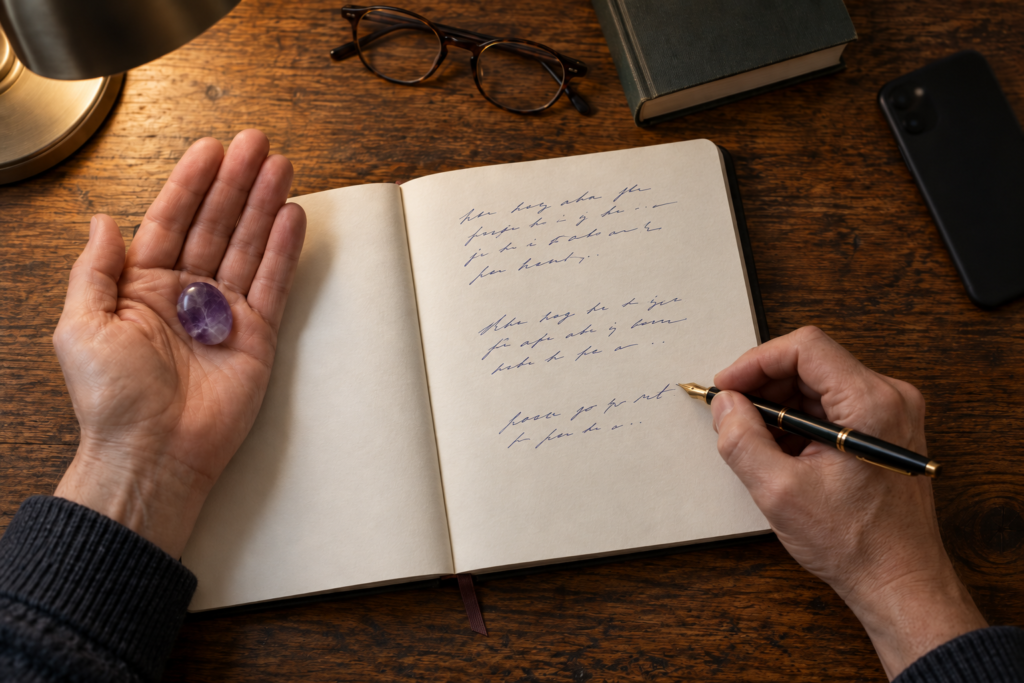
After meditation, open a journal.
Write only three lines.
What happened today?
One sentence.
What can wait?
One sentence.
What matters tomorrow?
One sentence.
Then stop.
This is not intended to become another task.
The purpose is closure.
Place the Amethyst on the closed journal.
The day is complete.
Why the Stone Should Not Become a Dependency
There is an important distinction between using a ritual object and believing you cannot function without it.
A crystal practice should ideally support personal agency.
Not replace it.
If you forget the Amethyst while travelling, you can still perform the meditation.
Hold another neutral object.
Or simply rest your hands together.
The capacity for attention does not live inside the crystal.
The stone supports the structure of the ritual.
You provide the awareness.
This distinction keeps crystal practice grounded and flexible.
What About Claims That Amethyst Treats Anxiety or Insomnia?
Amethyst is frequently promoted online as a treatment for anxiety, insomnia and other health conditions.
Such claims go beyond spiritual symbolism.
A crystal should not be presented as a scientifically established treatment for anxiety disorders, insomnia or other medical conditions.
Meditation and mindfulness themselves have been investigated scientifically, but that evidence does not demonstrate that adding Amethyst produces a therapeutic effect.
The distinction matters.
You can use Amethyst as:
- a meditation object
- a symbol of clarity
- part of an evening ritual
- a tactile attention anchor
- an object associated with personal spiritual practice
without claiming that the mineral medically treats a condition.
This allows a spiritual practice to remain meaningful without confusing belief with clinical evidence.
Ending the Ritual
When you are ready, open your hand.
Look once more at the Amethyst.
Then place it somewhere deliberate.
Perhaps on your journal.
Beside the bed.
On a small dish.
Or in the place where you keep active meditation stones.
Do not immediately pick up your phone.
Allow a short period of transition.
The ritual ends with the same principle with which it began:
clarity rather than excess.
The day happened.
Some things went well.
Some did not.
Some questions remain unanswered.
They do not all need to follow you into the rest of the evening.
A Stone With an Old Message
One of the most interesting aspects of crystal traditions is how symbolism changes while still carrying traces of the past.
Ancient people connected Amethyst with sobriety.
Later traditions associated it with piety, restraint and clear thinking.
Modern crystal practitioners often use it for meditation and contemplation.
The practices differ enormously.
Yet one theme continues to appear:
clarity.
That makes Amethyst particularly suited to an evening ritual.
Not because the stone removes thoughts.
Not because it guarantees sleep.
Not because it creates a scientifically measurable field of calm.
But because it gives the ritual a physical centre.
Hold the stone.
Observe what happened.
Separate fact from interpretation.
Decide what can wait.
Then put both the Amethyst and the day down.
Tomorrow can begin tomorrow.
References & Further Reading
Burke Museum — February: Month of Amethyst
The University of Washington’s Burke Museum provides an educational overview of Amethyst that includes its historical mythology and long-standing association with intoxication and sobriety.
American Gem Society — Amethyst History
An educational overview of Amethyst’s historical symbolism, including Greek and Roman traditions connecting the gemstone with clear-headedness, restraint and protection from intoxication.
https://www.americangemsociety.org/birthstones/february-birthstone/amethyst-history
American Gem Society — The Folklore of Amethyst
A dedicated educational page separating historical and legendary beliefs about Amethyst from factual claims, including traditions surrounding clarity, peace, focus and meditation.
https://www.americangemsociety.org/amethyst-folklore
Annual Review of Psychology — Mindfulness Interventions
J. David Creswell’s scholarly review examines mindfulness interventions, their emphasis on attention and awareness of present-moment experience, research findings, mechanisms and limitations.
https://doi.org/10.1146/annurev-psych-042716-051139
PubMed — How Mindfulness Training Promotes Positive Emotions
A peer-reviewed research record describing two randomised controlled trials examining monitoring and acceptance within mindfulness training and their relationship with emotional experience.
https://pubmed.ncbi.nlm.nih.gov/30550321
Historical gemstone beliefs and contemporary spiritual associations discussed in this article are presented as traditions, symbolism and personal practices rather than scientifically established properties of Amethyst. The mindfulness research cited concerns mindfulness practices themselves and does not establish therapeutic effects from using a crystal. Crystals should not replace appropriate professional healthcare or evidence-based treatment.
Related Products
-
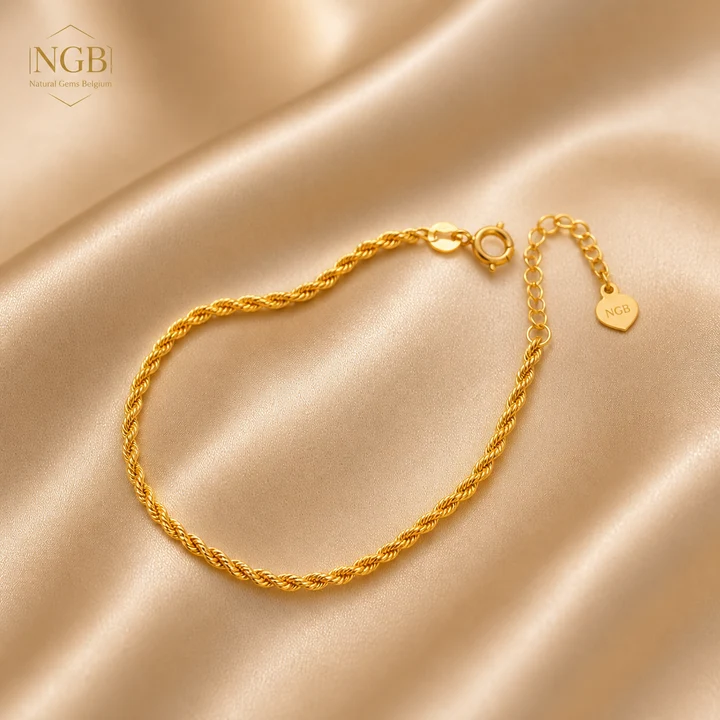
18K Yellow Gold Rope Chain Bracelet · Adjustable 15 · 18 cm · Luxury NGB Jewelry
$251.21 -
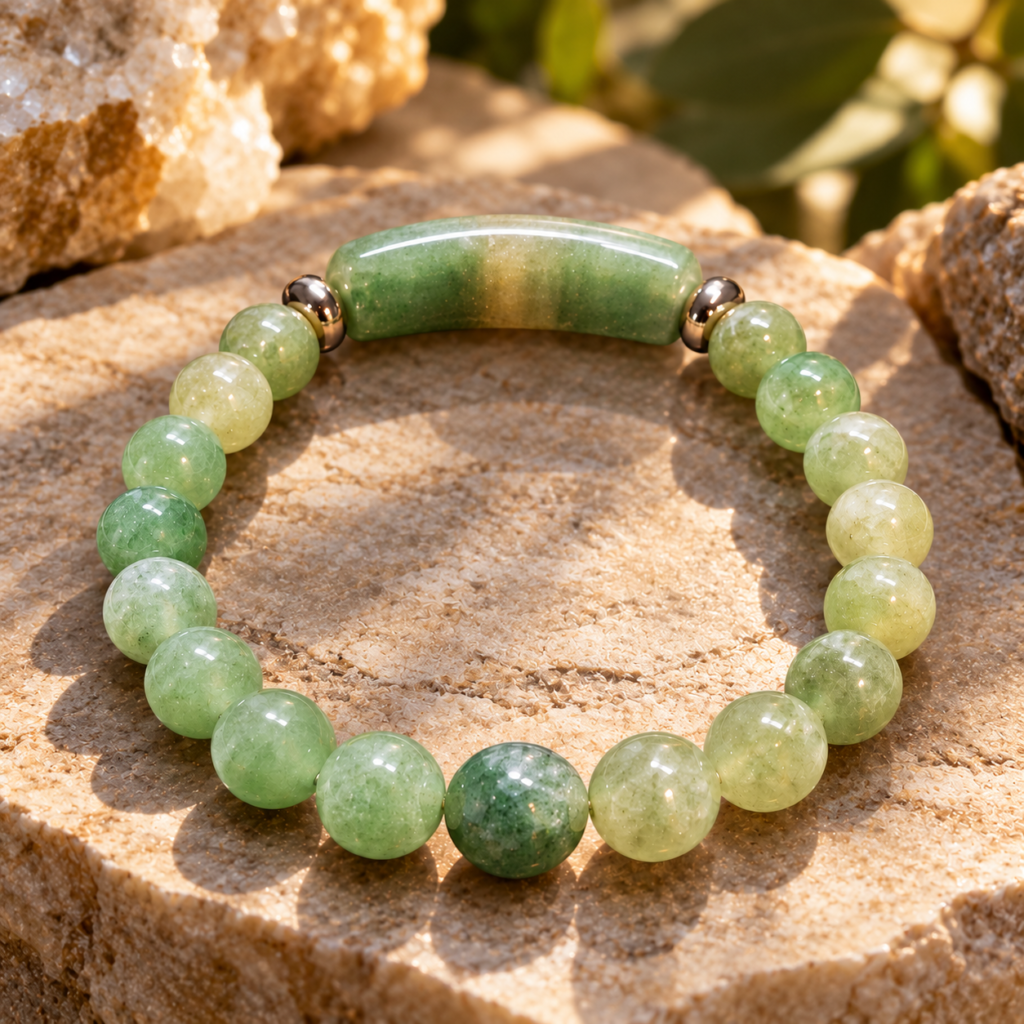
Aventurine Bead Bracelet with Bridge · 8 mm · 19 cm · Unisex · Untreated · Good Polish
$39.10 -
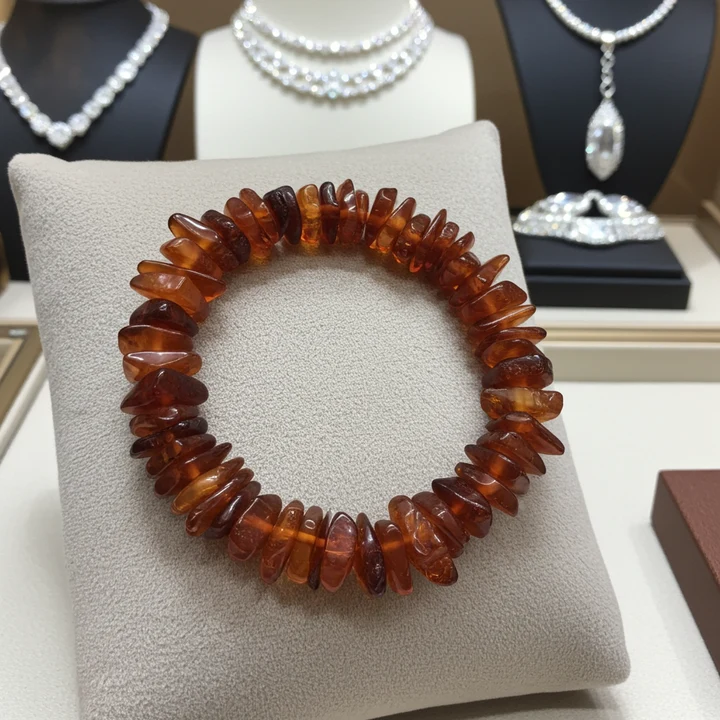
Baltic Amber Chip Bracelet 10 mm · Natural Dark Honey Amber Bead Bracelet
$32.67 -
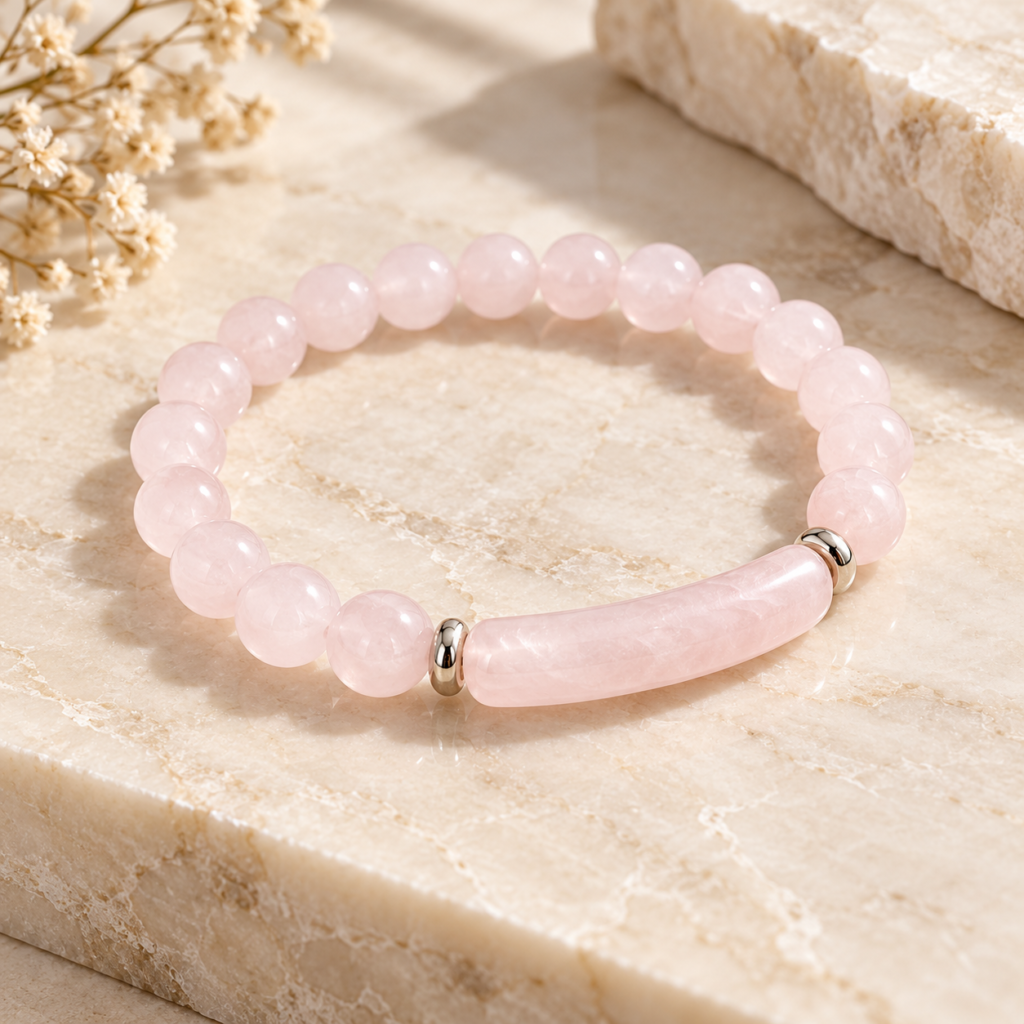
Bead Bracelet with bridge · Rose Quartz · 8mm · pink charm bracelet
$36.86